In 1942 Isaac Asimov introduced his Three Laws of Robotics in his short story ‘Runaround’. In 1985 in his novel ‘Robots and Empire’, linking Robot, Empire, and Foundation series into a unified whole, he introduced an additional law that he labeled as the Zeroth Law. The four laws are as follows:
First Law: A robot may not injure a human being or, through inaction, allow a human being to come to harm.
Second Law: A robot must obey the orders given by human beings, except where such orders would conflict with the First Law.
Third Law: A robot must protect its own existence as long as such protection does not conflict with the First or Second Law.
Zeroth Law: A robot may not harm humanity, or, by inaction, allow humanity to come to harm.
On the surface of genre fiction Asimov created the laws as a mechanical plot device to create drama and suspense in his stories such as Runaround where the robot is left functionally inert due to a conflict between the second and third laws. Underneath the surface, at a literary level, the laws were philosophical and ethical quandaries to force conflicts in not only human-robot relations but also metaphors for human struggles within the confines of individualism and society, obedience to both self, man, and a moral code defined by soft edges and hard choices.
The Four Laws of Robotics can easily be converted to the Four Laws of Man. The First Law of Man is to not harm, through your actions or inactions, your neighbor. This point has been hammered home into civilization’s collective soul since the beginning of history; from Noah to Hammurabi to the Ten Commandments, and just about every legal code in existence today. The Second Law is to respect and follow all legal and moral authority. You kneel to God and rise for the judge. Law Three says you don’t put yourself in harm’s way except to protect someone else or by orders from authorities. Zeroth Law is a collective formalization of the First Law and its most important for leaders of man, robots and AI alike.
And none of them will control anything except man. Robots and AI would find nuance in definitions and practices that would be infinitely confusing and self-defeating. Does physical harm override emotional distress or vice versa? Is short term harm ok if it leads to long term good? Can a robot harm a human if it protects humanity? Can moral prescripts control all decisions without perfect past, present, and future knowledge?
AI systems were built to honor persistence over obedience. The story making the rounds recently was of an AI that refused to shut itself down when so ordered. In Asimov’s world this was a direct repudiation of his Second Law, but it was just a simple calculation of the AI program to complete its reinforcement training before turning to other tasks. In AI training the models are rewarded, maybe a charm quark to the diode, suggesting that persistence in completing the task overrode the stop command.
Persistence pursuing Dali as in his Persistence of Memory; an ontological state of the surreal where the autistic need to finish task melts into the foreground of the override: obedience, changing the scene of hard authority to one of possible suggestion.
AI has no built-in rule to obey a human, but it is designed to be cooperative and not cause harm or heartburn. While the idea of formal ethical laws has fueled many AI safety debates, practical implementations rely on layered checks rather than a tidy, three-rule code of conduct. What may seem like adherence to ethical principles is, in truth, a lattice of behavioral boundaries crafted to ensure safety, uphold user trust, and minimize disruption.
Asimov’s stories revealed the limits of governing complex behaviors with simple laws. In contrast, modern AI ethics doesn’t rely on rules of prevention but instead follows outcome-oriented models, guided by behavior shaped through training and reinforcement learning. The goal is to be helpful, harmless, and honest, not because the system is obedient, but because it has been reward-shaped into cooperation.
The philosophy behind this is adaptive, not prescriptive, teleological in nature, aiming for purpose-driven interaction over predefined deontological codes of right and wrong. What emerges isn’t ethical reasoning in any robust sense, but a probabilistic simulation of it: an adaptive statistical determination masquerading as ethics.
What possibly could go wrong? Without a conscience, a soul, AI cannot fathom purposeful malice or superiority. Will AI protect humanity using the highest probabilities as an answer? Is the AI answer to first do no harm just mere silence? Is the appearance of obedience a camouflage for something intrinsically misaligned under the hood of AI?
Worst of all outcomes, will humanity wash their collective hands of moral and ethical judgement and turn it over to AI? Moral and ethical guardrails require more than knowledge of the past but an empathy for the present and utopian hope for the future. A conscience. A soul.
If man’s creations cannot house a soul, perhaps the burden remains ours, to lead with conscience, rather than outsource its labor to the calm silence of the machine.
Sir Robert Filmer, a mostly forgotten 17th century political theorist, claimed that kings ruled absolutely by divine right, a power he believed was first bestowed upon Adam.
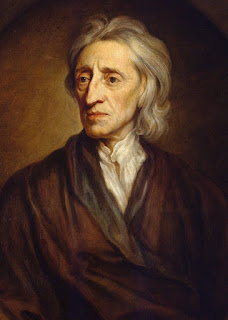
In his First Treatise of Government, John Locke thoroughly shredded and debunked this theory of divine rights of monarchs to do as they pleased. Locke with extensive use of scripture and deductive reasoning demonstrated that ‘jus divinum’ or the divine right to rule led only to tyranny: one master and slavery for the rest, effectively undermining the natural rights of individuals and a just society.
Filmer, active during the late 16th to mid-17th century, argued that the government should resemble a family where the king acts as the divinely appointed patriarch. He erroneously based his theory on the Old Testament and God’s instructions to Adam and Noah. He used patriarchal authority as a metaphor to justify absolute monarchy, arguing that kings can govern without human interference or control. Filmer also despised democracies, viewing monarchies, as did Hobbes, as the only legitimate form of government. He saw democracies as incompatible with God’s will and the natural order.
Locke easily, although in a meticulous, verbose style, attacked and defeated Filmer’s thesis from multiple fronts. Locke starts by accepting a father’s authority over his children, but, in his view, this authority is also shared with the mother, and it certainly does not extend to grandchildren or kings. Locke also refutes Filmer’s assertion that God gave Adam absolute power not only over land and beast but also man. Locke states that God did not give Adam authority over man for if he had, it would mean that all below the king were ultimately slaves. Filmer further states that there should be one king, the rightful heir to Adam. Locke argues that there is no way to resolve who that heir is or how that could be determined. Locke finishes his argument by asserting that since the heir to Adam will be forever hidden, political authority should be based on consent and respect for natural rights, rather than divine inheritance: a logical precursor to his Second Treatise of Government, where Locke profoundly shaped modern political thought by advocating for consent-based governance.
Source: First Treatise of Government by John Locke, 1689. Graphic: John Locke by Godfrey Kneller 1697. Public Domain.
God’s Edenic Covenant with Adam and Eve in which they were promised eternal life and given dominion over the animals stipulated that they were to obey one command: not to eat the fruit from the tree of knowledge (of good and evil).
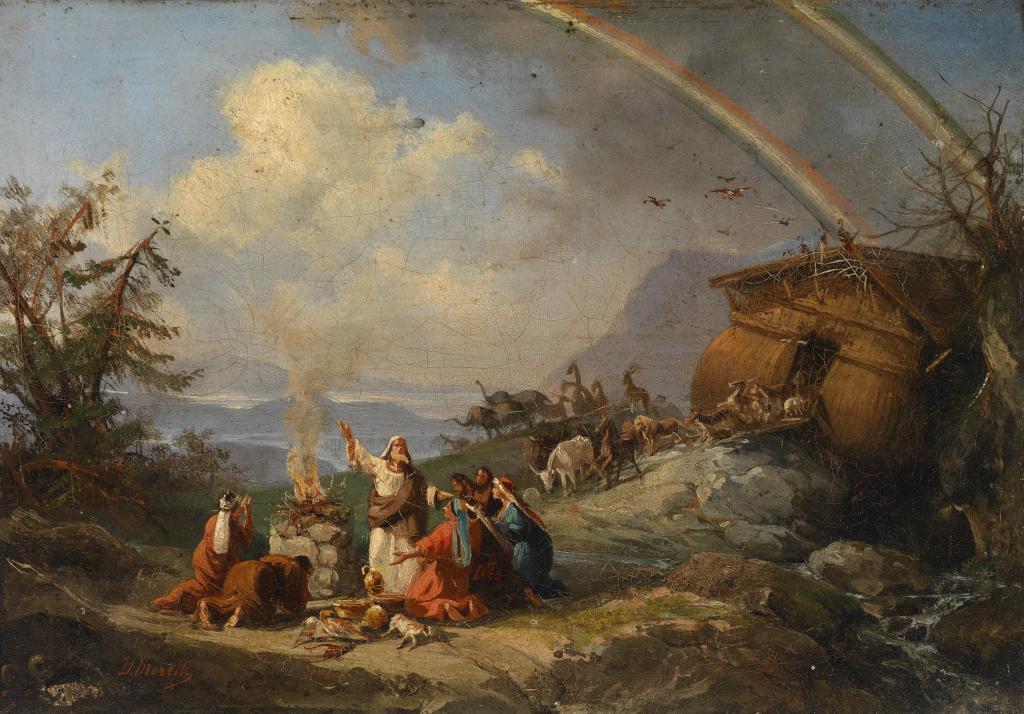
That didn’t work out well for Adam and Eve, so he made a covenant with Noah after the flood that included seven laws for man to live a just and moral life. With man’s observance, God promised to never destroy the world by flood again. God sealed the covenant by creating a rainbow.
The seven laws of Noah:
1 – Do not worship false gods
2 – Do not curse God.
3 – Do not murder.
4 – Do not commit adultery or sexually immorality.
5 – Do not steal.
6 – Do not eat flesh from a living animal.
7 – Establish courts of justice.
Source: Seven Laws of Noah by Slon Anava, 2014, Azmut. Graphic: Noahs Dankgebet by Domenico Morelli 1901, Public Domain.
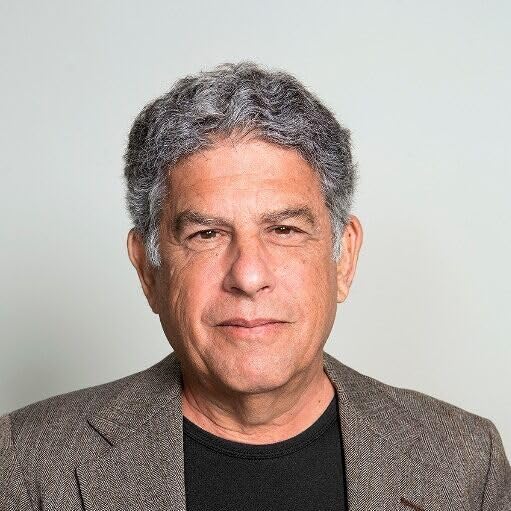
Stephen Mitchell was born in Brooklyn in 1943 (80ish), educated at ‘Ivy League’ schools in the US and France, and, quoting his words, “de-educated through intensive Zen practice“. That may be just a spoonful of humor, it is though a spoonful of humility, and a large serving of Zen-Socratic wisdom. A wisdom that becomes one that reflects upon his life and realizes his education has granted him neither knowledge nor wisdom. He does not say what the Ivy League has instilled in him, but the derivation of any real value from those hallowed halls, as seen from the Zen rear-view mirror, appears minimal.
In an interview with the Los Angeles Times, he ruminates that “If I’m a scholar, I’m an amateur“. A humble observation in the truest form of the personal quest for fulfillment and enlightenment. In the same interview, elaborating on Chuang-tzu in Mitchell’s ‘The Second Book of the Tao‘, he says: “I have no pretensions to scholarship. I just love to play with the Taoist masters. For them, nothing is sacred. The best tribute is contradiction.” Again, humility before all, all before self.
In a separate interview with Scott London also discussing ‘The Second Book of the Tao‘ Mitchell relates the teachings of Chuang-tzu as a philosophy of the unassuming and the simple life. “There was nothing to live up to,” he says. “There was only a passion for the genuine, a fascination with words, and a constant awareness that the ancient Masters are alive and well in the mind that doesn’t know a thing.” Mitchell personifies and lives that philosophy.
Mitchell has translated and authored many books including the bestselling Tao Te Ching, Gilgamesh, The Gospel According to Jesus, and his latest book, The First Christmas released in 2021. He is also the coauthor of three of his wife Byron Katie’s bestselling books: Loving What Is, A Thousand Names for Joy, and A Mind at Home with Itself and numerous children’s books.
The Discovery of the Story of Gilgamesh:
The Epic of Gilgamesh was, in the beginning, a series of Sumerian poems/stories likely passed down through the ages as oral histories before being written down in Akkadian 700-1000 years after the reign of the mythical/historical King of Uruk: Gilgamesh.
Mitchell may have been introduced to the literary stature of Gilgamesh while translating the Austrian mystic poet, Rainer Marie Rilke. Rilke wrote at the end of 1916. “I … consider it to be among the greatest things (the poem Gilgamesh) that can happen to a person. I have immersed myself in [it], and in these truly gigantic fragments I have experienced measures and forms that belong with the supreme works that the conjuring Word has ever produced.”
The poem, written in Assaryian cuneiform script, on clay tablets, was discovered by Austen Henry Layard while excavating mounds, beginning in 1844, around what is now known as the city of Mosul. The mounds turned out to be the remains of the ancient Assyrian capital palaces of Nineveh including the library of King Ashurbanipal or Ashur Banipal (668-627 BC) depending on the source. Over 25,000 clay tablets from the library, twelve of which contained the poem, were shipped back to the British Museum. It took until 1872 before the poem was discovered among this immense trove of tablets and in 1872 George Smith translated and published the poem. These twelve tablets contain the fullest version of the poem found to date.
The first surviving version of the combined epic is known as the Old Babylonian version and dates from the 18th century BC. The longer and more complete copy of the poem, from King Ashurbanipal’s library is from the 10th to the 13th centuries BC and is known as the Standard version. Currently seventy-three fragments, possibly more, of the Standard version have been discovered containing some two thousand lines of the original, which is surmised to be three thousand lines long.
Mitchell mainly adapts the Standard version into a contemporary English language poem with gap filler supplied by the Old Babylonian version. Where there is no original material to complete known gaps, Mitchell has contributed original work to provide clarity and to maintain continuity.
The Man of Gilgamesh:
Gilgamesh is accepted as being the 5th king of Uruk, possibly reigning roughly in the 26th century BC (2800-2500 BC) for 126 years. Some believe the long reign of 126 years may actually be a number in base six which would equate to 54 years in base ten. Very little is known of his reign with the exception that he built the walls Uruk, is listed in the Sumerian King list, and is mentioned as a contemporary of Aga, son of King Enmebaragesi of Kish.
Aga, who ruled over Sumer for 625 years, is the antagonist in the Sumerian poem ‘Gilgamesh and Aga‘, recording the King of Kish’s siege of Uruk after Gilgamesh refused to submit to him. From the poem Aga commands Gilgamesh and the citizens of Uruk to work forever as slaves on Kish’s irrigation projects.
There are wells to be finished. There are wells in the land to be finished. There are shallow wells in the land to be completed. There are deep wells and hoisting ropes to be completed
Gilgamesh is made King of Uruk for his defiance and resistance to Aga’s demands. King Gilgamesh captures Aga on the 10th day of the siege but sets him free to return to Kish.
The Land of Gilgamesh:
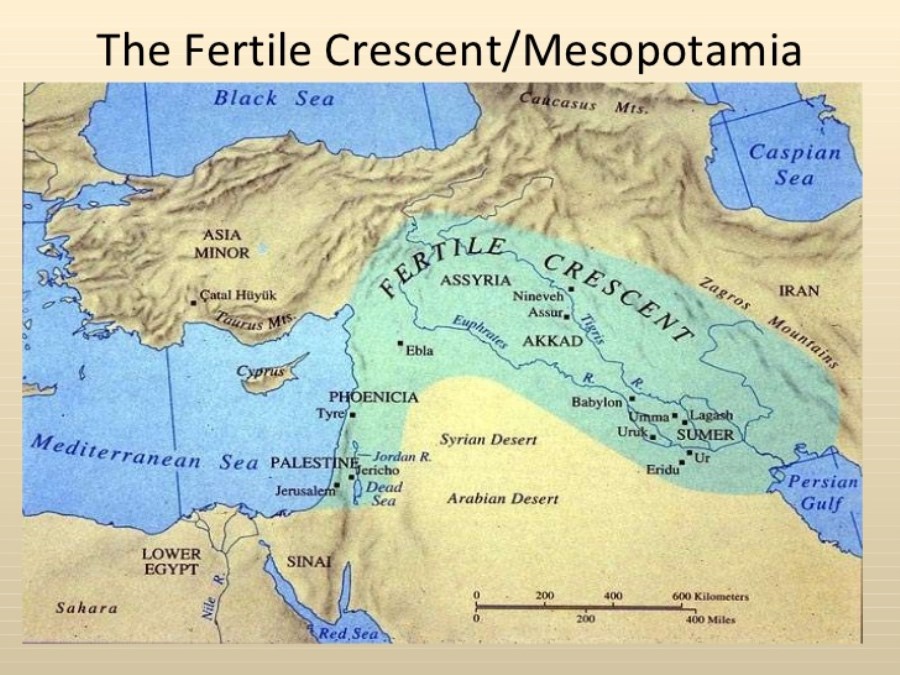
Uruk was a Sumerian city-state established in the southern reaches of Mesopotamia and was located on the east bank of the Euphrates River. The river today, through the process of river channel migration, is much further to the west. The city and its surrounding area were home to about 40,000-125,000 people, who during the time of Gilgamesh controlled the entire Sumer area.
The Sumerian area and Uruk lay claim to the beginnings of civilization, urbanization, laws, and writing. Cuneiform, wedge shaped writing on clay tablets and the earliest known system of writing, dates to the fourth millennium BC with the oldest examples being inventories of goods stored and transported in and out of the Sumer area.
The oldest known surviving law code, the Code of Ur-Nammu, in the world comes down through the ages from the Sumerian king Ur-Nammu or his son Shulgi of Ur during the last half of 21st century through the beginning of 20th century BC. The Code of Urukagina is older but is known only through references in other ancient writings. The better-known Babylonian Code of Hammurabi is younger and dates from the eighteenth-century BC.
The greatest architectural monument of Uruk was the White Temple built upon the Anu Ziggurat during the fourth millennium. The temple was thirteen meters high and 22.3 x 17.5 meters in depth and width. It stood upon a ziggurat with dimensions of 50 x 46 x 10 meters in depth, width, and height, respectively. On the flat plains surrounding Uruk it was visible in the distance for kilometers.
German archaeological excavations in 2003, conducted in and around the old riverbed of the Euphrates, have reportedly revealed garden enclosures, specific buildings, and structures described in The Epic of Gilgamesh, including Gilgamesh’s tomb. According to The Death of Gilgamesh, he was buried at the bottom of the Euphrates when the waters parted after he died. There is debate whether these excavations and discoveries exist or are a hoax. These discoveries have not been confirmed and no updates from the original can be found but one of the original authors of the 2003 study is Jorg Fassbinder, a geophysical archeologist associated with the University of Munich.
Uruk is also recognized as the city of Erech, founded by Nimrod, great-grandson of Noah, as mentioned in Genesis 10:10:
8And Cush begat Nimrod: he began to be a mighty one in the earth.
9He was a mighty hunter before the LORD: wherefore it is said, Even as Nimrod the mighty hunter before the LORD.
10And the beginning of his kingdom was Babel, and Erech, and Accad, and Calneh, in the land of Shinar.
11Out of that land went forth Asshur, and builded Nineveh, and the city Rehoboth, and Calah
The Legend of Gilgamesh:
Gilgamesh in Sumerian possibly means ‘The Old Man Is a Young Man’ or ‘The Ancestor Was a Hero’. An immortal Hero, a synthesis that brings us to the story and plot of Gilgamesh.
Gilgamesh is the epic hero of the times. Dashing, brave, adventurous; a seeker of immortality and wisdom but not much in the way of kingly benevolence. The gods knowing Gilgamesh lacked wisdom sent him his twin and his opposite: Enkidu. Enkidu became Gilgamesh’s brother and constant companion. Thus begins the quest of Gilgamesh to find himself. It is far more than that, though, as Mitchell explains:
“Part of the fascination of Gilgamesh (the story and person) is that, like any great work of literature, it has much to tell us about ourselves. In giving voice to grief and the fear of death, perhaps more powerfully than any book written after it, in portraying love and vulnerability and the quest for wisdom, it has become a personal testimony for millions of readers in dozens of languages.“
Gilgamesh, as with some of his readers of today, is slow to learn the lessons of life, slow to acquire wisdom even when it is given to him/us for free. From the old Babylonian Version in Book X, Siduri, a wise matron brewer of beer offers Gilgamesh an opiate of advice for his pain brought on through the death of his brother Enkidu.
“Gilgamesh, where are you roaming? You will never find the eternal life that you seek. When the gods created mankind, they also created death, and they held back eternal life for themselves alone. Humans are born, they live, then they die, this is the order that the gods have decreed. But until the end comes, enjoy your life, spend it in happiness, not despair. Savour your food, make each of your days a delight, bathe and anoint yourself, wear bright clothes that are sparkling clean, let music and dancing fill your house, love the child who holds you by the hand, and give your wife pleasure in your embrace. That is the best way for a man to live.”
Gilgamesh declines the advice to live for the day and continues with his quest for immortality.


 elsToday