Beelzebub has been wandering through western civilization since the Philistines appeared on the scene in the 12th century BC. The polytheistic Philistines of Ekron, one of their five cities within Canaan, worshiped Beelzebub, Baal-Zebub in the Philistine language, as a minor god of healing and protection from diseases, mainly from flies. In the semitic languages Beelzebub was literally known as the “Lord of the Flies”. (In Indo-European languages some interpretations suggest that Beelzebub is translated into a more friendly Lord of the Jungle.)
As monotheistic traditions took root in Canaan, Beelzebub shifted from a protective deity to a purveyor of evil, demonized within emerging Jewish thought. By the 9th century BC, the prophet Elijah condemned the Israel King Ahab and the prophets of Baal for worshiping this god rather than the true God of the Jews. By the time of the New Testament, which mentioned him 7 times in Matthew, Mark, and Luke, he was associated with Satan, who represented the emperor of Hell.
In Matthew and Mark, the Pharisees accused Jesus of casting out demons by the power of Beelzebub or the “Prince of the Demons”. Jesus counters by exclaiming that “Every kingdom divided against itself is brought to desolation, and every city or house divided against itself will not stand.” Jesus’ response backed the Pharisees into a corner, if they admitted that Jesus was casting out demons by God’s power, then they would have to acknowledge his divine authority. But if they insisted, he was working with Satan, they would have to explain why Satan would undermine his own influence: a house divided will not stand. (Lincoln in an 1858 speech used the same words with a moral rather than religious meaning, granted that is a very fine line, “A house divided against itself cannot stand,” suggesting that the evils of slavery would lead to collapse of the country.)
Between the 15th and 17th centuries Beelzebub was transformed into one of the seven princes of Hell: Lucifer the Emperor, Satan, Leviathan, Belphegor, Mammon, Asmodeus, and Beelzebub. Beelzebub represented the deadly sins of gluttony and envy.
In modern times Beelzebub remains a symbol of evil in literature and culture. John Milton’s Paradise Lost cast him as a chief demon and William Golding’s Lord of the Flies takes a more ancient meaning associated with corruption and destruction.
From an ancient minor Philistine god to Satan during the times of Jesus, to a major Christian demon in medieval times, back to Satan himself in modern times; Beelzebub’s transformation reflects the shifting religious and cultural landscapes over millennia, but demons will always have a name. In Mark 5:9, Jesus asks a possessed man, “What is your name?” The demon responds, “My name is Legion, for we are many.”
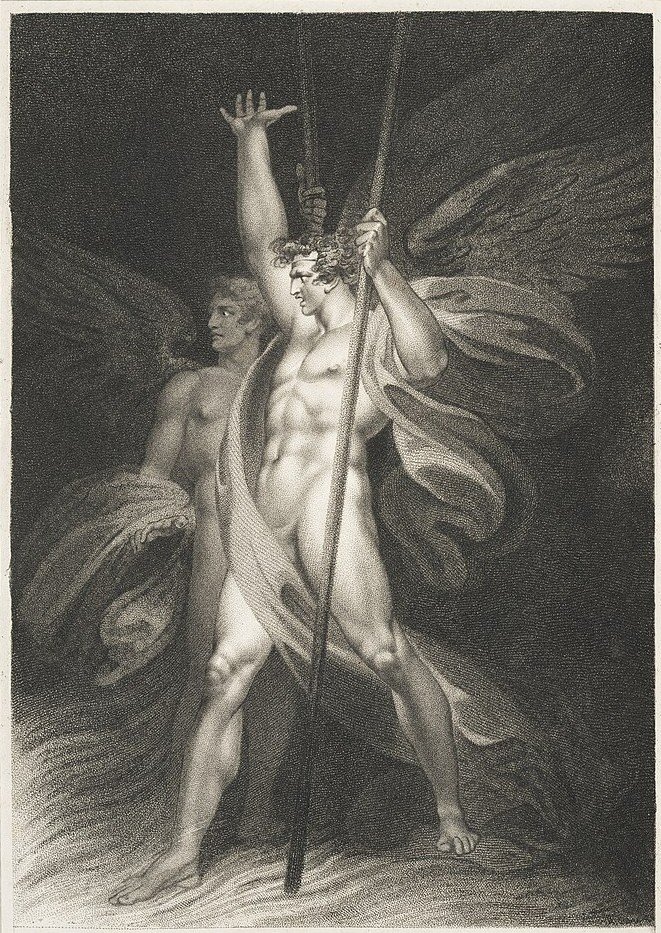
Graphic: Satan and Beelzebub by William Hayley, Jean Pierre Simon, Richard Westall: Paradise Lost. Public Domain.
“The notions of right and wrong, justice and injustice, have there no place. Where there is no common power, there is no law; where no law, no injustice.” — Leviathan by Thomas Hobbes
Thomas Hobbes saw human nature as a cauldron of chaos. In his state of nature, life is “nasty, brutish, and short,” a “war of all against all” where self-preservation is the only natural law. Shaped by Thucydides’ tales of strife and Machiavelli’s ruthless pragmatism, Hobbes cast man’s self-interest as a destructive force that casts morality aside. His remedy to avert chaos: a towering sovereign, ideally a monarch, to crush anarchy with an iron fist. The social contract trades liberty for security, forging laws as human tools to bind the beast within. Yet Hobbes stumbled: he failed to grasp power’s seductive pull. He assumed his Leviathan, though human, would rise above the self-interest he despised, wielding authority without buckling to its corruption.
“Reason, which is that law, teaches all mankind…that being all equal and independent, no one ought to harm another in his life, health, liberty, or possessions.” — Second Treatise of Government by John Locke
John Locke painted a gentler portrait of man than did Hobbes. He rooted natural law in reason and divine will, granting all people inherent rights to life, liberty, and property. His state of nature is peaceful yet imperfect, marred by the “want of a common judge with authority,” leaving it vulnerable to human bias and external threats. Optimistic, Locke envisioned a social contract built on the consent of the governed, protecting these rights through mutual respect and laying the groundwork for constitutional rule. Where Hobbes saw a void to be filled with control, Locke trusted reason to elevate humanity, crafting government as a shield, not a shackle.
Hobbes and Locke clash at the fault line of power. Hobbes’s sovereign, meant to tame chaos, reflects the rulers’ thirst for dominance, but his naivety about power’s effect cracks his foundation. Locke’s ideals, morality, reason, rights, empower the ruled, who yearn for liberty after security sours. Hobbes missed the flaw: rulers, driven by the same self-interest he feared, bend laws to their will, spawning a dual reality—one code for the governed, another for the governors. Locke’s vision of freedom and limited government inspires their soul, while Hobbes’s call for order fortifies their bones with courts, police, and laws of men. The U.S. Constitution marries both, yet scandals tip the scales: power corrupts, and liberty frays as safeguards buckle under the rulers’ grip.
Hobbes and Locke both accept the imperfection of man but take different paths to mitigate that imperfection with workable safeguards. Hobbes insists on the rule by law but drafted by imperfect man and applied with a Machiavellian indifference with no solution for absolute powers corrupting influence. Locke also chooses to rule by law but guided by morality, God and the will to depose of despots.
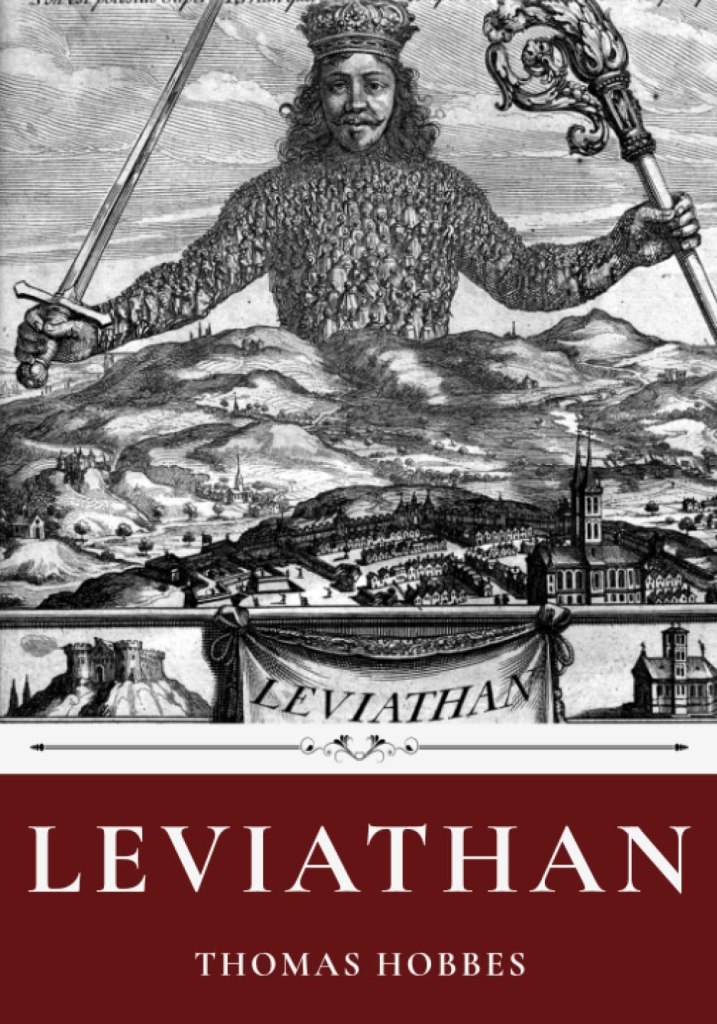
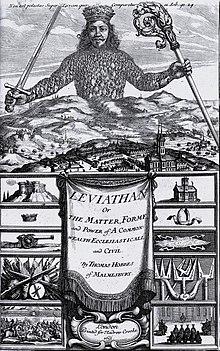
Sources: Leviathan, Thomas Hobbes; Second Treatise of Government, John Locke. Graphic:Original Leviathan frontispiece, a king composed of subjects, designed with Hobbes’s input.
Original Book Publication Dates: 1705/1714/1729/1733
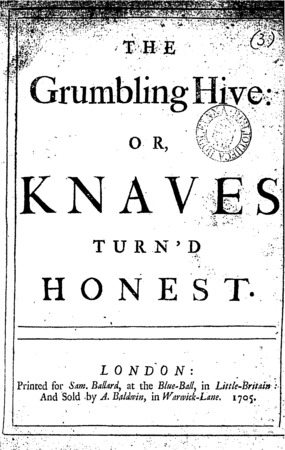
Bernard Mandeville was a free thinker, a contrarian, a troublemaker and likely loved every minute of it. His writings on vice and free living were greedily consumed by the 18th century public, and his notoriety began with a simple poem of 433 eight syllable coupled, rhymed lines, a doggerel of no artistic merit but with a moralistic message that has echoed, in various forms throughout the ages. It was originally titled: The Grumbling Hive or, Knaves turned Honest.
Mandeville was born in 1670 in the Dutch city of Rotterdam where he received a classical education at the Erasmus school and a medical degree from the University of Leiden. In the medical field he developed a special interest in what we would now call psychiatry and the use of talk therapy for curing hypochondriacs, the same branch his father practiced. He anticipated Freud by 175 years. Upon completing his medical studies, he moved to London to learn the language and decided to stay. In London he specialized in treating hypochondriacs, stomach ailments, writing political and philosophical tracts, all in which he achieved minor fame and fortune.
Beyond these meager particulars of his early life very little is known about Mandeville’s personal history. To know him, but not necessarily understand him, one must study his pamphlets and books on politics and philosophy and everything he wrote was soaked with politics and philosophy.
Mandeville’s written works sold so well that dozens of editions were needed to keep up with demand. His most celebrated work was The Grumbling Hive which he published anonymously in 1705. This little ditty immediately became a hit with the public and generated an immense amount of discourse and criticism.
Over the next 25 years or so he expanded the poem with commentary and essays under his own name with the next updated edition coming out in 1714 titled: The Fable of the Bees: or Private Vices, Public Benefits. In 1923 he again expanded the Fable of the Bees with an essay attacking charity schools, free schools for the poor, as nothing more than a vehicle to assuage the guilty conscience of the rich. The schools, while teaching the basics, the three Rs, were also a forum for instructing young minds in morality and religion. Mandeville was not so much against instructing the kids in addition and subtraction but that teaching morality in a capitalistic society was counterproductive.
Mandeville’s premise was that the rich set up and donated to the schools to atone for their gains attained through vice and greed. Mandeville would likely surmise that today’s charity and political donations, such as George Soros’ funding of weak on crime prosecutors, was atonement for their selfish gains in business and the markets. To put it mildly this did not go well with the upper crust, but it did increase the sales of his books.
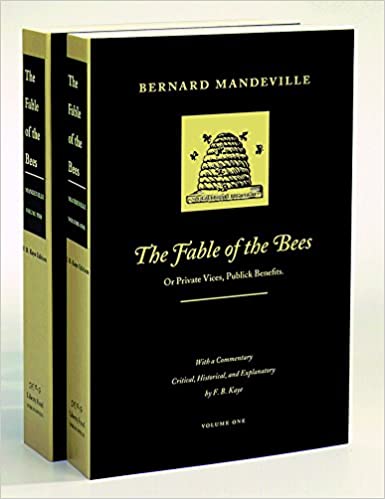
In 1728 Mandeville expanded the Fable of the Bees again by adding a second volume which provided additional defense of his thesis that vice is good in the form of dialogs: elaborations on the division of labor and their associated economics. The two volumes were published together in 1733, the year of Mandeville’s death.
Mandeville’s basic thesis underlaying the Fable of the Bees was that greed and vice were good for the economy and society. A person’s self-interest in the pursuit of wealth and luxury provides benefits for everyone. A rising tide lifts all boats. The idea of selfishness for the public good certainly predates Mandeville and continues to the present day. The 1987 movie Wall Street, Gordon Gekko played by Michael Douglas argues that the human march of progress is fueled by personal self-interest and greed. Self-interest to accumulate wealth and fame. Morality does not enter into the equation, or it shouldn’t.
Mandeville believed that vice had a negligible effect on the population, but he obviously understood that it was the gateway drug to harder crimes. He understood that victimless crime led to felonious crime. He understood the “Broken Windows Theory” before it had a name. As such he strongly advocated for a robust and universal system of justice. A system that John Adams in 1779 would codify into the Massachusetts constitution as “a government of laws, and not of men.” By laws Mandeville meant the rules of conduct that private society imposed on itself over centuries of trial and error. He was not prescribing a legislative solution to criminal behavior although he offered advice in that arena also. Rather his economic laissez faire attitude carried over to his thoughts on justice. The fewer government mandates the better. He would readily agree with the 20th century Italian political philosopher Bruno Leoni’s notion on government decrees, “legislation…has come to resemble more and more a sort of diktat that the winning majorities in the legislative assemblies impose upon the minorities, often with the result of overturning long-established individual expectations and creating completely unprecedented ones.”
He emphasized the word justice, as in justice for all, without giving much serious thought to the criminal part of the equation. Mandeville’s endeavors at navigating the differences between vice and crime usually led to ambiguous reasoning and muddy waters. He had a wishful belief in a harmless sort of anarchy where everyone didn’t or shouldn’t bother their neighbors — much. Mandeville was stuck between his belief that selfish behavior is good, and that morality is an illusion, leaving no room for compromise. In the end all behavior could be explained by our selfish desires and motives. Altruistic behaviors were just cover for a guilty conscience.
Mandeville’s intellectual, educational, and philosophical journey, with little supporting evidence other than circumstantial bits and pieces, could be a great case study in nature versus nurture. His father and great-grandfather were both respected physicians with the wherewithal to send him to the best schools in Rotterdam.
His formal education began at the local Erasmus school which gave the students a grounding in Christianity, literature, poetry, drama, art, philosophy, languages, and history with an emphasis on lifelong learning. Desiderius Erasmus, a 15th, and 16th century resident of Rotterdam believed that man could only rise above other animals through self-improvement and study.
Another local resident of Rotterdam that had a profound influence on Mandeville was his contemporary, although a few decades older than himself, Pierre Bayle, a philosopher, and skeptic in the purest sense of the word. Bayle believed Christianity did not have a lock on virtuosity and morality. He believed in religious toleration beyond Catholicism for the simple reason that he was persecuted as a protestant. And he believed that one shouldn’t burden one’s conscience with guilt from minor transgressions or sins of the flesh.
Thomas Hobbes, who died in the same decade that Mandeville was born, was an English polymath best known for his treatise on government and the governed: Leviathan. Leviathan is a discussion on how the individual and societies should be governed, and the covenants between the ruled and the ruler(s) that were needed to hold common-wealth, or as he called it, the Leviathan together. One of Hobbes main points about man as an individual in Leviathan, and which Mandeville was certainly familiar with, was that good and evil were constructs, mere names, for human emotional and physical appetites. The desires that make us human. Morality was nonsense.
26 years after Mandeville’s death Adam Smith wrote The Theory of Moral Sentiments where he introduced the concept of the ‘Invisible Hand’, a concept of individual self-interest driving the economic advancement of society. Adams stated, “They (ed. society) are led by an invisible hand to make nearly the same distribution of the necessaries of life, which would have been made, had the earth been divided into equal portions among all its inhabitants, and thus without intending it, without knowing it, advance the interest of the society, and afford means to the multiplication of the species.” Smith’s ‘Invisible Hand’ is practically interchangeable with Mandeville’s self-interest and greed thesis. Smith expanded upon the ‘Invisible Hand’ in his 1976 publication The Wealth of Nations.
The Theory of Moral Sentiments introduced the ‘Invisible Hand’ but was primarily intended to provide logical reasoning for man’s altruistic nature and furnish a rebuttal to Mandeville and others. Adams believed that morality was more than a word, more than an ethical nicety. Smith believed our sense of morality was real and natural. It was built into our being through the experience of living, and he termed it sympathy, what we would now call empathy. It was natural to care about the lives of others either because we have walked in the shoes of the less fortunate, or we can see with our own eyes what the less fortunate are living with or without. Empathy was the laissez faire sense of justice that Mandeville could not see, but should have, because it was in the opposite direction of selfishness. He wouldn’t look there because he believed it couldn’t be found.
Richard Dawkins’ 1976 book The Selfish Gene asserts that a human gene propagates itself into the future through the individual selfish motives of survival rather than through the desire to better a group or organism. The thought that a gene can be selfish is no more plausible than it can run a 4-minute mile, but it is a useful term to use as a descriptor. Dawkins claims that the selfish gene increases its chances of replication and survival by promoting altruistic behavior between like members of a group or organism. The selfish actions of the individual or the gene leads to unselfish actions of the group or the organism.
In the end Mandeville articulated a theory of self-interest driving societal economic advancement that causes emotional discomfort in most of us, not because it is wrong but because it is only half right. We may be selfish, but altruism and benevolence are part of our nature, a major part of who we are. Selfishness and altruism together advance our species and our society.
Bibliography:
1685 de Medicina Oratio Scholastica. Regneri Leers, Rotterdam. An oration in which BM declares his intent to study medicine at Leyden.
1689 Disputatio Philosophica de Brutorum Operationibus. Abraham Elzevier, Leyde. A dissertation delivered at Leyden in 1689, in which Mandeville defended the Cartesian position that animals are unfeeling automata.
1691 Disputatio Medica Inauguralis de Chylosi Vitiata. Abraham Elzevier, Leyden. Mandeville’s medical dissertation in which he argued that digestion involved fermentation, rather than warmth.
1703 Some Fables After the Easie and Familiar Method of Monsieur de la Fontaine. Printed for and sold by R. Wellington, London
1703 The Pamphleteers. A Satyr, London
1704 Æsop Dress’d or A Collection of Fables Writ in Familiar Verse. Printed for R. Wellington, London
1704 Typhon: Or the Wars Between Gods and Giants. Printed for J. Pero, Little Britain
1705 The Grumbling Hive, or Knaves Turn’d Honest. Printed for S. Ballard and A. Baldwin, London
1709 The Virgin Unmask’d: Or, Female Dialogues Betwixt an Elderly Maiden Lady … Printed, and are to be sold by J. Morphew, and J. Woodward, London
1709 The Female Tatler, by “a Society of Ladies”. A. Baldwin, London
1711 A Treatise of the Hypochondriack and Hysterick Diseases. In Three Dialogues. Printed J. Tonson, London
1712 Wishes to a Godson, with Other Miscellany Poems. Printed for J. Baker, London
1714 The Mischiefs that Ought Justly to be Apprehended from a Whig-Government. Printed for J. Roberts, London
1714 The Fable of the Bees: or, Private Vices, Public Benefits. Printed and sold by J. Roberts, London
1720 Free Thoughts on Religion, the Church, and National Happiness. Printed, and sold by T. Jauncy, and J. Roberts, London
1723 An Essay on Description in Poetry with A Description of a Rouz’d Lion. Printed in St. James Journal
1723 The Death of Turnus. Printed in St. James Journal
1723 The Fable of the Bees: or, Private Vices, Public Benefits. Expanded Edition. Printed for E. Parker, London
1724 A Modest Defence of Publick Stews. Printed by A. Moore, London
1725 An Enquiry into the Causes of the Frequent Executions at Tyburn: and a Proposal for Some Regulations Concerning Felons in Prison, and the Good Effects to be Expected from Them. Letters to the British Journal
1729 The Fable of the Bees: or, Private Vices, Public Benefits. Volume II. Printed and sold by J. Roberts, London
1732 An Enquiry into the Origin of Honour and the Usefulness of Christianity in War. Printed for J. Brotherton, London
1732 A Letter to Dion, Occasion’d by his Book called Alciphron. Printed and Sold by J. Roberts, London
1733 The Fable of the Bees: or, Private Vices, Public Benefits. Volumes I and II. London
 elsToday