In 1977, the science-fiction writer Philip K. Dick told an audience in Metz, France, that “we are living in a computer-programmed reality.” His claim was speculative, even playful, but it anticipated a question that would eventually move well beyond science fiction: what if computation is not something that happens inside the universe, but something the universe itself does?
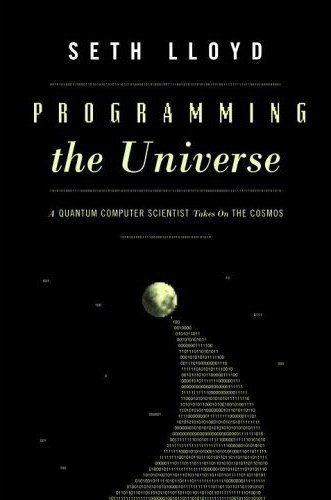
That distinction is at the heart of Seth Lloyd’s Programming the Universe. Lloyd is not primarily interested in the familiar science-fiction question of whether we happen to be living inside someone else’s simulation. His more fundamental question, and his thesis, is whether the physical universe can itself be understood as a computational process. If it can, then information is not merely something we use to describe physical reality. It may be one of the things from which physical reality is built.
This possibility has been explored, in different forms and with very different commitments, by figures including John Archibald Wheeler, Carlo Rovelli, Stephen Wolfram, Lee Smolin, and Nick Bostrom. Their arguments do not amount to a single theory, nor do they establish that the universe is literally a computer. But taken together, they point toward a remarkable shift in perspective: from asking what the universe is made of to asking what the universe does. And if I may be so bold: its telos.
Lloyd goes further. For him, computation is not simply a useful description of physical processes; it is fundamental to the physical processes themselves. The universe, in his formulation, computes its own evolution. And here the argument begins to turn back upon itself.
Computation requires rules. A computer does not create the rules by which it operates; the rules must in some sense be prior to the computation. Yet if the universe is both the computer and the thing being computed, where do those rules come from? If the laws of physics are the program, and the universe is the machine executing that program, what is it that establishes the laws? Lloyd’s answer seems to require the universe to supply both the machine and the instructions for its own operation.
This is more than a problem of terminology. In an ordinary computer, we can distinguish the hardware from the software, the state of the machine from the instructions acting upon that state, and the computation from the object being computed. Lloyd’s universal computer collapses these distinctions. The physical system is the hardware; its physical laws are the program; its state is the data; its evolution is the computation; and the result of the computation is the physical universe itself.
The analogy has therefore reached its limit. A computer can compute a model of the universe, but that does not by itself establish that the universe is a computer. A description of a process in computational terms is not necessarily an explanation of why that process exists or why its rules have the form they do. To say that the universe computes itself may ultimately be little more than a new vocabulary for saying that the universe evolves according to its physical laws.
The problem becomes still more complicated when Lloyd moves between the quantum and classical descriptions of reality. Quantum mechanics provides the natural language for his computational universe because quantum states can preserve and transform information in ways that classical computers cannot. But the world we actually observe is not simply a universal wavefunction evolving in an abstract computational space. It is a world of classical objects, definite records, irreversible processes, and apparent information loss. The transition from the quantum substrate to classical spacetime therefore cannot simply be ignored.
This is where the distinction between computation and physical reality becomes essential. At the level of the complete quantum state, evolution can be unitary and information-preserving. At the level of subsystems and classical observations, however, information can become inaccessible through processes such as decoherence. The computational picture therefore depends upon specifying exactly what constitutes the computer, what constitutes its state, and at what level information is being conserved.
Lloyd’s argument would have been compelling if the computer is identified with the underlying quantum state of the universe. It becomes considerably less clear when the same computational language is transferred wholesale to the emergent classical world of spacetime. If the computer is spacetime itself, then spacetime must somehow provide simultaneously the hardware, the state, the rules, and the computation. At that point the computational metaphor begins to explain the universe by presupposing the very structure it was introduced to explain.
The difficulty can be put more simply. A computer normally computes something other than itself. Lloyd’s universe computes its own evolution. But if the computer, the program, the data, the computation, and the output are all the same physical system, what explanatory work is left for the word computation to do?
It is rather like trying to lift yourself off the ground by pulling upward on your own hair.
Lloyd begins with bits generated by particle interactions, but the true primitive is spin: the representation structure of Hilbert space. If he had started from spin, he would have been forced to treat information as a property of the wavefunction itself rather than as a byproduct of spacetime events.
But he didn’t start with spin because it would collapse his entire “the universe is a quantum computer” narrative. If his thesis would have begun at the wavefunction there would have never been a “the universe computes itself.” Starting with spin would have forced him to confront the idea that the wavefunction exists under a different symmetry than spacetime.
The deeper difficulty is that Lloyd treats quantum mechanics as if it were simply the microscopic layer of the same spacetime reality we inhabit. In his account, the universal wavefunction is a physical object evolving in physical time, and its informational content is generated by physical interactions occurring at definite locations in spacetime. But this is not how the wavefunction is understood in contemporary quantum theory. The wavefunction does not live in spacetime. It is defined on configuration space, a high‑dimensional structure whose symmetries are not the symmetries of spacetime at all. It is not a field distributed over the universe; it is the mathematical object from which the appearance of a spacetime universe is derived.
Once this distinction is acknowledged, Lloyd’s computational metaphor becomes unstable. If the wavefunction belongs to a deeper, non‑spatiotemporal domain, then the “computer” cannot be spacetime itself. The computer would have to be whatever reality the wavefunction inhabits, and spacetime would be the rendered output: the interface produced by the evolution of the underlying quantum state. In that case, computation would not be something the spacetime universe performs. It would be something performed prior to spacetime, generating spacetime as a secondary description. The universe we observe would be the display, not the machine.
Lloyd never entertains this possibility because it would force him to abandon the idea that the universe computes itself. A system cannot compute its own interface. If the wavefunction is ontologically deeper than spacetime, then spacetime cannot be both the hardware and the output of the computation. The rules governing the wavefunction would have to be prior to spacetime, and therefore prior to the physical universe Lloyd wants to identify with the computer. His model requires a single domain in which the wavefunction, the laws of physics, the computational rules, and spacetime all coexist. But quantum theory does not support that unity. The wavefunction and spacetime obey different symmetries, inhabit different mathematical spaces, and participate in different kinds of evolution.
This is why Lloyd begins with bits generated by particle interactions rather than with spin, the true primitive of Hilbert space. Starting with spin would force him to acknowledge that information is a property of the wavefunction itself, not a byproduct of spacetime events. And once the wavefunction is treated as primary, spacetime becomes emergent: a rendered interface rather than a computational substrate. At that point, the universe cannot compute itself, because the computation would occur in a domain spacetime does not contain.
Lloyd’s argument depends on treating spacetime as the single, all‑encompassing domain in which information exists and computation occurs. For him, spacetime is not an emergent interface or a rendered classical description of a deeper quantum reality. It is the entire physical substrate: the hardware, the memory, the processor, the operating system, and the program. Every quantum interaction is a spacetime event; every bit is generated by a spacetime process; every computational step is performed by the spacetime universe itself. Lloyd never confronts the fact that the wavefunction does not inhabit spacetime and does not evolve within it. If he had, his model would have collapsed into a very different picture: spacetime as information only, a classical simulation produced by the decohered configuration of the underlying quantum state. Lloyd’s model requires spacetime to process all information in the wavefunction, but spacetime is informationally impoverished. Decoherence prevents spacetime from accessing the global relational structure that his computation metaphor requires.
But acknowledging that distinction would destroy the central claim of Programming the Universe. A universe that emerges from the wavefunction cannot compute itself, because the computation would occur in a domain spacetime does not contain.
Lloyd makes an intriguing aside that he never develops. He notes that a quantum computer the size of the universe, running a simulation of the universe, would be indistinguishable from the real thing. The remark is meant to be clever, but it quietly undermines his entire framework. If a simulation of the universe is indistinguishable from the universe itself, then the distinction between the computer and the simulation collapses. The universe would be both the machine and the model, both the substrate and the output. But this is only possible if spacetime is already a simulation: the classical, decohered configuration of the underlying wavefunction. A simulation running a model or simulation of itself.
Lloyd cannot pursue this implication because it would force him to acknowledge that the wavefunction belongs to a deeper domain than spacetime, and that spacetime is therefore informational rather than fundamental. His universal computer would dissolve into a rendered interface rather than a physical machine.
Had Lloyd begun with spin and the wavefunction, his quantum‑computational ideas might have endured. But by elevating spacetime to the status of fundamental substrate and insisting that it computes itself, he leaves the universe with no deeper domain from which its rules arise. What remains is a self‑explanatory physical reality: an ontology in which spacetime functions as its own ground of being. The metaphor of computation dissolves into metaphysics and omniscience.

