The End

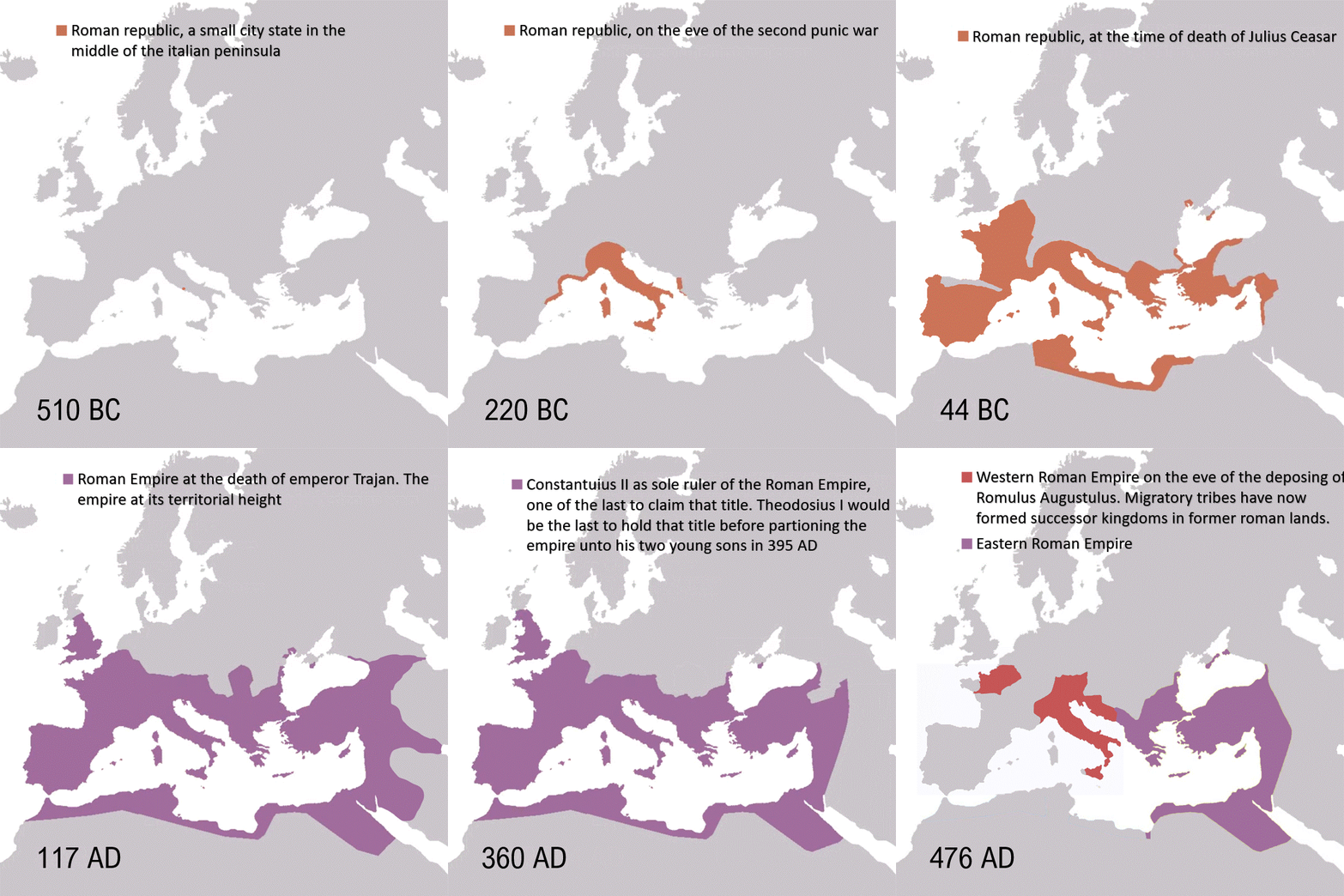
On 16 January 27 BC, the Roman Senate voted to confer the title of Augustus upon Octavian, Julius Caesar’s adopted son, realistically marking the end of the Roman Republic and the beginning of the Roman Empire. This decision aimed to restore stability and order after years of civil war and internal conflict, legitimizing Octavian’s authority while maintaining a veneer of republican governance. Augustus took effective control of the military, religion, bureaucracy, and administrative operations of the empire.

After the assassination of Julius Caesar in 44 BC, Octavian, in 43 BC, formed the Second Triumvirate with Mark Antony and Lepidus. Following their eventual conflict and his decisive victory at the Battle of Actium in 31 BC, Octavian became the uncontested ruler of Rome.

The Roman Empire was the final iteration of the Roman government, which began as a monarchy with Romulus as king in 753 BC, transitioned into a republic in 509 BC, and lasted through the era of civil wars and dictatorships until Octavian’s elevation as Augustus in 27 BC. The Roman Empire as a whole lasted until 476 AD when the Western Empire fell, while the Eastern Empire continued until 1453 AD.

Trivia: 16 January 27 BC, is the actual Julian calendar date, retained and quoted in texts for historical accuracy. According to the Gregorian calendar, however, the date marking the end of the Roman Republic would be 26,27 January 27 BC.

Source: Roman Republic…by M. Vermeulen, The Collector, 2020.  Graphic: Evolution of the Roman Empire, by ESKEHL-Wikipedia, 2022.

The Last Queen

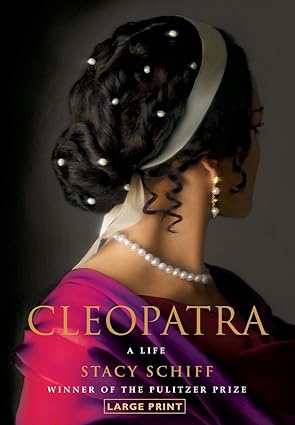
Cleopatra VII, descendant of Alexander the Great’s general Ptolemy Soter, inheriting the Egyptian Empire upon Alexander’s death, was the last pharaoh or queen of Egypt. Upon her death in 30 B.C., less than two weeks after the death of her lover, Mark Antony, she took her own life, likely with a fast-acting poison rather than the bite of an asp. This cleared the way for Augustus, the founder of the Roman Empire, to incorporate Egypt into the Roman realm.

In Cleopatra: A Life, Stacy Schiff weaves an engrossing tale of the queen’s ruthless ambition to restore the Egyptian Empire to its former glory. Though Cleopatra’s life lasted less than 40 years, she brought Rome into her world, achieving greatness that ultimately led to her downfall.

Cleopatra wanted greatness and found the means to attain it. Schiff states in her book that “Cleopatra appears to have had sex with only two men. They happen, however, to have been Julius Caesar and Mark Antony, among the most prominent Romans of the day. …Cleopatra had a child with Caesar and after his murder — three more with his protégé…The two [Cleopatra and Anthony] would together attempt to forge a new empire, in an alliance that spelled their ends.

Source: Cleopatra: A Life by Stacy Shiff, 2010.

Thought for the Day

T.H. Huxley, Darwin’s Bulldog, anatomist, and autodidact, reflecting upon time and matter, makes the humorous connection that, “It is very possible that atoms which once formed an integral part of the busy brain of Julius Caesar may now enter into the composition of Caesar, the housedog in an English homestead.

Source: Elementary Physiology, T.H. Huxley, 1902. Graphic: English Sheepdog, AI generated.

The Most Unkindest Cut of All

Mark Anthony opens his famous, but fictional, eulogy to Julius Caesar with 7 words of endearment and authority; Aristotelian pathos and ethos, that have become as familiar as blue sky to fans of Shakespeare and English lit students everywhere: “Friends, Romans, countrymen lend me your ears”.

Julius Caesar, a tragedy by Shakespeare, written around 1599, was based on Caesar’s life and death as documented in Plutarch’s Parallel Lives.

With pathos, logos and a chariot laden with irony, Anthony turns initial honor for Brutus and Caesar’s ambition inside out. He brings honor to Caesar and lays ambition on Brutus, along with Cassius. He brings condemnation to the conspirators and love for Caesar.

The first few lines of Anthony’s Eulogy:

Friends, Romans, countrymen, lend me your ears; I come to bury Caesar, not to praise him.
The evil that men do lives after them;
The good is oft interred with their bones;
So let it be with Caesar. The noble Brutus
Hath told you Caesar was ambitious:
If it were so, it was a grievous fault,
And grievously hath Caesar answer’d it.
Here, under leave of Brutus and the rest–
For Brutus is an honourable man;
So are they all, all honourable men–
Come I to speak in Caesar’s funeral.
He was my friend, faithful and just to me:
But Brutus says he was ambitious;
And Brutus is an honourable man.
He hath brought many captives home to Rome
Whose ransoms did the general coffers fill:
Did this in Caesar seem ambitious?
When that the poor have cried, Caesar hath wept:
Ambition should be made of sterner stuff:
Yet Brutus says he was ambitious;
And Brutus is an honourable man.
You all did see that on the Lupercal
I thrice presented him a kingly crown,
Which he did thrice refuse: was this ambition?
Yet Brutus says he was ambitious;
And, sure, he is an honourable man.
I speak not to disprove what Brutus spoke,
But here I am to speak what I do know.
You all did love him once, not without cause:
What cause withholds you then, to mourn for him?
O judgment! thou art fled to brutish beasts,
And men have lost their reason. Bear with me;
My heart is in the coffin there with Caesar,
And I must pause till it come back to me.

Source: “Julius Caesar” by William Shakespeare, Act 3, Scene II. Plutarch’s Parallel Lives. Graphic: Marlon Brando as Mark Antony in the 1953 film “Julius Caesar”

Slow Sadness

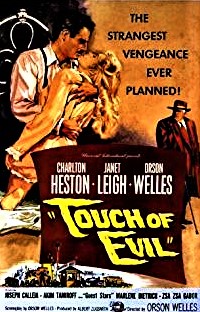
Touch of EvilM Touch 1958

Theaters:  February 1958

Streaming:  October 2000

Rated:  NR

Runtime:  95 minutes

Genre:  Classics – Crime – Drama –  Film Noir – Mystery – Suspense – Thriller

els:  8.5/10

IMDB:  8.1/10

Amazon:  4.4/5 stars

Rotten Tomatoes Critics:  8.9/10

Rotten Tomatoes Audience:  4.2/5

Metacritic Metascore:  NA/100

Metacritic User Score:  NA/10

Awards:

Directed by:  Orson Welles

Written by:  Orson Welles (screenplay), Whit Masterson: aka Robert Wade and Bill Miller (book)

Music by:  Henry Mancini

Cast:  Orson Welles, Charlton Heston, Janet Leigh, Marlene Dietrich, Zsa Zsa Gabor

Film Locations:  US

Budget:  $829,000

Worldwide Box Office:  $2,247,465

A man runs through a parking lot in a small Mexican town along the US border carrying a small package, placing it in the trunk of convertible moments before the owner and driver, Rudy Linnekar (Jeffery Green) and his young girlfriend Zita (Joi Lansing) arrive.  With the bomb ticking in the trunk of the car, Linnekar slowly drives through the town, filled with tourists and locals enjoying the cool night, heading for the nearby US border and home.  As they are driving, they pass the strolling newly married couple of Mike Vargas (Heston), a Mexican drug cop, and his American wife Susie (Leigh). The car crosses the border into the US and explodes.

Captain Quinlan (Welles), an obese cop with a bum leg, walking with the aid of a cane, arrives to take over the investigation of bombing. He quickly surmises that Sanchez (Victor Millan), who is secretly married to Rudy Linnekar’s daughter Marcia (Joanna Cook Moore), is the prime suspect.  Quinlan’s partner Pete Menzies (Joseph Calleia) plants incriminating evidence in Sanchez’s apartment and he is arrested. Vargas knows that the evidence against Sanchez was planted and begins to investigate the bombing and Quinlan, while letting his wife spend her honeymoon alone in some cheap deserted hotel in the dry scrublands of the American southwest.

Welles loosely based the movie’s screenplay on a 1956 Red Badge Mystery serial novel, Badge of Evil by Whit Masterson. The crime novel slowly solves the mystery of who killed Rudy Linnekar by blowing up his house with dynamite. The murder is investigated by police officers Hank Quinlan and Leron McCoy along with an assistant district attorney.  The 2 cops quickly make an arrest of Ernest Farnum, who soon commits suicide, even though incriminating dynamite was found in the apartment of Linnekar’s future son-in-law Delmont Shayon.

Whit Masterson is a pseudonym for 2 authors: Robert Allison “Bob” Wade and H. Bill Miller.  The pair, good friends since the age of 12, wrote more than 30 novels in their lifetimes with at least 6 adapted for movies.  Two other well received movies adapted from their books, in addition to this movie, were the 1942 All Through the Night with Humphrey Bogart, and The Yellow Canary starring Pat Boone.

Orson Welles, director, writer, actor, producer, and occasional illusionist was born an entertainer.  Shakespeare and presenting visual interpretations of the classic books were his passions. His colossal talent spanned the stage, radio, and movies, bequeathing an artistic ensemble to the world that increases in stature every year. In 1938, Welles produced, directed, and acted in Caesar, an updated version of Shakespeare’s Julius Caesar. The play was a monumental success. In the same year he narrated Mercury Theater’s adaptation of  H. G. Wells’, The War of Worlds, bringing him instant fame or at least infamy. In 1941 Welles, wrote, produced, directed, and acted in his greatest gift to movie goers everywhere: Citizen Kane.  A critical success on opening but financially not too great, held back by the Hearst’s family distaste and advertising boycott of the movie. Its impact on the public, though, has increased over time and by 2017 it was considered the greatest film ever made. He is also considered the 2nd greatest director of all time, with only Hitchcock ranking above him.

A Touch of Evil was Welles’ last Hollywood movie and one of the last in the film-noir genre, at least in the era of Hitchcock, Wilder, and Huston.  It ranks as one of his finest. Filmed in black and white, his use of upward shots, long sequences, and garish, crowded scenes gives the movie a dark and sinister look, foretelling from the beginning an ending of bleakness and sorrow.

Welles and Dietrich steal the show.  They are the 800 pound gorillas among the lesser greats of Heston, Leigh, and Cotton.  Heston’s acting is worthy of his name and this movie but casting him as a Mexican is a head scratcher.  Every time he appears in a scene you have to think about why he is portraying someone he clearly isn’t.

A Touch of Evil expresses the shadows of our lives that we all try to suppress, not by standing in the light but hiding them in our dark lonely places. Quinlan always getting his man regardless the cost, Vargas forsaking his wife to play the good cop, crime bosses sinking lower, night watchmen to afraid to do the right thing.  A tale of crossroads, with the right and left forks leading to the same forlorn scene of heartache and grief.

This is a movie you need to add to your “Must Watch in My Lifetime” list.  It is a great film-noir movie consistently ranking as one of the top 100 movies of all time.