
April Fools

April Fool’s Day brings pranks, jokes, and ‘kick-me’ notes to the consternation of almost all. The silliness has its foundations a long way in the past, nearly 450 years ago by some estimates, and is still going strong.

While its actual roots are debated, one popular explanation suggests that the origins of April Fool’s Day go back to the change from the Julian to the Gregorian calendar which occurred on 15 October 1582. Under the Julian calendar the new year began on April 1 and was moved to January 1st under the new calendar.

The transition to the new calendar was announced in Rome by Pope Gregory and was quickly adopted in Catholic countries such as Spain and Portugal but other areas found its adoption was slower, either through slow communications, religious differences, or just resistant to change.

Since the change over to the new calendar was slow, some people and communities continued to celebrate the New Year on April 1st and were roundly mocked as April Fools. This mockery quickly morphed into jokes, both vernacular and practical, which continued to this day.

The BBC has become known for their irreverent April Fool’s jokes. In 1957 they showed their viewers a clip of Swiss farmers harvesting spaghetti from trees, with many in their audience calling in to find out how they could grow their own spaghetti trees. In 1980 the BBC told its listeners that Big Ben was going to a digital readout and followed that up with an announcement that clock hands would be sold off to the first four that called in.
The End

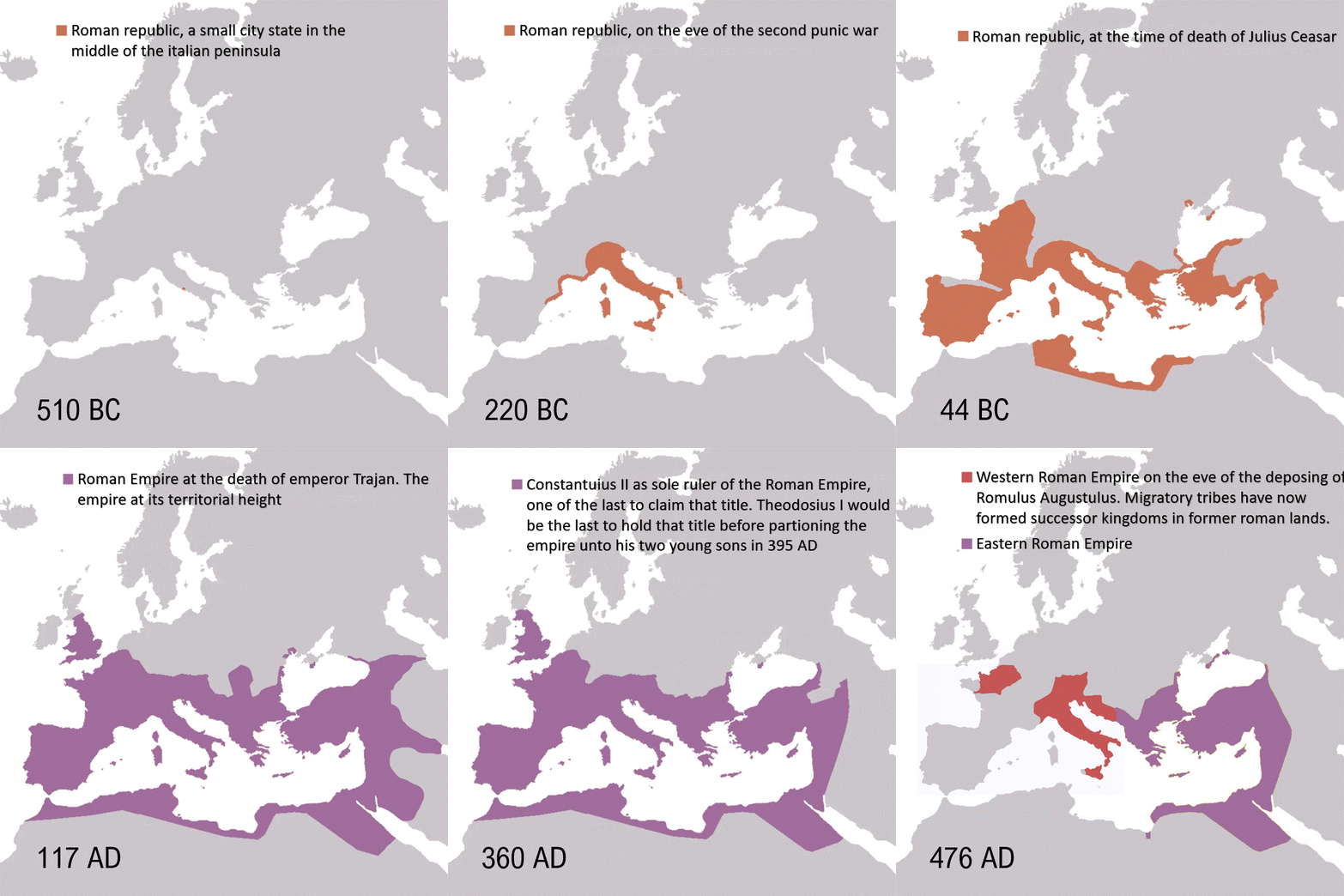
On 16 January 27 BC, the Roman Senate voted to confer the title of Augustus upon Octavian, Julius Caesar’s adopted son, realistically marking the end of the Roman Republic and the beginning of the Roman Empire. This decision aimed to restore stability and order after years of civil war and internal conflict, legitimizing Octavian’s authority while maintaining a veneer of republican governance. Augustus took effective control of the military, religion, bureaucracy, and administrative operations of the empire.

After the assassination of Julius Caesar in 44 BC, Octavian, in 43 BC, formed the Second Triumvirate with Mark Antony and Lepidus. Following their eventual conflict and his decisive victory at the Battle of Actium in 31 BC, Octavian became the uncontested ruler of Rome.

The Roman Empire was the final iteration of the Roman government, which began as a monarchy with Romulus as king in 753 BC, transitioned into a republic in 509 BC, and lasted through the era of civil wars and dictatorships until Octavian’s elevation as Augustus in 27 BC. The Roman Empire as a whole lasted until 476 AD when the Western Empire fell, while the Eastern Empire continued until 1453 AD.

Trivia: 16 January 27 BC, is the actual Julian calendar date, retained and quoted in texts for historical accuracy. According to the Gregorian calendar, however, the date marking the end of the Roman Republic would be 26,27 January 27 BC.

Source: Roman Republic…by M. Vermeulen, The Collector, 2020.  Graphic: Evolution of the Roman Empire, by ESKEHL-Wikipedia, 2022.