The end of the Peloponnesian War in 404 BC marked the end of Athens’ Golden Age. Most historians agree that the halcyon days of Athens were behind her. Some however, such as Victor Davis Hanson in his multi-genre meditations, A War Like No Other, a discourse on military history, cultural decay, and philosophical framing, offers a more nuanced view suggesting that Athens was still capable of greatness, but the lights were dimming.
During the following six decades, after the war, Athens rebuilt. Its navy reached new heights. Its long walls were rebuilt within a decade. Aristophanes retained his satirical edge even if it was a bit more reflective. Agriculture returned in force. Even Sparta reconciled with Athens or vice versa, recognizing once again that the true enemy was Persia.
Athens brought back its material greatness, but its soul was lost. What ended the Golden Age of Athens wasn’t crumbled walls or sunken ships. It was the loss of lives that took the memory, the virtuosity of greatness with it. With them generational continuity, civic pride, and a religious belief in the polis vanished. The meaning, truth, and myth of Athenian exceptionalism died with their passing. The architects of how to lead a successful, purpose driven civilization had disappeared, mostly through death by war or state but also by plague.
Victor Davis Hanson, in his A War Like No Other lists many of the lives lost to and during the war that took much of Athens’ exceptionalism with them to their graves. Below is a partial listing of Hanson’s more complete rendering with some presumptuous additions.
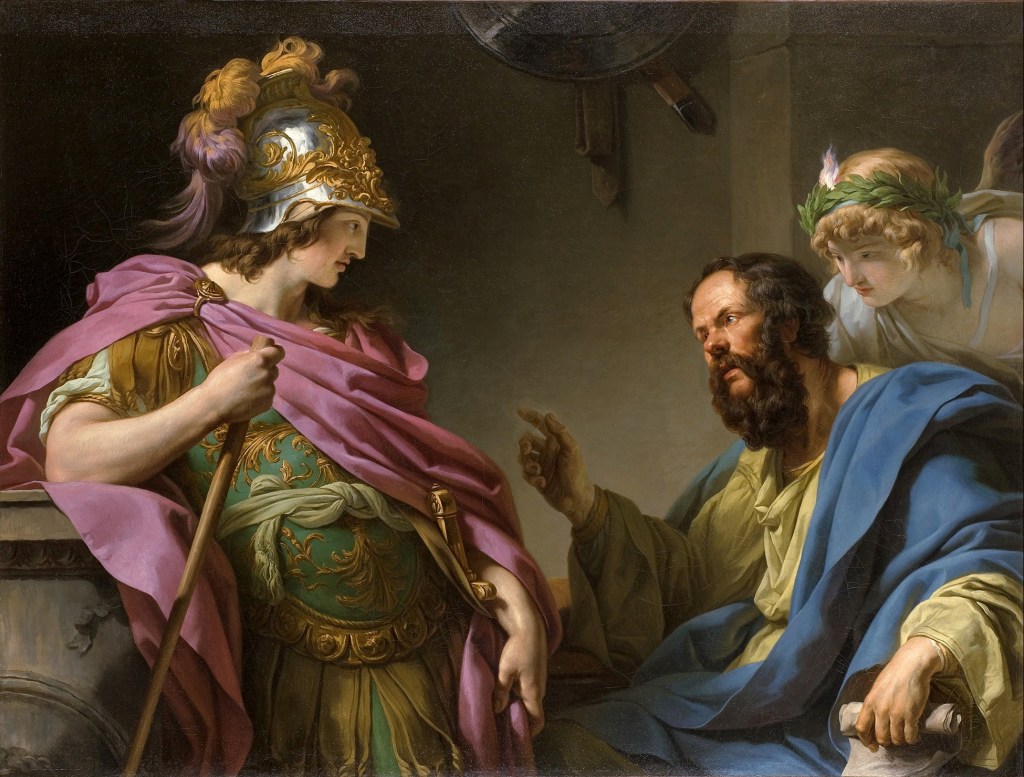
Alcibiades was an overtly ambitious Athenian strategist; brilliant, erratic, and ultimately treasonous. He championed the disastrous Sicilian expedition, Athens greatest defeat. Over the course of the war, he defected multiple times: serving Athens, then Sparta, then Persia, before returning to Athens. He was assassinated in Phrygia around 404 BC while under Persian protection, by, many beleive, the instigation of the Spartan general Lysander.
Euripides though he did not fight in the war exposed its brutality and hypocrisy in his plays such as The Trojan Woman and Helen. The people were not sufficiently appreciative of his war opinions or plays, winning only four firsts at Dionysia compared to 24 and 13 for Sophocles and Aeschylus, respectively. Disillusioned, he went into self-imposed exile in Macedonia and died there around 406 BC by circumstances unknown.
The execution of the Generals of Arginusae remains a legendary example of Athenian arbitrary retribution; proof that a city obsessed with ritualized honor could nullify military genius, and its future, in a single stroke. The naval Battle of Arginusae, fought in 406 BC, east of the Greek island of Lesbos, was the last major Athenian victory over the Spartans in the Peloponnesian War. Athenian command of the battle was split between 8 generals: Aristocrates, Aristogenes, Dimedon, Erasinides, Lysias, Pericles the Younger (son of Pericles), Protomachus, and Thrasyllus. After their victory over the Spartan fleet a storm prevented the Athenians from recovering the survivors, and the dead, from their sunken ships. Of the six generals that returned to Athens all were executed for their negligence. Protomachus and Aristogenes, likely knowing their fate, chose not to return and went into exile.
Pericles, the flesh and blood representation of Athens’ greatness was the statesman and general who led the city-state during its golden age. He died of the plague in 429 BC during the war’s early years, taking with him the vision of democratic governance and Athens’ exceptionalism. His 3 legitimate sons all died during the war. His two oldest boys likely died of the plague around 429 BC and Pericles the Younger was executed for his part in the Battle of Arginusae.
Socrates, the world’s greatest philosopher (yes greater than Plato or Aristotle) fought bravely in the war, but he was directly linked to the traitor Alcibiades. He was tried and killed in 399 BC for subverting the youth and not giving the gods their due. That was all pretense. Athens desired to wash their collective hands of the war and Socrates was a very visible reminder of that. He became a ritual scapegoat swept up into the collective expurgation of the war’s memory.
Sophocles, already a man of many years by the beginning of the war, died in 406 BC at the age of 90 or 91, a few years before Athens’ final collapse. His tragedies embodied the ethical and civic pressures of a society unraveling. With the deaths of Aeschylus in 456 BC, Euripides in 406 BC, and Sophocles soon after, the golden age of Greek tragedy came to a close.
Thucydides, author of the scholarly standard for the Peloponnesian War, was exiled after ‘allowing’ the Spartans to capture Amphipolis, He survived the war, and the plague, but never returned to Athens. His History ends in mid-sentence for the period up to 411 BC. He lived till 400 BC, and no one really knows why he didn’t finish his account of the war. Xenophon picked up where Thucydides left off and finished up the war in his first two books of Hellenica which he composed somewhere in the 380s BC.
The Peloponnesian War ended Athens’ greatest days. The men who kept its lights bright were gone. Its material greatness returned, glowing briefly, but its civic greatness, its soul, slowly dimmed. It was a candle in the wind of time that would be rekindled elsewhere. The world would fondly remember its glory, but Athens had lost its spark.
Source: A War Like No Other by Victor Davis Hanson, 2005. Graphic: Alcibiades Being Taught by Socrates, Francois-Andre Vincent, 1776. Musee Fabre, France. Public Domain.
The Peloponnesian War, fought over 27 years (431-404 BC), cost the ancient Greek world nearly everything. War deaths alone approached 8-10 percent of their population: up to 200,000 deaths from battle and plague. The conflict engulfed nearly all of Greece, from the mainland to the Aegean islands, Asia Minor and Sicily. Though Sparta and its allies, in the end, claimed a tactical victory, the war left Greece as a shadow of its former self.
The Golden Age of Athens came to an end. Athenian democracy was replaced, briefly, by the Thirty Tyrants. Sparta, unwilling to jettison its insular oligarchy, failed to adapt to imperial governance, naval power, or diplomatic nuance. Within a generation Sparta was a relic of history. First challenged by former allies in the Corinthian War, then shattered by Thebes, which stripped the martial city-state of its aura of invincibility along with its helot slave labor base: the economic foundation of Sparta. Another generation later, Macedon under Philip II and Alexander the Great finished off Greek dominance of the Mediterranean. After Alexander’s death in 323 BC, Rome gradually absorbed all the fractured pieces. Proving again, building an empire is easier than keeping one.
Thucydides, heir to the world’s first historian: Herodotus, reduced the origins of the Peloponnesian War to a primal emotion: fear. In Book I of his History of the Peloponnesian War he writes: “The growth of the power of Athens, and the alarm which this inspired in Sparta, made war inevitable.” Athens had violated trade terms under the Megarian Decree with a minor Spartan ally but that was pretext, not cause. Sparta did not go to war over market access. It went to war over fear. Fear of what Athens had become and a future that armies and treaties may not contain.
War and fear go together like flame to fuse. Sparta went to war not for fear of a foe, Sparta knew no such people. It was not fear of an unknown warrior, nor fear of battlefields yet to be choregraphed, but fear of an idea: democracy maintained and backed by Athenian power. And perhaps, more hauntingly precise, fear of itself. Not that it feared it was weak but of what it may become. They feared no sword or spear, their discipline reigned supreme against flesh and blood. Yet no formation, no stratagem, no tactic of war could bring down a simple Athenian belief: the rule of the many, an idea anathema, heretical even, to the Spartan way of life.
So, they marched to war, not to defeat an idea but to silence the source. Not to avenge past aggression but to stop a future annexation. They won battles, small and large. They razed cities. But they only destroyed men. The idea survived. It survived in fragments, bits here, bits there, across time and memory. What it did kill, though, was the spirit of Athens, the Golden Age of Athens. But the idea that was Athens lived on across space and time: chiseled into republics that rose from its ashes and ruins.
The radiance of Athens dimmed to shadow. Socrates became inconvenient. Theater became therapy; a palliative smothering of a cultural surrender. And so, civilization moved to Rome.
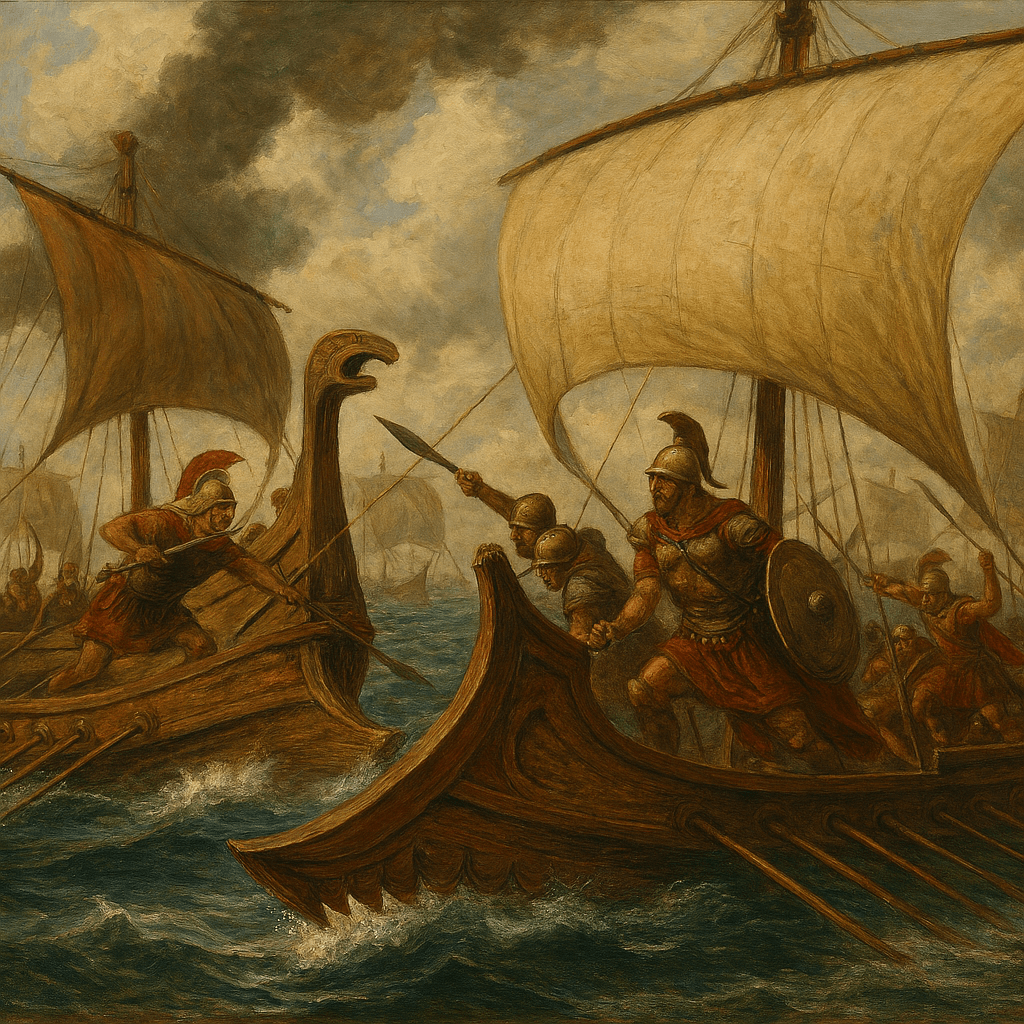
Source: A War Like No Other by Victor Davis Hanson, 2005. History of the Peloponnesian War by Thucydides, Translated by Richard Crawley, 2021. Graphic: Syracuse vs Athens Naval Battle. CoPilot.
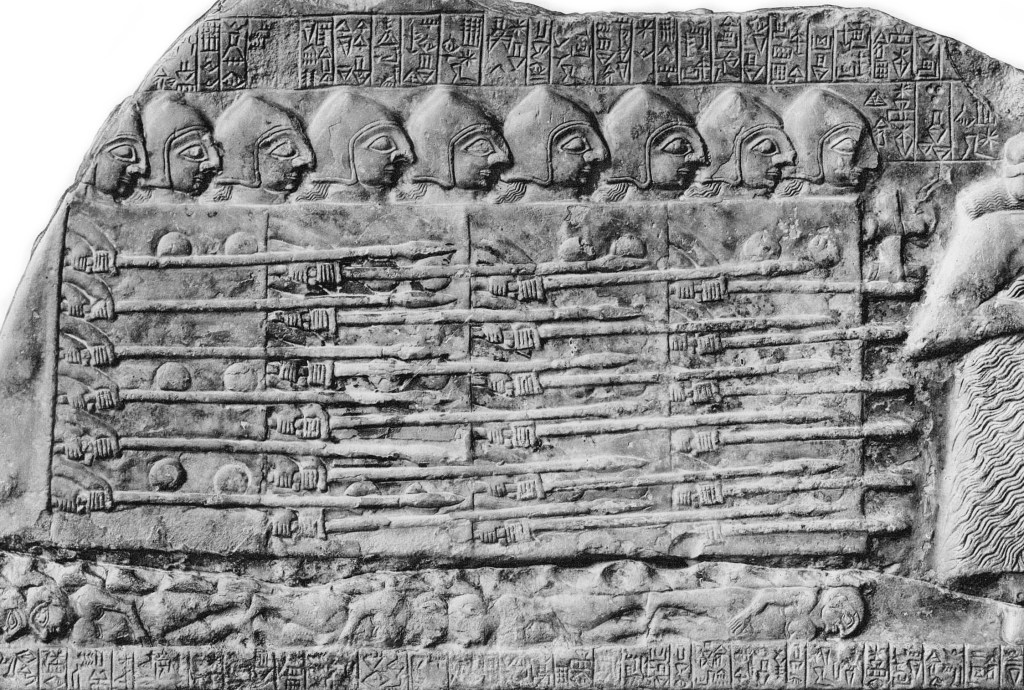
Near the ancient Sumerian city of Girsu, mid-way between present-day Bagdad and Kuwait City, stood a battle marker; the Stele of Vultures, now housed in the Louvre. It commemorates Lagash’s 3rd millennium BC victory over Umma. The stele derives its name from the monument’s carved vultures flying away with the heads of the dead. It also depicts soldiers of Lagash marching in a dense, shield to shield formation, holding spears chest high and horizontal, led by their ruler: Eannatum, who commissioned the stele in 2460 BC. The importance of the stele, though, is that it is the first visual depiction of the use of a phalanx in a battle. It is believed that the phalanx as a military tactic is much older.
The phalanx was more than a combat formation, it was a battlefield philosophy enshrining discipline and courage over strength, unity of the team over the individual. A dense, rectangular wall of men, generally 8 deep stretching across the battlefield to protect against flanking maneuvers. Each man wore heavy armor of leather and bronze: helmet, cuirass, greaves, armed with a spear and a short sword. But the breakthrough that brought the phalanx great renown was the apsis, a round shield invented for the Greek hoplite in the 8th or 7th century BC. With its dual grip, a forearm strap and central handhold, it allowed the infantryman precise control of his shield, helping create an impenetrable barrier of bronze and bone against the oncoming enemy’s spears and swords. It transformed the phalanx from an offensive wall of attack to an added defensive engine of defiance.
The phalanx only succeeded in cohesion. When courage and discipline held, the formation with the apsis as its core defense was practically unbeatable on confined terrain. It overcame the enemy with a seamless, tight mass executing a relentless forward march into the belly of the opposing beast. But it was only as strong as its weakest link. Once discipline faltered and cohesion broke, the formation collapsed, and the opposing army ran it to ground. Victory belonged not to brute force, but to the combined strength of the military unit. Teams won, individuals lost.
From late 8th century BC onward, Greek phalanxes were manned by hoplites: citizen soldiers, generally landowners and farmers. Emerging in Sparta or Argos, possibly imported from Sumeria or born of parallel discovery in Greece, phalanx battles initially were confined, blunt, and deadly affairs. They devolved into fierce pushing masses of brawn, bone, and metal until one side broke. Heavy casualties occurred when the enemy lines broke and soldiers fled Helter skelter in shock and chaos, pursued by the victors for plunder, unless they were restrained by honor.
The phalanx became the standard that destroyed the mighty Persian armies at Marathon and Thermopylae early in the 5th century BC. At Marathon in 490 BC 10,000 Athenians and 1000 Plataeans stretched out their formation to match the breadth of 26,000 Persians, filling the Marathon plain and denying the armies any room for flanking movements.
The Greeks stacked their wings with additional rows of hoplites and thinned them progressively toward the center creating a convex crescent. The Greek wings advance faster than the center generating a pincer movement that collapsed on the Persian center. When the dust settled 192 Athenians and 11 Plataeans were lost while the Persian losses were approximated at 6400.
In the 19th century, Napoleon, possibly improvising on phalanx encircling tactics developed at Marathon, would invert his attacking army with a concave formation consisting of a strong center and weaker wings. His strategy being to split the enemies’ center with strength and attack their divided ranks on the flanks. The tactic worked until Wellington at Waterloo.
At Marathon, unity triumphed with geometric discipline. At Thermopylae the formation bought time and ended with a sacrifice that concluded Persian hubris.
During the second Persian invasion in 480 BC, Darius’s son Xerxes with 120,000-300,000 men attacked a contingent of 7000 Greeks at Thermopylae. The Greeks held back the Persian advance like a cork in a bottle, using a rotating phalanx of roughly 200 men to defend a narrow pass for two days, until betrayal by Ephialtes exposed their flank and they were destroyed in a inescapable Persian barrage of arrows. Greek losses were estimated at 4000 men including Leonidas’ 300 Spartans and 2000-4000 Persians (beginning and ending estimates for manpower strength vary widely).
The Greeks defiant stand at Thermopylae allowed the Greek navy to regroup at Salamis where they won a decisive victory against the Persian navy. A year later the Greeks at Plataea crushed the Persians quest for a Hellenic satrapy.
The Phalanx endured for another century, including use in the Peloponnesian War, where it remained lethal but of limited use. Then came Epaminondas at Leuctra in 371 BC, transforming the phalanx into a machine that erased Sparta’s mighty reputation. Typically, each army’s phalanx strength was concentrated on their right wing so that the strongest part of a force always faced off against the weaker wing of the opposition. What Epaminondas did was say nuts to that.
He reversed the order and created an oblique formation, more triangular than rectangular with his strongest troops on the left wing. His left wing was stacked 50 deep while keeping his center and right wings thin. His 50-deep was aimed directly at Sparta’s best under the command of King Cleombrotus (in those days officers and kings were in the front rows of the phalanx). As the phalanxes began to attack Epaminondas kept his right-wing stationery creating an asymmetrical front. The left wing easily broke through Sparta’s right wing, killing Cleombrotus and collapsing their superior flank. At that point Epaminondas’s wing pivoted inward creating an enveloping arc around the remaining parts of Sparta’s phalanx effectively ending the Spartan myth of invincibility.
Epaminondas tactics shortened battles with fewer casualties. His innovations proved that properly trained and equipped citizen soldiers could defeat professional warriors while instilling a new civic honor through restraint and discipline. His oblique formation allowed landowners and farmers to settle their disputes, usually in a few hours or less, with minimal loss, and return to their farms in time for the harvest. Epaminondas not only brought asymmetrical tactics to the battlefield but shattered claims of superiority by employing the unexpected.
As the Golden Age of Athens and western civilization’s Greek center waned and Roman hegemony rose, the phalanx evolved again. The Greek phalanx gave way to the Roman manipular system, a staggered checkerboard pattern, enabling units to rotate, reinforce, or retreat as needed. It was a needed refinement and improvement to the phalanx, more effectual on open plains and less susceptible to calvary and arrows.
Then came Hannibal to Cannae in 216 BC. During the 2nd Punic War, he upended the war cart of tactics once again and ruthlessly exploited Rome’s refinements.
Hannibal’s improvisations of the phalanx maneuvering tactics, but not the actual formation, showed that he had studied Marathon. Instead of a convex line with strong wings and a weak center he developed a concave line with strong wings and weak center. He allowed the center to fall back, which the Romans unwittingly obliged by surging into Hannibal’s weak center. With the Romans committed Hannibal’s deception encircled them with precision and brutal lethality. The Romans were annihilated on the field losing somewhere between 50,000-70,000 killed and another 10,000 captured. Hannibal lost 6000-8000 men (again estimates vary). Then came the 3rd Punic War.
The phalanx began as a wall of spears and shields, a bulwark of bronze and bone. Its stunning victories echo through history’s scholarly halls and hallowed plains of death and destruction. Yet its Achilles’ heel, vulnerable flanks, precise terrain requirements proved incompatible to horses and gunpowder.
Still its legacy of discipline and unity endure. Born of necessity, refined through rigor, and studied for centuries, the phalanx stands as a testament Aristotle’s enduring insight, slightly abridged but still profound, ‘The whole is greater than the parts.’ And perhaps the Roman’s said it best: ‘E pluribus unum’, ‘out of many, one.’
Source: A War Like No Other by Victor Davis Hanson, 2005. Et al. Graphic: Stele of Vultures.
At the end of first year of the Peloponnesian War in 431 BC Athenians held the customary public funeral to honor the soldiers who gave their lives in the war against Sparta. As Thucydides records in his “History of the Peloponnesian War” the funeral was a procession of citizens that ushered ten cypress coffins representing the ten Athenian tribes plus one more for the soldiers not recovered from the field of battle to the public graveyard at Ceramicus.
Thucydides further states that “When the bodies had been buried, it was customary for some wise and prudent notable and chief person of the city, preeminent in honor and dignity, before all the people to make a prayer in praise of the dead, and after doing this, each one returned to his House. That time to report the praises of the first who were killed in the war, Pericles, son of Xanthippus, was chosen; who, having finished the solemnities made in the tomb, climbed on a chair, from where all the people could see and hear him, and gave this discourse.”
Pericles’ speech was given not only as a tribute to the fallen, but a celebration of the Athenian citizens’ patriotism and urged them to honor the dead by continued support for the city and its democratic ideals.
The following is the first paragraph of the speech recorded by Thucydides:
Most of those who have spoken here before me have commended the lawgiver who added this oration to our other funeral customs. It seemed to them a worthy thing that such an honor should be given at their burial to the dead who have fallen on the field of battle. But I should have preferred that, when men’s deeds have been brave, they should be honored in deed only, and with such an honor as this public funeral, which you are now witnessing. Then the reputation of many would not have been imperiled on the eloquence or want of eloquence of one, and their virtues believed or not as he spoke well or ill. For it is difficult to say neither too little nor too much; and even moderation is apt not to give the impression of truthfulness. The friend of the dead who knows the facts is likely to think that the words of the speaker fall short of his knowledge and of his wishes; another who is not so well informed, when he hears of anything which surpasses his own powers, will be envious and will suspect exaggeration. Mankind are tolerant of the praises of others so long as each hearer thinks that he can do as well or nearly as well himself, but, when the speaker rises above him, jealousy is aroused and he begins to be incredulous. However, since our ancestors have set the seal of their approval upon the practice, I must obey, and to the utmost of my power shall endeavor to satisfy the wishes and beliefs of all who hear me.
Source: Richard Hooker, 1996, University of Minnesota, Human Rights Library. Graphic: Pericles Funeral Oration by Philipp Foltz, 1877, Public domain.
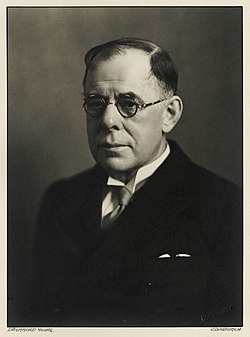
Alfred Edward Taylor was born in Oundle, England in 1869, and died in Edinburgh, Scotland in 1945. He was a professor, a Greek classicist, and a philosopher of metaphysics and ethics. He spent his adult life at the ancient Scottish Universities of St. Andrews and Edinburgh researching and teaching the spiritual; the immortal basis for morality and the philosophy of Plato. Plato was a student of Socrates and as such he was a concern to and within the orbit of Taylor.
Socrates’, leaving no written record, entire philosophical corpus and biography have reached us today primarily through the writings of two near contemporary Greeks: Plato and Xenophon. Taylor’s contribution to our present day understanding of Socrates was to argue that Plato’s four basic texts on Socrates: Euthyphro, Apology, Crito, and Phaedo, are accurate depictions of what Socrates said and did. Xenophon, who also wrote extensively about Socrates but later, Taylor argued, is less reliable. This may seem trivial, but this point has been and still is contested due to the immense stature of Socrates as one of the founders of Western philosophy in general and ethics in particular. The basic question among philosophers is whether Plato’s writings describing Socratic philosophy are accurate or are amalgamations of Socratic and Platonic thought? Who knows? The dispute will continue till the end of days so we will leave it as Taylor says.
Taylor’s studies within the philosophy of ethics and morality centered on what is right and good, whether the two were complementary and/or achievable. Taylor argued right and good or the moral practice of the individual is constrained and flawed without the aid of the supernatural: God. His thesis was that searching inward, within oneself for rebirth and betterment, for a moral compass, flows only in circles leading nowhere. To reach a higher level of morality or good requires looking outward to the spiritual through contemplation of the eternal good. Taylor argued that the will to reach for a better or eternal good is impetus for the eternal, the divine good to reach for you. Additionally, morality, Taylor surmises, plateaus in the human confines of a person’s physical life, requiring, unfortunately or fortunately depending on your perspective, death to continue the soul’s moral journey for better or worse.
Socrates:
Any biography of Socrates is going to be short. Almost all authoritative writings concerning his work, teachings, and life that have reached us in the 21st century consists of approximately two hundred written pages, in English, by Plato and about three hundred English written pages by Xenophon with the two containing significant overlap. Taylor’s biography, using Plato and Xenophon as primary sources, is no exception managing to encapsulate Socrates’ remarkable life into a quick read of 142 pages. Within these few pages concerning this most remarkable man everything has been disputed except for the Athenians putting him to death for being a royal pain in the rear, some have used the term gadfly. That is the one piece of his life that no one disagrees with. No one disputes that he was put to death in 399 BC, and it is likely that no one disputes that he was a royal pain in the posterior, a gadfly.
Socrates was born, circa 469 BC, grew up and lived in Athens until he was put to death in 399 BC at the age of seventy. He lived during the Golden Age of Athens (478-404 BC) and the overlapping Age of Pericles (461-429 BC) both now combined and known by the excessively non-descriptive non-demonym: Fifth Century Athens. (Why classical historians thought this was a useful, didactic change defies any sound, logical reasoning. Alas it was changed to avoid hurt feelings of Greeks and Athenians whose best years occurred two thousand seven hundred years ago. How you soothe pouting children should not be an instruction manual for sane adults.)
Socrates only left Athens to serve in military battles prior to and during the (second) Peloponnesian War. He was a hoplite in the Athenian army, a heavy infantry soldier outfitted with a shield, sword, and/or spear fighting in a phalanx or block-like formation. By all accounts he was a good and courageous soldier. His first recorded engagement, at the age of thirty-eight, was the battle and siege at Potidaea beginning in 432 BC. lasting until 429 BC. Potidaea was a Greek city-state, approximately 155 miles, as the crow flies, north of Athens, threatening to break free of Athenian control. This battle helped trigger the much larger and costlier Peloponnesian War beginning in 431 BC and lasting until 404 BC.
Socrates saved the life of Alcibiades, a gifted Athenian general and politician, but exceptionally duplicitous and erratic. Socrates heroic action should have garnered him the prize for valor, but Alcibiades was awarded it instead due to his higher birth and rank. A very powerful disincentive to the rank and file indeed.
Five and seven years later Socrates fought for Athens in the losing battles of Delium and Amphipolis, respectively, during the initial stages of the twenty-seven year-long Peloponnesian War. During the battle of Delium in 424 BC, Alcibiades saved Socrates’ life thus repaying Socrates’ valiant deed and cementing their life-long, but problematic, friendship.
Alcibiades recounts a story of Socrates during the engagement of Potidaea that bears on the philosopher’s power, or possibly prophetic power of thought. One morning Socrates, while contemplating an assumed perplexing problem became motionless, a state he remained in until the next morning when he said a prayer and walked away invigorated, amazing his fellow soldiers who had been watching him through the night. This story has him either being completely lost in thought, refusing to move to avoid breaking that train of thought, or as another occurrence of the ‘Sign’, voice, or daimonion that came to him, starting in his childhood and continuing throughout his adult life.
The ‘Sign’ was a voice usually described as an inner call, not to action, but to caution, a warning of future woes to come. Socrates mentioned at his trial that whenever the voice spoke to him it turned him away from something he was about to do. Some believe the ‘Sign’ was simply his subconscious speaking to him while others feel it was divine. A message from God.
To stretch a minor detail, Socrates almost never referred to the Gods, just God in the singular, a minor point yes, but a point all the same that the ‘Sign’ may have been religious vision or experience from the perspective of monotheism versus accepted Greek polytheism. At his trial he states, “It is to fulfill some function that I believe God has placed me in the city. I never cease to rouse each and every one of you, to persuade and reproach you all day long…” His ‘Sign’ did not speak to him during his trial leaving him to conclude that the sentence of death was something he should accept.
Socrates’ ‘religion’ began with his belief in the soul, and that it was immortal and unchanging. The soul existed before you were born and continued after your death. He believed the soul was your truth, your essence, your reality beyond your corporal self. He believed the soul must be looked after and kept in immaculate condition.
Socrates believed that to care for your soul required a focus on personal growth. Growth comes from the pursuit of wisdom and knowledge, the study of philosophy, to further one’s understanding of not only yourself but the world around you. The pursuit of wisdom through what became known as the Socratic method, questioning and logical reasoning started with yourself: ‘know thyself’ and expanded to include the universe beyond your own flesh. To seek wisdom and knowledge by examining your life was to seek truth. Seeking wisdom and knowledge for the sake of truth is what Socrates meant when he spoke his famous line at his trial in 399 BC, “The unexamined life is not worth living.” Without truth, life is not worth living. Without truth one risks living a lie.
Socrates examined and questioned everything and everyone. His thirst for knowledge and wisdom all flowed from his stated belief in his own ignorance, stating “as for me all I know is that I know nothing.” No one that knew Socrates believed this statement for a second. He was known as a sage, a philosopher, and shrewd one at that. His wisdom was even embraced by the Oracle of Delphi who said Socrates was the wisest person in Athens.
For Socrates, though, his statement professing to know nothing wasn’t an expression of humility or ignorance but a challenge. A challenge to question one’s beliefs and opinions concerning all things seen and unseen. Two plus two equals four, everything else is questionable. “All I know is that I know nothing” is an acknowledgement that the search for wisdom: truth, at a minimum is transitory, possibly imaginary, and thus one must never stop searching. This was not to say there were no truths available to the living, but the search could be difficult and deceptive.
Socrates’ quest for the truth manifested itself first through his rejection of fame, money, and power. The corollary of that rejection is he lived a life of poverty, neglected hygiene, and wore no shoes. No shoes whether with feet on burning stones or frosted rocks. Pain and discomfort did not seem to bother him.
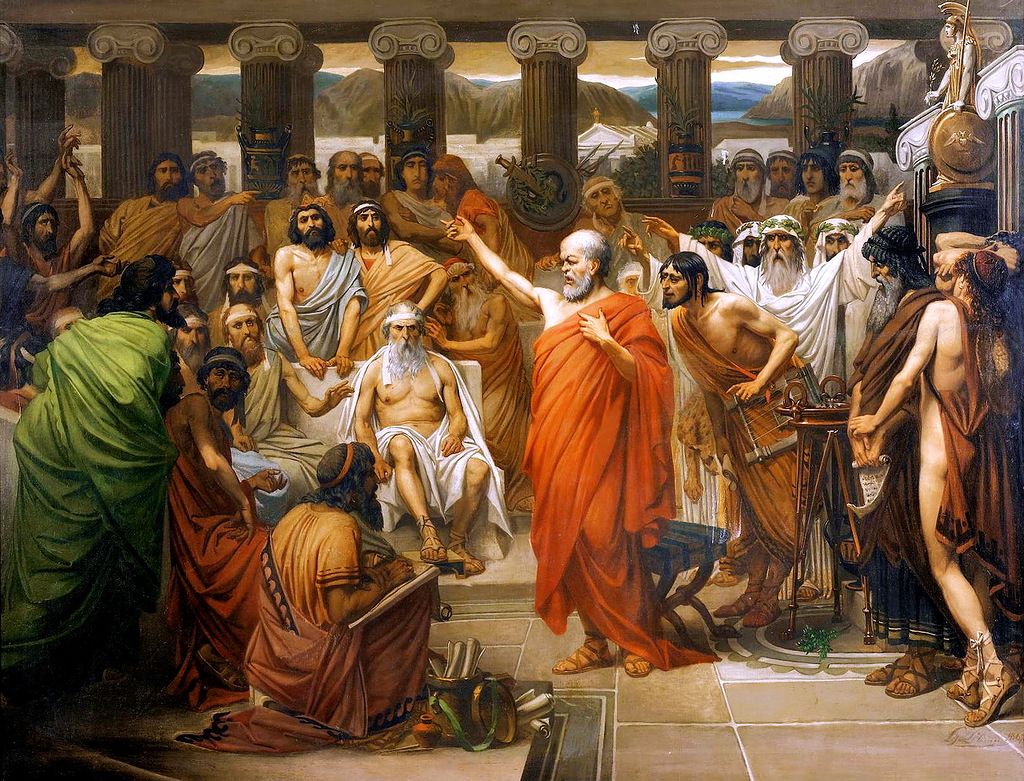
Secondly his quest for the truth was through the spoken word, never written. Conversations with his fellow Athenians occurred throughout the city, the Lyceum and the Agora were his two favorite haunts where he questioned his victims, and they were victims, in his famous ‘Socratic Method’ style of inquisition. Below is a short description of Socratic torture from the–Explainer: Socrates and the Life Worth Living (link below):
Socrates engages an interlocutor who appears to possess knowledge about an idea
The interlocutor makes an attempt to define the idea in question
Socrates asks a series of questions which test and unravel the interlocutor’s definition
The interlocutor tries to reassemble their definition, but Socrates repeats step three
Both parties arrive at a state of perplexity, or aporia (ed. a philosophical puzzle), in which neither can any further define the idea in question
Socrates’ Address. Louis J. Lebrun. 1867
A humorous sketch illustrating his method from Plato’s ‘Euthyphro‘ picks up near the end of a discussion concerning the gods:
Euthyphro: Why you don’t suppose, Socrates, that the gods gain any advantage from what they get from us, do you?
Socrates: Well then, what would those gifts of ours to the gods be?
Euthyphro: What else than honor and praise, and, as I said before, gratitude?
Socrates: Then, Euthyphro, holiness is grateful to the gods, but not advantageous or precious to the gods?
Euthyphro: I think it is precious, above all things.
Socrates: Then again, it seems, holiness is that which is precious to the gods.
Euthyphro: Certainly.
Socrates: Then will you be surprised, since you say this, if your words do not remain fixed but walk about, and will you accuse me of being the Daedalus who makes them walk, when you are yourself much more skillful than Daedalus and make them go round in a circle? Or do you not see that our definition has come round to the point from which it started? For you remember, I suppose, that a while ago we found that holiness and what is dear to the gods were not the same, but different from each other; or do you not remember?
Socrates: Then don’t you see that now you say that what is precious to the gods is holy? And is not this what is dear to the gods?
Euthyphro: Certainly.
Socrates: Then either our agreement a while ago was wrong, or if that was right, we are wrong now.
Euthyphro: So it seems.
Socrates: Then we must begin again at the beginning and ask what holiness is. Since I shall not willingly give up until I learn. […]
Euthyphro: Some other time, Socrates. Now I am in a hurry, and it is time for me to go.
Socrates: Oh my friend, what are you doing? You go away and leave me cast down from the high hope I had that I should learn from you what is holy, and what is not, and should get rid of Meletus’s indictment by showing him
Socrates’ learnings in search of the truth have been passed down to us through Plato, Aristotle, Epicurus, Locke, and others, climaxing in Jefferson’s preamble to Western civilization’s crowning ode to self and country: the ‘Declaration of Independence‘, proclaiming the fundamental, natural rights of man: Life, Liberty and the pursuit of Happiness.
The phrase the ‘pursuit of Happiness’ has been thoroughly misconstrued to mean something foreign and vulgar to Jefferson’s original intent. The ‘pursuit of Happiness’ was not a grant to seek earthly enrichments and pleasures but a call to a higher state of being. Epicurus provided a definition of happiness that comes closest to the meaning of Jefferson, “the end of all our actions is to be free from pain and fear, and once this is obtained the tempest of the soul is quelled.” Life, Liberty, and the pursuit free from pain and fear. The ‘pursuit of Happiness’ sounds better.
Epicurus seeks a soul free of pain and fear. Socrates sought a pure soul. Both pursued it through the same means. Socrates and Epicurus’ greatest pleasure in life was the pursuit of wisdom and truth. Neither sought fame, money, or power nor feared death. Epicurus did not fear death because it was the end of the body and the soul. There was nothingness after death. No greater glory. No damnation. Just nothing. Socrates did not fear death because a pure and good soul went on to something better.
Socrates, then, lived a good life. A life in pursuit of truth. A death to continue his journey to a higher plane.
Socrates died, supposedly, for impiety and corruption of the youth. Both charges were difficult to square with reality, but they achieved the desired outcome: removing an inconvenient seeker of truth. Silencing the moral inquisitor, the examiner of the soul. Extinguishing the gadfly.
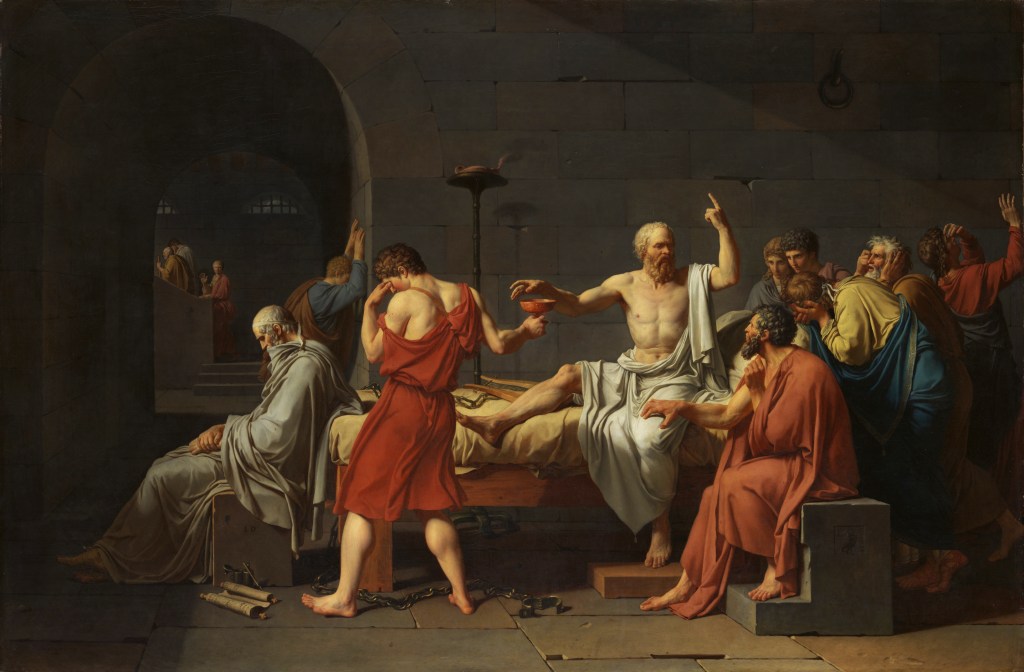
At the end of his trial Socrates’ soul was at peace but still he seeks truth: “Now the hour to part has come. I go to die, you go to live. Which of us goes to the better lot is known to no one, except God.”
The Death of Socrates. By Jacques-Louis David. 1787

 elsToday