Journalism – Johann Hari

Johann Hari has been involved in significant journalistic malpractice since joining the British media in 2001, earning sneering testimonials for plagiarism, fabrication, misconduct, misrepresentation of research, malicious editing of his biography, false and defamatory articles against fellow journalists, threats of libel suits against anyone challenging his ethical failings, selective editing of interviews to alter narratives, errors in cited data, and claiming evidence without proper citations. And he’s only 45.

Hari has worked for numerous prestigious publications, including the New Statesman, The Independent, The Huffington Post, The New York Times, the Los Angeles Times, The New Republic, The Nation, Le Monde, El Pais, The Sydney Morning Herald, Haaretz, BBC, and Slate. He currently writes non-fiction books on drugs—both legal and illegal—drug culture, and the harm of social media.

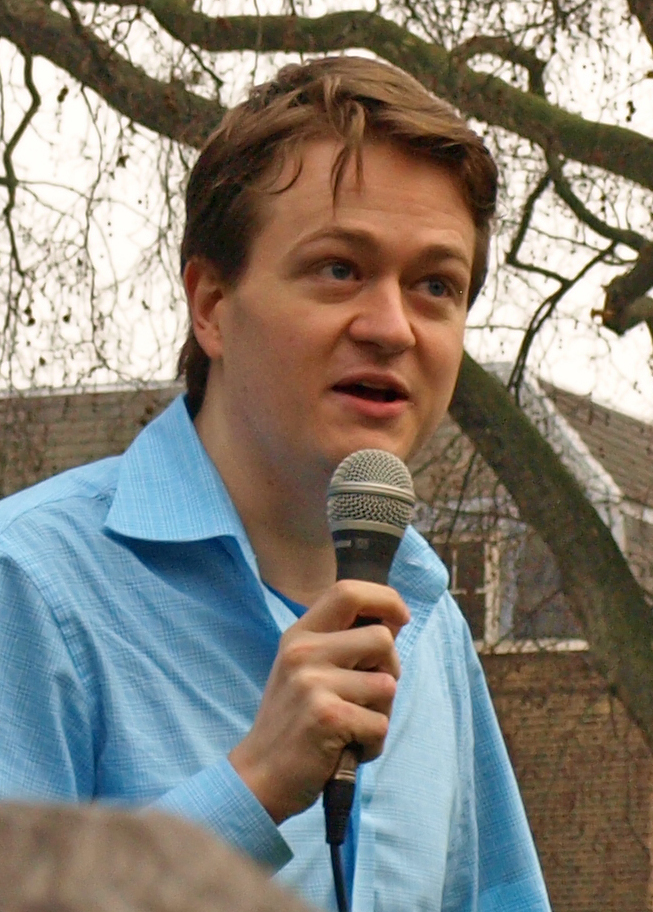
Source: Forbes. Wikipedia. Graphic: Johann Hari supplied by Johann Hari, 2011, creative commons.

Near Death Experiences

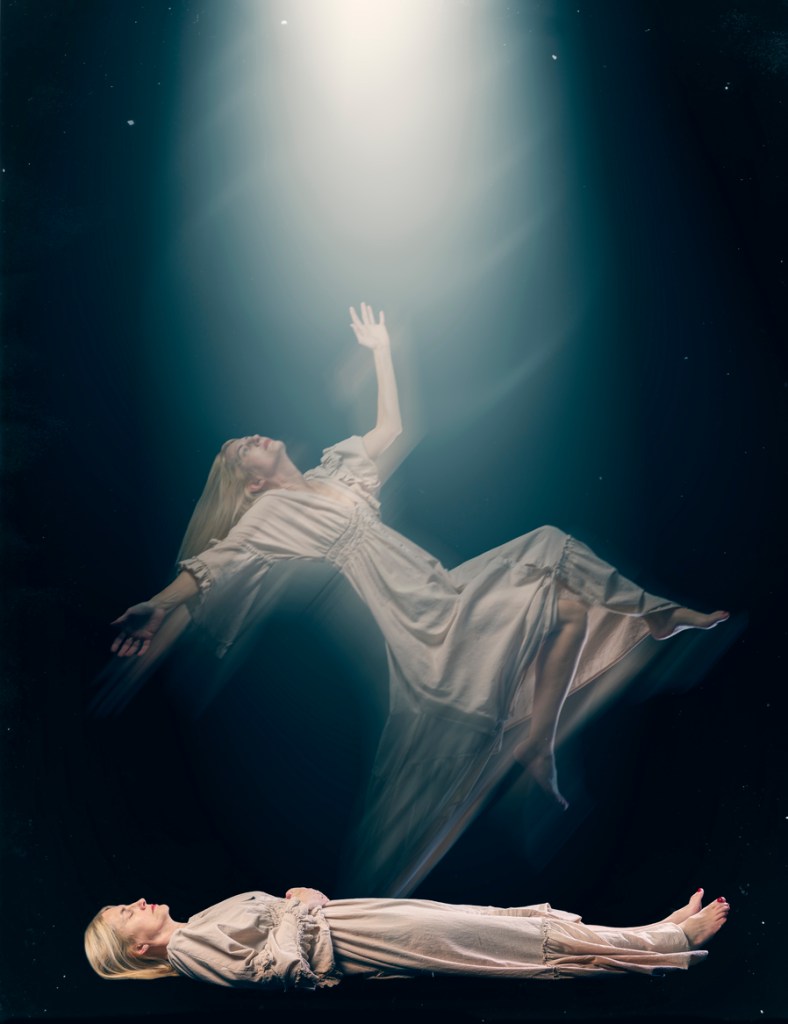
Bruce Greyson in a paper published in the Journal Humanities states that, “Near-death experiences (NDEs) are vivid experiences that often occur in life-threatening conditions, usually characterized by a transcendent tone and clear perceptions of leaving the body and being in a different spatiotemporal dimension.”

NDEs have been reported throughout history and across various cultures, with many interpreting them as proof of life after death or the continuation of existence beyond the death of the physical body.

Dr. Eben Alexander, a neurosurgeon, experienced his own NDE during a week-long coma induced by a brain illness. During this experience, he reported traveling outside his body to another world, where he encountered an angelic being and the maker of the universe. He interpreted his experience not only as evidence that consciousness exists outside the mortal body but also as proof of God and heaven.

Socrates believed that the soul, a concept encompassing not only consciousness but also the whole psyche of a person, was immortal and existed in a realm beyond the physical world. According to the Platonic concept of “anamnesis”, the soul is temporarily housed in the mortal body until the body’s death, at which point it returns to a “spiritual” realm. Socrates firmly believed that because the soul is immortal, it is imperative to live a moral and virtuous life to avoid damaging the soul.

Zeno of Citium and the Stoics, following in Socrates’ footsteps, developed the concept of “pneuma” or spirit, which they viewed as a physical substance that returns to the cosmos after the death of the body. They believed that the universe is a living being, a concept known as “pantheism,” and that pneuma or souls are part of the greater universal whole.

Omniscience–Omnipresence.

Source: The Near-Death Experience by Sabom, JAMA Network, Proof of Heaven by Alexander. Memorabilia by Xenophon. Graphic: Out of Body, istock licensed.

Faith

All money is a matter of belief”, according to Adam Smith, author of The Wealth of Nations.

The value that is assigned to money is subjective and is essentially a matter of trust. There isn’t a fixed value for money except the belief that it is useful for the exchange of goods and services.

If that faith or trust erodes, then its value can drop sharply and lead to crises in the economy or society.

Money is an idea, and it’s built on trust. Bitcoin and the Dollar are an idea.

Source: The Socratic Method: Money.

Contrived

Conclave: The Pope has died, and Cardinal-Dean Thomas Lawrence (Ralph Fiennes) must convene a Conclave of the College of Cardinals to choose a new Pope. A Conclave acknowledging not so much the guiding hand of God but the vanities of man.

Conclave features stunning visuals and competent acting, yet it is undermined by a script full of amateurish, contrived plot twists designed, supposedly, to advance the writers’ Robert Harris and Straughan’s feverish dreams of utopian Church doctrine rather than create a compelling narrative of suspense detailing the fallibility of man. After 120 minutes of an unending, stacked series of Deus ex machina plot devices, the fatigue reaches a smothering comatose level. Mercifully, the movie ends not with applause but with a resounding sigh of relief that your cinematic suffering is over.

Trivia: According to John Mulderig, under canon law in pectore appointments end with the pope’s death. Cardinal Benitez would not have been allowed into the Conclave.

Genre: Drama-Mystery-Suspense-Thriller

Directed by: Edward Berger

Screenplay by: Peter Straughan

Music by: Volker Bertelmann

Cast: Ralph Fiennes, Stanley Tucci, John Lithgow

Film Location: Rome

ElsBob: 3.0/10

IMDb: 7.5/10

Rotten Tomatoes Critics: 93%

Rotten Tomatoes Popcornmeter: 85%

Metacritic Metascore: 79%

Metacritic User Score: 6.8/10

Theaters: 25 October 2024

Runtime: 120 minutes

Budget: $20 million

Box Office: $34.8 million

Source: Rotten Tomatoes, IMDb, Metacritic.Catholic Review. Graphic: Concave Poster and Trailer, copyright Focus Features

Chateau Blaignan 2018

Bordeaux Red Blends from Medoc, Bordeaux, France

Purchase Price: $60 (Restaurant)

Wilfred Wong 91, James Suckling 90, Wine Enthusiast 90, ElsBob 91.

ABV 14%

Aromas of black fruits and spice, medium to full-bodied, dry with silky tannins. We enjoyed this wine with medium rare, peppered beef filets with a side of grilled thick-cut vegetables: delicious.

An excellent fine wine at a little more than half the retail price (~$23) for a comparable vintage and rated wine.

Trivia: Château Blaignan is the one of the oldest winemaking estate in the Médoc region of Bordeaux. Documents dating back to the 15th century reveal that vineyards were planted in the Blaignan hamlet nearly 600 years ago.

Trivia II: During the 15th century, the Bordeaux region was a significant battleground during the Hundred Years’ War between England and France. The English kings, including Edward III, and Henry V, led several military campaigns in the region. The war culminated in the Siege of Bordeaux in 1453, which marked the end of English rule, by Henry VI, in the region and the conclusion of the Hundred Years’ War.

Goodbye Yellow Brick Road

Fifty years ago, Elton John’s double album Goodbye Yellow Brick Road spent 10 weeks as the number one album on the Billboard 200, from the week of November 10th through December 29th, 1973. The album is Elton John’s most successful, selling an estimated 31 million copies.

The attached video is from Elton John’s performance at the Glastonbury Festival on the Pyramid Stage, Worthy Farm, Pilton, England. The concert was recorded on 25 June 2023, as part of the Farewell Yellow Brick Road World Tour, which was billed as his final UK show. The tour began in Allentown, Pennsylvania on 8 September 2018, and finished in Stockholm, Sweden on 8 July 2023. It was a five-year tour, grossing almost a billion dollars, the third highest tour to date, eclipsed only by Taylor Swift and Coldplay.

Trivia: The album liner notes feature an illustration of head silhouettes in front of a movie screen, which inspired a similar graphic for the comedic film review TV series Mystery Science Theater 3000.

Source: Billboard. BestSellingAlbums.org. Graphic: Yellow Brick Road Album Cover and the song Saturday Nights Alright for Fighting, DJM Records.

Roman Entertainment

Gladiator II: Lucius (Paul Mescal) loses a battle against the Romans in his North African home and is taken to the Roman port of Ostia, where he is tested for gladiator skills. He impresses Macrinus (Denzel Washington), who then enters him into matches in the Roman Colosseum to fight for his life in front of emperors and a bloodthirsty crowd of citizens.

Gladiator II is, first and foremost, an action movie with a touch of drama and minimal historical accuracy for flavor. Except for Washington, the acting is deficient in places, and the dialogue occasionally seems to exist merely as filler between action sequences. However, the visuals and action are spectacular.

Trivia: In Apuleius’s 2nd-century A.D. romance The Golden Ass, the Roman protagonist Lucius grapples with transformation and identity issues. Similarly, in Gladiator II, Lucius is forced to come to terms with his own new, albeit unwanted, identity. Both characters must navigate the consequences of fate to find their own path through the thicket of choices.

Genre: Action-Adventure-Drama-Epic-Historical

Directed by: Ridley Scott

Screenplay by: David Scarpa

Music by: Harry Gregson-Williams

Cast: Paul Mescal, Pedro Pascal, Denzel Washington, Connie Nielsen

Film Location: Morocco, Malta, UK

ElsBob: 8.0/10

IMDb: 6.9/10

Rotten Tomatoes Critics: 71%

Rotten Tomatoes Popcornmeter: 83%

Metacritic Metascore: 64%

Metacritic User Score: 5.3/10

Theaters: 22 November 2024 US

Runtime: 148 minutes

Budget: $210-250 million

Box Office: $320 million

Source: Rotten Tomatoes, IMDb, Metacritic. Graphic: Gladiator II Poster and Trailer, copyright Paramount Pictures-Scott Free Productions.

Social Contract

Thomas Hobbes, a 17th-century philosopher and author of Leviathan, argued that humans are driven by self-interest and the instinct for survival, which can be inherently self-destructive. To curtail our tendency to drift towards chaos and early death, he proposed his social contract theory, where we sacrifice some freedoms to the state in exchange for safety, peace, and security.

Hobbes recognized that surrendering freedoms may lead to tyranny. He said that if the state becomes oppressive, the social contract is broken, and citizens are no longer bound to submit to its authority. He argued that the contract is rational and valid only as long as the benefits outweigh the costs.

Thomas Jefferson used a similar argument in the Declaration of Independence, stating: “That whenever any Form of Government becomes destructive of these ends, it is the Right of the People to alter or to abolish it, and to institute new Government, laying its foundation on such principles, and organizing its powers in such form, as to them shall seem most likely to effect their Safety and Happiness.

Source: Hobbes’s Moral and Political Philosophy, SEP 2022. Graphic: AI generated.

Journalism–BuzzFeed 2017

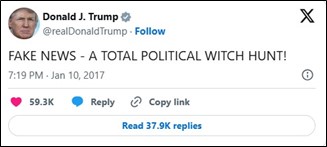
On January 10, 2017, ten days before Donald Trump’s inauguration as the 45th President of the United States, BuzzFeed News published an unverified, salacious dossier compiled by Christopher Steele, a former British intelligence officer, suggesting that Russia had compromising evidence on the future President.

The dossier’s claims, laughable and fictional to any objective reporter, included graphic instances of abhorrent sexual behavior and treasonous activity. BuzzFeed supposedly attempted to verify or falsify any of the claims but was unable to do so. They published the dossier anyway.

On January 5, 2017, U.S. Intelligence, including James Comey, John Brennan, Mike Rogers, and James Clapper, briefed Obama on the contents of the dossier. The next day, likely on Obama’s orders, the same intelligence chiefs briefed Trump in New York. Trump later claimed that he thought the intelligence chiefs, mainly Comey, were trying to blackmail him. Comey knew at the time that the Democrats had funded the dossier but felt that information was immaterial to the discussion with Trump.

After much gnashing of teeth and rending of clothes concerning Trump’s alleged misdeeds by the mainstream media, it eventually came out that the Steele dossier was a complete fiction, although Steele to this day maintains its accuracy. It was bought and paid for by the 2016 Hillary Clinton presidential campaign and the Democratic National Committee. The dossier funding was brokered by the Democratic lawyer Marc Elias, who at the time was working for the Clinton campaign, through the law firm Perkins Coie. This firm then hired Fusion GPS, which in turn hired Christopher Steele to compile the dossier.

After the BuzzFeed publication, Trump responded a few hours later on X as shown in the attached graphic, calling it nothing but fake news.

Trivia: In May 2024, Vivek Ramaswamy paid $3.3 million for a small interest in BuzzFeed, attempting to steer its content to the right. His interest is too small to affect any change.

Source: These Reports Allege Trump Has Deep Ties to Russia by Bensinger, Elder, and Schoofs, 10 January 2017, BuzzFeed. Graphic: X Response from Trump, 2017.
Who Knew

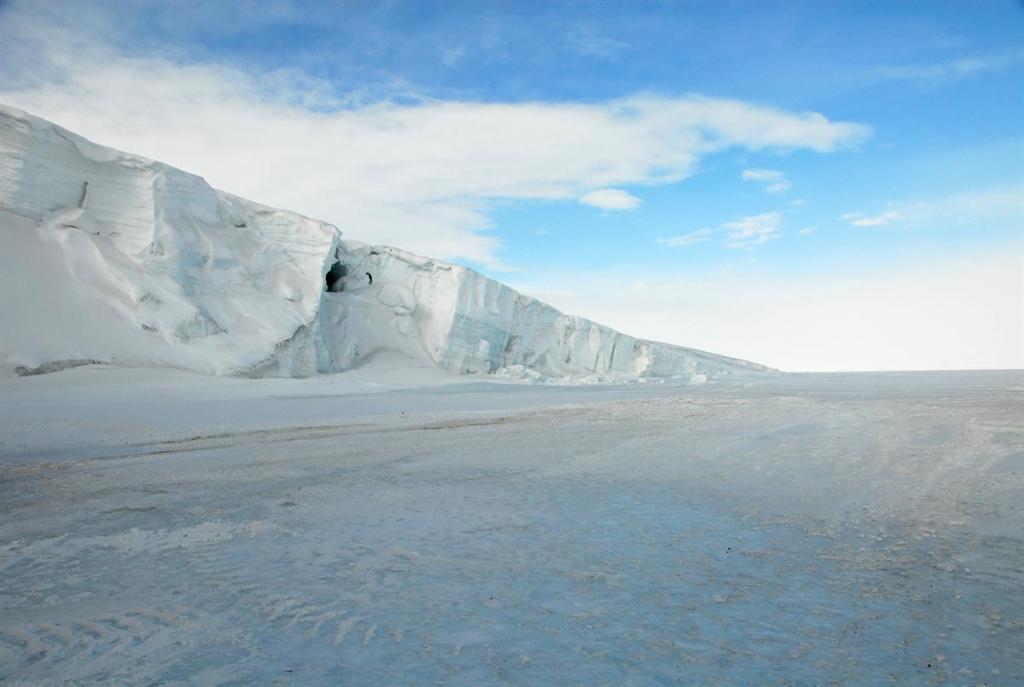
Researchers from the University of Birmingham and two other UK schools provide long-suspected evidence that glaciers near volcanoes move along the surface approximately 50% quicker than the average glacier.

The researchers write in the journal Communications Earth & Environment that, “Specifically, proximity to volcanoes most likely means higher volcanic geothermal flux or heat, which in turn triggers enhanced subglacial melt, increased basal water pressures, sliding, and ice flow.” In other words, a thin layer of water between the glacier and the warm ground acts as a lubricant, allowing the glacier to move faster.

The authors of the paper believe that monitoring the velocity of glaciers would prove to be a useful tool to assess imminent volcanic hazards. Left unsaid in the paper is that increased movement of glaciers may point to a natural process that is not related to climate change.

Trivia: One percent of the planet’s 214,086 glaciers are found within 3 miles (5 km) of an active volcano.

Source: Proximity to Active Volcanoes Enhances Glacier Velocity by Mallalieu et al, CE&E 2024.  Graphic: Antarctic Glacier.