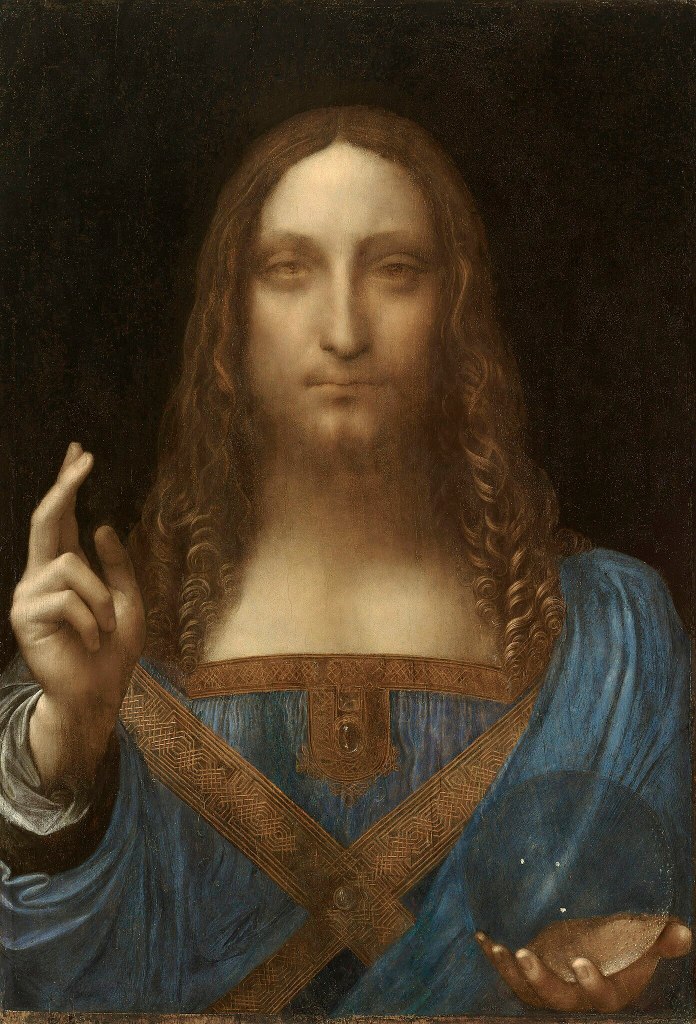
Salvator Mundi, Savior of the World, is believed to have been painted by Leonardo da Vinci sometime between 1499 and 1510 which is considered by historians to be the beginning of the High Renaissance period. The painting was supposedly commissioned by King Louis XII of France and was later recorded in the possession of the English Kings Charles I and II. How the English acquired the painting is unknown. It was then passed onto the Duke of Buckingham in the 1600s after which his son sold it in 1763. The painting then disappeared for 137 years.
It reappeared in 1900, changing hands a few times without anyone realizing it may be an authentic Leonardo. In 2005 a consortium of art dealers and collectors purchased it with the intent to have it cleaned and restored all the while attempting to prove that it was indeed a Leonardo painting. In 2013 most experts agreed that it was an authentic Leonardo allowing it to be sold for $80 million to Swiss art dealer Yves Bouvier which he quickly resold to the Russian Rybolovlev for $127.5 million. This sale quickly became a legal mess with the resolution not entirely clear.
Somehow the legal issues resolved themselves and the painting came to market again in 2017 selling for $450.3 million, making it the most expensive painting ever sold. After much wild and erroneous speculation, it was revealed that Abu Dhabi’s Department of Culture and Tourism bought the painting. It is currently in storage awaiting the completion of the Louvre Abu Dhabi in the United Arab Emirates.
In 2020 the experts have struck again and attribution of the painting to Leonardo is in doubt. Experience says this debate will continue ad infinitum. Meanwhile an extremely expensive art piece supposedly by a gay painter of Jesus Christ resides in the Arab Middle East.
Sources: Leonardo da Vinci by Walter Isaacson published in 2017. Salvator Mundi by Christies published in 2017. Salvator Mundi by ArtNet published in 2020.
It was the year without summer. During the year 1816, temperatures in Europe were the coldest of any recorded between 1766 and 2000. Across the pond in New England frost occurred every month of the year and six inches of snow fell in June. Crops failed, food was scarce, and people died unpleasantly premature.
There was no summer that year because in 1815 the Indonesian volcano, Mount Tambora, had a fit and blew its top, more or less straight up into the stratosphere. The amount of material injected into the upper atmosphere blocked the sunlight and caused global cooling.
Meanwhile, not to let bad weather forestall important matters, Lord Bryon while vacationing in Geneva, challenged his two companions, Percy Shelly, and Mary Godwin, the soon to be Mary Shelly, to a contest of who could write the best ghost story. Lord Bryon and Percy soon abandoned the project, but Mary persevered and published her Frankenstein two years later, giving birth to the monster with no name, countless movies, myths, legends, and frightful nights for children everywhere.
In the tenth chapter of her epistolary novel, Frankenstein, or The Modern Prometheus, we finally meet her fictional monster to learn not only that it lives, but it also speaks grammatically correct King’s English. Shelly cast her monster as Lucifer from the pages of Milton’s Paradise Lost. The monster, addressing its creator, Victor Frankenstein, speaks of profound loneliness, “The fallen angel becomes a malignant devil. Yet even that enemy of God and man had friends and associates in his desolation; I am alone.”
In the end the monster wishes to die but the author leaves those matters in the reader’s hands.
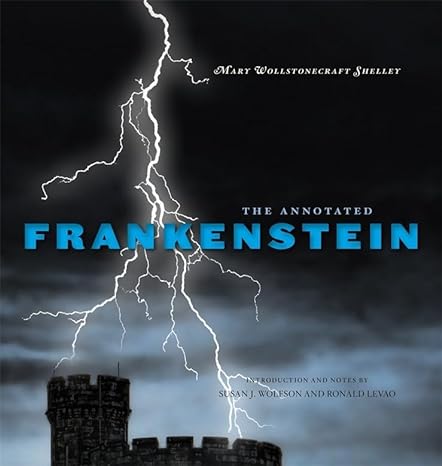
Sources Frankenstein by Mary Shelly. First published in 1818. The 100 Greatest Literary Characters by Plath et al, published 2019. Cover from a 2012 edition of Frankenstein shown below.
Directed by: Denny Tedesco (Son of 1960s session musician Tommy Tedesco)
Music by: Everyone
Cast: James Taylor, Carole King, David Crosby, Keith Richards, Linda Ronstadt, Jackson Browne, Don Henley, Stevie Nicks, Warren Zevon, Phil Collins, Lyle Lovett, Steve Jordan, Neil Young, plus the band
Film Locations: USA
Budget: –
Worldwide Box Office: $66,100
Some of the greatest rock and pop session and touring musicians ever come together after 50 years of playing for others to play as family. The Immediate Family is Danny Kortchmar on guitar and vocals, Russ Kunkel on drums, Steve Postell on guitar and vocals, Leland Sklar on bass, and Waddy Wachtel on guitar and vocals.
This documentary follows the musicians from their beginnings in the 1970s as studio musicians that decided to take their talent on the road. In the past the studio guys backed the stars and helped them get their music to the market and that was it. Studio guys didn’t go on the road because when they got back someone else would have taken their job. Going on tour is something session musicians just didn’t do until Danny, Russ, Steve, Leland, and Waddy came along. They were so good that the artists asked for them and the studios went out and brought them in.
They have just released their second studio album, Skin In the Game, on 16 February 2024 through Quarto Valley Records. Skin in the Game weighs in with 14 tracks, 13 originals plus a cover by the Sparks’: “The Toughest Girl in Town”. It is a wonderful addition to their first eponymous named album/EP.
If you followed rock and pop through the seventies and onward you heard these guys play, you just may not have known who they were; until now.
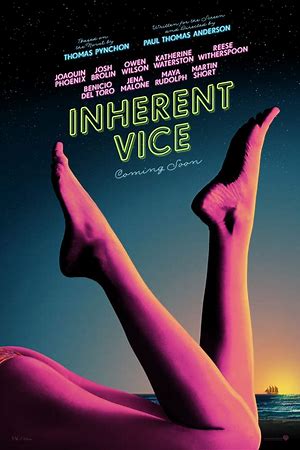
While waiting for Dune Part 2 I’ve been catching up on Josh Brolin movies. This is a don’t blink movie. There are enough jigsaw pieces to the plot that it takes almost till the end of the movie to put all the pieces back together and it is likely that a few pieces will remain hidden under the table, because well, you blinked.
Plot synopsis: Chinatown meets Big Lebowski. Inherent Vice comes in third.
Definition of Inherent Vice for the curious:
Inherent vice, aka a latent defect, refers to a natural characteristic of goods or property that can cause them to deteriorate, become damaged, or spoil. Insurance companies typically exclude coverage for losses resulting from this inherent quality or defect. Here are some examples where an inherent vice exclusion would apply:
Books: If books deteriorate due to acid in the paper from the manufacturing process.
Film: When film deteriorates over time due to instability of the chemicals it contains.
Food: If food deteriorates due to improper storage temperatures.
Grain: Spontaneous fermentation or combustion of improperly dried grain.
In essence, inherent vice is a hidden flaw or characteristic that makes the item an unacceptable risk for carriers or insurers. It is usually an insurance exclusion for marine policies.
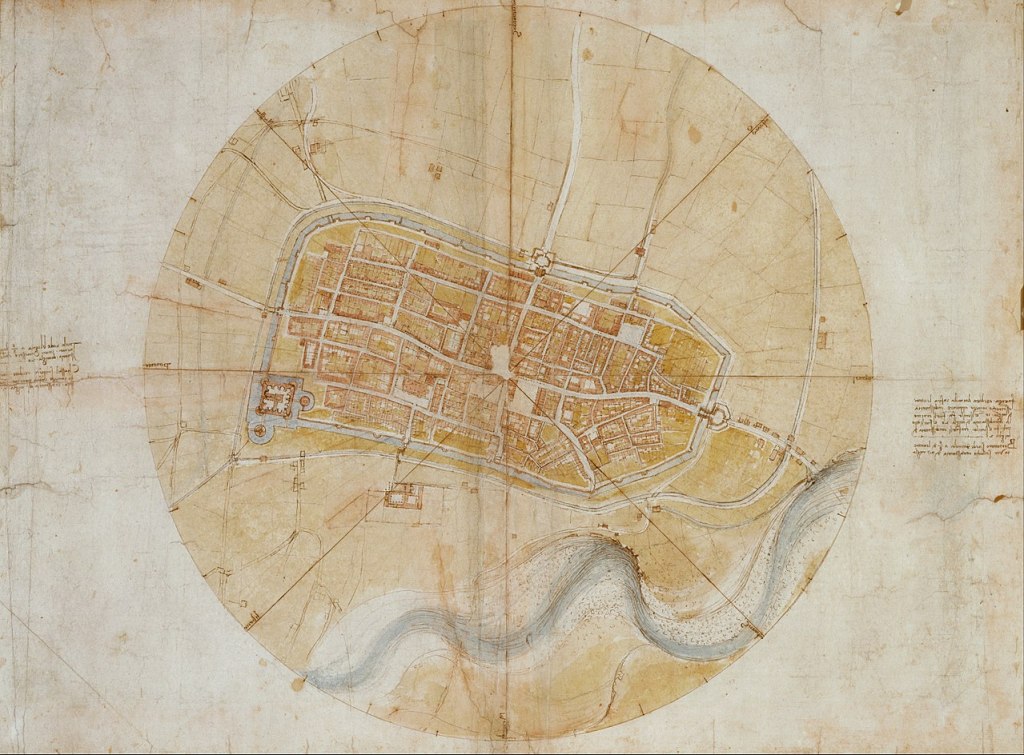
Leonardo, dreamer, artist, and scientist; Cesare Borgia, Cardinal, murderer, duplicitous tyrant; and likely subject of Niccolo Machiavelli’s book: The Prince, were holed up together for three months during the Renaissance winter of 1502-1503 in the five blocks by eight blocks Italian walled garrison town of Imola.
According to Walter Isaacson in his 2017 “Leonardo da Vinci” biography he states that, “While he was in Imola with Machiavelli and Borgia, Leonardo made what may be his greatest contribution to the art of war. It is a map of Imola… It is a work of beauty, innovative style, and military utility…Drawn in ink with colored washes and black chalk… The aerial view is from directly overhead, unlike most maps of the time. On the edges he specified the distances to nearby towns, useful information for military campaigns…”
Cesare Borgia (1475-1507), backed by his father Pope Alexander VI, was on a military campaign to carve out his own personal princedom, by hook, crook or force. He had moved his court to Imola to further plans for his conquest of the area. Leonardo da Vinci (1452-1519) was there because he had signed on as Borgia’s chief military engineer. Leonardo’s task was to reinforce castles and defenses in the region and construct new military machines based on his notebook designs such as his rapid-fire projectile weapon, armored car, helicopter, and giant crossbows; none of which were ever built in his lifetime. Niccolo Machiavelli (1469-1527), was dispatched by the Florentine authorities as a diplomat to discern Borgia’s intentions towards the city and dissuade him, if possible, from attacking Florence.
As an aside, Friedrich Nietzsche (1844-1900), German philosopher and critic, introduced the concept of Ubermensch: an idealized individual who transcends conventional morality and societal norms. Nietzsche elevated Borgia to this lofty status. Borgia’s daring, ruthlessness, and strategic cunning seemed to align with the philosopher’s ideals of a powerful individual who creates his own fate. Many have split hairs with Nietzsche’s concept of Ubermensch but when one creates his own morality it is hard to distinguish the end result from that of a psychopath.
Shown above is Leonardo’s map of Imola drawn in 1502-03. Public domain.
Shown above right is a Friedrich Nietzsche, circa 1975. Photo by Friedrich Hartmann. Public domain.
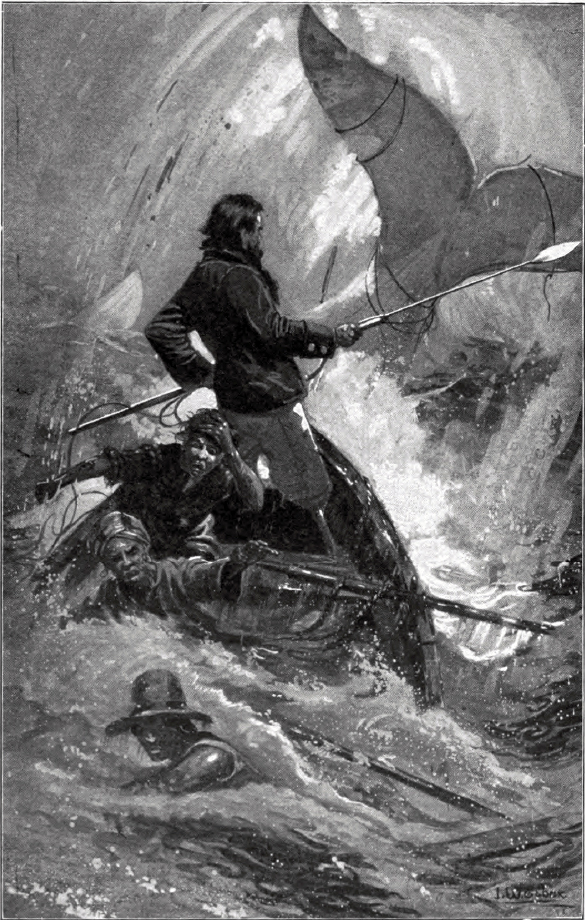
“I’ll chase him round Good Hope, and round the Horn, and round the Norway Maelstrom, and round perdition’s flames before I give him up.” – From Chapter 36-The Quarter-Deck of Melville’s Moby Dick. Published 1851.
FootNoteA
“Some know him by his peg leg…Others by the white scar that runs head to toe, the result of an unfortunate encounter witha lightning bolt. Still others by his entourage of harpooner henchmen with names like Fedallah, Daggoo, Tashtego, and Queequeq.
Mostly, readers know him because he’s shorthand for any intense, self-destructive fixation…
He, of course, is Captain Ahab…”
Excerpt from “The 100 Greatest Literary Characters”. By Plath, Sinclair, and Curnutt. 2019.
FootNoteB:
The book also has one of the great opening lines in all of literature: “Call me Ishmael.” The narrator introduces himself to the reader in three words. How simple and straightforward can one get? In a few more lines he sets the stage for how he will tell his story. “With a philosophical flourish Cato throws himself upon his sword: I quietly take to the ship.”
FootNoteA: Illustration of the final chase of Moby-Dick. By I.W. Taber. 1902. In Moby-Dick. Charles Scribner’s Sons, New York. Public Domain.
FootNoteB: Illustration below from an early edition of Moby Dick – 1892. C.H. Simonds Co. Public Domain.
Weather and climate are often confused as being the same, but they are definitely not the same. Weather is what you worry about when you’re planning a trip to the beach or a hike in the mountains. Weather patterns occur for a few days, a few weeks, maybe even for a few years then those patterns dissipate, and everything reverts to the mean. The 1930s, in the plain states of North America, experienced a prolonged drought, hot temperatures, and high winds, putting dirt into everything everywhere. These conditions lasted about a decade then the weather returned to what most would call normal conditions. Exceptionally cold winters show up every 20-40 years, lasting until you finally decide to move to Florida and then they’re over.
The point is that weather events can set temperature and precipitation records for that day or that year but then it all settles down with a retreat from the extremes back to normal conditions. This is not a change in climate, just a change in the weather.
Climate is a long-term event that has a period of at least 30 years and usually a lot longer and the changes tend to last for 100s of years. Climate is something you shouldn’t worry about. It may impact your grandchildren or great grandchildren, but you are going to live out your life in blissful happiness of carping about the rainstorm ruining your tennis game and succulents, but it will not be an end of life as you know it or your life, or your neighbor’s life, just another day riding out the storm. Then it’s gone.
When the climate does change volcanoes seem to have an overwhelming part to play in initiating the change. To cause climate change really big explosive volcanos are needed, not the run of the mill Mt. St. Helens or Mt. Pinatubo variety. They were spectacular for sure, and they did drop the temperatures for a year or two, but they were not climate changing volcanoes. On the Volcanic Explosive Index scaled from 1-8, 8 being an absolute monster, Mt. St. Helen and Mt. Pinatubo were mere kiddies throwing tantrums, only VEI 5 and 6s, respectively. Big but the grownups just smile at their antics.
Climate changing volcanoes need to be rated in the 7 and 8 categories. These VEI 7 and 8 volcanoes eject 100-1000s of cubic kilometers of material into the troposphere and stratosphere affecting climate for 100s or years. One VEI 8 volcano can likely initiate global cooling by itself, but VEI 7 volcanic eruptions will likely need an assist from several smaller volcanic eruptions to affect climate change. There have been no VEI 8 volcanoes in the Holocene and only 4 VEI 7 volcanoes have erupted in the last 10,000 years: Mazama 5700 BC, Kikai 4300 BC, Samala 1257 AD, and Tambora 1815 AD.
Tambora cooled the Earth by about 5.5 degrees Fahrenheit and led to a year without summer in 1816. This year was also referred to as “Eighteen Hundred and Froze to Death” and the “Poverty Year” because of the extreme weather conditions. In New England, for instance, six inches of snow fell in June and every month of the year had a hard frost. These conditions led to hoarding and significant price increases for agricultural commodities, causing many people to go hungry. It is estimated that tens of millions of lives were lost to the volcano, either directly from the explosion or indirectly from starvation due to crop failures and disease. Tambora was a massive volcano but even it by itself was insufficient to cause any lasting climate change. A few years after Tambora or for that matter, Mazama and Kikai, the weather returned to normal. Samala is a different matter and it’s discussed below.
Be happy, don’t worry. Below are some examples of when the climate really did change and luckily for us, we are not due for anything life changing for a few hundred more years.
Pre-Holocene andHolocene Climate Changes:
FootNoteA
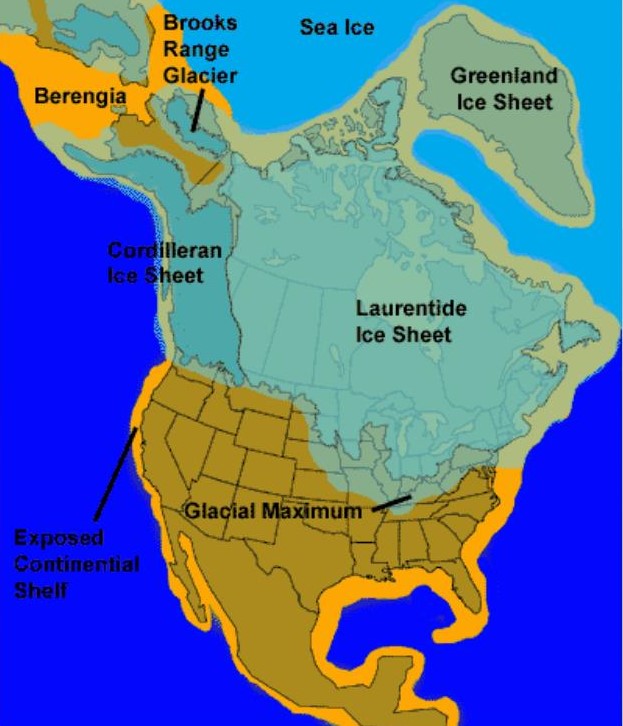
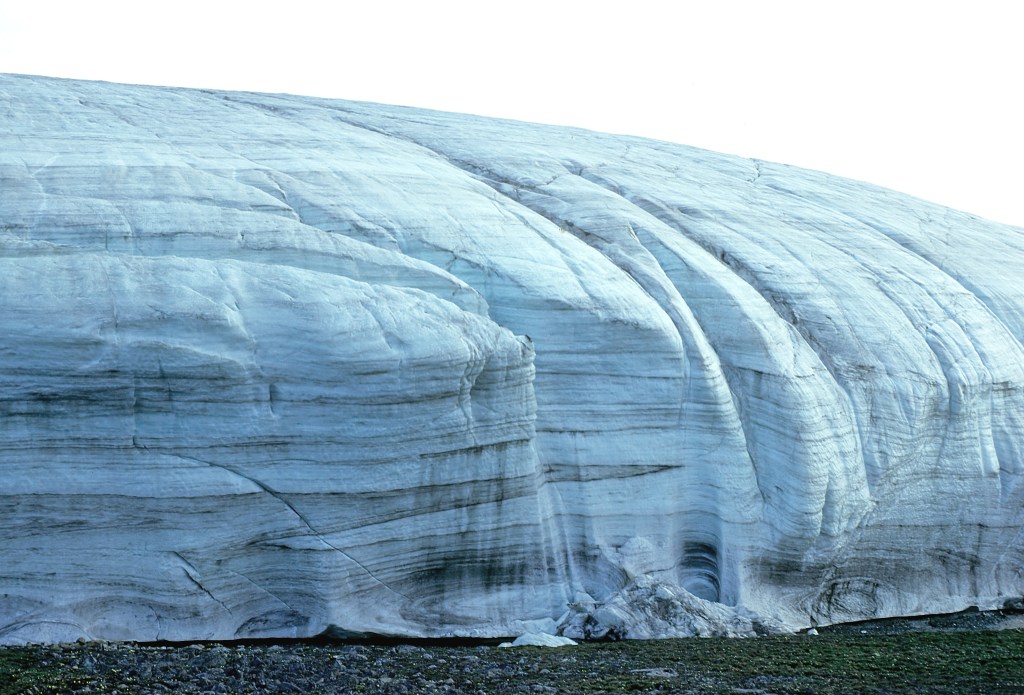
The Wisconsin glaciation, North America’s last occurrence of continental glaciers, began between about 100,000 and 75,000 years ago and ended about 11,000 years ago. At its peak, the ice sheets, in places almost 2 miles thick, covered most of Canada, the Upper Midwest, and New England, as well as parts of Idaho, Montana, and Washington. The Cordilleran Ice Sheet, which covered the area between the Rocky Mountains and the Pacific coast, had expanded south as far as the state of Washington. The Laurentide Ice Sheet, which covered the eastern four-fifths of the continent, had advanced as far as southeastern South Dakota, northern Iowa, central Illinois, Indiana, Ohio, and northern Pennsylvania and New Jersey. The Earth’s tilt is one of the likely contenders for the formation of Wisconsinian glaciers although some speculate it may have been due to a decrease in CO2.
The Last Glacial Maximum, LGM, the greatest extent of the Wisconsinan ice sheets, occurred approximately from 26,000-20,000 years ago. The beginning of the end of the LGM in the northern hemisphere commenced around 20,000-19,000 years ago with the West Antarctica ice sheet starting to decline in size around 15,000-14,000 years ago. The West Antarctica melting of the glaciers led to a rise in the sea levels of approximately fifty feet in three hundred years. The current rate of sea level rise is approximately 14 inches per 100 years. The seas from 14,000-6500 years ago rose 360 feet due to world-wide melting of the Wisconsinian aged glaciers. The melting of glaciers from the LGM is attributed to changes in the Earth’s orbit or more solar energy hitting the northern hemisphere, along with the rise in CO2 which came from the overturning of the deep waters in the Southern Ocean.
FootNoteB
The Younger Dryas period saw a return to glacial conditions approximately 12,900-11,700 years ago. During this time, temperatures fell 7-18 degrees Fahrenheit, with this drop occurring within one hundred years; overnight in geological time. There is no consensus on the cause of this return to glacial conditions but two of the leading contenders are enormous amounts of fresh water from melting glaciers mixing with the sea water causing the ocean currents to slow down, leading to a cooler Europe and North America along with increased Arctic Sea ice. It is also believed that increased fresh water into the seas can also cause warming, so scratch your head and buyer beware. The other possibility is increased volcanic activity.
FootNoteC
The Neoglacial Period occurred about five thousand years ago, around the time of the beginning of the Early Dynastic Period in Egypt and continued until the medieval warm period. During this period glaciers advanced globally. Temperatures were thought to be about 0.5-degree Fahrenheit cooler than today. The 26,000-year Milankovitch cycle is thought to be the cause of cooling. This cycle affects the tilt of the Earth and thus the amount of sunlight reaching the planet’s poles.
The Medieval Warm Period (MWP) or the Medieval Climate Optimum or the Medieval Climatic Anomaly, occurred from approximately 950-1250 AD. It is predominately a Northern Hemispheric event that raised temperatures 3- or 4-degrees Fahrenheit. Europe during this period reported alpine tree lines rising in elevation and increased crop yields. Why MWP occurred is poorly understood and potential causes include increased solar activity and or reduced volcanic activity. This period was followed almost immediately by the Little Ice Age.
The Little Ice Age was a time of regional cooling beginning in the 14th century and continuing into the mid-19th century or 1300-1850. Evidence from glacial advances throughout the world suggests that the cooling did not occur at the same time everywhere. The cooling is estimated to have been 2-3.5 degrees Fahrenheit lower than present temperatures. Various theories have been brought forward for why the temperatures dropped during this period but heightened volcanic activity is the favored cause. On the island of Lombok in Indonesia in 1257 the volcano Samalas erupted with a VEI of 7, making it one of the largest volcanic explosions in the last 10,000 years. Before and after Samala erupted another three smaller volcanic eruptions in 1230, 1276, and 1286 followed suit which likely led to increased cooling due to excessive volcanic material in the troposphere and stratosphere. These smaller eruptions are inferred from other data, but the exact volcanoes are unknown.
The Modern Warm Period followed the Little Ice Age, and the Earth is still in the midst of this climate period.
The United States Air Force commissioned the Massachusetts Institute of Technology’s Lincoln Laboratory to design and build a series of satellites, known as Lincoln Experimental Satellite (LES), that would test both devices and techniques for satellite communication. The stated goal was to increase the downlink transmission capabilities of small satellites. The development phase of the program ran from 1965 to 1976 but the last satellite developed, LES-9, continued to transmit data for 44 years until it was decommissioned in the year 2020.
FootnoteA
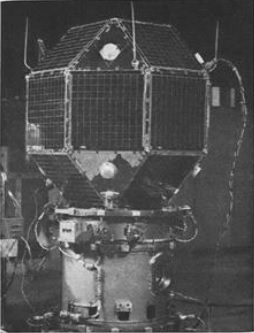
The first satellite the Lincoln Laboratory developed was the LES-1. It was designed to test a solid-state X-band transmitter while in orbit above the Earth. A ground-based mobile receiver was also part of the test package.
The LES-1 was a 26-sided polyhedron, with eighteen square faces and eight triangular faces. Also known as a rhombicuboctahedron, a small rhombicuboctahedron, or an Archimedean solid, if you really must know. It had a diameter of 61 cm (24 inches) and a mass of 31 kg (68 lbs.). The square faces were covered with 2,376 solar cells generating a minimum of 26 W in sunlight. The eight triangular faces held Earth and Sun sensors and eight semi-directional horn antennas.
FootNoteB
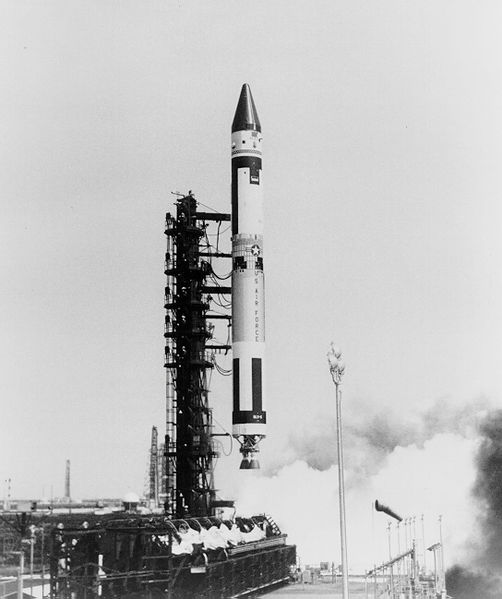
The satellite was launched on a Titan 3A rocket which was a modified two-stage Titan 2 ICBM with a third stage added. The rocket lifted off from Kennedy Space Center on 11 February 1965 and the first two stages performed their mission successfully. The third stage after its first burn placed the satellite into its planned 185-kilometer (115 mile) orbit. The second burn of the third stage moved the satellite into a 2,777 by 2806 kilometer (1726 by 1744 miles) slightly elliptical orbit. At this point, the satellite was deployed with a destination of 18,500-kilometer (11495 mile) apogee orbit. Because of a malfunction the smaller attached satellite rocket didn’t fire, and the satellite remained in its 2,777-kilometer orbit. Despite this failure, the project was still able to collect some useful data, but the satellite was spinning out of control making continued operations difficult. The LES 1 was shut down in 1967.
On 18 December 2012, the satellite woke up after 46 years of silence. A signal from LES 1 was detected in North Cornwall, England by an amateur radio operator. It is believed that a short developed in the satellite which allowed its power system to reach the transmitter directly. The signal being transmitted is believed to be a test tone but because the satellite is tumbling it sounds ghostly and garbled.
As of 2022 the satellite is still transmitting. It is now referred to as a zombie satellite.
“At the end of the day, I’m fighting for the things I said I’d fight for.” – Ron DeSantis
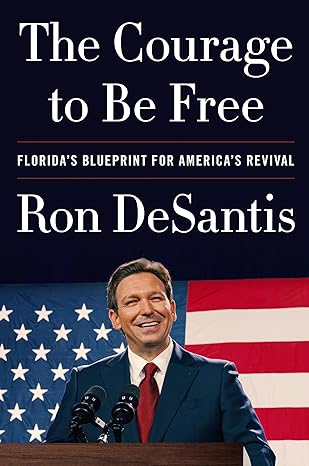
Courage to Be Free is the Florida governor’s biography with a good measure of politics, vision and American government thrown in. It’s a simple read from someone selling himself as an authentic American and an honest and ethical broker who supports the citizens through good government.
Ron Desantis was born in Jacksonville, Florida in 1978, married Casey Black in 2009, and has three children, two girls and a boy. He attended Yale and graduated in 2001 with a B.A. A year later he entered Harvard and graduated with a law degree in 2005. During law school he was commissioned as an officer in the U.S. Navy. In 2007 he was assigned as a legal advisor to SEAL Team One in Fallujah, Iraq where he was awarded the Bronze Star.
In 2012 he was elected to the U.S. House of Representatives and was re-elected in 2014 and 2016. DeSantis decided not to run for re-election to the House for the 2018 term but instead competed for the Florida governorship which he won. He won re-election in 2022 and as he is term limited by Florida law will not seek that office in 2024. Since he has dropped out of the Presidential race what he does next is an open question.
The first half of Desantis’ book is dedicated to his biography followed by his vision of government and national policy. He draws heavily on the expository essays and articles within the Federalist Papers and their vision for a constitutional republic. The authors of the Federalist Papers, Madison, Hamilton, and Jay argue strenuously for a republican form of government and against direct democracy which one could paraphrase in slang terms as mob rule. DeSantis agrees.
His political philosophy is simple in principle, excoriatingly difficult in execution. Encapsulating his thoughts he states, “The right path forward is not difficult to identify; it just requires using basic common sense and applying core American values…” He follows this up with his blueprint for Florida and America: “Be willing to lead, have the courage of your convictions, deliver for your constituents, and reap the political rewards.” Reaping the political rewards sounds like every politician that has ever walked the face of this Earth and I don’t recognize that as a positive trait.
Literary Criticism:
Courage to Be Free was a number one bestseller in the New York Times, Wallstreet Journal, Amazon, and Publisher’s Weekly shortly after it was released in 2023. Although sales figures are almost impossible to find, for free, the book had an initial print run of 250,000. There hasn’t been a second printing.
Hagiographies are one sided affairs with nary a discouraging word to be found, with sainthood lurking right around the corner. DeSantis autobiography is a hagiography but in fairness one doesn’t provide his opposition with free negative research when your goal is to introduce yourself to the public.
This book had only one purpose, to launch DeSantis into the 2024 presidential Republican primary in the best possible light and as a bonus, get your targeted audience to pay for it by purchasing the book. It admirably accomplishes the task, but it certainly is not a literary masterpiece, rather it reads like a college term paper completed under duress. Simple, direct, with no flowery prose or memorable lines. If you want to learn something about this man, give it perusal, a quick read is all it needs and watch one or two of his Republican primary debates for additional elucidation.
The only reason I read this book was because of the title: The Courage to Be Free. It reminded me of the title of John F. Kennedy’s Profiles in Courage. Kennedy’s book employs a better writing style but that is because Kennedy didn’t author his book. In a previous post I stated who did and I’ll leave it to you to look it up if you are curious. In the end both are about embellishing their respective reputations. Mission accomplished.
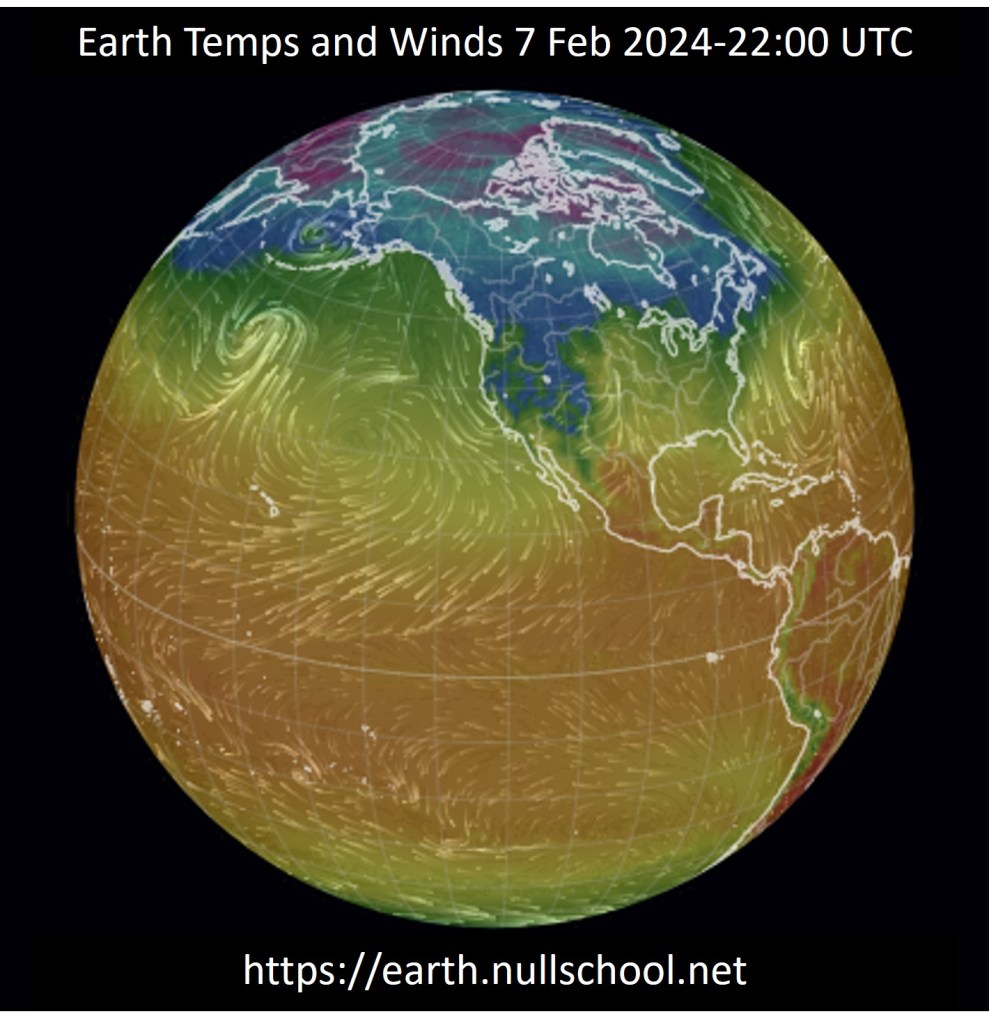
The northern great plains of the U.S. experienced an exceptionally mild 2023-2024 winter, about 10 degrees Fahrenheit above normal, due to the onset of a strong El Nino event, now called a Super El Nino by some. As is shown below, this categorization as super is overstated. Hyperbole by the press is a bad habit they just can’t seem to break.
National Geographic defines an El Nino, along with its sister event, La Nina as, “…a climate pattern that describes the unusual warming of surface waters in the eastern equatorial Pacific Ocean. El Nino is the “warm phase” of a larger phenomenon called the El Nino-Southern Oscillation (ENSO). La Nina, the “cool phase” of ENSO, is a pattern that describes the unusual cooling of the region’s surface waters. El Nino and La Nina (EN) are considered the ocean part of ENSO, while the Southern Oscillation (SO) is its atmospheric changes.”
El Nino events last from 9-12 months on average with a rare occurrence lasting up to 18 months. La Nina events can endure for longer periods than El Ninos with some lasting up to 24 months. Both weather events reoccur every 2-7 years for reasons unknown but may be, and this is stretch on my part, related to polar and core wobbles. Earth’s axis experiences two discrete periodic oscillations; the 14 month Chandler Wobble and a 12 month wobble. These two wobbles cause the poles to trace a spiral path over about 6.5 years. Earth’s inner core mysteriously wobbles with a periodicity of approximately 8.5 years. The combination of these wobbles may help explain the peridicity of ENSO weather events.
The National Oceanic and Atmospheric Administration states: “El Nino usually causes increased rainfall and sometimes destructive flooding. La Nina, however, usually causes drier weather in the South, but the Northwest tends to be colder and wetter than average. Even though El Nino occurs in the Pacific Ocean, it often reduces the number of hurricanes that form in the Atlantic Ocean. Conversely, La Nina events tend to be related to an increase in the number of Atlantic hurricanes.”
Hurricanes in the Atlantic Basin occur less often, supposedly, during El Nino than La Nina. This is because there is less vertical wind shear in the troposphere during a La Nina than an El Nino. Wind shear tears hurricanes apart while the lack of wind shear allows hurricanes to form and intensify. Wind shear in the troposphere develops due to pressure gradients which in turn are caused by temperature contrasts between the ocean surface and high-altitude tropospheric air. During El Nino warm ocean surface waters create a greater contrast with the high-altitude cool troposphere air than the cooler La Nina ocean surface waters do. Wind shear lessens when the temperature contrast decreases between the ocean surface and higher altitudes. When ocean temperatures are higher, wind shear is greater resulting in fewer hurricanes. With lower ocean temperatures, wind shear is less resulting in more hurricanes.
This is the theory, whereas actual hurricanes making landfall appear to increase in numbers after weak to moderate El Ninos rather than strong ones. There doesn’t appear to be any correlation between strong El Ninos and increases in hurricanes making landfall during the subsequent La Nina events.
This year’s El Nino was driven by a larger than normal spike in Pacific Ocean temperatures that were about 0.5-degree Fahrenheit above 2022 temperatures. This is considered an exceptionally large increase. This has led to warmer, dryer winters in the upper mid-western states of the U.S. along with greater precipitation in the western U.S.
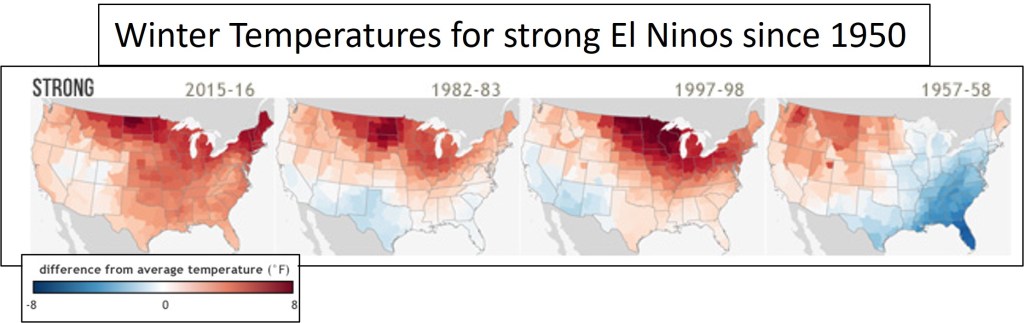
The graph below, from NOAA Climate.gov, shows the change in average winter temperatures during strong El Ninos since 1950. In northeastern North Dakota during the 2023-2024 winter, from the months December to February, temperatures are about 10 degrees warmer on average than the previous year’s winter temperatures. This increase is similar to what was experienced in the 1997-1998 El Nino.
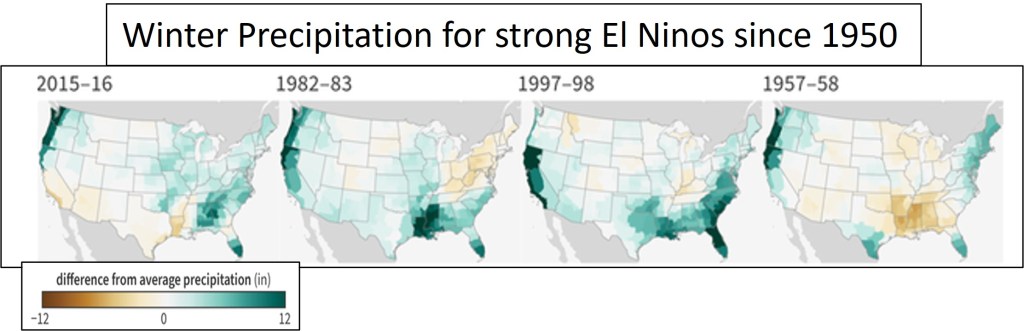
The graph below, again from NOAA Climate.gov, shows winter precipitation during strong El Ninos since 1950. In Long Beach, California the 1997-1998 winter brought 17.77 inches of rain whereas the winter of 2023-2024 has already brought 13.88 inches of rain with 19 days left in the month of February to add to that total. This year’s winter precipitation in Long Beach should be similar to what occurred in the 1997-1998 winter season.
The winter that is occurring in northeastern North Dakota is like what happened temperature-wise 26 years ago during the 1997-1998 winter. Similarly, in Long Beach California the El Nino induced precipitation is likely to be about the same as the totals for this same El Nino event.
In conclusion the strong El Nino of 2022-2023 is a carbon copy of the strong El Nino that occurred 26 years ago during the winter of 1997-1998. The end of 1997-1998 El Nino was followed by seven hurricanes making landfall during the 1999 season suggesting the 2024 season should see about the same number of hurricanes making landfall.






 elsToday