Mamma Mia

Bohemian Rhapsody” was the eleventh track, and the first single released from Queen’s 1975 album, A Night at the Opera. Written by Freddie Mercury, the song has become the band’s signature tune and is hailed as one of the greatest rock songs ever recorded. Initially, critics were unsure what to make of the song, with some labeling it as a novelty, campy, calculated, and a brazen hodgepodge. However, they were all wrong. Rolling Stone ranked it 17th in its list of the 500 greatest songs in 2021, and Time ranked it among the top 100 songs written since 1923.

Mercury started writing the song in the 1960s, and it is a combination of three songs with multiple parts, including a cappella ballad, opera, and hard rock. This six-minute lament appeals to many, but everyone has their own interpretation of the song’s meaning. The band has never fully explained the lyrical meaning of the song, only stating that Freddie was a complicated individual with mercurial personality traits and habits. In the album’s Iranian release, it was mentioned in the liner notes that Freddie Mercury, of Indian and Persian descent, explained that ‘Bohemian Rhapsody‘ is about a young man who accidentally kills someone, makes a Faustian bargain by selling his soul to the devil, and ultimately calls upon God, Bismillah, to reclaim his soul.

Source: …Bohemian Rhapsody by Lily Rothman, Time, 2015. Graphic: Bohemian Rhapsody, Cover and Video by Queen, 2008.

Flat-Footed Clown

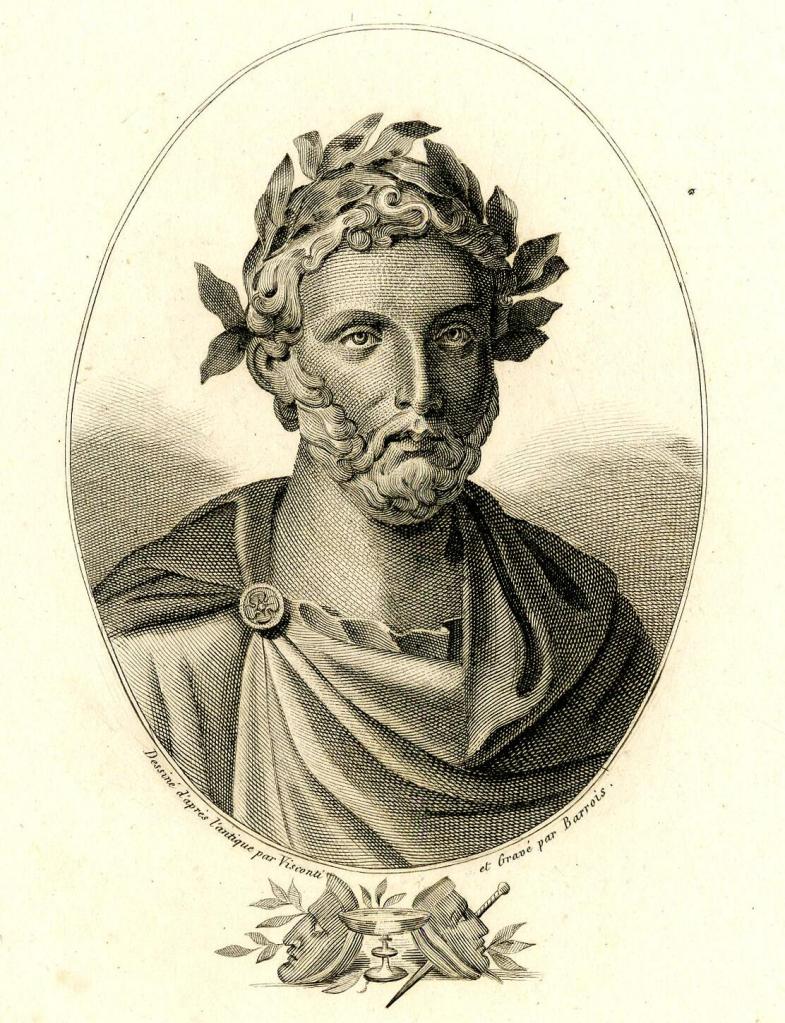
Titus Maccius Plautus was a 2nd century BC Roman playwright known for his loose translations of Greek comedies. It is known that he developed an early attachment to the theater, beginning as a stage carpenter and scene shifter, eventually progressing into acting. During this time, he adopted the nom de plume “Maccius Plautus.” “Maccius” refers to a type of clown, and “Plautus” means flat-footed or bare-footed, thus his name loosely translates to “Titus the Flat-Footed Clown.”

After making some money in the theater, Plautus left the profession, only to lose all his money, forcing him to seek employment in a grain mill. Mill work in ancient Rome was usually reserved for slaves and mules, making it a humiliating job for a free person. However, the drudgery likely provided the motivation for his translation and repurposing of Greek comedies for the Roman audience.

The grind of mill work finds a voice in his plays. Wolfgang De Milo, the current editor and translator of Plautus’s plays for the Loeb Classical Library, states that his plays “…abound in young men doing business abroad and slaves being threatened with being sent to the mill.” While his plays were not strictly original, Plautus incorporated his Italian heritage and customs into his translations of Greek plays, thus making them his own.

Plautus borrowed Greek themes and infused them with his witty take on gods, family, love, money, and immorality. Like the old comedy Greek playwrights, he mocked everything for laughs and urged people to lighten up. His enduring popularity shows that his humor remains timeless and relevant.

Source: Plautus I edited and translated by Wolfgang De Milo, 2011. Graphic: Plautus engraving by Pierre Barrois, 1770, Public Domain

Looking In All the Wrong Places

Johnny Lee’s 1980 recording of “Lookin’ for Love” in all the wrong places is a mantra that most scientists and engineers eventually learn. Not love, but when confronted with the conundrum of not finding an object where it should be, the first response, before questioning the theory, is to look elsewhere.

This is further encapsulated in Arthur Conan Doyle’s “Fate of the Evangeline” when Holmes quips, “Exclude the impossible and what is left, however improbable, must be the truth.”

Recent research suggests that Earth and Mars originally had higher concentrations of moderately volatile elements (MVEs), such as copper. These elements were likely abundant in the early formation of Earth and Mars but were depleted by violent cosmic events, such as collisions with meteorites.

These collisions during planetary formation caused large-scale vaporization, leading to the loss of these crustal sources of MVEs into space but not necessarily those present in the mantle or core. While this new understanding challenges traditional theories about why MVEs are not in higher concentrations on Earth, it may also mean that we need to look not only to space for the lost MVEs but also to other deeper and less explored crevices and crannies here on Earth.

Additional areas of exploration on Earth may include hydrothermal vents on the ocean floors, deep crustal and mantle areas, tectonic boundaries, and active volcanic provinces.

Source: …Earth’s Missing Elements by Kim Baptista ASU, 2025. Lookin’ for Love written by Morrison, Ryan, and Mallette. Graphic: Earth Collision, Grok, 2025.

The Legacy of John Locke

The English Bill of Rights was signed into law on 13 February 1689, creating the constitutional monarchy that still exists today, albeit with the monarchy reduced to a figurehead status.

The coronation of William III and Mary II was conditional on their agreeing to the terms stipulated in the Bill of Rights, which included, among others, free speech for members of Parliament, the freedom to bear arms for self-defense, freedom from cruel and unusual punishment, and the establishment of due process.

The Bill of Rights was primarily drafted by members of the English Parliament in response to the abuses of power by King James II, who was overthrown in the Glorious Revolution of 1688.

John Locke’s “Second Treatise of Government” had a significant influence on the English Bill of Rights of 1689. Locke was a proponent of natural rights, the social contract, and the separation of powers, which were foundational to the development of constitutional government. His work emphasized that government should be based on the consent of the governed and that individuals have inherent rights to life, liberty, and property.

Source: JohnLocke.net. Graphic: John Locke, 1697, Public Domain.

The Mystic

Rasputin: Dark Servant of Destiny.  Grigori Rasputin, often referred to as the “Mad Monk,” was a peasant with a fondness for madeira, cheap steaks, and prostitutes. He seemingly cured the Tsar’s son, Alexei, returning him to health by a gift from God: the power of faith.

Rasputin, living by the Russian proverb “You can’t avoid that which is meant to happen,” accepted his fate and was welcomed by the Empress and her son into the royal household with open arms. However, he was later expelled from the royal household by the Tsar and his handlers for violating another Russian proverb: “Don’t bring your own rules into someone else’s monastery.”

Rasputin: Dark Servant of Destiny, a 1996 HBO TV movie seen by almost no one, is Alan Rickman’s tour de force. It provides an exquisite emotional interpretation of religious fervor and mystical power. The film brings the myth of Rasputin into the realm of authenticity and historical plausibility.

The film recreates Rasputin’s madness amidst the early 20th-century events that predated and possibly presaged the madness of events set into motion by Lenin in 1917 (Rasputin was murdered towards the end of 1916). These events led to what Orwell succinctly summarized in “Animal Farm” when the new boss replaced the old boss: “The creatures outside looked from pig to man, and from man to pig, and from pig to man again; but already it was impossible to say which was which.

Genre: Biographical, Drama, Historical

Directed by: Uli Edel

Screenplay by: Peter Pruce

Music by: Brad Fiedel

Cast: Alan Rickman, Greta Scacchi, Ian McKellen, Freddie Finlay

Film Location: Budapest, Hungary and St. Petersburg, Russia

ElsBob: 7.0/10

IMDb: 6.9/10

Rotten Tomatoes Critics: -%

Rotten Tomatoes Popcornmeter: 79%

Metacritic Metascore: -%

Metacritic User Score: -/10

Theaters: 23 March 1996

Runtime: 135 minutes

Source: Rotten Tomatoes, IMDb. Graphic: Rasputin Movie Trailer, copyright HBO.

Red Wine Retail Prices

It is time for my yearly posting on red wine retail prices in the US. The ugly part of the post is that wine prices at the retail level have increased substantially; 5-550%, depending on vintage and rating since last year, with an average increase around 20%. The 2021-2023 vintage column for the posted spreadsheet is likely representative of reality while the other columns suffer from low sampling rates for some ratings.

A 90-point red of recent vintage has a medium price around $43. Last year that same quality wine went for about $28. These are medium values for a bottle of wine, half are less, half are more. My personal rule of thumb is that the medium value is the maximum one should pay.  Additionally, at the beginning of 2024 you could easily find a 90-point red for $10-15. You may be able to still find a 90-point red in that price range, but it will take some effort. Most 90-point reds now start at $20.

As with last year, Argentina, Chile, and Spain offer the best value in red wines while France and US tend to be priced 3 to 4 times above those from South America and the Iberian Peninsula.

Money for Nothing

In 1985 Dire Straits released their 5th studio album “Brothers in Arms”, becoming their most successful album while attaining several firsts for the band and British music. It was the first album to sell over a million CDs and the first British album to go 10x Platinum in the UK, eventually reaching 14x platinum.

The whimsical, tongue in cheek firmly planted, “Money for Nothing”, the 2nd track on “Brothers in Arms” was to become their greatest commercial success reaching No. 1 on the Billboard Hot 100 in the United States and winning the Grammy Award for Best Rock Performance by a Duo or Group with Vocal. The song’s partially animated music video was a staple on MTV when the channel focused on music videos.

Mark Knopfler got the idea from listening to hardware store employees who thought rock stars had it easy. He, however, found a successful musician’s life exhausting. In 2009, he remarked, “If anyone can tell me one good thing about fame, I’d be very interested to hear it.”

Source: PDMusic.org. Knopfler…by Ian Young, BBC, 2009. Graphic: Money for Nothing—Dire StraitsVEVO.

Love, Class, and Money

Framley Parsonage, by the Victorian author Anthony Trollope, is the fourth novel in the six-part Chronicles of Barsetshire series. This series is set in the fictional county of Barsetshire in the English countryside and details the social entwinings of the gentry, rich mercantile classes, clergy, and occasionally what we would today refer to as the comfortable middle class. The novels, which can be read in any order, revolve around themes of maintaining social status, finding love, marrying well, and money. Hypocrisy, chicanery, and snobbish attitudes often create dilemmas that Trollope, in a winding but satisfying narrative fashion, concludes as the reader wishes.

Framley Parsonage specifically details the misadventures of the amiable but horribly naive vicar, Mark Robarts, who is a boyhood friend of Lord Ludovic Lufton. Through this friendship, Ludovic’s mother, Lady Lufton, installs Robarts in the Framley Parsonage with a sufficient salary to support his young family’s basic needs. Through a misplaced sense of ambition, Robarts attempts to further his standing in life by associating with a parliament member, charlatan, and aptly named Mr. Sowerby, bringing humiliation and disgrace upon himself.

Trollope displays an absolute sense of enjoyment in writing this novel, skewering the political class with an abundance of wit and satire, along with exploring four marriage sub-plots that he resolves with appropriately deserved denouements of happiness or the lack thereof.

Source and Graphic: Framley Parsonage by Anthony Trollope, Publisher Everyman’s Library, 1994.

Exploits in Dying

Grigori Rasputin, a Russian mystic, met an inglorious, improbable, and inexplicable end in 1916 at his assassin’s Moika Palace in Saint Petersburg. Although accounts vary, Rasputin’s executioners ostensibly made multiple attempts to murder him. They began with cyanide-laced cakes, which did not achieve their desired outcome. Next, in an attempt to reach a different result with the same measures, they offered him wine fortified with more cyanide. This attained the same result as the first attempt.

Following this, they shot him multiple times, but he continued to move, eventually attacking his would-be murderers. Finally, they wrapped him up in a carpet and tossed him into a freezing river, where he supposedly died of hypothermia.

A less imaginative account of his death suggests that he died from a single bullet to the head.

Rasputin supposedly left a letter, which was read by Alexandra, the wife of Tsar Nicholas II, prophesizing that if he was killed by Russian nobles, the Russian Tsar’s family would be executed within a few years.

Source: Biography, 2021. Graphic; Rasputin, c1910, Russian Empire, public domain. 

15 Million Asteroids

How high’s the water, mama?
Two feet high and rising
How high’s the water, papa?
She said is two feet high and rising”
(Johnny Cash Five Feet High and Rising)

The early development of life on Earth relied on two essential building blocks: carbonaceous (carbon) material and water. It has long been postulated that asteroids, comets, and other planetesimals brought these ingredients to our planet. Water in meteorites existed in the form of hydrous minerals and possibly brine.

Researchers from Rutgers University, led by Professor Katherine Bermingham, studied isotopes of molybdenum from meteorites and Earth’s crust. They inferred that water arrived on Earth during its late accretion phase, around 4.1-3.8 billion years ago. The team also suggested that the water was delivered by inner solar system planetesimals such as comets and asteroids.

This is a crucial milestone in Earth’s development timeline, as there are two competing theories about when water was delivered to our planet: the Moon-Forming Event and the Late Heavy Bombardment (LHB). The Moon is believed to have formed about 4.5 billion years ago, shortly after Earth formed around 4.56 billion years ago, caused by a large object crashing into Earth. The LHB is a period of intense bombardment by planetesimals on the inner planets, occurring around 4.1-3.8 billion years ago.

An inference from the LHB is that all planets and moons existing at that time either contained or still contain water.

Trivia: Assuming the median size of planetesimals striking Earth during its early formation was around 15 kilometers (9.3 miles) with an average water content of 5% of their total volume, it would take about 15,688,960 hunks of rock to supply the current volume of water on Earth. Dividing that number by the LHB time interval of 300 million years suggests a significant impact every 227 months, or roughly every 19 years.

Source: Life-bearing Water, by Bermingham et al, Rutgers, 2025. Graphic: Comet Cometh, Grok, 2025.