Paris in the Evening

Henri Toulouse-Lautrec, born in 1864, was a unique figure among French nobility and artists. Despite his diminutive stature and aristocratic lineage tracing back to Charlemagne, Lautrec defied conventional expectations with his eccentric, mischievous character, and individualistic style. While influenced by the Impressionists, exemplified by masters like Monet and Degas, he later embraced the Post-Impressionist movement alongside Gauguin and Cézanne, leaving a distinctive mark on the art world. Post-Impressionists diverged from their predecessors by infusing their work with deeper emotion, personal experiences, and greater individualism. Their bold brushwork, exaggerated colors, and unconventional techniques laid the groundwork for the future, anticipating Expressionism.

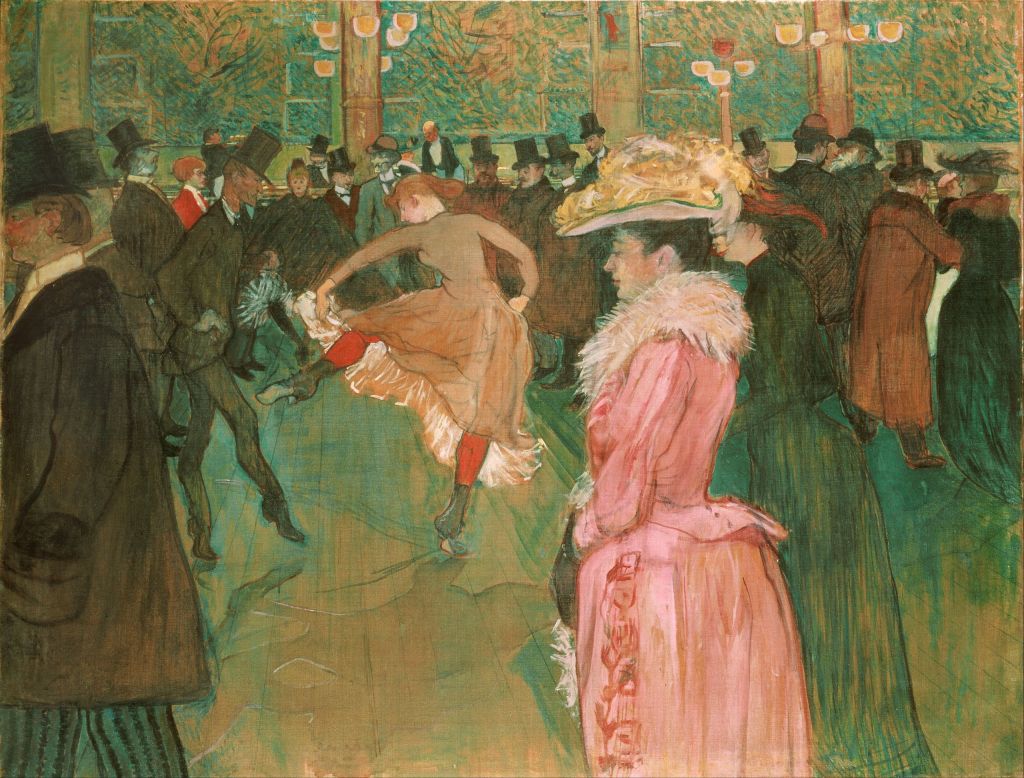
Parisian nightlife was a cornerstone of Lautrec’s art, and At the Moulin Rouge: The Dance stands as his most famous painting, portraying fashionable society and featuring many of his friends and family in a composition of overlapping planes with a perspective that subtly defies reality and logic. The artwork is divided into three distinct planes. The static background features figures such as Lautrec’s father, the poet Yeats, and Jane Avril, a renowned can-can dancer nicknamed “Crazy Jane,” who was both a close friend of Lautrec and a frequent model. In the center, the action unfolds as Valentin le Désossé, a gentleman in a top hat, instructs a cabaret dancer in new steps. The foreground is a detailed study of a contrasting passivity from the central swirl. The viewer’s eye swings between the galloping dancer in earthy tones accented by orange stockings and the quiet, introspective woman in pink.

Lautrec intentionally distorted the painting’s perspective, evident in the mismatched linear lines of the floorboards and fluid, swaying shadows that resemble a confused liquid more than lighting effects. These artistic choices enhance the surreal atmosphere of the scene, amplifying the contrast between the hyper-dynamic dancer and the passive, tranquil surroundings. Through At the Moulin Rouge: The Dance, Lautrec masterfully evokes the opposing vibrant activity and a ‘to be seen’ spirits of Parisian nightlife, providing a vivid outline while inviting viewers to interpret the finer details themselves.

Source: Toulouse-Lautrec by Doughlas Cooper, 1982. Graphic: At the Moulin Rouge: The Dance, Toulouse-Lautrec, 1890. Philadelphia Museum of Art. Public Domain.
Black Swans Part II

Last week, we introduced Taleb’s definition of black swans; rare, unpredictable ‘unknown unknowns’ in military terms, with major impacts, exploring historical examples that reshaped society post-event. This week I’m going to introduce a fictional black swan and how to react to them but before that the unpredictable part of Taleb’s definition needs some modifications. True black swans by Taleb definition are not only rare but practically non-existent outside of natural disasters such as earthquakes. To discuss a black swan, I am going to change the definition a bit and say these events are unpredictable to most observers but predictable or at least imaginable to some. Taleb would likely call them grey swans. For instance, Sputnik was known to the Soviets, but an intelligence failure and complete surprise to the rest of the world. Nikola Tesla anticipated the iPhone 81 years ahead of time. 9/11 was known to the perpetrators and was an intelligence failure. Staging a significant part of your naval fleet in Pearl Harbor during a world war and forgetting to surveil the surrounding area is not a black swan, just incompetence.

With that tweak out of the way, we’ll explore in Part II where Taleb discusses strategies to mitigate a black (grey) swan’s major impacts with a fictional example. His strategies can be applied to pre-swan events as well as post-swan. Pre-swan planning in business is called contingency planning, risk management, or, you guessed it, black swan planning. They include prioritizing redundancy, flexibility, robustness, and simplicity, as well as preparing for extremes, fostering experimentation, and embracing antifragility.

Imagine a modern black swan: a relentless AI generated cyberattack cripples the Federal Reserve and banking system, wiping out reserves and assets. Industry and services collapse nationwide and globally as capital evaporates, straining essentials, with recovery decades away if ever. After the shock comes analysis and damage reports, then the rebuilding begins.

The Treasury, with no liquid assets, must renegotiate debt to preserve global trust. Defense capabilities are maintained at a sufficient level, hopefully hardened, to protect national security, while the State Department reimagines the world to effectively bolster domestic production and resource independence while keeping the wolves at bay.

Non-essential programs, from expansive infrastructure projects, research, federal education initiatives, all non-essential services are shelved, shifting priorities and remaining resources to maintaining core social and population safety nets like Social Security and Defense. Emergency measures kick in: targeted taxes on luxury goods and wealth are imposed to boost revenue and redirect resources. Tariffs encourage domestic production and independence.

Federal funding to states and localities is reduced to a trickle. States and municipalities must take ownership of essential public services such as education, water, roads, and public safety. The states are forced to retrench and innovate, turning federal scarcity into local progress.

Looking ahead, resilience becomes the first principle. Diversification takes center stage, with the creation of a sovereign wealth fund based on assets like gold, bitcoin, and commodities, bolstered by states that had stockpiled reserves such as rainy-day funds, ensuring financial stability. Local agriculture, leaner industries and a realigned electrical grid, freed from federal oversight, innovate under pressure, strengthening a recovery. Resilience becomes antifragility, the need to build stronger and better in the face of adversity. And finally, the government must revert to its Lockean and Jeffersonian roots, favoring liberty and growth over control, safety, and stagnation: anti-fragility.

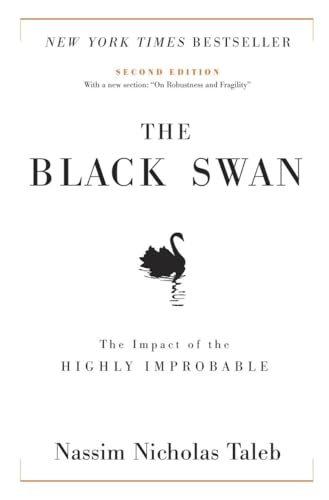
Source: The Black Swan by Nassim Nicholas Taleb, 2007. Graphic: The Black Swan hardback cover.

The Fable of the Turkey

Drum, a plump turkey, trusted his caring master, Strum, who fed him daily and cooed, “You’re the finest bird here.” Drum, a data geek, tracked his weight, 18 pounds on day 300, projecting 24 by day 400. On day 364, a Wednesday, he lost his head and some weight. By Thursday, day 365, Strumpf found him tasty, and his weight hit zero. Blind trust in trends can carve you up.

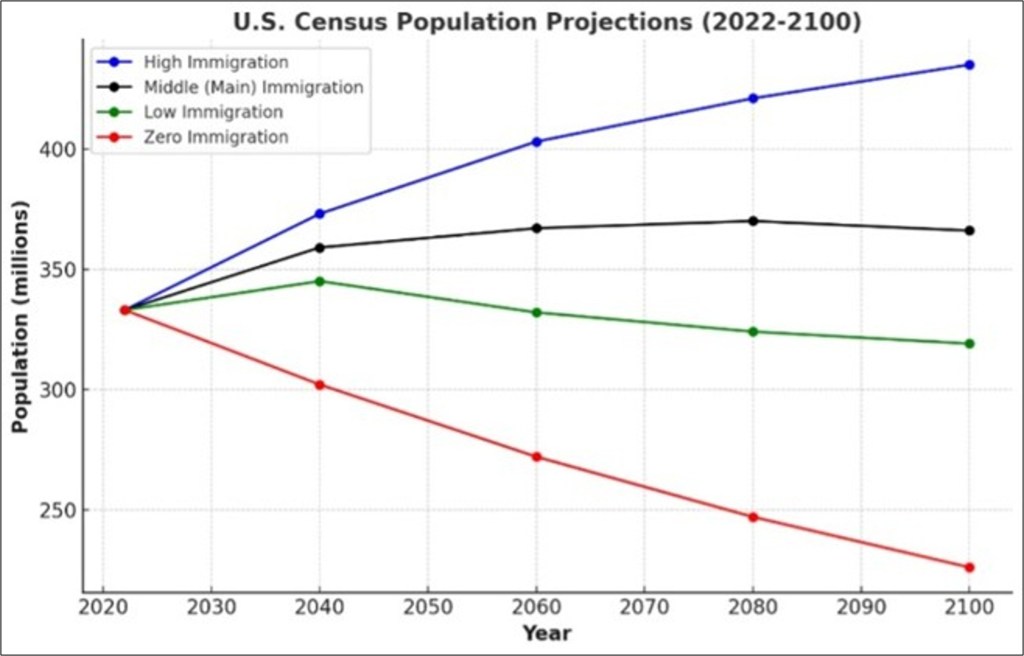
The Census Bureau’s 2023 Population Projections for the U.S. to 2100 play the same game. This “projection, not prediction” uses births (Total Fertility Rate, TFR, at 1.6), deaths, and net migration, spinning four population scenarios: Zero Immigration (333 million today drops to 226 million, down 32%), Low (down to 317 million), Main (up to 369 million), and High Immigration (435 million with 1–1.5 million newcomers yearly). Only immigration increases the population; births and deaths stay flat. It’s 78 years built on 2–3 years of data; no risks, no “what ifs,” no alternatives.

This is a house of cards sold as insight. Projections might hold up in the short term, but 78 years? Please. The Census Bureau, I assume, pitches this study for policy, budgets, districts, but it’s a narrative push: immigration or bust. Zero immigration craters us to 226 million; 1.5 million new bodies annually swells the population to 435 million. Yes, immigration boosts numbers, but why’s it the only solution? No probe into low births, no fixes beyond “import more bodies.” It’s not analysis, just bait for Congress and the public.

A growing or declining population has consequences. A 30% drop could tank GDP and programs such as Social Security. Or yield cheaper homes and a leaner U.S., like Japan (96 million by 2050, still thriving). Growth has costs too, more support for Social Security but more sprawl, maybe more crime, resource strains but the Census skips over those trade-offs. And a low TFR isn’t fate. The WWII generation raised four kids on $60,000 (adjusted) when homes were $12,700. Now we have $420,000 homes, $65,000 wages, and $10,000-per-kid childcare, maxing out affordable families at two. Inflation (2%+ since ‘71) and $36 trillion in debt, increasing by a trillion every 3 months, destroyed the dollar and concomitantly the Federal Reserve and government killed big families.

Increasing family size is a choice. Possible solutions to reverse the trend are tax credits at $5,000 per kid, or even an expanding credit for each additional child above 2, could lift TFR from 1.6 to 2.1 by 2035. That’s 700,000–1 million extra births annually within a decade, millions more Americans by 2050, no immigration spike needed. Cut housing costs by slashing senseless regs, open land to building, drop mortgage rates to 1%) and one income might work again. A declining family size is a choice, not a given.

The Census Bureau releases raw numbers, no “why,” no debate. Immigration’s one fix but not the only one. The government broke the system; it can unbreak it. Next time, Mr. Census Bureau, ask some questions, beyond just slinging spurious stats to support a preferred narrative.

Source: Census Bureau, The Black Swan, Fable of the Bees.  Graphic: Population Projections by the Census Bureau.

Party On

Wine bottle sizes have wonderfully creative and often biblical names although when or who named them is lost in the mists of time. Below is a listing of the common and uncommon ones:

  • Split or Piccolo: 187.5 mL or one-quarter of a standard 750 mL bottle. Usually used for sparkling wines. Piccolo means little or small in Italian and is the smallest standard wine bottle.
  • Half Bottle or Demi: 375 mL or a half of a standard 750 mL bottle. Demi is half or less than whole in Latin.
  • Standard: 750 mL This is the most common size for a wine bottle.
  • Magnum: 1.5 liters or two standard bottles. Magnum comes from the Latin meaning great or large.
  • Double Magnum: 3 liters or four standard bottles.
  • Jeroboam: 3 liters for Champagne and Burgundy bottles or 4.5-5 liters for Bordeaux bottles. The volume difference between the varietals is historically unclear, but Bordeaux wines continually seek grandeur at the expense of everyone else. Additionally, the Jeroboam for Bordeaux was 4.5 liters until 1978 when it switched over to the 5-liter size. Jeroboam was the first king of the northern Kingdom of Israel, from 931-910 BC, after the monarchy split into the ten tribes remaining in the north and Judah and Benjamin claiming south.
  • Rehoboam: 4.5 liters only used for sparkling wine. Rehoboam, son of Solomon, was the last king of a united Israel. The northern tribes started to rebel against Solomon before his death, leading Rehoboam to relocate to Judah shortly after his coronation over the united Israel. He ruled over Judah from 931-913 BC.
  • Methuselah: 6 liters used for sparkling wine or Burgundy. Methuselah was a biblical patriarch and the oldest person, 969 years, mentioned in the bible. He was the son on Enoch, father of Lamech, and grandfather to Noah. The name Methuselah, now synonymous with exceptional longevity, is traditionally believed to have meant “his death shall bring” during his lifetime. Tradition holds that he died in the same year as, but just prior to, the Great Flood, indicating that his life may have foreshadowed this event.
  • Imperial: 6 liters or eight standard bottles. The meaning is possibly related to the region’s historical emphasis on creating wines worth of royalty and at 6 liters capable of serving several blue bloods in one sitting.
  • Salmanazar: 9 liters equivalent to 12 standard bottles. The name likely refers to Shalmaneser V, an Assyrian king who reigned from 727 to 722 BCE. He is mentioned in the Bible for his conquest of Samaria and the exile of the northern Kingdom of Israel’s inhabitants. The dispersal of the inhabitants at this time became known as “Ten Lost Tribes”.
  • Balthazar: 12 liters is equivalent to 16 standard bottles. Balthazar is traditionally known as one of the Three Magi who visited the infant Jesus after his birth. According to Christian tradition, Balthazar was the King of Arabia and brought the gift of myrrh to Jesus, symbolizing suffering and death. Myrrh during ancient times was not only used incense and perfumes, but it was also associated with embalming and anointing the dead including Jews. It was gift that foreshadowed Christ’s end.
  • Nebuchadnezzar: 15 liters or 20 standard bottles. This monster, including wine and the bottle would weigh at least 40 lbs. Nebuchadnezzar II, ruling from 605-562 BC, was a Neo-Babylonian king. He is renowned for his military conquests, notably the destruction of Jerusalem and Solomon’s temple, and the exile of the Jewish people in 586 BC, marking the third major instance of Jewish exile in ancient history.

Fate of the Universe

Astronomers once observed exploding stars (supernovae) and found the universe expanding, driven by a mysterious force called dark energy. This led to the standard cosmological model of the late 1990s, Lambda-CDM, where “Lambda” represents dark energy, assumed constant, and “Cold Dark Matter” (CDM) explains unseen mass shaping cosmic structure. Evidence for CDM includes steady star rotation speeds in galaxies, cosmic microwave background fluctuations, galaxy clustering, and light bending by gravity. Though successful, Lambda-CDM has faced ongoing scrutiny almost from inception of the theory.

Enter the Dark Energy Spectroscopic Instrument (DESI) at Kitt Peak National Observatory in Arizona. With 5,000 robotic fiber-optic sensors, DESI captures light from galaxies and quasars, mapping the universe’s expansion history. A new study, analyzing three years of DESI data, 15 million objects, with plans for 50 million, combines it with cosmic microwave background radiation, supernovae, and weak gravitational lensing data. Fitting all this into Lambda-CDM with a constant dark energy revealed cracks in the model. But if dark energy weakens over time, a “dynamical dark energy“, the model aligns better.

By observing objects up to 11 billion years away, DESI peers deep into cosmic history. Researchers found hints that dark energy’s strength may have peaked around 7 billion years ago, then started weakening, challenging its fixed nature in Lambda-CDM. While not certain, this could rival the 1990s discovery of accelerated expansion, potentially demanding a new model.

The universe’s fate depends on dark energy versus matter. It’s been accelerating, but a weakening dark energy might slow it down, halt it, or, if gravity overtakes sufficiently, trigger a “Big Crunch.” New data from DESI, Europe’s Euclid, NASA’s Nancy Grace Roman, and Chile’s Vera Rubin Observatory could clarify this within five years, possibly nailing dark energy’s role.

Source: “Dark Energy Seems to Be Changing, Rattling Our View of Universe” by Rey and Lawler, Phys.org, March 2025. Graphic: DESI Collaboration Photo of Galaxies.

Ship Rams Bridge—Bridge at Fault

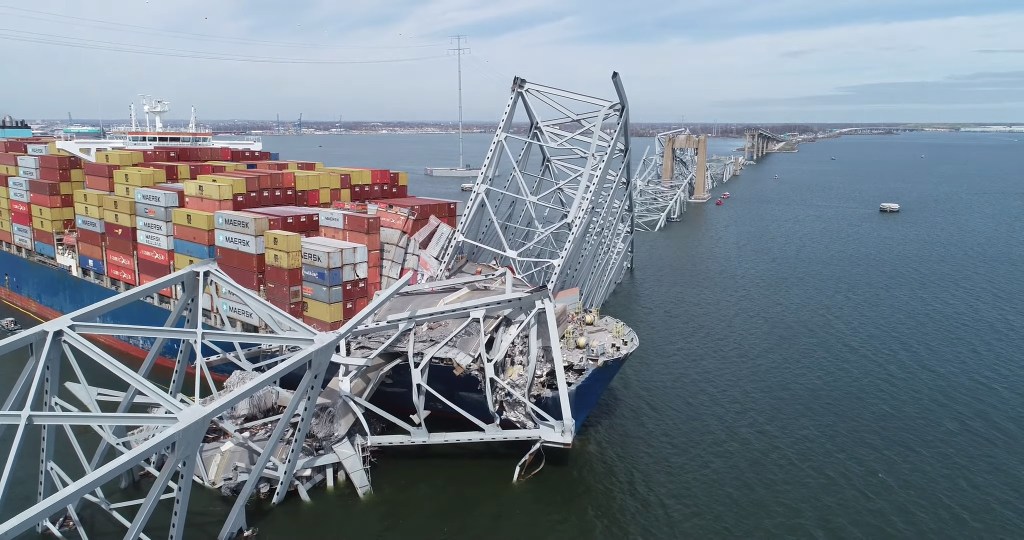
An hour and a half after midnight on 26 March 2024 the main spans of the Francis Scott Key bridge collapsed when the Singapore registered container ship MV Dali lost power and collided with the supporting pier of the main truss section. The NTSB blamed the bridge for being old and not up to snuff with the latest safety features. If the bridge had been built a day after the collision with adequate safety redundancies in place it certainly would not have collapsed.

The bridge collapse blocked the shipping channel to the Port of Baltimore, causing daily economic losses of $15 million and billions in total from damages, lost business, and liability.

The Maryland Department of Transportation stated that construction of a replacement bridge, which began in early 2025 is projected to take four years to complete, with an estimated cost of $2 billion.

The U.S. government and Maryland sued the ship’s owners and operators for full liability but maritime law limits catastrophic losses for shipping companies. The owners and operators will be limited to $100 million in damages, mainly for cleanup of collapsed bridge.

The ship’s owners not only argued for limited liability under maritime law, but that bridge was ill-prepared for a sneaky late-night naval attack on its structure. Of course, the fact that the ship was ill-prepared to sail the seven seas is immaterial. Legal arguments are interesting features of modern life, providing unlimited opportunities for head scratching cognitive dissonance and wonderment.

Graphic: Francis Scott Key Collapse by NSTB.

D’Arenberg The Stump Jump Cabernet Sauvignon 2021

Cabernet Sauvignon from McLaren Vale, South Australia.

Purchase Price: $11.99

Wine Enthusiast 91, Wine Spectator 90, ElsBob 89

ABV 14.5%

Aromas of red and black fruits (Le Rouge et le Noir, Stendahal 1830😊), spice; full bodied, bold, chunky tannins with a medium long finish. Not particularly a great sipping wine. Will need to be paired with bold foods such as lamb or strong cheese.

A very good fine wine at a fair price. Although I find the wine label simply atrocious, the eye charts are a playful sobriety test to determine if you can, or should, have another glass.

Trivia: The phrase “stump jump” in Australia refers to the stump-jump plough, an agricultural tool invented in South Australia in 1876. This plough was designed to “jump” over tree stumps, roots, and rocks allowing farmers to cultivate land without the labor-intensive process of removing the buried debris. The tool was recognized as one of the most important agricultural inventions of the 19th century.

Chagall and Expressionism

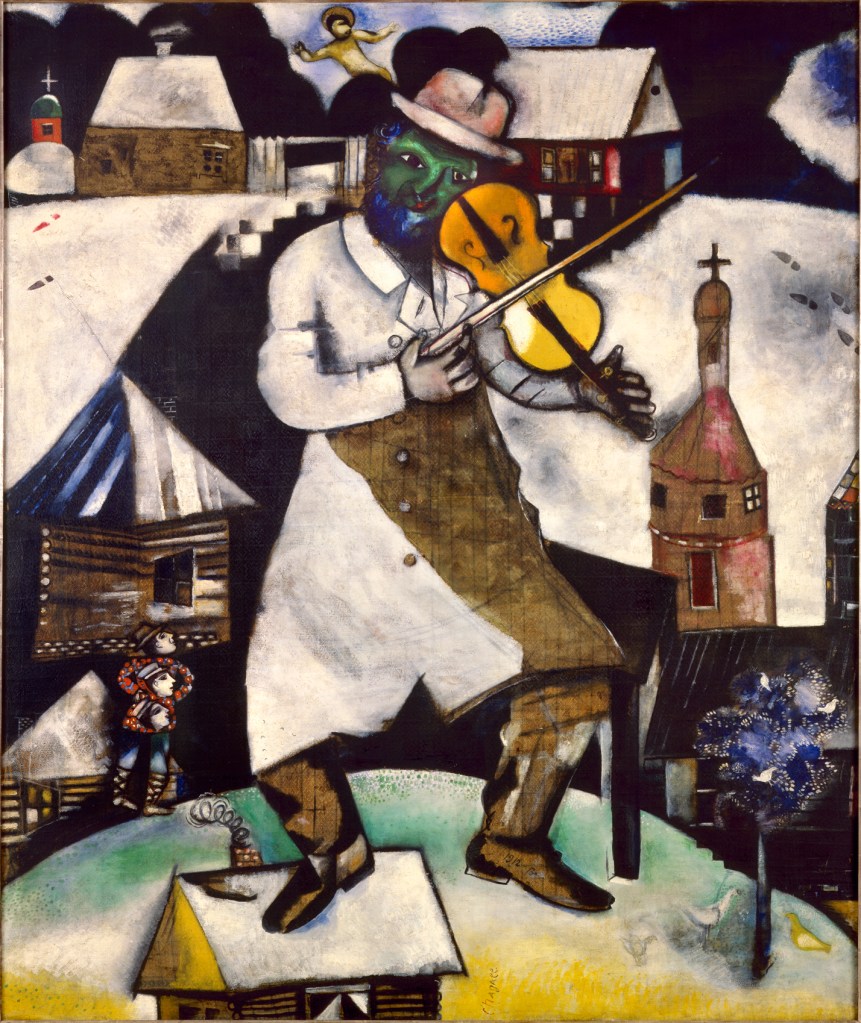
Art critic Raimond Cogniat described Marc Chagall as an artist of opposites, a painter who thrived in the interplay of form and color, color and meaning. Chagall infused his paintings with love and happiness, crafting worlds that felt both fantastical and deeply alive. He shaped reality from his feelings, “making it conform to his inner spiritual logic,” even if, as he once confessed, he wasn’t entirely conscious of his process.

Born Moishe Shagal in 1887 in Vitebsk (now Belarus), Chagall grew up in a Jewish enclave within the Russian Empire. He later embraced France as his adoptive home, blending his Eastern European roots with French artistic flair. Though he briefly explored Cubism during its peak in the early 20th century, he thankfully abandoned that style to carve his own path as an expressionist. Vivid, otherworldly colors, and exaggerated forms defined his style, while his Jewish heritage, evident in depictions of shtetl life, fiddlers, and biblical scenes, remained his anchor. His 1912–1913 painting The Fiddler is said to have inspired the title of the musical Fiddler on the Roof.

In a 1963 speech to an American audience, Chagall reflected on his philosophy: “Any moral crisis is a crisis of color, texture, blood and the elements, of speech, vibration, etc.—the materials with which art, like life, is constructed. Even when mountains of color are piled on a canvas, if one can discern no single object even through great sound and vibration, this will not necessarily give authenticity.” To Chagall, authenticity was more than paint; it demanded the infusion of human experience, blood, and the essence of nature.

Source: Chagall by Raimond Cogniat, translated by Ann Ross, 1977. Graphic: The Fiddler, Chagall, 1912-1913. Public Domain

Black Swans Part I

Black swans are rare and unpredictable events, what the military calls “unknown unknowns“, that often have significant, domain-specific impacts, such as in economics or climate. Despite their unpredictability, societies tend to rationalize these occurrences after the fact, crafting false narratives about their inevitability. COVID-19, for instance, ripples across multiple domains, beginning as a health crisis but expanding to influence the economy, legal systems, and societal tensions. As a human-made pathogen, its risks should have been anticipated.

Black swans throughout history are legendary. Examples include the advent of language and agriculture, the rise of Christianity (predicted yet world-changing), and the fall of Rome, which plunged the Western world into centuries of stagnation. Islam (also predicted), the Mongol conquests, the Black Death, and the Great Fire of London shaped and disrupted societies in profound ways. The fall of Constantinople, the Renaissance, the discovery of America, the printing press, and Martin Luther’s Reformation brought new paradigms. More recently, the Tambora eruption (“the year without a summer”), the Great Depression, WWII brought unforeseen disruptions to economies and geopolitics, the Manhattan Project, Sputnik, the fall of the Berlin Wall, and the rise of PCs and the internet altered the trajectory of human progress. Events like 9/11 and the iPhone have similarly reshaped the modern world. While black swans may be rare, they are not inevitable. We should expect moments of dramatic collapse or unanticipated brilliance to recur throughout history.

Nassim Taleb, author of the 2007 book The Black Swan, suggests several approaches to mitigate the effects of such events without needing to predict them. His recommendations include prioritizing redundancy, flexibility, robustness, and simplicity, as well as preparing for extremes, fostering experimentation, and embracing antifragility: a concept where systems not only withstand shocks but emerge stronger.

Through the lens of history, black swans appear as a mix of good and bad, bringing societal changes that were largely unanticipated before their emergence. As history has shown, predicting the impossible is just that: impossible. What might the next frontier be, the next black swan to transform humanity? Could it be organic AI, a fusion of human ingenuity and machine intelligence, unlocking potential but posing profound risks to free will, societal equilibrium, and humanity’s very essence? (Next week—preparing for a black swan: an example.)

14th Amendment

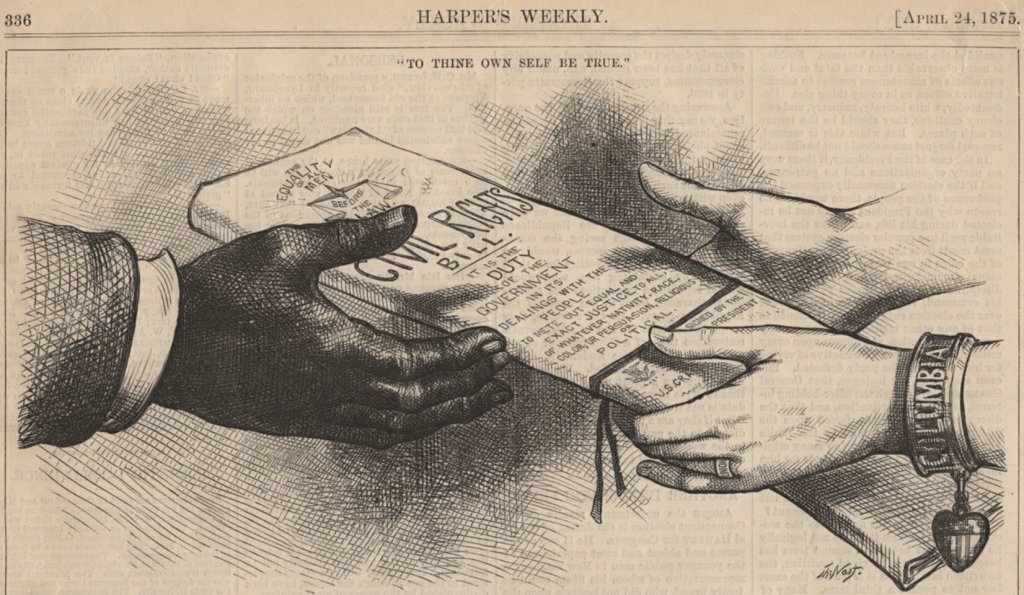
The 14th Amendment, introduced during the Reconstruction era, was crafted to address legal and constitutional deficiencies exposed after the U.S. Civil War. Its first sentence; “All persons born or naturalized in the United States, and subject to the jurisdiction thereof, are citizens of the United States and of the State wherein they reside“, has become a focal point for competing interpretations. Much like the Second Amendment, its wording has sparked legal and grammatical debates, particularly surrounding the clause “and subject to the jurisdiction thereof.”

The Second Amendment faced similar scrutiny for over 200 years, particularly its prefatory clause, “A well-regulated Militia.” This ambiguity was finally addressed in District of Columbia v. Heller (2008), where the Supreme Court clarified that the historical record and documents like the Federalist Papers supported the right of private citizens to own firearms. The Court also ruled that the prefatory clause did not limit or expand the operative clause, “the right of the people to keep and bear Arms, shall not be infringed.

Likewise, the 14th Amendment’s clause “and subject to the jurisdiction thereof” remains unsettled, awaiting similar historical and grammatical scrutiny to solidify its interpretation. Initially aimed at protecting freed slaves and securing their citizenship, this provision has since invited broader interpretations in response to modern challenges like immigration.

The framers’ intent during Reconstruction was to ensure equality and citizenship for freed slaves and their descendants, shielding them from exclusionary laws. At the time, the inclusive principle of jus soli (birthright citizenship) aligned with the nation’s need to address the injustices of slavery and foster unity among the country’s existing population. However, changing migration patterns and modern cultural dynamics have shifted the debate. The ambiguity of “subject to the jurisdiction thereof” now raises questions about its application, such as how jurisdiction applies to illegal immigrants or children of foreign diplomats, in a globalized world.

Legal precedents such as United States v. Wong Kim Ark (1898) affirmed that nearly all individuals born on U.S. soil are citizens, regardless of whether their parents’ immigration status is legal or illegal. While this aligns with the practical interpretation of jurisdiction, it has spurred debates about the fairness and implications of modern birthright citizenship practices.

Immigration today involves a broader spectrum of cultures and traditions than during earlier waves, when newcomers often shared cultural similarities with the existing population. Assimilation, once relatively seamless, now faces greater challenges. Nations like Britain and Germany have recently revised their jus soli policies to prioritize the preservation of societal norms. The unresolved question of how to address declining populations further complicates the debate; a debate with the citizens that has not occurred much less resolved.

While originally crafted to address the systemic exclusion of freed slaves, the 14th Amendment’s principle of birthright citizenship continues to evolve in its application.

Graphic: 14th Amendment Harper’s Weekly.