My Name is Legion

Beelzebub has been wandering through western civilization since the Philistines appeared on the scene in the 12th century BC. The polytheistic Philistines of Ekron, one of their five cities within Canaan, worshiped Beelzebub, Baal-Zebub in the Philistine language, as a minor god of healing and protection from diseases, mainly from flies. In the semitic languages Beelzebub was literally known as the “Lord of the Flies”. (In Indo-European languages some interpretations suggest that Beelzebub is translated into a more friendly Lord of the Jungle.)

As monotheistic traditions took root in Canaan, Beelzebub shifted from a protective deity to a purveyor of evil, demonized within emerging Jewish thought. By the 9th century BC, the prophet Elijah condemned the Israel King Ahab and the prophets of Baal for worshiping this god rather than the true God of the Jews. By the time of the New Testament, which mentioned him 7 times in Matthew, Mark, and Luke, he was associated with Satan, who represented the emperor of Hell.

In Matthew and Mark, the Pharisees accused Jesus of casting out demons by the power of Beelzebub or the “Prince of the Demons”. Jesus counters by exclaiming that “Every kingdom divided against itself is brought to desolation, and every city or house divided against itself will not stand.” Jesus’ response backed the Pharisees into a corner, if they admitted that Jesus was casting out demons by God’s power, then they would have to acknowledge his divine authority. But if they insisted, he was working with Satan, they would have to explain why Satan would undermine his own influence: a house divided will not stand. (Lincoln in an 1858 speech used the same words with a moral rather than religious meaning, granted that is a very fine line, “A house divided against itself cannot stand,” suggesting that the evils of slavery would lead to collapse of the country.)

Between the 15th and 17th centuries Beelzebub was transformed into one of the seven princes of Hell: Lucifer the Emperor, Satan, Leviathan, Belphegor, Mammon, Asmodeus, and Beelzebub. Beelzebub represented the deadly sins of gluttony and envy.

In modern times Beelzebub remains a symbol of evil in literature and culture. John Milton’s Paradise Lost cast him as a chief demon and William Golding’s Lord of the Flies takes a more ancient meaning associated with corruption and destruction.

From an ancient minor Philistine god to Satan during the times of Jesus, to a major Christian demon in medieval times, back to Satan himself in modern times; Beelzebub’s transformation reflects the shifting religious and cultural landscapes over millennia, but demons will always have a name. In Mark 5:9, Jesus asks a possessed man, “What is your name?” The demon responds, “My name is Legion, for we are many.”

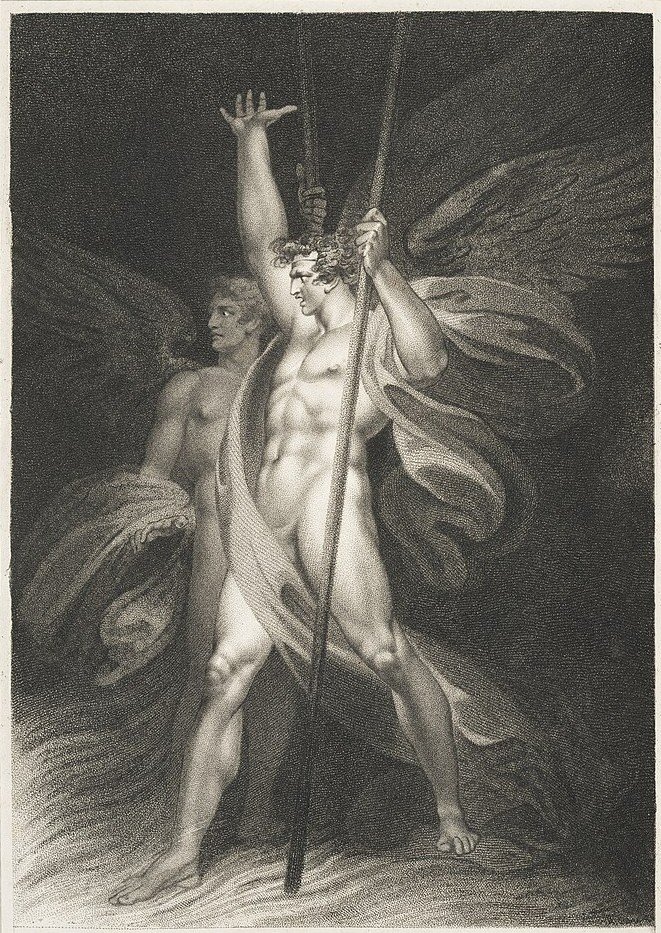
Graphic: Satan and Beelzebub by William Hayley, Jean Pierre Simon, Richard Westall: Paradise Lost. Public Domain.
Beelzebub Retold

 “No matter where or what, there are makers, takers, and fakers.” Heinlein: Time Enough for Love, 1973.

William Golding’s 1954 dystopian novel Lord of the Flies follows a group of stranded schoolboys who, without adult supervision, descend into savagery. Their initial attempt at cooperative survival deteriorates as fear and power struggles drive the strong to dominate the weak; order gives way to chaos, smothering courage beneath a blanket of terror.

While Lord of the Flies initially struggled in sales, Heinlein, perhaps one of its few early readers, found its premise of boys descending into barbarity overnight to be an absurd fiction. In response, he swiftly crafted Tunnel in the Sky, a sci-fi adventure that presents a striking contrast with a parallel plot: instead of chaos and savagery, his young survivors rise to heroic heights, confronting their primal fears with resilience and camaraderie.

The ninth of Heinlein’s thirteen juvenile novels (1947–1963), Tunnel in the Sky is framed as sci-fi but at its core,it’s an adventure story rooted in the conceptual school of literary romanticism. A story of survival wrapped in the timeless cloak of human values and existence. The novel uses sci-fi primarily as a means to transport young student survivalists to an uninhabited planet for their final class exam: surviving 5–10 days in a primitive, dangerous setting. After depositing the students on the planet, the novel’s sci-fi categorization reverts to Call of the Wild. A passing grade is assigned to those that were able to walk or crawl out alive.

After sending the students to the planet the transport mechanism malfunctioned and they are trapped alone on the planet with only a few provisions, maybe forever. With a few knives, limited medical supplies, and other paraphernalia that would fit in packs and pockets they are forced to search out each other to put together a workable society to provide food, shelter, and defense against the elements and native man-eating fauna. With expected fits and starts the kids put together a workable society that provides for their needs and a few wants eventually raising the question of whether they would even accept a rescue.

Heinlein was an incorrigible optimist and humanist. He believed humanity could and will solve all existential problems. To him Lord of the Flies was an impossibility. Humans want to live and self-interest eventually embraces “The needs of the many outweigh the needs of the few” (Spock-The Wrath of Khan).

In semitic languages such as Hebrew, Lord of the Flies is a literal translation of Beezlebub, who was initially a minor Philistine god that expelled flies, believed to be a source of sickness. Over time the Jews referred to him as a major demon and eventually Christianity elevated him to Satan himself. In Indo-European languages Beezlebub literally translates to Lord of the Jungle, one who conquers for the good of humanity: lebensraum. Golding’s Beelzebub represents dystopian destruction; Heinlein’s brings forth the utopian Lord of the Jungle.

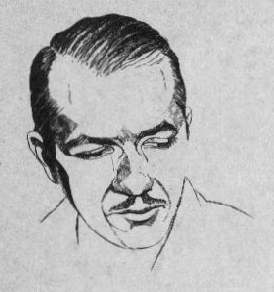
Source: Tunnel in the Sky by Robert Heinlein, 1955.  Graphic: Heinlein in Amazing Stories, 1953. Public Domain.