Prince Amleth, ‘The Northman’, losing his royal inheritance with the murder of his father the king, vows vengeance against his uncle, killer of his father, and kidnapper of his mother.
‘The Northman’ is loosely based on the Norse legend of Amleth, son of King Horwendil and his wife Gerutha. Horwendil was murdered by the king’s brother Feng, who then married Gerutha. Amleth feigned madness to retain his head and to plot his vengeance upon his uncle for murdering his father.
Amleth was Shakespeare’s inspiration for Hamlet in his most famous tragedy ‘Hamlet, Prince of Denmark’. Hamlet is the son of the late king of Denmark and the king’s wife Gertrude. He is also the nephew of the present king, Claudius who killed his father and took Hamlet’s mother as his wife. Hamlet is told by his father’s ghost that Claudius murdered him and that he must exact revenge for his death. The play climaxes where Hamlet, Gertrude, and Claudius all meet a tragic end.
Mark Anthony opens his famous, but fictional, eulogy to Julius Caesar with 7 words of endearment and authority; Aristotelian pathos and ethos, that have become as familiar as blue sky to fans of Shakespeare and English lit students everywhere: “Friends, Romans, countrymen lend me your ears”.
Julius Caesar, a tragedy by Shakespeare, written around 1599, was based on Caesar’s life and death as documented in Plutarch’s Parallel Lives.
With pathos, logos and a chariot laden with irony, Anthony turns initial honor for Brutus and Caesar’s ambition inside out. He brings honor to Caesar and lays ambition on Brutus, along with Cassius. He brings condemnation to the conspirators and love for Caesar.
The first few lines of Anthony’s Eulogy:
Friends, Romans, countrymen, lend me your ears; I come to bury Caesar, not to praise him. The evil that men do lives after them; The good is oft interred with their bones; So let it be with Caesar. The noble Brutus Hath told you Caesar was ambitious: If it were so, it was a grievous fault, And grievously hath Caesar answer’d it. Here, under leave of Brutus and the rest– For Brutus is an honourable man; So are they all, all honourable men– Come I to speak in Caesar’s funeral. He was my friend, faithful and just to me: But Brutus says he was ambitious; And Brutus is an honourable man. He hath brought many captives home to Rome Whose ransoms did the general coffers fill: Did this in Caesar seem ambitious? When that the poor have cried, Caesar hath wept: Ambition should be made of sterner stuff: Yet Brutus says he was ambitious; And Brutus is an honourable man. You all did see that on the Lupercal I thrice presented him a kingly crown, Which he did thrice refuse: was this ambition? Yet Brutus says he was ambitious; And, sure, he is an honourable man. I speak not to disprove what Brutus spoke, But here I am to speak what I do know. You all did love him once, not without cause: What cause withholds you then, to mourn for him? O judgment! thou art fled to brutish beasts, And men have lost their reason. Bear with me; My heart is in the coffin there with Caesar, And I must pause till it come back to me.
Source: “Julius Caesar” by William Shakespeare, Act 3, Scene II. Plutarch’s Parallel Lives. Graphic: Marlon Brando as Mark Antony in the 1953 film “Julius Caesar”
Awards: Best Actress–Best Supporting Actor, Academy Awards; Best Actress–Best Picture–Best Screenplay–Best Supporting Actor, Golden Globe Awards; and many others.
How I missed this movie for 7 years is mystery but I’m glad I found it. The movie won multiple major Academy and Golden Globe Awards and it didn’t even register within my sphere of consciousness. Of course, if I paid any attention, which I don’t, to Hollywood award shows I may have caught it. But any who, I saw a mention about the movie online while browsing and decided to give it view. I’m probably the only person on the planet that hasn’t watched this movie but on the off chance you haven’t, you should.
After Coen Brother’s 1996 black comedy crime film: ‘Fargo‘, ‘Three Billboards‘ brings another black comedy crime film without the Coens but thankfully with Joel Coen’s spouse, the fantastically wonderful actress, Frances McDormand to the screen. McDormand takes the lead role in ‘Three Billboards‘, as she did in ‘Fargo‘, and turns in a engrousing performance as a grieving and scheming mother earning her the Academy and Golden Globes Best Actress awards in the process.
‘Three Billboards‘ was written and directed by Martin McDonagh in which he garnered the 2017 Golden Globe Best Screenplay for the movie. He followed up this film with the 2022 movie ‘The Banshees of Inisherin‘ which won the 2022 Golden Globe for Best Movie. In both movies McDonagh brings his trademark dark humor cloaked in a drama to the big screen. Tragedy is a better genre fit for McDonagh’s work but that term seems to belong to a time long passed.
FootnoteA
Frances McDormand, as Mildred, is a mother looking for closure over her daughter’s rape and murder in the small town of Ebbing, Missouri. After many months of waiting for the local authorities to solve the crimes she grows despondent and desperate over the lack of progress in apprehending, or at a minimum, identifying a suspect and begins to take matters into her own hands.
This movie hits on all cylinders, the screenplay, direction, cinematography which is beautiful, and acting all come together to produce a mostly coherent story with multiple sub-plots that are a feast for your senses and emotions. The only ding I have is that towards the end of the movie McDonagh introduces a twist in the plot that makes very little sense unless they were planning for a sequel, or it is a deus ex machina solution to an intractable plot problem. It is a minor irritation but in its defense, without the twist the final scene would have been very different and likely not as fullfilling.
On an extraneous side note, as with ‘Fargo‘ which was filmed mainly in multiple locations in Minnesota, ‘Three Billboards’ was filmed in multiple locations in North Carolina. Movies are for believers.
a child surreptitiously or unintentionally substituted for another. (dictionary.com)
a child who is suspected not be a couple’s real child. (vocabulary.com)
(in folklore) an ugly, stupid, or strange child left by fairies in place of a pretty, charming child. (dictionary.com)
a human-like creature found in folklore throughout Europe. A changeling was believed to be a fairy that had been left in place of a human (typically a child) stolen by other fairies. (wikipedia.com)
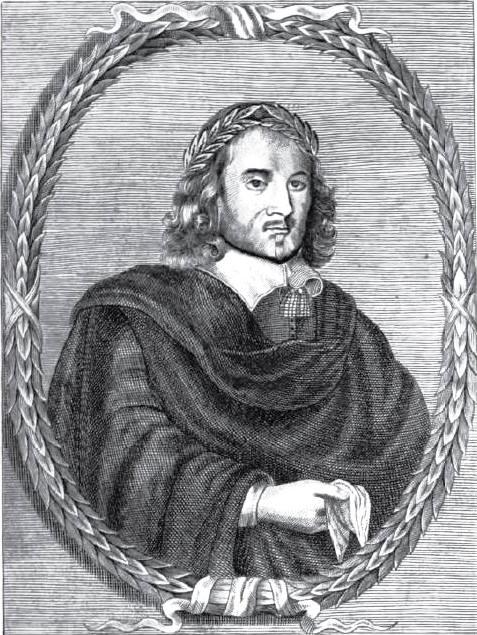
Thomas Middleton, born in London in 1580 living for 47 years, was a famous and prolific Jacobean playwright and poet. He wrote about 27 plays, 18 alone and the remainder with other English playwrights including, William Shakespeare (Women of Timons), Thomas Dekker (The Roaring Girl, et al), John Fletcher (Nice Valour, et al) and of course William Rowley. Middleton’s plays raised him to the loftiest heights of seventeenth century theater, with his fame only eclipsed by Shakespeare and possibly Ben Jonson (Volphone) and John Webster (The White Devil).
His oeuvre included comedy, tragedy, satire, and masque. His greatest play was his great tragedy, The Changeling, which combined violence, intrigue, and a modicum of comedy to produce one of literature’s most intriguing characters: Beatrice-Joanna, a psychopath only surpassed by Patricia Highsmith’s twentieth century protagonist and rogue Mr. Ripley.
(Masque plays were performances that included music, dance, poetry, elaborate sets, and costly costumes which included the wearing of masks. These plays were immensely popular in London theaters and in the courts of nobility such as the English queen Anne of Denmark and Louise the XIV of France. Masque plays can be traced, in various forms, from Greek theater during the Golden Age of Athens to present day Broadway in New York.)
Rowley Biography:
FootnoteD
William Rowley, born in London(?) in 1585, living until the age of 39, is best known for works written in collaboration with other contemporary playwrights. Today he would be categorized as a freelance writer, an independent that works for a set fee. His work is easy to identify as his unexceptional verse stands in stark contrast to the often-polished language of his co-writer(s).
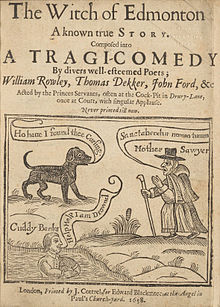
Plays written solely by Rowley are rare and generally of contested authorship. The fact that he co-authored so many plays with the greatest playwrights of his time suggests they saw something in him that critics of today do not. His name lives on though, mainly because of his collaboration with Middleton on ‘The Changeling‘.
The Changeling:
In an attempt to ascertain who wrote what in this play, Pauline Wiggin’s writing style studies in 1897 along with David Lake in 1975 parsed the authorship in the following manner: Middleton likely wrote Act II; Act III, scenes i, ii, and iv; Act IV, scenes i and ii; Act V, scenes i and ii while Rowley likely wrote Act I; Act III, scene iii; Act IV, scene iii; Act V, scene iii. This division of labor credits Middleton for the main plot and Rowley wrote the subplot along with the opening and closing scenes. The main plot of ‘The Changeling‘ is taken from John Reynolds’ 1621 stories.
The main plot revolves around Beatrice-Joanna and her betrothed, Alonzo, along with the one she genuinely loves: Alsemero. To clear the way for her to marry Alsemero she persuades De Flores, her father’s ugly servant, and one who also secretly loves her, to murder Alonzo. Thus, tragedy ensues. The sub-plot occurs in a nearby madhouse run by a Dr. Alibius who is jealous of and afraid that his young wife Isabella will not be loyal to him because he cannot satisfy her. Lollio, the doctor’s servant who also loves Isabella is entrusted by Alibius to make sure she is kept safe from any unwanted romantic advances. Lollio assures him that no madmen will bother her in his house. Franciscus and Antonio, the changeling, are also in love with Isabella. They pretend to be a madman and a fool, respectively, to get committed to the doctor’s care so they can be with her. A sub-plot of comedy wrapped around a main plot of tragedy.
Literary Criticism:
A play of intrigue, treachery, murder, adultery, and death. A play displaying human failings without remorse. Love and treachery in one house, madness in another. But which is which. A morality play for the ages which hasn’t lost its sheen or relevancy in four hundred years.
FootnoteA: It is common today to find William Rowley’s name not listed on the cover of reprints for ‘The Changeling‘. I’m not sure there is any meaning in the omission other than the publishers didn’t do their homework. Amazon picture
FootnoteB: A scene from “The Legend of St. Stephen” by Martino di Bartolomeo, in which the devil steals a baby and leaves a changeling in its place. Wikimedia Commons
FootnoteC: Thomas Middleton. Wikimedia Commons
FootnoteD: The Witch of Edmonton: by William Rowley, Thomas Dekker, John Ford, &c. Printed in London by J. Cottrel, 1658. One of the few plays showing Rowley’s name. Wikimedia commons
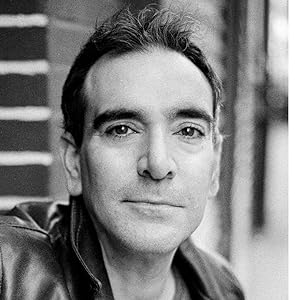
Aaron Poochigian earned a PhD in Classics from the University of Minnesota and an MFA in Poetry from Columbia University. He has authored four books of poetry and translated seven books from Greek and French. He won the Muse Book Award for his book of poetry, Manhattanite and the Richard Wilbur Award for another book of poetry, American Divine. He currently lives and writes in New York City.
In an interview with Heide Sander in 2021 she asked Poochigian to share a story about what first drew him poetry. His answer, to me anyway, was unexpected to say the least, “I had a religious experience when I was 18. Sitting outside an ivy-covered old brick building on the quad of my campus, I was looking at the opening lines of an epic poem in Latin, the Aeneid: ‘Arma virumque cano Troiae qui primus ab oris. . .‘ Though I did not yet know the language, the sky became brighter, and I could feel my synapses lighting up, and it became clear to me that I was supposed to spend my life writing poetry. For better or worse, for richer and poorer, that’s what I have done.”
I find this fascinating. What strain of curiosity exists for someone to read lines of poetry, or any text for that matter, in a language one doesn’t understand. Truly beguiling or maybe closer to the point, mystifying but I’m not a poet so I’m likely missing something important.
For those that are curious, The Aeneid an epic poem written in Latin by Virgil between 29-19 BC, describes the adventures of Aeneas, a Trojan who fled Troy after it fell to the Greeks and who subsequently made his way to Italy, becoming the ancestor of all Romans. The above quoted Latin phrase in bold type is a small snippet from the opening line of the Aeneid which the entire line in English reads as follows: “I sing of arms and the man who first from the shores of Troy came to Italy and Lavinian shores, exiled by fate, that man who was tossed much both on lands and on the deep by the power of the gods because of the mindful anger of savage Juno; also he suffered many things in war until he could found a city and bring his gods to Latium, whence the Latin race and the Alban fathers and the walls of high Rome” .
Poochigian, in his introduction, feels the need to point out that slavery existed during the Golden Age of Athens, as if it ever went away. He states: “…would do well to acknowledge that the entire edifice of the glorious civilization that was fifth century Athens including its rich tradition of theatrical performance, was built on a foundation of forced, uncompensated labor. Athenians themselves may have been willfully blind to the injustice of reserving democratic self-determination for themselves and relegating their defeated enemies to abject servitude, but it is impossible for us now to ignore it.”
The “built on a foundation” and “willfully blind” are very bold assumptions whose conclusive inerrancy would improve with a smidgen of support from the historical record. Also, to translate the works of a free Athenian citizen, whose works were supposedly built on the backs of slaves, then hold out your hand for payment does seem a bit much. One may wish to consider how the future humans will look upon present-day west coast cities in the U.S. Will their view of us be judged by the abhorrent spectacle of unending tent cities and homelessness, unchecked crime, filth in the streets, untreated mental illness, rampant drug use and addiction? Should the future disparage our attempts to uplift the human condition of some because we failed to uplift all? If we cannot accept the civilizational accomplishments from 2800 years ago because slavery existed then, as it does today, do we expect the future to treat us differently?
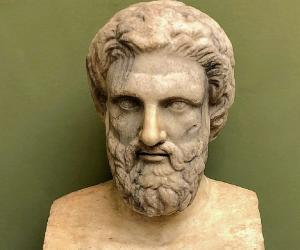
Aristophanes — Wikipedia
Aristophanes Biography:
Aristophanes, Greek playwright, born circa 448-6 and died circa 386-5 grew up in Athens during the Age of Pericles, 461-429 BC. His early adult years on into middle age occurred during the declining period of the Athenian Golden Age due to the mounting strategic failures and monetary costs of the city-state’s losing gambles in the Peloponnesian War from 431-404 BC.
It is unknown whether Aristophanes fought in the war, but it is believed he did due to the Athenian compulsory draft of all eligible citizens during the Peloponnesian War. Then again, if he did serve in the military, it didn’t appear to impede his prodigious writing output.
Aristophanes, known as the ‘Father of Comedy’, produced thirty-six to forty plays, maybe more, of which only eleven exist in completed form while another eleven are found in fragments. He is the only writer of Greek ‘Old Comedy’ whose plays still survive.
He submitted his first play, The Banqueters to the festival in Dionysia in 427 BC, receiving second prize out of the three that were accepted for live performance. His plays went on to garner eleven prizes at Dionysia and Lenaea even managing the exceptional feat of winning first and second prize at Lenaea in 422 BC for his plays The Preview and The Wasps respectively.
Aristophanes plays, at least the eleven surviving ones, are all stylistic examples of what is now called ‘Old Comedy’, the initial form of Greek theater comedy. Old Comedy was characterized by the merciless skewering of public figures while entertaining the audience with beautiful lyrical songs, dance, ribald and licentious speech, and absurd plots. Aristophanes plots began sane and logically, centered around an imaginative hero, progressing to a preposterous but victorious heroic conclusion such as in The Birds where a middle-aged burnout from Athens, searching the wilderness for peace, stumbles into a ruling role of the bird kingdom which in the end supplants the Greek gods for supremacy.
Greek Competitive Theater:
Ancient Greeks invented theater with Greek tragedy first appearing in the late sixth century BC. It is believed that Greek theater began as songs and dances, known as the dithyramb, honoring Dionysus or Bacchus, the Greek god of all that was fun: wine, fertility, festivity, insanity, and theater. The songs and dances celebrating fertility evolved into rites of spring with theatrical plays becoming central to the festivities. The Dionysia as the festival became known was the second most important Greek celebration after the Panathenaic, the quadrennial Athenian athletic games.
The theatric festival was eventually held as a competition where three tragic poets or playwrights wrote and produced three tragedies on a common theme. Additionally, the poets were also required to produce a satyr play, a heroic tragedy with cheerful atmospherics and rural backgrounds. An award, initially believed to have been a goat, fortunately becoming a wreath of ivy and/or a bronze tripod cauldron, was given to the best tragic poet. The term “tragedy” comes from the Greek word ‘tragoidia’, which translates to ‘goat song’. From 449 BC onward the best actors, known as protagonists, were also given prizes.
Comedy was introduced at Dionysia in 486 BC with five poets initially competing for the prize. In 440 BC a minor festival to Dionysus was established in January at Lenaea where initially, only comedy was staged. Tragedy was added at Lenaea in 432 BC. Five comedies were presented yearly at Lenaea except during the Peloponnesian War when only three plays were staged. Four tragedies were presented at this winter festival but were composed by only two poets.
Aristophanes’ Theater Awards for Comedy:
Second prize at the Dionysia in 427 BC for The Banqueters (now lost)
First prize at Dionysia in 426 BC for The Babylonians (only fragments remain)
First prize at the Lenaea in 425 BC for The Acharnians
First prize at Lenaea in 424 BC for The Knights
Third (last) prize at Dionysia in 423 BC for The Clouds (first edition now lost)
First prize at the Lenaea in 422 BC for The Preview (now lost)
Second prize at the Lenaea in 422 BC for TheWasps
Second prize at the Dionysia in 421BC for Peace
Second prize at the Dionysia in 414 BC for The Birds
First prize at the Lenaea in 411 BC for Lysistrata
First prize at the Lenaea in 405 BC for The Frogs
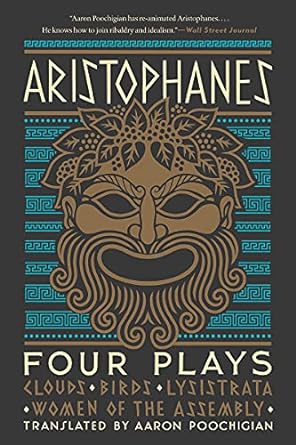
Aristophanes — Four Plays Plot Summaries and Commentary:
Clouds is a tale detailing the importance of an education and the resulting moral rot that accompanies it. A spendthrift and unappreciative son Pheidippides is driving his father, Strepsiades, into bankruptcy. Strepsiades counts on the wrong argument, taught by sophists at the Thinkery school with Socrates as the headmaster, to win him a reprieve from his debts.
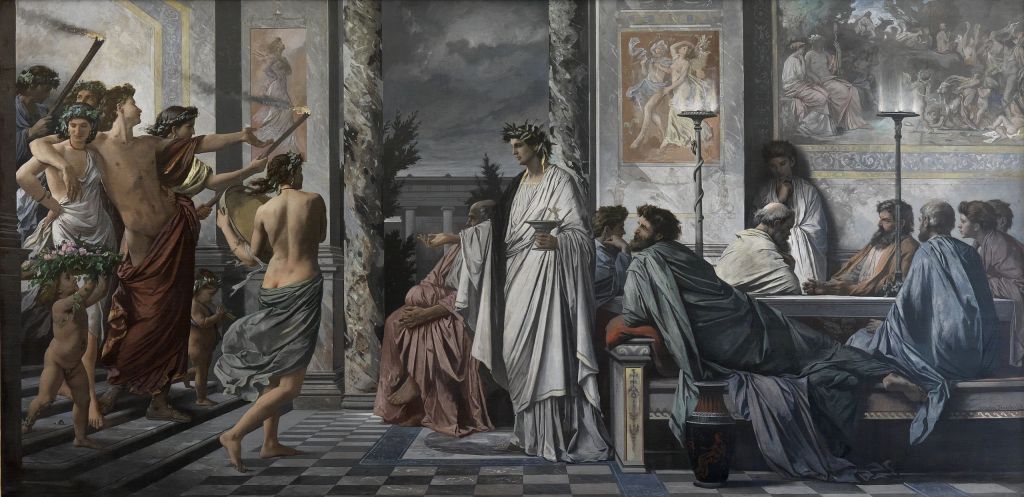
Symposium by Feuerbach — First version — 1869 — Socrates is in the right center facing the wall.
Sophists, in the original Greek meaning were sages or experts imparting wisdom and learning. During the Golden Age of Athens in fifth century BC, professional educators roamed the Greek empire teaching for a fee on a wide range of subjects from rhetoric, poetry, music, philosophy, and mathematics. Rhetoric or the art of apprising and persuasion was the preeminent study for the litigious Athenians. When discussing sophists, one would be remiss not to mention that Aristophanes had numerous students under his care throughout his career as a playwright, which one can assume were not instructed for free, whereas Socrates taught and lectured for free.
The Clouds that took third (last) at Dionysia in 423 BC is now lost. The one that reaches us here in the 21st century is a revised version of the play from 418 BC, which Aristophanes, it is believed, never presented to the public.
In Plato’s Apology the author claims this play was a contributing factor in the conviction and execution of Socrates for the specious crime of corrupting Athen’s youth.
Birds, taking second prize at Dionysia in 414 BC, attempts to find utopia outside of the struggles of Athens. The plot begins with a worn-out Athenian, Pisthetaerus, wandering in the wilderness with his fellow traveler, Euelpides, looking for Tereus the Hoopoe, supreme leader of the birds. Upon finding Tereus, Pisthetaerus hatches a great idea to establish a city in the sky, Cloudcuckooland and reclaim the birds’ standing as the first among gods.
Many have tried to find allegorical meaning in the play, but sometimes a fairy-tale is just that, a fairy-tale, a fantasy that entertains without it being weighed down with heavy philosophical and political interpretations.
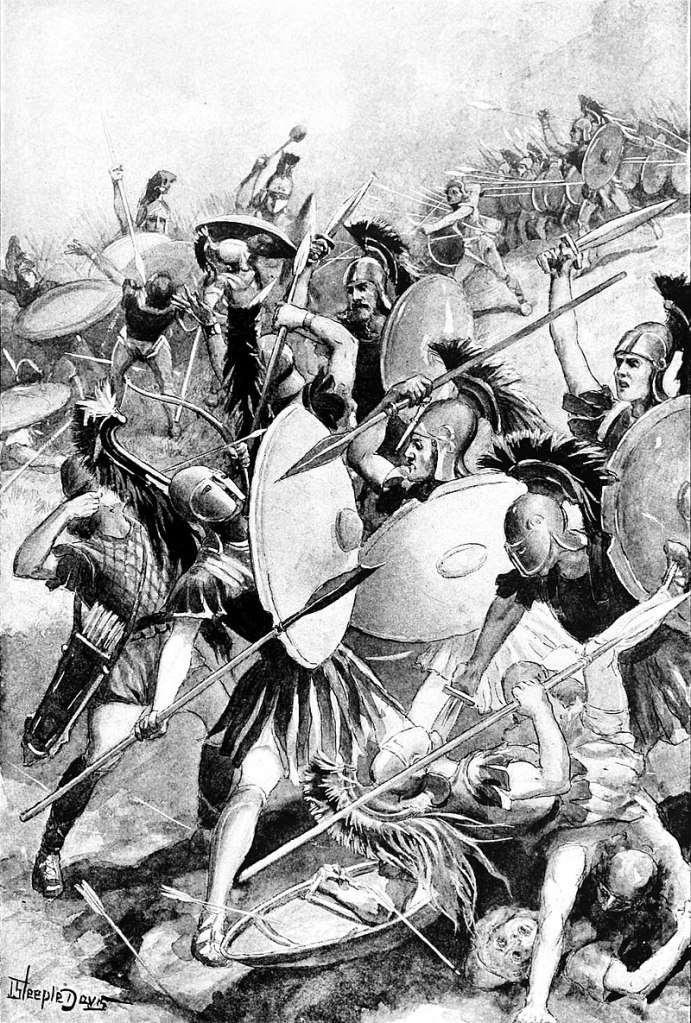
Destruction of Athenian army at Syracuse — Davis 1900 — Wikipedia
Lysistrata, taking first prize at Lenaea in 411 BC, has Aristophanes bringing the matriarchy to the forefront of Greek society were the Athenian wives, brides, and lovers of war-locked men attempt to end the Peloponnesian War. Lysistrata and the other women of Athens hatch a plan to deny sex to the men until they end the war thus denying themselves, their one and only desire in life.
By 411 BC Athens was losing badly in the Peloponnesian War through the treachery of Alcibiades, the incompetence of military commanders in Sicily and elsewhere, and the political blunders emanating from Athens. Having lost most of their navy in 413 BC, Athens was slowing and mercilessly succumbing to Sparta and its ally, Persia, with their tightening noose around Athens’ perimeter choking off their much-needed trade and silver resources to continue the war.
The play has feminist overtones, but it is unabashedly an enactment of societal male domination designed to protect women from their baser and irrational instincts. While the play is a creed to the ethos of patriarchy, it subtly informs the Athenians that all is lost, and it was time to make peace with Sparta.
Women of the Assembly goes by more names than the devil: Assemblywomen, Congresswomen, A Parliament of Women, Women at the Assembly, Women of Ecclesia, Women in Parliament, Women in Power, and possibly others. Ecclesia, along with the plethora of previously listed names, in ancient Greece was the assembly of citizens of the city-state which included all male citizens 18 years and older. In Aristophanes time the Ecclesia was summoned by the ruling Boule of four hundred, a Greek council or senate. The assemblies were charged with debating and voting on matters presented to them by the council.
The play, presented in 391 BC, is one of Aristophanes’ weaker and rightly, less appreciative efforts, garnering no awards at Dionysia or Lenaea. The women of Athens take over the Ecclesia, dressed as men and force a communistic system of sexual equity for all, the ugly and the beautiful, and a ban on the rich. Equality of outcomes, of one ring, to rule them all.
The play on the surface is an exploration of feminist power in government whereas it is truly a rebuke of effeminate men in the halls of government. Aristophanes believed in a binary world. If men and women were interchangeable and indistinguishable then madness and sadness is everyone’s just reward.
Literary Criticism:
German poet Henrich Heine said: “There is a God, and his name is Aristophanes.” Once a god is conceded all negatives melt away. I will concede the obvious–the negatives are not only trivial but possibly non-existent.
Aristophanes plays were filled not only with comedy but with fantasy and fetish, irrationalism, satire, ribald commentary, and vulgar ridicule of Athenian society. Aristophanes respected no sacred cows, skewering everyone and everything with impunity, an unrestrained destruction, fairly or unfairly, imparting a message to all comers that they were mostly fools. Open season was declared on poetry, religion, philosophy, and politics as were the famous and infamous of society such as Socrates, Cleon, fellow poet Euripides, and when he ran out of the famous, he turned his sharp swords of locution on the Athenian people. He truly was a god of Greek poetry, comedy, and theater.
Aristophanes surfeit use of vulgarity, phallic imaging, and sexual inuendo comes across as juvenile upon reading his plays but then these plays are for presentation at festivals honoring Bacchus, the Greek god of wine. It may not be unrealistic to assume that his audience, at a minimum, is slightly inebriated, in which case Aristophanes isn’t being crude but deliberately playing to his audience’s relaxed mental state.
Poochigian believes in magic. The magic of poetry, stating in 2021, “Poetry is a magic circle of sound and image in which anything can happen. Yes, poetry means magic to me, and I see the poet as a magician who, with his/her incantations, creates special spaces outside of prose and everyday life.” He is an able translator of Aristophanes plays bringing his Greek poetry into realm of the vernacular of almost blue-collar English but managing to leave the magic behind in the agoras and councils of the Athens.
Poochigian’s translation of Tereus’, king of the birds, great speech summoning his subjects is typical, “…come here, all you endowed with wings, all you who flutter over acres of fertile land, you myriad throngs who feed on grain, you swift seed-pickers who warble such delightful songs. Come all that over furrowed ground twitter, molto espressivo, this pleasant sound–tio, tio, tio, tio, tio, tio, tio, tio...” Where is the beauty, the magic in this translation? This is prose of the common man. It is amusing though that the Italian term, molto espressivo, meaning very expressive, is used to translate the Greek to English.
An anonymous translator from the early 20th century gives us Epops summoning his subjects, “…here, here, quick, quick, quick, my comrades in the air: all you who pillage the fertile farming lands, the numberless tribes who gather and devour the barley seeds, the swift flying race that sings so sweetly. And you whose gentle twitter resounds through the fields with the little cry of tiotiotiotiotiotiotiotio…” This is poetry. This is magic.
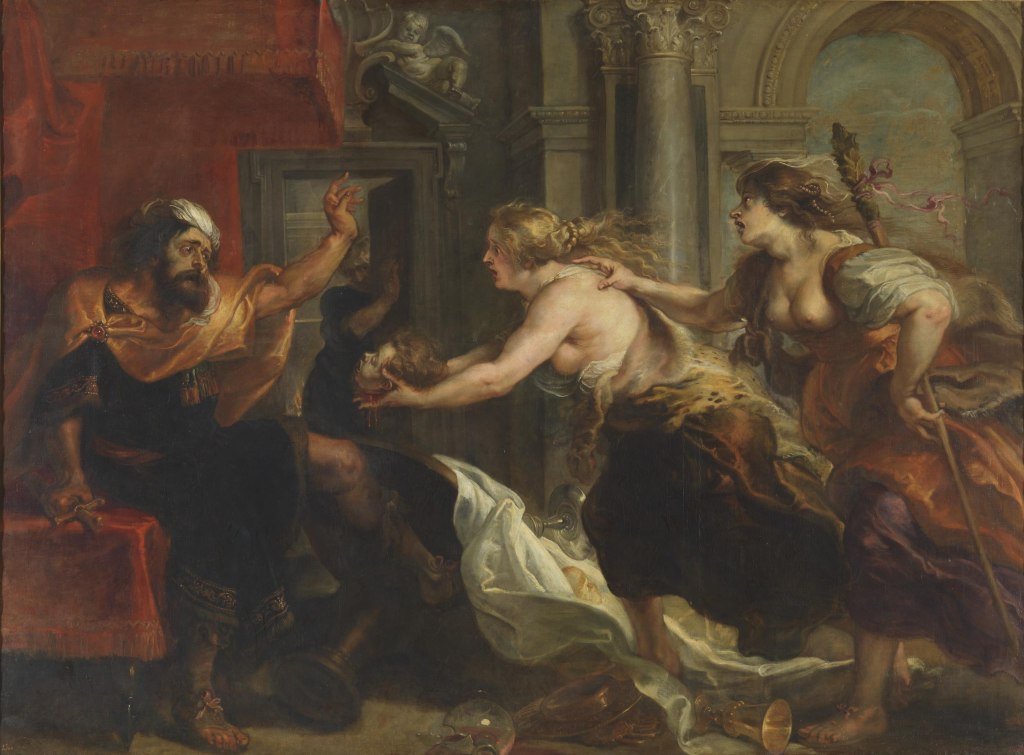
Tereus Confronted with the Head of his Son Itys — Rubens — 1636-38
Epops, in Latin and Greek, is a hoopoe. A bird with a long beak and a crest of feathers. Why the anonymous translator called Tereus Epops is unknown. The name of the king of birds in Aristophanes play is the hoopoe Tereus. Tereus is a character from Greek mythology who was the king of Thrace and the son of Ares, the god of war, and Bistonis, a water nymph. He married Procne, the daughter of Pandion, the king of Athens. However, he also raped and mutilated his sister-in-law Philomela, who was Procne’s sister. As a result, Procne and Philomela took revenge on Tereus by killing his son Itys and serving him as a meal to Tereus. When Tereus discovered the truth, he tried to kill them, but the gods intervened and turned them all into birds. Tereus became a hoopoe. Procne became a nightingale with a beautiful song. Philomela became a swallow who could not sing.
Aristophanes’ Surviving Complete Plays Bibliography:



 elsToday