
Shot in the Dark

The Earth orbits the Sun at a brisk 107,000 km/hr (66,486 mi/hr). The Sun, in turn, circles the Milky Way at a staggering 828,000 km/hr (514,495 mi/hr). And deep in the galactic core, stars whirl around the supermassive black hole at relativistic speeds, up to 36 million km/hr (22,369,363 mi/hr). Gravity is the architect and master of this motion: the invisible hand that not only initiates these velocities but binds our galaxy into a luminous spiral of unity.

Except it shouldn’t. Not with the piddling amount of mass that we can see.

The Milky Way contains 60-100 billion solar masses, an impressive sum, but a puny, gravitationally insufficient amount. With only that amount of ordinary matter, the galaxy would disperse like dry leaves in a breeze. Its stars would drift apart, its spiral arms dissolve, and the universe itself would remain a diffuse fog of light and entropy, never coalescing into structure or verse. No Halley’s Comet. No seasons. No Vivaldi.

To hold the Milky Way together at its observed rotation speeds requires about 1.4 trillion solar masses, seven times the visible amount. And we know this mass is there not because we’ve seen it, but because the galaxy exists. Much like Descartes’ Cogito, ergo sum (“I think, therefore I am”), we reason: The Milky Way is; therefore, it must possess sufficient mass.

The problem is that 85% of that mass is missing; from view, from touch, from detection. Enter stage right: Dark Matter. It does not emit, absorb, or reflect light. It does not interact with ordinary matter in any known way. It is invisible, intangible, a Platonic ether of shadow reality. Without it, the sacrament of gravity and being floats away like a balloon on a huff and puff day. And the universe loses its meaning.

Much like the neutrino, predicted by theory, is a particle once postulated to preserve the sanctity of conservation laws, a piece of the quantum world long before it was ever seen. Dark Matter is another elusive phantom, inferred by effect, but physically undetected. Dark Matter bends light, sculpts galaxies, and governs gravitational dynamics, yet it inhabits a metaphysical realm that requires faith to make it real. Unlike the neutrino, it lacks a theoretical platform. The General Theory of Relativity insists it must have mass; the Standard Model offers it no space. It is an effect without a cause: a gravitational fingerprint without a hand.

Yet, physicists are trying to tease it out, not so much to grasp a formless ghost, but rather to catch a glimpse of a wisp, a figment, without knowing how or where to look. To bring light to the dark one must grope around for a switch that may or may not exist.

Researchers at the University of Zurich and the Hebrew University of Jerusalem have devised an experiment called QROCODILE: Quantum Resolution-Optimized Cryogenic Observatory for Dark matter Incident at Low Energy (One can only guess at the amount of time and gin the Docs spent on that acronym 😊) to help tease out the existence of Dark Matter.

The experiment is designed to detect postulated ultralight dark matter particles that may interact with ordinary matter in currently unfathomable ways. To find these particles they have built a detector of superconducting nanowire sensors, cooled to near absolute zero, that achieves an astounding sensitivity to detect an infinitesimally small mass of 0.11 electron-volts (eV).

0.11 eV is roughly the energy difference between two quantum states in a molecule. An imperceptible shiver in the bond between two hydrogen atoms: a mass so slight, it might provoke a murmur of dark matter itself.

Using this detector over a 400-hour run (16.66 days) the team recorded a handful of unexplained signals that are real but not necessarily dark matter. Eventually they hope to achieve detections that resolve directionality, helping distinguish dark matter from background noise. The next phase of the experiment: NILE QROCODILE, (groan*) will move the detectors underground to reduce cosmic interference.

QROCODILE is a shot in the dark. It’s an epistemological paradox: how do you build a detector for something you don’t understand? How, or why, do you build an energy detector for a substance, if it is indeed a substance, that doesn’t emit or absorb energy.

While dark matter is known through its gravitational pull, that detection at a particle level is infeasible. Energy detectors, then, are a complementary strategy, betting on weak or exotic interactions beyond gravity.

Whether it finds Dark Matter or not, QROCODILE reminds us that science begins not with certainty, but with the courage to ask questions in the dark, and the craftsmanship to build instruments that honor the unknown.

* NILE QROCODILE: an acronym that evokes remembrance of the socially awkward Dr. Brackish Okun, a secluded researcher of aliens and their tech at Area 51 in the 1996 movie Independence Day.

Source: …Dark Matter Search with QROCODILE… by Laura Baudis et al, Physical Review Letters, 2025. Graphic: Nile Crocodile Head by Leigh Bedford, 2009. Public Domain.
Web of Dark Shadows

Cold Dark Matter (CDM) comprises approximately 27% of the universe, yet its true nature remains unknown. Add that to the 68% of the universe made up of dark energy, an even greater mystery, and we arrive at an unsettling realization: 95% of the cosmos remains unexplained.

Socrates famously said, “The only thing I know is that I know nothing.” Over two millennia later, physicists might agree. But two researchers from Dartmouth propose a compelling possibility: perhaps early energetic radiation, such as photons, expanded and cooled into massive fermions, which later condensed into cold dark matter, the invisible force holding galaxies together. Over billions of years, this dark matter may be decomposing into dark energy, the force accelerating cosmic expansion.

Their theory centers on super-heavy fermions, particles a million times heavier than electrons, which behave in an unexpected way due to chiral symmetry breaking: where mirror-image particles become unequally distributed, favoring one over the other. Rather than invoking exotic physics, their model works within the framework of the Standard Model but takes it in an unexpected direction.

In the early universe, these massive fermions behaved like radiation, freely moving through space. However, as the cosmos expanded and cooled, they reached a critical threshold, undergoing a phase transition, much like how matter shifts between liquid, solid, and gas.

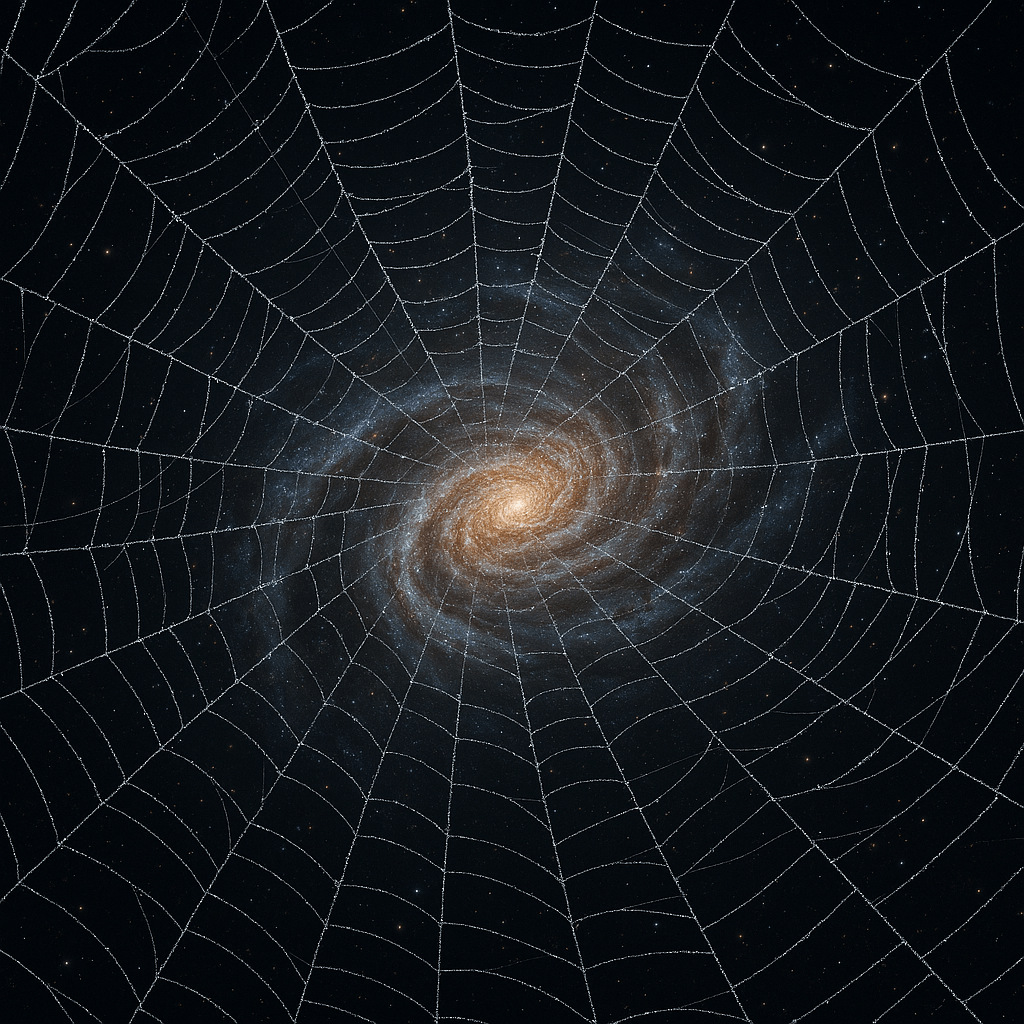
During this transformation, fermion-antifermion pairs condensed—similar to how electrons form Cooper pairs in superconductors, creating a stable, cold substance with minimal pressure and heat. This condensate became diffuse dark matter, shaping galaxies through its gravitational influence, acting as an invisible web counteracting their rotation and ensuring they don’t fly apart.

However, dark matter may not be as stable as once thought. The researchers propose that this condensate is slowly decaying, faster than standard cosmological models predict. This gradual decomposition feeds a long-lived energy source, possibly contributing to dark energy, the force responsible for the universe’s accelerated expansion.

A more radical interpretation, mine not the researchers, suggests that dark matter is not merely decaying, but evolving into dark energy, just as energetic fermion radiation once transitioned into dark matter. If this is true, dark matter and dark energy may be two phases of the same cosmic entity rather than separate forces.

If these hypothesis hold, we should be able to detect, as the researchers suggest, traces of this dark matter-to-dark energy transformation in the cosmic microwave background (CMB). Variations in density fluctuations and large-scale structures might reveal whether dark matter has been steadily shifting into dark energy, linking two of cosmology’s biggest unknowns into a single process.

Over billions of years, as dark matter transitions into dark energy, galaxies may slowly lose their gravitational cage and begin drifting apart. With dark energy accelerating the expansion, the universe may eventually reach a state where galaxies unravel completely, leaving only isolated stars in an endless void.

If dark matter started as a fine cosmic web, stabilizing galaxies, then over time, it may fade away completely, leaving behind only the accelerating force of dark energy. Instead of opposing forces locked in conflict, what if radiation, dark matter, and dark energy were simply different expressions of the same evolving entity?

A tetrahedron could symbolize this transformation:

  • Radiation (Energetic Era) – The expansive force that shaped the early universe.
  • Dark Matter (Structural Phase) – The stabilizing gravitational web forming galaxies.
  • Dark Energy (Expansion Phase) – The force accelerating cosmic evolution.
  • Time (Governing Force) – The missing element driving transitions between states.

Rather than the universe being torn apart by clashing forces, it might be engaged in a single, continuous transformation, a cosmic dance shaping the future of space.

Source: CDM Analogous to Superconductivity by Liang and Caldwell, May 2025, APS.org. Graphic: Galaxy and Spiderweb by Copilot.

Seeking God

95% of the universe is a mystery. About 68% is dark energy, which is believed to drive the accelerated expansion of the universe, though its exact nature is unknown. 27% is dark matter, which holds galaxies together and is believed to consist of one or more massive, yet unknown, particles.

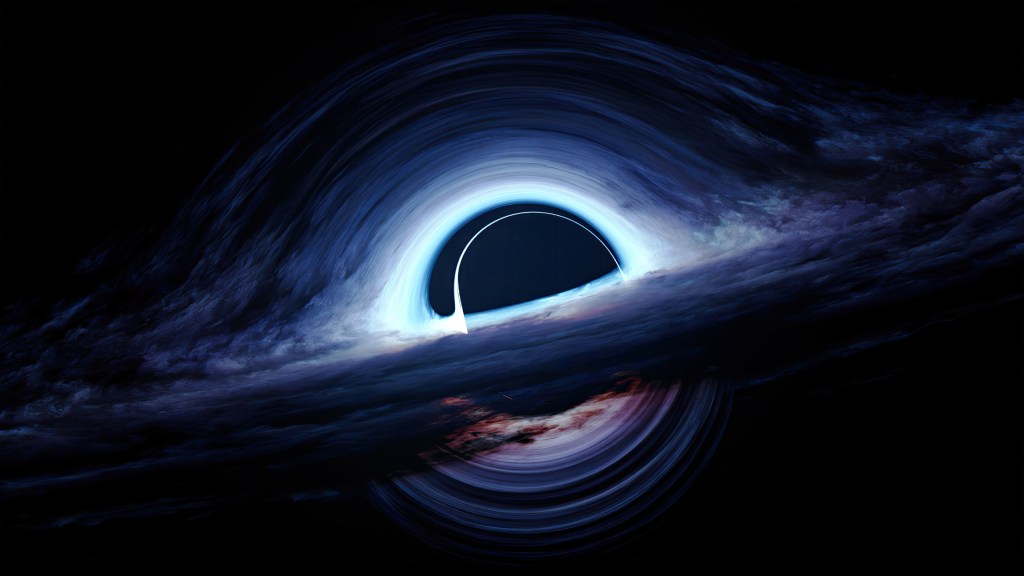
Science Daily reports that researchers at the University of Michigan and five other institutions “have strengthened the case that matter becomes dark energy when massive stars collapse and become black holes.” This suggests that the universe’s expansion may be partly explained by the expansion of black holes through cosmological coupling. It also implies that black holes can gain mass without consuming matter, directly challenging the Standard Model of particle physics.

This either leads to the Big Freeze—infinite expansion through not quite infinite time—or the Big Crunch, where gravity eventually says ‘Enough!’ and collapses everything back into an infinitesimal point.

To sum up, we may or may not understand 5% of the universe, while the remaining 95% aligns with Socrates’ axiom from 6th century Greece—we essentially know nothing.

Source: University of Michigan. “Evidence Mounts for Dark Energy from Black Holes.” Science Daily. 2024. Graphic: Black Hole.