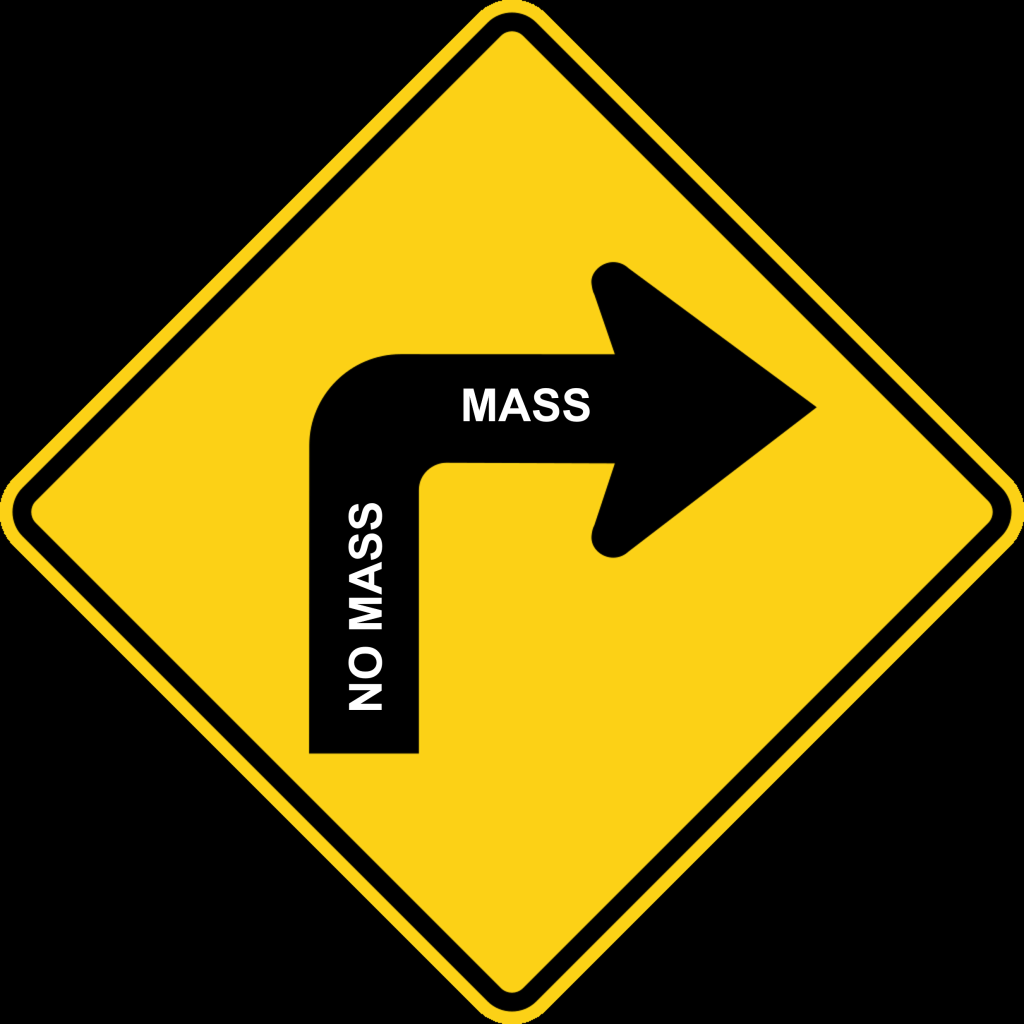
Mass–No Mass

A team of researchers from Penn State and Columbia University has recently observed a quasi-particle that is massless when moving in one direction but acquires mass when moving in a different direction. This quasi-particle, known as a semi-Dirac fermion, was captured by the team inside a ZrSiS crystal and was first theorized 16 years ago. The scientists observed that when the particle travels in one direction at the speed of light, it remains massless. However, when it is forced to change direction, it slows down for the ‘turn’ and gains mass.

This property relates to Einstein’s most famous equation, E=mc², which states that energy and mass are interchangeable, connected by the speed of light squared. According to Einstein’s Theory of Special Relativity, mass traveling at the speed of light would have infinite mass and require infinite energy to maintain its speed, which is impossible. Therefore, only massless particles can travel at the speed of light.

Relativistic effects also come into play when objects approach and attain the speed of light. As an object with mass moves faster, time dilation and length contraction effects become significant. At the speed of light, time would effectively stop for the object, and distances would shrink to zero. These extreme conditions are not physically achievable for objects with mass.

Source: ScienceDaily by Adrienne Berard, 2024. Semi-Dirac Fermions in a Topological Metal. Physical Review X, Shao, et al, 2024.
It Happened Already

The Stars and The Earth or Thoughts upon Time, Space, and Eternity

By Felix Eberty

Translator: Josephine Caruana

Published by Comino-Verlag

Copyright: © 2018

A short read reflecting on the information carried by a photon as it reaches your eye from the far reaches of space.

Originally the book was published in two volumes, both together totaling less than 80 pages, in 1846 and 1847. The book sought the union of physics and religion, metaphysics; for God sees the past and the present as a single point in the space time continuum, time stopping when moving with the light, observing all in three dimensions rather than four. Eberty continues his thesis from an all-seeing God to a time when man’s technological progress allows him to see as God sees or the child of God becomes a god.

Eberty knowing that the speed of light was finite, about 300,000 km/s, contemplated that all visuals captured by any type of eye, human or otherwise, happened in the past. The past including an inconceivably, insignificantly small amount of time in the past, such as a plate of mac and cheese in front of you, is still in the past, what you see has already occurred. Jurgen Neffe, author of a biography of Albert Einstein, stated it succinctly “time travels with light”. Observing light traveling from a billion light years away exhibits events as they happened a billion years ago but if you traveled with those photons for those billion years the past occurs at the same time as your present.

Eberty’s thoughts on the meaning of time and space were recognized at the time not only as novel but metaphysical in nature, maybe not so much today.