Elephants, Magicians, and Zombies: Oh My

The Fantasies of Robert A. Heinlein B Fantasies Heinlein

Written by:  Robert A. Heinlein

Published by:  Tom Doherty Associates

Copyright:  © 1999

Robert A. Heinlein, the dean of science fiction writers during his lifetime, the first among equals, the first among the 20th century big three: Asimov, Clark, and Heinlein; began his writing and publishing career with short stories and novellas. He first appeared in print with a 1939 short story titled Life Line, published in the pulp fiction magazine, Astounding Science Fiction. He published 29 short stories and novellas before publishing his first novel in 1947, Rocket Ship Galileo.  (Heinlein did write a novel in 1939, For Us, The Living: A Comedy of Customs, but it remained unpublished until 2003, 15 years after his death.)

The Fantasies of Robert A. Heinlein is a collection of 8 short stories and novellas written between 1940 and 1959, illustrating why he was selected as the first Grand Master, in 1974, by The Science Fiction Writers of America.  The line between fantasy and sci-fi is a fine one: the majority of these stories have one foot in each realm with the scales tipping towards the fantastic. I had read all these stories individually many years ago, and I enjoyed them then, but they are still fresh and fun to read today, maybe more so, since they are all packaged together, chronologically, allowing the reader to assess Heinlein’s progression as a writer and story-teller through the years. Below are the short stories and novellas contained in this compilation.

Magic, Inc., © 1940, with an alternate title of The Devil Makes the Law. Magic, Inc. makes the rules until Amanda and Archie take charge.

–And He Built a Crooked House, © 1940. You may run out of time when building your house or maybe your house will run into time.  The title to story was a spoof on the English nursery rhyme:

There was a crooked man, and he walked a crooked mile.
He found a crooked sixpence upon a crooked stile.
He bought a crooked cat, which caught a crooked mouse,
And they all lived together in a little crooked house.

They–, © 1941.  Just because you’re paranoid doesn’t mean your mentally ill.

Waldo, © 1942, written under the pseudonym of Anson MacDonald. Anson was Heinlein’s middle name. Magic makes the world go around.

The Unpleasant Profession of Jonathan Hoag, © 1942. Artistic endeavors usually need some touch up paint.

Our Fair City, © 1948.  It’s hard to dance with a whirlwind when you have crooked feet.

The Man who Traveled in Elephants, © 1957.  A good life, a few good friends, great beginnings. Heinlein considered this his best story.

“–All You Zombies–“, © 1959. Punctuation-wise, word-wise, a strange title; you need to read a few words short of the end to figure it out.  While you are reading, Ella Fitzgerald may be appropriate background music; spring, …time, can really hang you up the most.
Everyone Gets An Upgrade

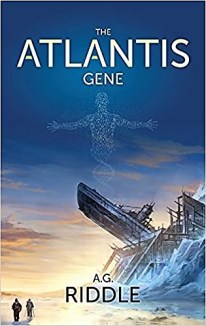
The Atlantis Gene  (The Origin Mystery, Book 1) B Atlantis Gene


Copyright:  © 2013

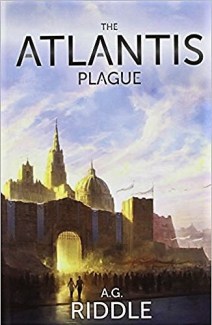
The Atlantis Plague (The Origin Mystery, Book 2)

Copyright:  © 2013

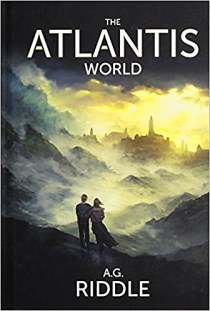
The Atlantis World (The Origin Mystery, Book 3)

Copyright:  © 2014

All Written by:  A.G. Riddle

All Published by:  A.G. Riddle © 2014

Science Fiction is replete with original, creative and amazing stories of the future and future’s past; Herbert’s feudal future checked by a hulking nematode in his Dune series; Asimov’s stories of future doom and mitigation in the Foundation series; Card’s tales of adolescent potency and adult deception in his Ender’s series. RiddleB Atlantis Plague‘s Origin Mystery trilogy is not one of these original and creative stories.

The trilogy explores an alternate history of mans origins, portending a simple plot of who controls who and for what purpose, but quickly gets lost in extraneous details and insignificant sub-plots.  Reading Riddle is the printed expression of ADHD, character development is stunted and dribbled out in brief disconnected chapters that come back together eventually, after they have slipped from your memory, only to bifurcate again; sub-plots within sub-plots within plots, tentacles going everywhere and nowhere, impulsively going off on tangents to explore another unnecessary point. B Atlantis World

Originality and gifted writing does not live in this book.  Most of the topics and plots have been done before and usually better. Dialog and narrative are 1 and 2 dimensional.

…Dorian rushed forward and struck Ares, killing him in one blow. The Atlantean hadn’t expected it, and Dorian fought like a feral animal with nothing to lose.

Striking one blow and fighting like a feral animal are not congruent actions.

…Dorian rushed forward, killing Ares again…The cycle repeated twelve times, and twelve dead bodies, all Ares…on the thirteenth resurrection, Ares stepped out and held up his hands…Dorian rushed forward and killed Ares again.

Occasional changing up the verbs keeps the monotony away and Live Die Repeat, the movie, already did this scene – creatively better.

Steven King’s greatest achievement, The Dark Tower series is a captivating and deliciously fun 5000 pages of dystopian fantasy that will go down as one of literatures greatest creative endeavors. The punitive sin in the entire series was the creation, the introduction of a new character, Patrick, the destroyer of Mordred, in the last 100 pages of the series, solving King’s plot dilemma with an eraser.  Riddle pulls the same amateurish stunt towards the final chapters of his trilogy, introducing the god-like Sentinels, a deceitful writing ploy, but thankfully it euthanized the tale.

Riddle should have kept this to a single volume, forcing a simpler, crisper plot line.

God Will Come When We Become Gods

Childhood’s End

Written by: Arthur C. Clarke

Published by:  Harcourt, Brace & World

Copyright:  © 1953

B Childhood's EndArthur C. Clarke, or imposing proper reverence, Sir Arthur C. Clarke, was an avowed atheist, dancing, contradictory, with the concept of God through all his great works; notably Childhood’s End, 2001: A Space Odyssey, 2010: Odyssey 2, 2061: Odyssey 3, and 3001: The Final Odyssey. At times he was adamant about his beliefs, “I don’t believe in God or an afterlife”; and on other occasions absolutely flippant, “Any path to knowledge is a path to God—or Reality, whichever word one prefers to use.”; which is remarkably similar to his third law; any sufficiently advanced technology is indistinguishable from magic.

His chosen god-given paradise was that of an evolutionary, transcendent transformation to a higher order; not necessarily a gift from an omniscient being but that certainly is a conceivable end point of several of his utopian narratives.

Childhood’s End begins with humans not worthy of traveling further into that celestial ether but our progeny are trainable to receive that gift. Earth is taken over by a race of space aliens known as the Overlords, that have come to suppress our worst instincts and desires, prepare and guide us, towards the enlightenment of the Overmind.

Childhood’s End is considered Clarke’s greatest novel and he certainly thought it his best, and it definitely sent him on a trajectory to further explore concepts of transcendence in later works culminating in his hugely successful Space Odyssey series.

Enough Already

Alien ConvenantAlien: Covenant

Theaters:  May 2017

Streaming:  August 2017

Rated:  R

Runtime:  120-122 minutes

Genre:  Action – Adventure – Fantasy – Horror – Science Fiction – Thriller

els:  2.5/10

IMDb:  6.5/10

Amazon:  2.9/5 stars

Rotten Tomatoes Critics:  6.3/10

Rotten Tomatoes Audience:  3.3/5

Metacritic Metascore:  65/100

Metacritic User Score:  5.9/10

Awards:

Directed by:  Ridley Scott

Written by:  John Logan and Dante Harper, screenplay; Jack Paglen and Michael Green, story

Music by:  Jed Kurzel

Cast:  Michael Fassbender, Katherine Waterson, Billy Crudup

Film Locations:  Australia and New Zealand

Budget:  $97,000,000

Worldwide Box Office:  $240,900,000

The year is 2104, a little more than a decade since the ill-fated Prometheus was destroyed, denying humanity’s creators from undoing the birth of man, and the Weyland Corporation is sending another ship: the Covenant, carrying several thousands humans, to populate another, distant planet.  The ship has all its human occupants in stasis for the trip and all are watched over by a new and improved version of the psychopath David: Walter.  A starburst, looking a lot like a meteor shower, pierces the ship’s hull and kills the captain while he sleeps in his stasis chamber.  Walter wakes up the 14 members of the ship’s crew, including those married to each other to repair the ship.  The newly revived crew receives a human-like transmission from a nearby planet that appears to be a perfect place to start a new colony, better than their original destination.  The new captain, with the commonsense of a milk cow, diverts the ship putting in motion a series of explicable bad decisions that endangers everyone, the ship’s crew, the ship’s occupants, and the ship.

Samuel Coleridge, author of The Rime of the Ancient Mariner, stated that a written unbelievable narrative that was shown to have a “semblance of truth” could be enjoyed by the reader or audience by suspending judgement on the implausible parts. This is usually stated as the willing suspension of disbelief or to believe the unbelievable.  J.R.R. Tolkien, author of The Hobbit and The Lord of the Rings, took this concept in a different direction by suggesting that the narrative could have a secondary belief system within an inner consistency of reality.  Tolkien believed that suspension of disbelief was only required when the story’s plot line does not maintain an internally consistent fictional world.

Alien Covenant fails not because of poor direction or bad acting but because the writers of the story and screenplay put forth an unbelievable and implausible plot that destroys everything else the movie has to offer, and that’s before you even discover it is a complete rehash of the five previous Alien movies (I refuse to add in the Predator vs Alien movies).  The writers, mainly John Logan, somehow believe that the Peter Weyland Corporation is willing to put up a fortune of bitcoins and pieces of eight to build, outfit and send off a colossal starship, containing thousands of human embryos and adults, capable of traversing the vast parsecs of empty space, to find a suitable planet for human colonization; then staff the running of the ship with unintelligent and irrational beings that are incapable of assessing risk or following protocols, all the while compounding the silliness of their decision-making by having spouses or significant others amplifying their emotional buffoonery.  Gads, why not just leave it to Mother, Father, David or Walter.  With computers or androids running the show the writers can at least insert some plausible scenarios for illogical scenes that don’t have to rely on the characters and or audiences being absolute morons.  If  all else fails maybe the space faring chimps: Albert, Ham and Gordo have some offspring that are up for the task.  Hopefully Logan will return to writing plays and leave science fiction to those that can formulate plausible plots.

Alien Covenant goes where the previous Alien movies have already gone. Good androids, bad androids. Sniff and closely examine all gooey eggs, repeat endlessly. Find the Alien, lose the Alien. Burn, nuke, melt, freeze, shoot, chop, slice, dice, mince, atomize the Alien. How about we just bury the concept so deep that all the Alien acid combined will not be able to uncover it again.

Zombies — or Not

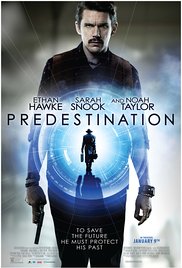
PredestinationPredestination.jpg

Theaters:  March 2014

Streaming:  February 2015

Rated:  R

Runtime:  97 minutes

Genre:  Drama – Mystery – Science Fiction – Thriller

els:  8.0/10

IMDb:  7.5/10

Amazon:  3.9/5 stars

Rotten Tomatoes Critics:  6.9/10

Rotten Tomatoes Audience:  3.7/5

Metacritic Metascore:  69/100

Metacritic User Score:  8.0/10

Awards:

Directed by:  Michael and Peter Spierig

Written by:  Michael and Peter Spierig (screenplay) Robert A. Heinlein (story- All You Zombies)

Music by:  Michael and Peter Spierig

Cast:  Ethan Hawke, Sarah Snook, Noah Taylor

Film Locations:  Melbourne, Australia

Budget:  $NA

Worldwide Box Office:  $5,386,852

Ethan Hawke, temporal agent and bartender, must find and eliminate the Fizzle Bomber before he explodes one last devastating bomb that will take thousands of lives.

For the child of God, time is linear and unidirectional; we are born, we live, we die; the beginning, the middle and the end are all planned out except you can choose what to do with God’s offered grace.  Predestination, the doctrine, the outcome is a certainty; Predestination, the movie, the outcome is in doubt.  For predestination versus free will, the doctrine, is not a contradiction because, for God, time is immaterial, all moments are present in their immediacy. For predestination versus free will, in this movie, it is not a contradiction because time is circular and the protagonist can Keep On Keeping On until he selects good over evil, death over life (Live Die Repeat and Groundhog Day).

The Spierig brothers are identical twins born in Germany, living and working in Australia, creating movies from the ground up.  They write, they direct, they produce, they create the music, but they don’t act. Predestination is their 3rd feature film.

Predestination is a faithful rendition of Heinlein’s All You Zombies with enough temporal displacement to develop a very twisted noodle. The movie provides enough clues that you should figure out the plot well before the end credits roll; but knowing the plot ending neither diminishes the fun nor un-scrambles your brain.

The directing, writing and acting are all superb, but the story is what puts it on my to watch again list.