Basin in the Meantime

Maybe there’s nothin’ happenin’ there
Or maybe there’s somethin’ in the air  —
John Hiatt – Memphis in the Meantime

The operation in Caracas did not inaugurate a new doctrine so much as enforce an old one: The Monroe Doctrine or as the new moniker that is sweeping social media: The Don-roe Doctrine, The DDs. It demonstrated that, when the United States chooses to act in its near abroad, it can do so quickly, decisively, and without the prolonged escalation that once defined hemispheric interventions. The speed mattered less than the silence that followed.

What stretches south from the U.S. southern border is not a collection of isolated states so much as a single basin of changing fortunes. A shared space of currents and constraints where energy, food, money, people, and power circulate unevenly. In that basin, geography compresses time, stretching from long somnolence to sudden, decisive action in prestissimo. Decisions made in one port quickly reverberate into another; scarcity in one system bleeds into the next. When a major node fails, the effects do not remain local, they resonate in a loose, syncopated jazz time

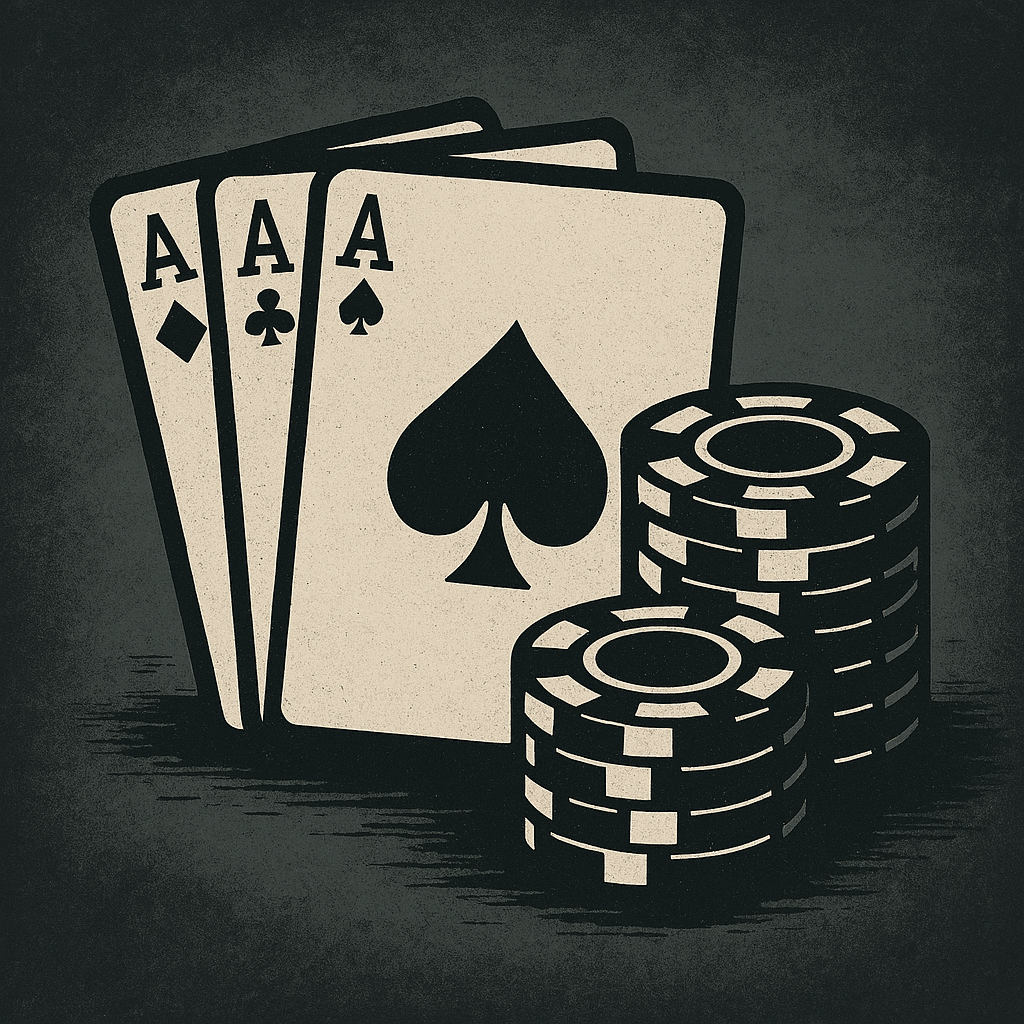
The removal of Venezuela as a patron did not merely end Maduro’s dictatorship, it likely altered the flow of reality in the basin itself. What followed from adjacent confines and distant hegemons alike was not immediate confrontation but boilerplate as hesitancy or visa-versa. Borders were secured. Procedural condemnations were issued. The United Nations will hear of this! Behind the statements, positions were analyzed and reassessed. Cards were checked. No one raised. Everyone counted their chips. Everyone kept their cards, except Maduro, but no one pushed the pot.

In the meantime: the basin holds it breath, the alternatives have no luster, and time has taken on a velocity beyond the speed limits of the usual diplomatic stall. In the basin, survival at all costs no longer promotes stability of government nor docility of the populace. In the basin, the strength of will is now measured in meals, watts, and months: maybe. The Venezuela operation lasted 3 hours.

The absence of a Venezuelan military effective response was not the lack of detection of the opposing force or bribery of key personal to look the other way. It was the predictable outcome of a hollowed-out command structure confronted more attuned to loyalty rather than ability. Selective strikes against decision‑making nodes, combined with degraded communications and uncertainty about leadership status, collapsed the chain of authority before it could cohere into action. In a system likely conditioned to await orders from the top rather than exercise initiative, paralysis was the rational response. No one bucks the top…North Korea redux. A thirty‑minute operation leaves no room for deliberation; it ends before the system can decide what it is seeing. Maduro wasn’t answering his phone.

And the operation was not just the removal of a bad actor; it was also about who was watching.

The Iranian strike was never just a counter‑proliferation exercise. Reducing nuclear capability was the mechanism, not the message. The message was capability itself. It was designed to be seen not by Tehran, which already understood the risks, but by Moscow and Beijing. The flight profiles, the munitions used, the coordination, the timing, the public naming of the operation, all of it communicated U.S. reach, patience, and the ability to act unilaterally at scale without triggering uncontrolled escalation. It was deterrent by demonstration, not a declaration for further action.

The Venezuela operation carries the same scent, even if the target is less world‑ending. Different theater, different tools, same audience. There were other tells. In Moscow, state‑adjacent channels reverted to cultural filler, Swan Lake on shortwave. A gesture with a long memory. In Russian political language, it has historically marked moments of uncertainty at the top: authority suspended, clarity withheld, everyone instructed to wait. It was not a declaration, but it was not nothing either. Less foreknowledge than recognition. An acknowledgment that something irreversible was unfolding, inferred from U.S. posture rather than anything concrete.

That recognition itself would not have gone unnoticed. Intelligence services watch each other as closely as they watch targets, and awareness on one side becomes signal on the other. A brief pause, publicly attributed to weather or timing around the holidays, need not imply any hesitation. It can just as easily reflect confirmation: that inference had not translated into possible interference, that compromised channels would remain compromised, and that recognition would stay passive. In that sense, the music was not a warning, and the delay was not a feint. Both were acknowledgments that the hand had changed, and that no one intended to show their cards before the next move was made.

The unrest in Iran reads differently. Less recognition than diversion. When leverage is limited in one theater, pressure migrates to another. Iran’s internal volatility has long been a known fault line. One where agitation carries asymmetric cost. Disruption there absorbs Iranian authorities’ attention, resources, and narrative bandwidth, reducing the capacity for coordinated response elsewhere. Whether by design or exploitation, the effect is the same: consequences are diluted across theaters rather than concentrated at the point of action. Hezbollah and Hamas in the Caribbean remain isolated and neutered.

This does not require coordination to function. Systems under strain respond predictably to stress applied at their weakest seams. Iran’s unrest filled the information space with noise at precisely the moment clarity elsewhere would have been costly.

In Venezuela, the point wasn’t regime change as an ostentatious show of force or a shot across the bow. It was proof of access, intelligence dominance, and decision‑speed inside a space long assumed to be cluttered with foreign influence. The absence of a name matters. So does the brevity. So does the lack of follow‑on rhetoric, which, for Trump, is really saying something.

Regional reactions reflected this reality. The message, delivered without verbiage, was understood immediately. Except in Congress. Colombia’s troop movements were defensive and stabilizing, aimed at spillover rather than confrontation. Mexico and Colombia’s appeals to multilateral condemnation preserved diplomatic cover without altering facts on the ground. China and Russia issued ritualized objections. Entirely predictable, restrained, and notably unaccompanied by action. Iran’s rhetoric filled space where leverage was absent. Across the board, states assessed their stacks of chips and chose not to raise.

This collective hesitation revealed the deeper shift. The Caracas operation likely removed Venezuela as a structural patron and sanctuary, not just a regime. That removal matters less for ideology than for logistics. It collapses the external framework that allowed other systems: most notably Cuba, to remain in the game, even without chips.

Cuba’s predicament is not strategic; it is temporal and tactical. The island lacks indigenous energy beyond biomass, cannot sustain its grid without imported fuel, and faces chronic food insecurity dependent on foreign exchange. Its export of human capital: doctors, engineers, security personnel, once generated influence and cash, but those returns have diminished, and the population left behind is aging and shrinking. Tourism and remittances no longer provide reliable buffers. Scarcity does not need to become catastrophic to destabilize a system; it only needs to become unpredictable. Revolution is three meals away.

In this context, the familiar options narrow. Refusal to accept the obvious with re-engerized brutality can delay outcomes but the path ahead remains the same. Partial opening risks unleashing forces that cannot be re-contained. A managed transition preserves continuity but requires acknowledging mistakes and ultimately exhibiting weakness. Waiting for the irrational rescue likely recreates Ceausescu execution at the hands of an exhausted populace. Time is now a luxury. And there is no Che Guevara left to pretend this is about anything other than power.

The broader hemispheric picture reinforces this compression. Panama’s strategic assets favor quiet realignment rather than confrontation. Colombia’s incentives point toward containment. Mexico’s long‑standing safety valves, outward migration and remittance flows, have narrowed as borders tighten and returns increase. At the same time, cartel finances face pressure from heightened surveillance, financial enforcement, and disrupted logistics. When money tightens, patience evaporates. Ambiguity and neutrality become expensive.

The external powers, beyond the basin, face their own constraints. Russia’s tools in the hemisphere are limited to smoke signals, narrative, and opportunistic cyber and communication disruption; it cannot project sustained force near U.S. logistics without unacceptable risk. China’s leverage is financial and infrastructural: think Peru’s deepwater port, but money loses persuasive power when leaders weigh it against personal liability. Loans cannot guarantee immunity. Infrastructure cannot extract individuals from collapsing systems. A Berlin‑style airlift to sustain Cuba is implausible: geography, energy requirements, and visibility make sustained resupply untenable without escalation. A step that neither Beijing nor Moscow appear willing to risk.

What emerges instead is a less noisy contest. The real currency becomes safe passage for the unwanted and the management of transitions rather than bids for loyalty. Ports, telecom, finance, and migration policy, to and from the U.S., become the levers. Intelligence exploitation encourages action against cartels, rolling up networks of crime rather than staging battles.

In this environment, public speeches matter less than demonstrated capability. Respectful language toward leaders paired with relentless focus on non‑state threats: cartels, preserves diplomatic niceties while narrowing the options. The message is conveyed not through ultimatums but through persistence: neutrality becomes costly; alignment allows for tomorrows.

The western hemisphere has entered a meantime: not a moment of dramatic conquest, but a period where waiting is the most dangerous strategy. Outcomes will be shaped less by declarations than by which pressures are allowed to accumulate, and which are relieved. The Caracas operation did not end the game; it thinned the table and moved the stakes to the final table.
Black Swans Part II

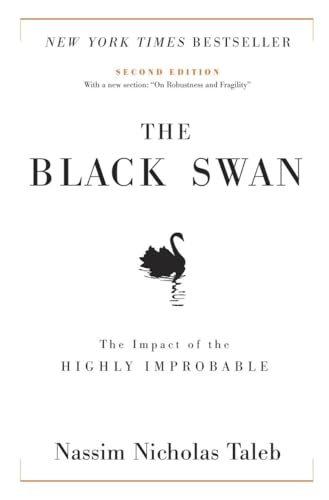
Last week, we introduced Taleb’s definition of black swans; rare, unpredictable ‘unknown unknowns’ in military terms, with major impacts, exploring historical examples that reshaped society post-event. This week I’m going to introduce a fictional black swan and how to react to them but before that the unpredictable part of Taleb’s definition needs some modifications. True black swans by Taleb definition are not only rare but practically non-existent outside of natural disasters such as earthquakes. To discuss a black swan, I am going to change the definition a bit and say these events are unpredictable to most observers but predictable or at least imaginable to some. Taleb would likely call them grey swans. For instance, Sputnik was known to the Soviets, but an intelligence failure and complete surprise to the rest of the world. Nikola Tesla anticipated the iPhone 81 years ahead of time. 9/11 was known to the perpetrators and was an intelligence failure. Staging a significant part of your naval fleet in Pearl Harbor during a world war and forgetting to surveil the surrounding area is not a black swan, just incompetence.

With that tweak out of the way, we’ll explore in Part II where Taleb discusses strategies to mitigate a black (grey) swan’s major impacts with a fictional example. His strategies can be applied to pre-swan events as well as post-swan. Pre-swan planning in business is called contingency planning, risk management, or, you guessed it, black swan planning. They include prioritizing redundancy, flexibility, robustness, and simplicity, as well as preparing for extremes, fostering experimentation, and embracing antifragility.

Imagine a modern black swan: a relentless AI generated cyberattack cripples the Federal Reserve and banking system, wiping out reserves and assets. Industry and services collapse nationwide and globally as capital evaporates, straining essentials, with recovery decades away if ever. After the shock comes analysis and damage reports, then the rebuilding begins.

The Treasury, with no liquid assets, must renegotiate debt to preserve global trust. Defense capabilities are maintained at a sufficient level, hopefully hardened, to protect national security, while the State Department reimagines the world to effectively bolster domestic production and resource independence while keeping the wolves at bay.

Non-essential programs, from expansive infrastructure projects, research, federal education initiatives, all non-essential services are shelved, shifting priorities and remaining resources to maintaining core social and population safety nets like Social Security and Defense. Emergency measures kick in: targeted taxes on luxury goods and wealth are imposed to boost revenue and redirect resources. Tariffs encourage domestic production and independence.

Federal funding to states and localities is reduced to a trickle. States and municipalities must take ownership of essential public services such as education, water, roads, and public safety. The states are forced to retrench and innovate, turning federal scarcity into local progress.

Looking ahead, resilience becomes the first principle. Diversification takes center stage, with the creation of a sovereign wealth fund based on assets like gold, bitcoin, and commodities, bolstered by states that had stockpiled reserves such as rainy-day funds, ensuring financial stability. Local agriculture, leaner industries and a realigned electrical grid, freed from federal oversight, innovate under pressure, strengthening a recovery. Resilience becomes antifragility, the need to build stronger and better in the face of adversity. And finally, the government must revert to its Lockean and Jeffersonian roots, favoring liberty and growth over control, safety, and stagnation: anti-fragility.

Source: The Black Swan by Nassim Nicholas Taleb, 2007. Graphic: The Black Swan hardback cover.

Falcon Heavy

Seven Years ago on 6 February 2018, SpaceX’s Falcon Heavy made its maiden voyage, carrying a Tesla Roadster with Starman in the driver’s seat. The rocket is designed to go beyond low Earth orbit but is not certified to carry any sentient biologics.

Recently, astronomers affiliated with Harvard announced the discovery of an asteroid in an orbit uncomfortably close to Earth. Further research by the red-faced researchers revealed that it was the Tesla roadster launched by SpaceX in 2018. The Tesla is in a heliocentric orbit and is currently on its second trip around the sun, according to Pearson.

To date, Falcon Heavy has inserted 11 payloads into GEO, GTO, HEO, LEO, and heliocentric orbits. It has up to 10 more missions scheduled through 2028. Eventually, the rocket will supposedly be retired when Starship is fully operational.

Source: US News. Person. CNET. Graphic: Falcon Heavy Demo Mission, 2018, copyright SpaceX. Falcon Heavy First Launch 6 February 2018, copyright SpaceX.

Journalism – Denver Post 2024

I’ve been running a weekly post on the shortcomings and biases within the news media complex since April of 2024, starting with Walter Duranty of the New York Times covering for Stalin’s forced collectivization of Ukrainian farms in 1929. Duranty claimed in 1933 that no Ukrainian’s died of starvation even though estimates stated that up to 5 million did die from severe ‘food shortage’ in Timesman’s words.

I’ve attempted to cover just the most egregious and mendacious examples of media malpractice over the last 9 months amounting to about 30 posts spanning about 95 years of print and broadcast journalism. One thing that has become clear over that time is reporting hasn’t improved; fabrications, prevarications, and deceptions still appear to be the currency of the realm. Objective and factual journalism only appears when there are no winners or losers, a rare occurrence indeed.

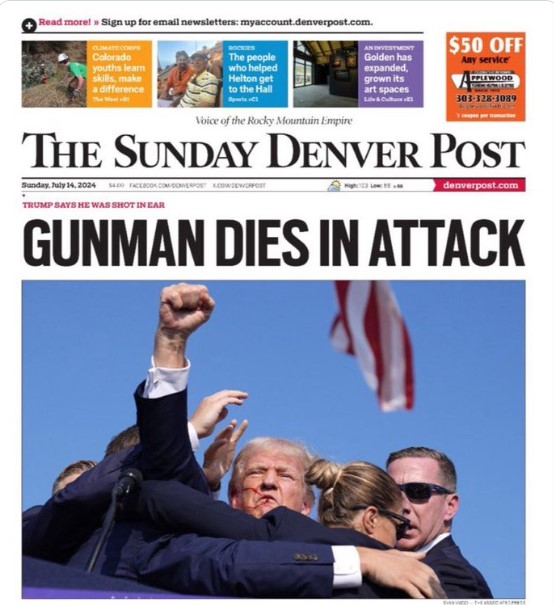
So, let’s start off the new year with the Denver Post’s initial headline documenting the attempt on Trump’s life at his Butler rally on 13 July 2024: “Gunman Dies in Attack.” A major candidate for the presidency is almost killed and the paper’s concern is for the assassin.

After taking considerable flak for that headline the Post scrubbed the headline from their website and replaced it with “Trump is injured but ‘fine’…

Graphic: Front Page Denver Post, via Charlie Kirk, 14 July 2024, X.

Journalism—CNN’s Sycophants for Saddam Hussein 2003

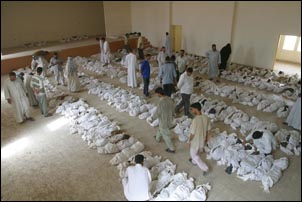
CNN’s news chief in 2003, Eason Jordan, admitted that the network ignored and suppressed Saddam Hussein’s mass killings of his citizens and other crimes against humanity, to keep their access to the Iraqi thug. Jordan said that telling the truth likely would have meant closing their Baghdad bureau. Franklin Foer of the New Republic wrote in The Wall Street Journal: “CNN could have abandoned Baghdad. Not only would they have stopped recycling lies, they could have focused more intently on obtaining the truth about Saddam.”

CNN lied; Iraqis died.

Human Rights Watch has estimated that 250,000 to 290,000 Iraqis were presumed killed under Saddam.

Eason Jordan resigned from CNN in 2005. It wasn’t possible to discover why he wasn’t fired in 2003 for his efforts to aid Saddam Hussein.

Source: The Washington Post. HRW 2003. Franklin Foer, Wall Street Journal 2003.   Graphic: Iraqi Victims Found in a Mass Grave killed under Saddam’s Rule, GWB Whitehouse Archives, 2003.

Journalism – Scott Thomas Beauchamp

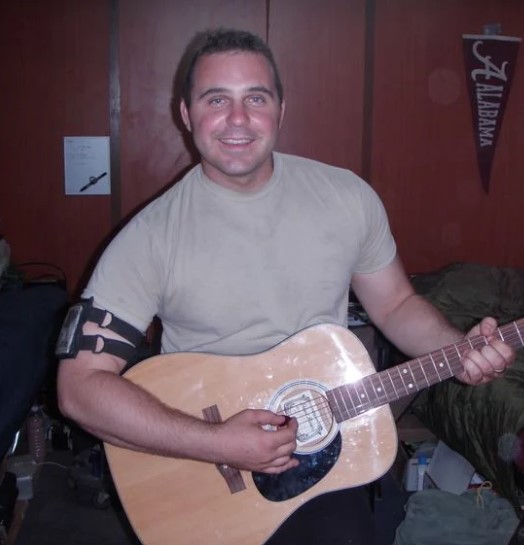
In 2007 The New Republic published three articles by an American Army private, Scott Thomas Beauchamp serving in Iraq titled “Shock Troops”, detailing misdeeds and possible war crimes occurring in and near his forward operating base, Falcon, in Bagdad. The articles were, in part, fact checked by The New Republic Fact-Checker Elspeth Reeve who was also Private Beauchamp’s wife.

Beauchamp claimed that army personnel found mass graves that contained children, and targeted wild dogs for fun, and Beauchamp horribly insulted a woman disfigured by an IED.

The US Army and other news outlets could find no collaboration or substantiation for the events described by Beauchamp. In late 2007 The New Republic stated that they could no longer stand by Beauchamp’s stories.

Reeve is currently a correspondent for CNN. There is no information on the current activities or whereabouts of Beauchamp.

Source:  Fog of War, The New Republic.  Alchetron, 2024. Graphic: Beauchamp by Alchetron, copyright unknown.

Florida Today

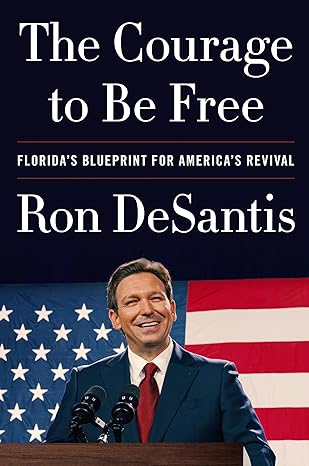
The Courage to Be Free

By Ron DeSantis

Broadside Books

Copyright: © 2023

AmazonPicture

DeSantis Biography and Courage to Be Free:

At the end of the day, I’m fighting for the things I said I’d fight for.” – Ron DeSantis

Courage to Be Free is the Florida governor’s biography with a good measure of politics, vision and American government thrown in. It’s a simple read from someone selling himself as an authentic American and an honest and ethical broker who supports the citizens through good government.

Ron Desantis was born in Jacksonville, Florida in 1978, married Casey Black in 2009, and has three children, two girls and a boy. He attended Yale and graduated in 2001 with a B.A. A year later he entered Harvard and graduated with a law degree in 2005. During law school he was commissioned as an officer in the U.S. Navy. In 2007 he was assigned as a legal advisor to SEAL Team One in Fallujah, Iraq where he was awarded the Bronze Star.

In 2012 he was elected to the U.S. House of Representatives and was re-elected in 2014 and 2016. DeSantis decided not to run for re-election to the House for the 2018 term but instead competed for the Florida governorship which he won. He won re-election in 2022 and as he is term limited by Florida law will not seek that office in 2024. Since he has dropped out of the Presidential race what he does next is an open question.

The first half of Desantis’ book is dedicated to his biography followed by his vision of government and national policy. He draws heavily on the expository essays and articles within the Federalist Papers and their vision for a constitutional republic. The authors of the Federalist Papers, Madison, Hamilton, and Jay argue strenuously for a republican form of government and against direct democracy which one could paraphrase in slang terms as mob rule. DeSantis agrees.

His political philosophy is simple in principle, excoriatingly difficult in execution. Encapsulating his thoughts he states, “The right path forward is not difficult to identify; it just requires using basic common sense and applying core American values…” He follows this up with his blueprint for Florida and America: “Be willing to lead, have the courage of your convictions, deliver for your constituents, and reap the political rewards.” Reaping the political rewards sounds like every politician that has ever walked the face of this Earth and I don’t recognize that as a positive trait.

Literary Criticism:

Courage to Be Free was a number one bestseller in the New York Times, Wallstreet Journal, Amazon, and Publisher’s Weekly shortly after it was released in 2023. Although sales figures are almost impossible to find, for free, the book had an initial print run of 250,000. There hasn’t been a second printing.

Hagiographies are one sided affairs with nary a discouraging word to be found, with sainthood lurking right around the corner. DeSantis autobiography is a hagiography but in fairness one doesn’t provide his opposition with free negative research when your goal is to introduce yourself to the public.

This book had only one purpose, to launch DeSantis into the 2024 presidential Republican primary in the best possible light and as a bonus, get your targeted audience to pay for it by purchasing the book. It admirably accomplishes the task, but it certainly is not a literary masterpiece, rather it reads like a college term paper completed under duress. Simple, direct, with no flowery prose or memorable lines. If you want to learn something about this man, give it perusal, a quick read is all it needs and watch one or two of his Republican primary debates for additional elucidation.

The only reason I read this book was because of the title: The Courage to Be Free. It reminded me of the title of John F. Kennedy’s Profiles in Courage. Kennedy’s book employs a better writing style but that is because Kennedy didn’t author his book. In a previous post I stated who did and I’ll leave it to you to look it up if you are curious. In the end both are about embellishing their respective reputations. Mission accomplished.

References and Readings: