
Shot in the Dark

The Earth orbits the Sun at a brisk 107,000 km/hr (66,486 mi/hr). The Sun, in turn, circles the Milky Way at a staggering 828,000 km/hr (514,495 mi/hr). And deep in the galactic core, stars whirl around the supermassive black hole at relativistic speeds, up to 36 million km/hr (22,369,363 mi/hr). Gravity is the architect and master of this motion: the invisible hand that not only initiates these velocities but binds our galaxy into a luminous spiral of unity.

Except it shouldn’t. Not with the piddling amount of mass that we can see.

The Milky Way contains 60-100 billion solar masses, an impressive sum, but a puny, gravitationally insufficient amount. With only that amount of ordinary matter, the galaxy would disperse like dry leaves in a breeze. Its stars would drift apart, its spiral arms dissolve, and the universe itself would remain a diffuse fog of light and entropy, never coalescing into structure or verse. No Halley’s Comet. No seasons. No Vivaldi.

To hold the Milky Way together at its observed rotation speeds requires about 1.4 trillion solar masses, seven times the visible amount. And we know this mass is there not because we’ve seen it, but because the galaxy exists. Much like Descartes’ Cogito, ergo sum (“I think, therefore I am”), we reason: The Milky Way is; therefore, it must possess sufficient mass.

The problem is that 85% of that mass is missing; from view, from touch, from detection. Enter stage right: Dark Matter. It does not emit, absorb, or reflect light. It does not interact with ordinary matter in any known way. It is invisible, intangible, a Platonic ether of shadow reality. Without it, the sacrament of gravity and being floats away like a balloon on a huff and puff day. And the universe loses its meaning.

Much like the neutrino, predicted by theory, is a particle once postulated to preserve the sanctity of conservation laws, a piece of the quantum world long before it was ever seen. Dark Matter is another elusive phantom, inferred by effect, but physically undetected. Dark Matter bends light, sculpts galaxies, and governs gravitational dynamics, yet it inhabits a metaphysical realm that requires faith to make it real. Unlike the neutrino, it lacks a theoretical platform. The General Theory of Relativity insists it must have mass; the Standard Model offers it no space. It is an effect without a cause: a gravitational fingerprint without a hand.

Yet, physicists are trying to tease it out, not so much to grasp a formless ghost, but rather to catch a glimpse of a wisp, a figment, without knowing how or where to look. To bring light to the dark one must grope around for a switch that may or may not exist.

Researchers at the University of Zurich and the Hebrew University of Jerusalem have devised an experiment called QROCODILE: Quantum Resolution-Optimized Cryogenic Observatory for Dark matter Incident at Low Energy (One can only guess at the amount of time and gin the Docs spent on that acronym 😊) to help tease out the existence of Dark Matter.

The experiment is designed to detect postulated ultralight dark matter particles that may interact with ordinary matter in currently unfathomable ways. To find these particles they have built a detector of superconducting nanowire sensors, cooled to near absolute zero, that achieves an astounding sensitivity to detect an infinitesimally small mass of 0.11 electron-volts (eV).

0.11 eV is roughly the energy difference between two quantum states in a molecule. An imperceptible shiver in the bond between two hydrogen atoms: a mass so slight, it might provoke a murmur of dark matter itself.

Using this detector over a 400-hour run (16.66 days) the team recorded a handful of unexplained signals that are real but not necessarily dark matter. Eventually they hope to achieve detections that resolve directionality, helping distinguish dark matter from background noise. The next phase of the experiment: NILE QROCODILE, (groan*) will move the detectors underground to reduce cosmic interference.

QROCODILE is a shot in the dark. It’s an epistemological paradox: how do you build a detector for something you don’t understand? How, or why, do you build an energy detector for a substance, if it is indeed a substance, that doesn’t emit or absorb energy.

While dark matter is known through its gravitational pull, that detection at a particle level is infeasible. Energy detectors, then, are a complementary strategy, betting on weak or exotic interactions beyond gravity.

Whether it finds Dark Matter or not, QROCODILE reminds us that science begins not with certainty, but with the courage to ask questions in the dark, and the craftsmanship to build instruments that honor the unknown.

* NILE QROCODILE: an acronym that evokes remembrance of the socially awkward Dr. Brackish Okun, a secluded researcher of aliens and their tech at Area 51 in the 1996 movie Independence Day.

Source: …Dark Matter Search with QROCODILE… by Laura Baudis et al, Physical Review Letters, 2025. Graphic: Nile Crocodile Head by Leigh Bedford, 2009. Public Domain.
A New Center

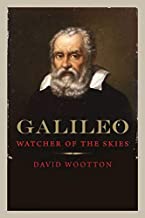
Galileo: Watcher of the Skies

By David Wootton

Published by Yale University Press

Copyright: © 2010

David Wootton, age 71, is the Anniversary Professor (a named professor in the British system is equivalent to a full professor in the American system…I believe) of History at the University of York in England. His work ranges from the history of the individual to the wider-ranging histories, and philosophies of ideas that shaped our world. His published interests concentrate on the Renaissance but stretch back to the Greeks and forward to the embryonic American experiment. He is an old-school historian with his scholarship supported by the evidence available coupled with the existing mores of the times. His selection of topics that I have read or perused suggests a thorough dearth of confidence in past historical interpretations and a jaundiced view of present sense and sensibilities. Or more succinctly and in his own words, “History is always about a particular time, a particular place; it is always about groups more than it is about individuals; it is always the history of somewhere.” and if I may so boldly add, it is always the history of (some)time.

Wootton’s written works (books) include:

Wootton’s lectures and pop culture additions include:

Wootton’s biography of Paolo Sarpi, a contemporary and patron of Galileo, likely provided, albeit 27 years later, the impetus and scholarship for Wootton publishing his second biography in 2006 on that aforementioned watcher of the skies. Sarpi, a devout Copernican and a supposedly not so devout Catholic supported Galileo’s heliocentric theories and shielded him, for a time, from his Roman inquisitors. Parenthetically, Wootton in his book on Galileo almost apologizes for writing biographies mainly because his peers look down on the genre, a sentiment I used to harbor but I now appreciate the category because they provide the who to the what, where, and when.

Bad Medicine, Wootton’s second book, postulates that doctors have dispensed more harm than good, beginning with Hippocrates in the fifth century B.C and continuing through to the present day. Covid or the Wuhan Flu pandemic will not provide the medical profession with the needed catharsis to dispel Wootton’s conjecture.

In The Invention of Science Wootton walks us through the birth of the scientific method starting with a supernova shining in the Renaissance night sky of the 1500s and culminating with Newton’s discovery that visible light contains a plethora, or at least 7 wavelengths and hues in the early 1700s.

In Power, Pleasure, and Profit, Wootton expands on the concept of selfishness driving all human progress. A concept, although anathema to all Christian and Western ethics and morality, was espoused by Machiavelli’s The Prince, published in the early 1500s and Mandeville’s The Fable of the Bees, also known as The Grumbling Hive, first published in 1705.

Wootton’s Besterman Lecture: Adam Smith, Poverty, and Famine, we find out that charity is not a word in Smith’s vocabulary. Academics and maybe the rest us can really get into the weeds.

And finally, before I get into Galileo, The BBC devoted 40 minutes interviewing four guests, Wootton being one of them, on The Fable of the Bees, written initially as a poem, as stated above, by Bernard Mandeville and expanded into a book length dissertation sub-titled Private Vices, Publick Benefits which proposes that personal pleasure and greed drive human progress not altruism or Christian charity.

Galileo, born in the small city of Pisa, Italy in 1564, lived to the astronomical age of 77, some 25 years beyond the average lifespan for that era. He spent his final years blind, serving a life sentence, originally in a papal prison but eventually the prison was exchanged for confinement to his home located in a small village outside of Florence. His crime was for authoring a book defending the heliocentric model of the universe as theorized by Copernicus in 1543 rather than promoting the geocentric model as demanded by the Catholic Church.

Galileo was a tinkerer and thinker more akin to our modern definition of an engineer rather than a scientist, taking innovative ideas and novel inventions to the next level. He didn’t invent the telescope, Hans Lippershay of the Netherlands in 1608 did, but Galileo’s design quickly became the standard and he eventually increased Lippershay’s 3x magnification to 23-30x. His leaden tube with a convex lens in one end and concave lens in the other end discovered the mountains and plains of the moon, the moons of Jupiter, the rings of Saturn, the phases of Venus, possibly the planet Neptune, individual stars of the Milky Way, and sunspots. Today we can purchase a 30x set of binoculars for less than $100 which we use to peep through our neighbors’ windows and watch songbirds in the meadow across the street. All his discoveries aided in the proof of a heliocentric universe, his universe being mostly what we would refer to today as the solar system. Our discoveries prove that our neighbors are weird.

Galileo was a fascinating man and genus who introduced the world to a new way of advancing our knowledge of the world and the universe. His tinkering and thinking were the rudimentary beginnings of what we now call the scientific method–observe, hypothesize, test, repeat.

His proof of Copernicus’ theory was mostly correct. The Church’s defense of the geocentric model wasn’t. The Church admitted their error in 1992.