Sarcasm Slightly Cold

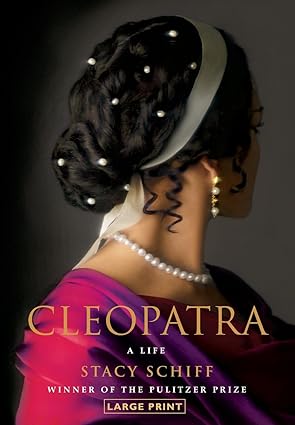
Stacy Schiff, biographer of Cleopatra VII and history of Egypt and Rome during her reign as Egypt’s queen is an entertaining writer with a sardonic sense of humor.

Wit of Schiff I: Cleopatra and Mark Anthony, after a three-year separation, reunited in 37 BC in Antioch. They rekindle their relationship, Cleopatra becomes pregnant, and they part again in early 36 BC, he for a military campaign in Parthia and she to go south to meet with Herod in Jerusalem.

In the course of the visit she met Herod’s fractious extended family…Herod had the misfortune to share an address with several implacable enemies, first among them his contemptuous, highborn mother-in-law, Alexandra…his insinuating mother; a grievance-loving, overly loyal sister; and Mariamme, the cool, exceptionally beautiful wife…who to his frustration, somehow could never get past the fact that Herod had murdered half her family.

Wit of Schiff II: Mark Anthony after conquering Armenia, which included parts of modern Turkey and Azerbaijan, in 34 BC, “returned to Alexandria in triumph, taking with him not only the collected treasure of Armenia, but its King, his wife, their children, and the provincial governors. Out of deference to their rank, he bound the royal family in chains of gold.

Trivia: No good, confirmed likenesses of either Cleopatra or Herod exist. Recently a bust from the Egyptian Taposiris Magna temple near Alexandria has been recovered which the archaeologist, Kathleen Martinez claims is a likeness of Cleopatra. Other experts disagree.

Source: Cleopatra: A Life by Stacy Shiff, 2010. Marble Bust Found, Gadgets 360, 2024.
A Little Package of our Past

World History: 50 Key Milestones You Really Need to Know B 50 History

Written by:  Ian Crofton

Published by:  Quercus

Copyright:  © 2011

Attempting to describe 12-15,000 years, since the big ice fields melted, of human endeavors in 200 pages and 50 topics would seem presumptuous and futile, and you would be right, but one has to start somewhere and the first steps can and should be small but decisive.  One can quibble about the exact 50 topics, and I will do just that in a bit, but the author, Ian Crofton, performs the task with aplomb, and provides the maximum amount of useful information possible given the limiting format.

This book is a quick and fun read for both those without a broad or deep introduction to human history or those that just want to refresh their memory on once familiar, but long forgotten topics. Even if you are familiar with all the topics in the book there will be a sufficient amount of new informational tidbits to make it worth your time. For myself, as one example, I found the observation that our ancestral hunter-gather cousins versus the first cereal grain farmers, were healthier, due mainly to their higher protein intake from a meat rich diet, was new and interesting.

Each “idea” or event is developed, chronologically, over 4 printed pages that includes a short thesis, an expansion of that thesis, a timeline of notable events, a famous quote(s) and an ending synopsis of the discussion.  The publisher of this book, Quercus, has published at least 27 other books of a similar nature and format that explore the great topics of the human experience including: architecture, art, astronomy, big ideas, biology, chemistry, the digital world, earth, economics, ethics, the future, genetics, the human brain, literature, management, math, philosophy, philosophy of science, physics, politics, psychology, quantum physics, religion, science, universe, war, and world history. I believe they continue to add more topics as the years go by.  I have several of the topics, listed above on my already too fat reading list.

Not to detract from the topics that the author has chosen, his are all defendable, but for myself I probably would have included 5 different topics devoted to: the Iron Age, Israelites of the 12th century BC, 1st century Christianity, Sumerians development of an alphabet in 300 BC coupled with Guttenberg’s first printing press in the 15th century AD, 18th century BC Babylonian Hammurabi’s, and 7th century BC Greek Draco’s legal codifications, and finally the advent of computers in the 20th century and beyond.  Adding 5 topics requires that 5 be removed. I would likely leave out: Empires and Kingdoms of Africa, The Bubonic Plague, the Vietnam War, integral to the late 20th century US, but will likely be a footnote on communism in the future, and lastly, the Arab-Israeli conflict and the post 9-11 topics, at a minimum, combined into a topic on 21st century divisions in civilization and culture, as if that were something new. On further thought, maybe just leave those last two topics out completely, mainly because they are too fresh to decide their seminality to our future development as a species.

That leaves our list one shy of 50. What topic(s) would you add?