Beginnings

A recent ScienceDaily write‑up titled “Scientists just found the hidden cosmic fingerprints of dark matter” suggests a breakthrough in the elusive substance that binds galaxies together. In reality, the study reports that Lyman‑Alpha emitters are a transient phenomenon, interesting, but nowhere near the revolutionary advance implied by the headline.

For readers uninitiated in cosmology and astrophysics, that’s a lot of jargon at once. So let’s bring it down a notch with some plain definitions.

Dark matter is the invisible mass that holds galaxies together through gravity. Without it, galaxies would fly apart. We infer its existence only because galaxies behave as they do. It makes up about 27% of the universe’s total energy density. By comparison, ordinary matter, the stuff we can see and measure, accounts for a measly 5%. Dark energy, the mysterious driver of cosmic acceleration, contributes about 68%. But that’s a story for another day.

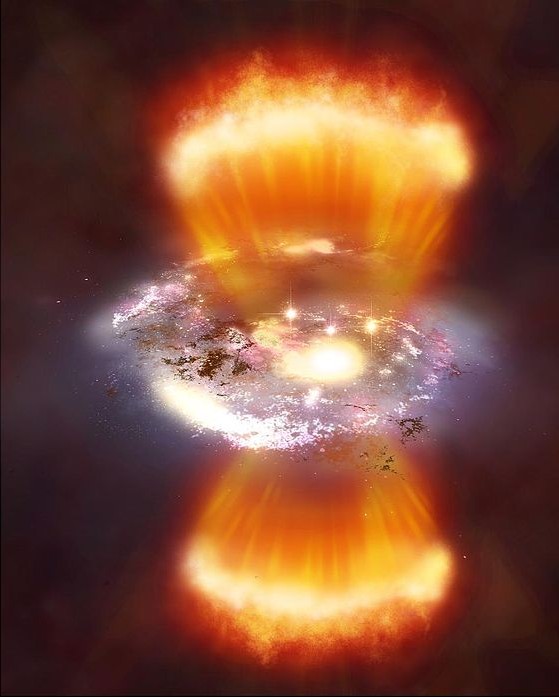
Lyman‑Alpha emitters (LAEs) are distant, generally low‑mass galaxies that shine in Lyman‑alpha radiation: ultraviolet light produced when a hydrogen electron drops from the second energy level to the ground state (n=2 → n=1). Because this light is strongly redshifted by cosmic expansion, LAEs act as beacons of the early universe. Observing the ones implied in the opening science press headline means looking back to a time when the cosmos was less than a billion years old.

Scientists examine the clustering of LAEs across three epochs, each marking a milestone in cosmic evolution, a page from the manuscript of creation. At a redshift of 6, when the universe was about 0.9 to 1.0 billion years old, roughly 12.8 billion years ago, the first galaxies and stars were re‑ionizing neutral hydrogen, lifting the primordial fog and making the universe transparent. This period is known as the Epoch of Reionization.

The next epoch, at a redshift of 5.7 (about 100 million years later, or 12.7 billion years ago), is called the Late Reionization / Transition Epoch. Here, scientists measure how quickly the fog of neutral hydrogen dissipated and how galaxies began to cluster. Clustering serves as a proxy for the gravitational wells of dark matter, which drew in and anchored ordinary matter.

Finally, at a redshift of 3, around 11.8 billion years ago, the Post‑Reionization Epoch reveals a more mature universe with large‑scale structures taking shape. LAEs in this era trace galaxy clustering and help infer the masses of the dark matter halos they inhabit. These halos are vast, spherical envelopes of unseen matter surrounding galaxies and clusters.

With this groundwork, we return to the science press claim that researchers have found the “fingerprints” of dark matter itself. In truth, the fingerprints show no loops or swirls, no identification of what dark matter is or how it is distributed, only confirmation of what is already established. Without dark matter, galaxies would not exist. It is, in essence, a Cartesian maxim: I gather, therefore I am. Nothing more. Nothing less.

There was, however, a genuine insight. Lyman‑alpha emitters are transient, short‑lived luminous phases in galaxies that trace the framework of dark matter. The clustering function does not reveal dark matter’s nature; it just shows how rarely baryonic light, the real stuff of frogs, men, and cybertrucks aligns with gravitational tugs.

This raises a deeper question: why does dark matter clump at all, instead of remaining uniform across the cosmos? The answer lies in gravitational instability. Minute quantum fluctuations in the infant universe were stretched to cosmic scales by inflation, imprinting faint density variations, ripples in spacetime itself (if time exists is another a question for a different day). Cold, non‑interacting dark matter streamed into these wells, not merely seeking density but becoming it, deepening the imprints and laying the invisible scaffolding upon which galaxies and clusters would later rise. In turn, the growing clumps reinforced the very variations that seeded them, a feedback loop that sculpted the universe’s large‑scale structure. Quantum fractures first, dark matter responding.

And yet another knot: where did dark matter come from? If it does not interact, how could it be born from interaction? Perhaps it is not a product of the Big Bang at all. Did it exist outside the Bang, or was it a transformation from an earlier state?

Unto the spirit of dark energy, the expansive gust that stretches spacetime, accelerating the universe’s drift into an ever‑expanding horizon. If dark matter is transformation, is dark energy its continuation, or merely a phase toward dissolution?

Together they form a cosmic tension: cohesion and dispersal, gathering and vanishing. The Big Bang may not be the beginning, but only the first visible flare in a manuscript already dictated eons before the dawn.

In this reframing, baryonic matter: atoms, stars, flesh, machines, is a late arrival. Bone, blood, and silicone are ritual sparks, flaring briefly in the gravitational wells carved by dark matter and stretched by dark energy. We are not the fathers of the universe, but the children of a violent past.

Dark matter is the glue. Dark energy erases the image. We are but the punctuation; marks in a manuscript whose lines were written long before our arrival.

Source: …Fingerprints of Dark Matter, Science Daily, Sept. 2025. ODIN: Clustering Analysis… by Herrera et al, Astrophysical Journal Letters, 2025. Graphic: Lyman-Alpha Galaxy Up Close Illustration by M. Wiss, 2009. Public Domain

Shot in the Dark

The Earth orbits the Sun at a brisk 107,000 km/hr (66,486 mi/hr). The Sun, in turn, circles the Milky Way at a staggering 828,000 km/hr (514,495 mi/hr). And deep in the galactic core, stars whirl around the supermassive black hole at relativistic speeds, up to 36 million km/hr (22,369,363 mi/hr). Gravity is the architect and master of this motion: the invisible hand that not only initiates these velocities but binds our galaxy into a luminous spiral of unity.

Except it shouldn’t. Not with the piddling amount of mass that we can see.

The Milky Way contains 60-100 billion solar masses, an impressive sum, but a puny, gravitationally insufficient amount. With only that amount of ordinary matter, the galaxy would disperse like dry leaves in a breeze. Its stars would drift apart, its spiral arms dissolve, and the universe itself would remain a diffuse fog of light and entropy, never coalescing into structure or verse. No Halley’s Comet. No seasons. No Vivaldi.

To hold the Milky Way together at its observed rotation speeds requires about 1.4 trillion solar masses, seven times the visible amount. And we know this mass is there not because we’ve seen it, but because the galaxy exists. Much like Descartes’ Cogito, ergo sum (“I think, therefore I am”), we reason: The Milky Way is; therefore, it must possess sufficient mass.

The problem is that 85% of that mass is missing; from view, from touch, from detection. Enter stage right: Dark Matter. It does not emit, absorb, or reflect light. It does not interact with ordinary matter in any known way. It is invisible, intangible, a Platonic ether of shadow reality. Without it, the sacrament of gravity and being floats away like a balloon on a huff and puff day. And the universe loses its meaning.

Much like the neutrino, predicted by theory, is a particle once postulated to preserve the sanctity of conservation laws, a piece of the quantum world long before it was ever seen. Dark Matter is another elusive phantom, inferred by effect, but physically undetected. Dark Matter bends light, sculpts galaxies, and governs gravitational dynamics, yet it inhabits a metaphysical realm that requires faith to make it real. Unlike the neutrino, it lacks a theoretical platform. The General Theory of Relativity insists it must have mass; the Standard Model offers it no space. It is an effect without a cause: a gravitational fingerprint without a hand.

Yet, physicists are trying to tease it out, not so much to grasp a formless ghost, but rather to catch a glimpse of a wisp, a figment, without knowing how or where to look. To bring light to the dark one must grope around for a switch that may or may not exist.

Researchers at the University of Zurich and the Hebrew University of Jerusalem have devised an experiment called QROCODILE: Quantum Resolution-Optimized Cryogenic Observatory for Dark matter Incident at Low Energy (One can only guess at the amount of time and gin the Docs spent on that acronym 😊) to help tease out the existence of Dark Matter.

The experiment is designed to detect postulated ultralight dark matter particles that may interact with ordinary matter in currently unfathomable ways. To find these particles they have built a detector of superconducting nanowire sensors, cooled to near absolute zero, that achieves an astounding sensitivity to detect an infinitesimally small mass of 0.11 electron-volts (eV).

0.11 eV is roughly the energy difference between two quantum states in a molecule. An imperceptible shiver in the bond between two hydrogen atoms: a mass so slight, it might provoke a murmur of dark matter itself.

Using this detector over a 400-hour run (16.66 days) the team recorded a handful of unexplained signals that are real but not necessarily dark matter. Eventually they hope to achieve detections that resolve directionality, helping distinguish dark matter from background noise. The next phase of the experiment: NILE QROCODILE, (groan*) will move the detectors underground to reduce cosmic interference.

QROCODILE is a shot in the dark. It’s an epistemological paradox: how do you build a detector for something you don’t understand? How, or why, do you build an energy detector for a substance, if it is indeed a substance, that doesn’t emit or absorb energy.

While dark matter is known through its gravitational pull, that detection at a particle level is infeasible. Energy detectors, then, are a complementary strategy, betting on weak or exotic interactions beyond gravity.

Whether it finds Dark Matter or not, QROCODILE reminds us that science begins not with certainty, but with the courage to ask questions in the dark, and the craftsmanship to build instruments that honor the unknown.

* NILE QROCODILE: an acronym that evokes remembrance of the socially awkward Dr. Brackish Okun, a secluded researcher of aliens and their tech at Area 51 in the 1996 movie Independence Day.

Source: …Dark Matter Search with QROCODILE… by Laura Baudis et al, Physical Review Letters, 2025. Graphic: Nile Crocodile Head by Leigh Bedford, 2009. Public Domain.

Cosmos of the Lonely

The universe keeps expanding. When researchers analyze data from the Hubble and James Webb telescopes, alongside a suite of other astronomical tools, they find that the recessional velocity of galaxies, the speed at which they appear to move away from the Earth, varies depending on what they measure.

If they calibrate distances deep into the cosmos using Cepheid variable stars, the expansion rate appears faster than when they use red giant stars or the Cosmic Microwave Background (CMB). This discrepancy, known as the Hubble tension, reveals a deeper mystery: different cosmic yardsticks yield different rates of expansion.

Yet despite the disagreement in values, all methods affirm the same truth: space is stretching…a lot…like a sheet pulled and stretched taut between Atlas’s burden and Hermes flight: a cosmos caught between gravitational pull and a mysterious push: Pushmi-Pullyu on a cosmic scale.

To understand why the cosmos resembles a sheet of rubber we need to travel back about 110 years and peer into the minds of those who first saw increasing separation as a universal law. These new architects of reality: Einstein, Friedmann, Lemaitre; who replaced Newton’s planetary, static models of the cosmos with a dynamic spacetime of bends, ripples, and persistent expansion.

After Einstein published his General Theory of Relativity in 1915, Russian physicist Alexander Friedmann’s analysis of his work showed that the universe could be expanding, and that Einstein’s equations could be used to calculate the rate. In 1927 Belgium priest and physicist Georges Lemaitre proposed that the expansion might be proportional to a galaxy’s velocity relative to its distance from Earth. By 1929, American astronomer Edwin Hubble expanded on Lemaitre’s work and published what became known as Hubble-Lemaitre law: galaxies are moving away from us at speeds proportional to their distance. The greater the distance the faster the speed.

A key feature of this law is the Hubble constant, the proportionality that links velocity and distance. Hubble’s initial estimate for this constant was whopping, and egregiously off, 500 kilometers per second per megaparsec (km/s/Mpc), but as measurements improved, it coalesced around a range between 67 and 73, with the most recent value at 70.4 km/s/Mpc, published by Freedman et al. in May 2025.

The Hubble constant is expressed in kilometers per second per megaparsec. The scale of these units is beyond human comprehension but let’s ground it to something manageable. A megaparsec is about 3.26 million light-years across, and the observable universe, though only 13.8 billion light-years old, has stretched to 46 billion light-years in radius, or 93 billion light-years in diameter, due to the expansion of space (see mind warping explanation below).  

To calculate the recessional velocity across this vast distance, we first convert 46 billion light-years into megaparsecs: which equates to 14,110 megaparsecs. Applying Hubble’s Law: 70 km/s/Mpc times 14,110 Mpc equals 987,700 km/s. This is the rate at which a galaxy 46 billion light-years away would be receding relative to another galaxy one megaparsec closer to Earth.

That’s more than three times the speed of light (299,792 km/sec) or Warp 3 plus in Star Trek parlance. Einstein said this was impossible but fortunately there is some nuance that keeps us in compliance with Special Relativity (or else the fines would be astronomical). This isn’t the speed of a galaxy moving through space, but the speed at which space between galaxies is expanding. Which, admittedly, is terribly confusing.

The speed of a galaxy, composed of matter, energy, and dark matter, must obey Einstein’s rules: gravity and Special Relativity. And one of the rules is that the speed of light is the cosmic speed limit, no one shall pass beyond this.

But space between the galaxies decides to emphasize the rules in a different order. The expansion of space is still governed by Einstein’s equations, just interpreted through the lens of spacetime geometry rather than the motion of objects. This geometry is shaped by, yet not reducible to, matter, energy, and dark matter.

Expansion is a feature of spacetime’s structure, not velocity in the usual sense, and thus isn’t bound by the speed of light. If space wants to expand, stretch, faster than a photon can travel, well so be it.

The space between galaxies is governed by dark energy and its enigmatic rules of geometry. Within galaxies, the rules are set by dark matter, and to a lesser extent by matter and energy, even though dark energy is likely present, its influence at galactic scales is minimal.

Note the use of the word scale here. Galaxies are gigantic, the Milky Way is 100,000-120,000 light-years in diameter. But compared to the universe at 93,000,000,000 light-years across, they’re puny. You would need 845,000 Milky Ways lined up edge-to-edge to span the known universe.

Estimates of the number of galaxies in the universe range from 100 billion to 2 trillion. So, at the scale of the universe, galaxies are mere pinpoints of light; blips of energy scattered across the ever-expanding heavens.

This brings us to dark energy, the mysterious force driving cosmic expansion. No one knows what it is, but perhaps empty space and dark energy are the same. There’s even some speculation, mostly mine, that dark energy is a phase shift of dark matter. A shift in state. A triptych move from Newtonian physics to Quantum Mechanics to…Space Truckin’.

In the beginning moments after the big bang, the universe was dominated by radiation composed of high energy particles and photons. As the universe cooled, the radiation gave way to matter and dark matter. As more time allowed gravity to create structures, black holes emerged and a new force began to dominate, dark energy. But where did the dark energy come from? Was it always part of the universe or did it evolve from other building blocks. Below are a few speculative ideas floating around the cosmic playroom.

J.S. Farnes proposed a unifying theory where dark matter and dark energy are aspects of a single negative mass fluid. This fluid could flatten galaxy rotation curves and drive cosmic expansion, mimicking both phenomena simultaneously.

Mathematicians Tian Ma and Shouhong Wang developed a unified theory that alters Einstein’s field equations to account for a new scalar potential field. Their model suggests that energy and momentum conservation only holds when normal matter, dark matter, and dark energy are considered together.

Ding-Yu Chung proposed a model where dark energy, dark matter, and baryonic matter emerge from a dual universe structure involving positive and negative mass domains. These domains oscillate and transmute across dimensions.

These ideas all rotate around the idea that reality revolves around a concept that everything evolves and that matter and energy, of all forms, flickers in and out of existence depending on dimensional scaffolding of space and the strength of gravity and radiation fields.  Rather than radiation, energy, matter, dark matter, and dark energy as separate entities, these may be expressions of a single evolving field, shaped by phase transitions, scalar dynamics, or symmetry breaking.

Now back to my regularly scheduled program. In August 2025, Quanta Magazine reported on a study led by Nobel laureate Adam Riess using the James Webb Telescope (JWST) to measure over 1,000 Cepheid variable stars with unprecedented precision. Cepheid stars pulsate in brightness over time with a highly predictable rate or rhythm, making them ideal cosmic yardsticks. Riess’s team found a Hubble constant of ~73.4 km/s/Mpc, consistent with previous Hubble Space Telescope measurements of Cepheid stars but still significantly higher than what theory predicts.

That theory comes from the standard model of cosmology: Lambda Cold Dark Matter. According to this framework photons decoupled from the hot electron-proton opaque soup about 380,000 years after the Big Bang went boom, allowing light to travel freely for the first time, and allowing space to be somewhat transparent and visible. This event produced the Cosmic Microwave Background (CMB).

This CMB permeates the universe to this day. It was discovered in 1964 by Bell Lab physicists Arno Penzias and Robert Wilson, who were trying to eliminate background noise from their radio antenna. The noise turned out to be the faint afterglow from the Big Bang, cooled down from its original 3000 Kelvin to a frosty 2.7 Kelvin. They received the Nobel Prize in Physics for this discovery in 1978.

Light from the CMB, as measured by the European Space Agency Planck satellite, has a redshift of approximately 1100, meaning the universe has expanded by a factor of 1100 over the past 13.42 billion years. By analyzing the minute temperature fluctuations in the CMB, Planck can infer the density of matter, dark energy, and curvature of the universe. Inserting these parameters into the Lambda Cold Dark Matter model yields a Hubble constant which turns out to be 67.4 + 1.71 (65.69-69.11). This value is considered the gold standard. Values beyond the Planck measurement are not necessarily wrong, just not understood.

At first glance, the difference between Planck’s 67.4 and Riess’ 73.4 may seem small. But it is cosmically significant. Two galaxies 43 billion light-years away and 3.26 billion light-years apart (1000 Mpc) would have a velocity difference of 6000 km/s or about 189 billion kilometers of increased separation per year. That’s the scale of what small differences in the value can add up to and is referred to as the Hubble tension.

Meanwhile, a competing team of researchers studying red branch and giant branch stars consistently scored the Hubble constant closer to the theoretical prediction of 67.4. This team led by Wendy Freedman believes that Hubble tension, the inability of various methods of measuring the Hubble constant to collapse to a single value, is a result of measurement errors

While some researchers, Wendy Freedman and others, suggest lingering systematic errors may still be at play, the persistence of this discrepancy, across instruments, methods, and team, has led others to speculate about new physics. Among the most provocative ideas: the possibility that the universe’s expansion rate may vary depending on direction, hinting at anisotropic expansion and challenging the long-held assumption of cosmic isotropy. But this seems far-fetched and if true it would likely break the Lambda Cold Dark Matter model into pieces.

And so, the cosmos grows lonelier. Not because the galaxies are fleeing, but because space itself is stretching, a wedge governed by the geometry of expansion. The further they drift apart, the less they interact, a divorce from neglect rather than malice. In time, entire galaxies will slip beyond our cosmic horizon, receding faster than light, unreachable even in principle. A cosmos of the lonely.

Source: The Webb Telescope Further Deepens the Biggest Controversy in Cosmology by Liz Kruesi, Quanta Magazine, 13 August 2024. JWST Observations Reject Unrecognized Crowding of Cepheid Photometry as an Explanation for the Hubble Tension at 8σ Confidence by Riess et al, The Astrophysical Journal Letters, 6 February 2024. Graphic: Cosmic Nebula by Margarita Balashova.

Life, the Universe, and Everything: Speculative Musings on the Cutting Edge of Physics

The Higgs boson, theorized in the 1960s, is a massive quantum particle central to the Standard Model of particle physics. It arises from the Higgs field, an invisible sea permeating all of space, which gives fundamental particles, like electrons and quarks, their mass. Unlike electromagnetic fields, created by moving charges like protons, the Higgs field exists everywhere, quietly shaping the universe. In 2012, CERN’s Large Hadron Collider detected the Higgs boson, confirming the field’s existence. While the boson is observable, the field remains invisible, known only by its effects on particle masses.

The Higgs field assigns mass, but gravity governs how that mass behaves across the vast scales of spacetime. Blending gravity with quantum mechanics, which includes the Higgs field, requires a yet-undiscovered theory of quantum gravity. If successful, quantum gravity might untangle physics-defying singularities, points of extreme density, into structured, comprehensible forms. Some theorize it could also reveal how early radiation morphed into matter, possibly influencing the formation and behavior of mysterious dark matter and its potential link to dark energy.

Before the Big Bang, some picture a singularity, a point of extreme density, though not necessarily infinite matter, where known physics and spacetime break down. Quantum gravity, however, hints this wasn’t truly infinite but a transition phase. From what? Perhaps a prior universe or a chaotic quantum state, science doesn’t yet know. This shift, possibly tied to the Higgs field, may have sparked quantum fluctuations, birthing radiation, matter, and the cosmic structure we see today.

What if the universe is cyclic, not a one-time burst? Instead of a singular Big Bang, some speculate a “bounce”, a transition where spacetime contracts, then expands again. Early on, energetic radiation like photons cooled and condensed into heavy particles, or fermions, a million times heftier than electrons. Some theorize these fermions underwent chiral symmetry breaking, like a spinning top wobbling one way instead of both, potentially forming cold dark matter, though evidence is sparse. This invisible web of dark matter stabilized galaxies, keeping them from spinning apart.

The Higgs field might have shaped dark matter by influencing the mass of early fermions, but this link is speculative, lacking direct proof. Dark matter, in turn, may be evolving. If it slowly decays or transitions into dark energy, as some hypothesize, it could drive the universe’s accelerating expansion. Ordinary matter, atoms, molecules, and radiation, also formed via the Higgs field, while energy, mostly electromagnetic radiation, fuels cosmic evolution. These pieces dance within a framework shaped by the Higgs, elusive quantum gravity, and the subtle interplay of dark matter and dark energy.

Could radiation, dark matter, and dark energy be different faces of a single, evolving force? Radiation transitioning to dark matter gradually shifting into dark energy, the universe might unravel, leaving isolated stars drifting in an endless void. Then, fluctuations in the Higgs field and quantum gravity could trigger contraction, setting the stage for another bounce. Rather than destruction, this might be a cosmic recycling, a continuous interplay of forces across time: Life, the Universe, and Everything.

Source: CDM Analogous to Superconductivity by Liang and Caldwell, May 2025, APS.org. Graphic: Cosmic Nebula by Margarita Balashova.
Web of Dark Shadows

Cold Dark Matter (CDM) comprises approximately 27% of the universe, yet its true nature remains unknown. Add that to the 68% of the universe made up of dark energy, an even greater mystery, and we arrive at an unsettling realization: 95% of the cosmos remains unexplained.

Socrates famously said, “The only thing I know is that I know nothing.” Over two millennia later, physicists might agree. But two researchers from Dartmouth propose a compelling possibility: perhaps early energetic radiation, such as photons, expanded and cooled into massive fermions, which later condensed into cold dark matter, the invisible force holding galaxies together. Over billions of years, this dark matter may be decomposing into dark energy, the force accelerating cosmic expansion.

Their theory centers on super-heavy fermions, particles a million times heavier than electrons, which behave in an unexpected way due to chiral symmetry breaking: where mirror-image particles become unequally distributed, favoring one over the other. Rather than invoking exotic physics, their model works within the framework of the Standard Model but takes it in an unexpected direction.

In the early universe, these massive fermions behaved like radiation, freely moving through space. However, as the cosmos expanded and cooled, they reached a critical threshold, undergoing a phase transition, much like how matter shifts between liquid, solid, and gas.

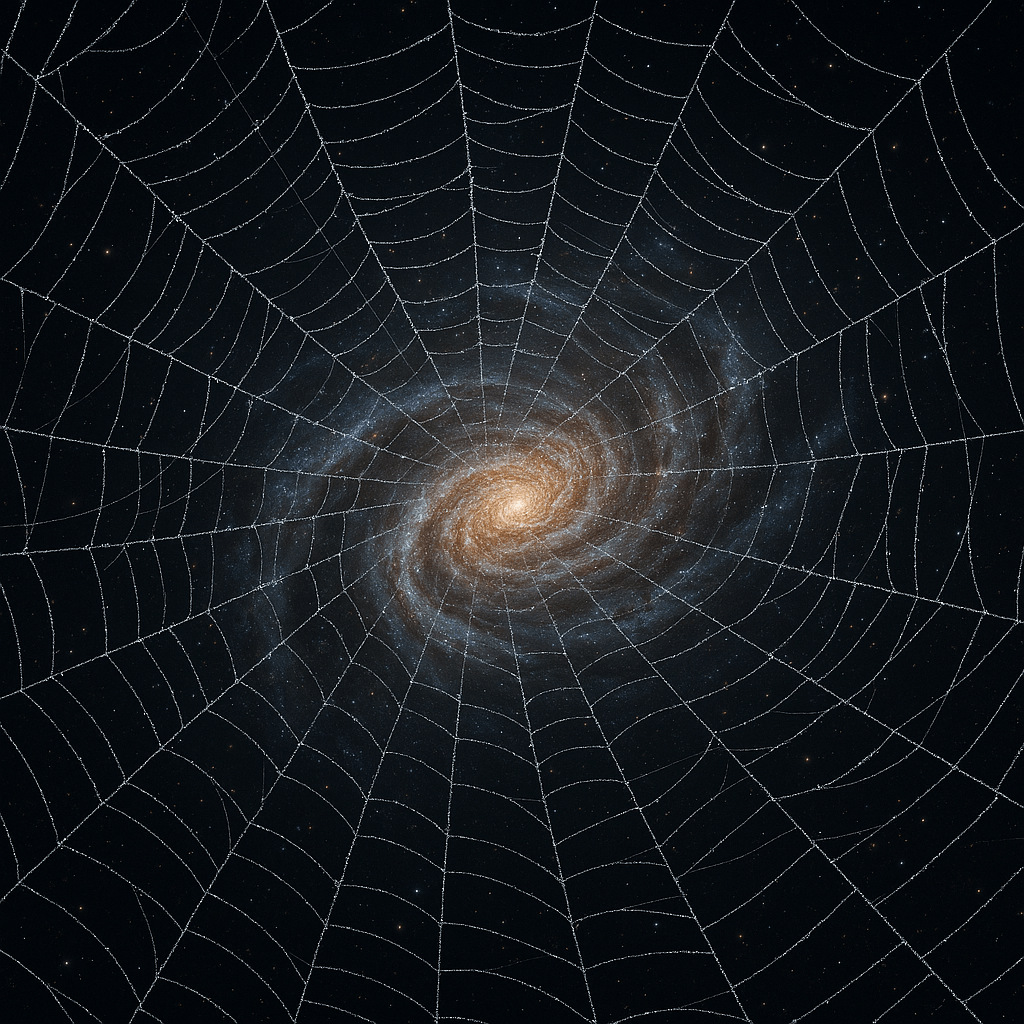
During this transformation, fermion-antifermion pairs condensed—similar to how electrons form Cooper pairs in superconductors, creating a stable, cold substance with minimal pressure and heat. This condensate became diffuse dark matter, shaping galaxies through its gravitational influence, acting as an invisible web counteracting their rotation and ensuring they don’t fly apart.

However, dark matter may not be as stable as once thought. The researchers propose that this condensate is slowly decaying, faster than standard cosmological models predict. This gradual decomposition feeds a long-lived energy source, possibly contributing to dark energy, the force responsible for the universe’s accelerated expansion.

A more radical interpretation, mine not the researchers, suggests that dark matter is not merely decaying, but evolving into dark energy, just as energetic fermion radiation once transitioned into dark matter. If this is true, dark matter and dark energy may be two phases of the same cosmic entity rather than separate forces.

If these hypothesis hold, we should be able to detect, as the researchers suggest, traces of this dark matter-to-dark energy transformation in the cosmic microwave background (CMB). Variations in density fluctuations and large-scale structures might reveal whether dark matter has been steadily shifting into dark energy, linking two of cosmology’s biggest unknowns into a single process.

Over billions of years, as dark matter transitions into dark energy, galaxies may slowly lose their gravitational cage and begin drifting apart. With dark energy accelerating the expansion, the universe may eventually reach a state where galaxies unravel completely, leaving only isolated stars in an endless void.

If dark matter started as a fine cosmic web, stabilizing galaxies, then over time, it may fade away completely, leaving behind only the accelerating force of dark energy. Instead of opposing forces locked in conflict, what if radiation, dark matter, and dark energy were simply different expressions of the same evolving entity?

A tetrahedron could symbolize this transformation:

  • Radiation (Energetic Era) – The expansive force that shaped the early universe.
  • Dark Matter (Structural Phase) – The stabilizing gravitational web forming galaxies.
  • Dark Energy (Expansion Phase) – The force accelerating cosmic evolution.
  • Time (Governing Force) – The missing element driving transitions between states.

Rather than the universe being torn apart by clashing forces, it might be engaged in a single, continuous transformation, a cosmic dance shaping the future of space.

Source: CDM Analogous to Superconductivity by Liang and Caldwell, May 2025, APS.org. Graphic: Galaxy and Spiderweb by Copilot.

Fate of the Universe

Astronomers once observed exploding stars (supernovae) and found the universe expanding, driven by a mysterious force called dark energy. This led to the standard cosmological model of the late 1990s, Lambda-CDM, where “Lambda” represents dark energy, assumed constant, and “Cold Dark Matter” (CDM) explains unseen mass shaping cosmic structure. Evidence for CDM includes steady star rotation speeds in galaxies, cosmic microwave background fluctuations, galaxy clustering, and light bending by gravity. Though successful, Lambda-CDM has faced ongoing scrutiny almost from inception of the theory.

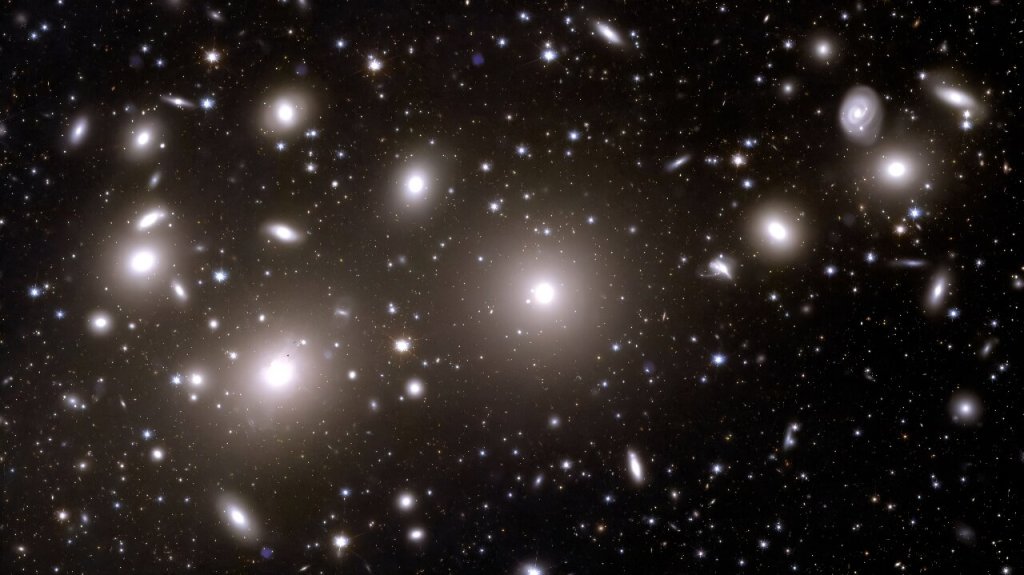
Enter the Dark Energy Spectroscopic Instrument (DESI) at Kitt Peak National Observatory in Arizona. With 5,000 robotic fiber-optic sensors, DESI captures light from galaxies and quasars, mapping the universe’s expansion history. A new study, analyzing three years of DESI data, 15 million objects, with plans for 50 million, combines it with cosmic microwave background radiation, supernovae, and weak gravitational lensing data. Fitting all this into Lambda-CDM with a constant dark energy revealed cracks in the model. But if dark energy weakens over time, a “dynamical dark energy“, the model aligns better.

By observing objects up to 11 billion years away, DESI peers deep into cosmic history. Researchers found hints that dark energy’s strength may have peaked around 7 billion years ago, then started weakening, challenging its fixed nature in Lambda-CDM. While not certain, this could rival the 1990s discovery of accelerated expansion, potentially demanding a new model.

The universe’s fate depends on dark energy versus matter. It’s been accelerating, but a weakening dark energy might slow it down, halt it, or, if gravity overtakes sufficiently, trigger a “Big Crunch.” New data from DESI, Europe’s Euclid, NASA’s Nancy Grace Roman, and Chile’s Vera Rubin Observatory could clarify this within five years, possibly nailing dark energy’s role.

Source: “Dark Energy Seems to Be Changing, Rattling Our View of Universe” by Rey and Lawler, Phys.org, March 2025. Graphic: DESI Collaboration Photo of Galaxies.

Seeking God

95% of the universe is a mystery. About 68% is dark energy, which is believed to drive the accelerated expansion of the universe, though its exact nature is unknown. 27% is dark matter, which holds galaxies together and is believed to consist of one or more massive, yet unknown, particles.

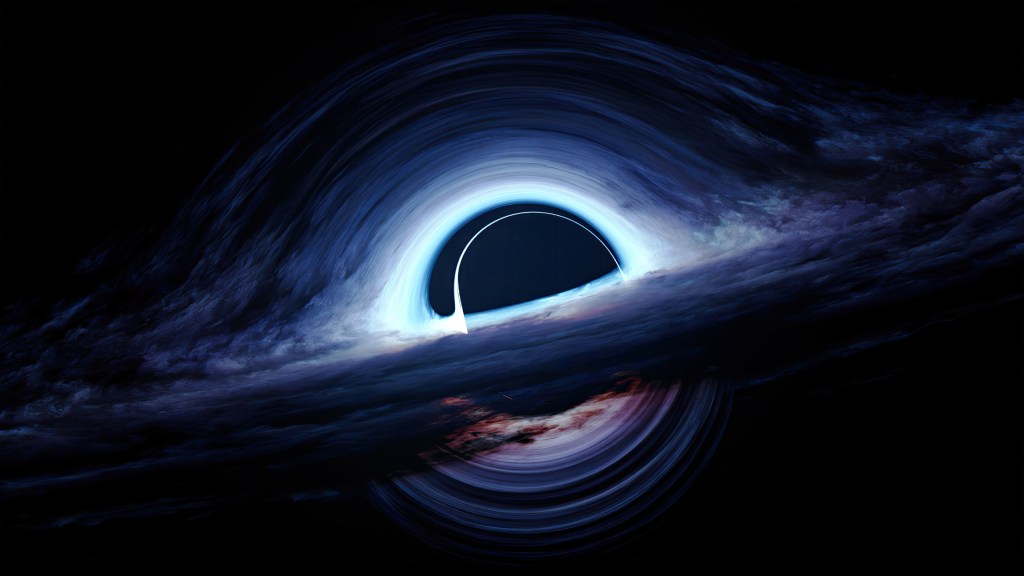
Science Daily reports that researchers at the University of Michigan and five other institutions “have strengthened the case that matter becomes dark energy when massive stars collapse and become black holes.” This suggests that the universe’s expansion may be partly explained by the expansion of black holes through cosmological coupling. It also implies that black holes can gain mass without consuming matter, directly challenging the Standard Model of particle physics.

This either leads to the Big Freeze—infinite expansion through not quite infinite time—or the Big Crunch, where gravity eventually says ‘Enough!’ and collapses everything back into an infinitesimal point.

To sum up, we may or may not understand 5% of the universe, while the remaining 95% aligns with Socrates’ axiom from 6th century Greece—we essentially know nothing.

Source: University of Michigan. “Evidence Mounts for Dark Energy from Black Holes.” Science Daily. 2024. Graphic: Black Hole.

WIMPs

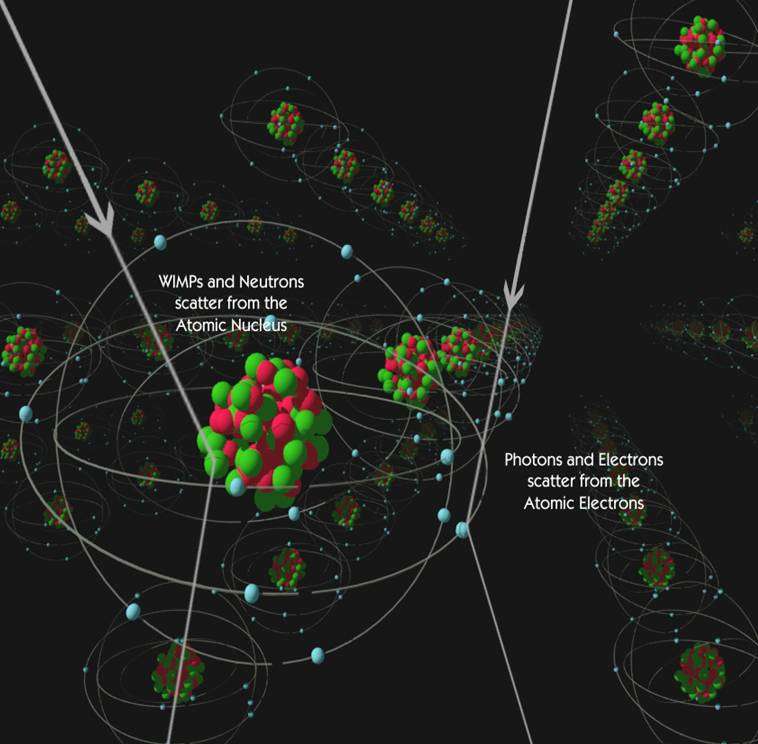
Weakly Interacting Massive Particles or WIMPs are hypothetical dark matter particles that supposedly make up 26-27% of the universe. They are only detectable through their gravitational effects.

In a recent ScienceNews article LUX-ZEPLIN researchers monitoring 10 metric tons of liquid xenon almost a mile below the surface in Lead, South Dakota have reduced the cross-sectional area that WIMPs can interact with normal matter by about 80%.

This reduced area of interaction implies that the particles are even weaker than previously thought. This would make them even harder to detect.  

Triva time: A cube that could hold 10 metric tons of xenon would need to be about 1.5 meters on a side.

Source: The Possibilities for Dark Matter…by Emily Conover, 2024, Science News. Graphic: WIMPs by University of California Berkley, 2013.