Wood is evolution’s most durable invention. The material that made height, permanence, and stability possible. When trees rose, the world changed: ecosystems and climates steadied, and the conditions for complex life expanded. Long before humans appeared, wood was already shaping the stage we would inherit. Without trees, life would be harsher; without wood, civilization would never have found its footing.
Trees emerged more than 385 million years ago and have since diversified into over 73,000 known species and, by some estimates, roughly three trillion individuals. They anchor ecosystems, feed and shelter life, and help regulate the planet’s climate. Yet they resist definition. “Tree” is not a single lineage but a recurring evolutionary strategy; the decision to rise above other plants by building height, structure, and longevity.
At its broadest definition, a tree is simply a perennial plant with a trunk and branching leaves. This inclusive definition sweeps in tree ferns, palms, bananas, and other tall monocots. Stricter definitions insist on woody tissue and secondary growth, limiting “trees” to the gymnosperms and angiosperms: conifers and hardwoods. Still other definitions narrow the term to plants capable of producing lumber or exceeding a certain height. The ambiguity is not really a flaw but more a clue to their diversity: trees are not defined by their ancestry but by their form.
The adaptation that gave trees their decisive advantage was the evolution of secondary xylem, or true wood. A ring of vascular tissue: the cambium, laid down successive layers of lignified support, allowing trunks to resist gravity and wind. With wood, plants could grow taller, capture more sunlight, and outcompete the low canopy. Height became an advantage and a renewable resource.
The earliest trees we know of belong to the tree ferns and the enigmatic cladoxylopsids of the Devonian, around 385 million years ago. Gymnosperms followed roughly around 319 million years ago, dominating vast forests through the Carboniferous and Permian. Flowering trees or the angiosperms: appeared in the Cretaceous and began overtaking conifers during the Tertiary, reshaping forests into the forms we recognize today.
When the first true trees appeared, they did so on a planet whose landmasses were slowly converging into a single supercontinent. By the Late Carboniferous and Permian, nearly all terrestrial surfaces were fused into Pangaea, a world with vast continental interiors far from the moderating influence of the sea. This geography shaped the evolution and distribution of early forests. The interior of Pangaea was marked by extreme seasonality; scorching summers, frigid winters, and long dry intervals, conditions that favored drought‑tolerant, cold‑resistant, and fire‑adapted trees. Conifers, cycads, ginkgos, and seed ferns thrived in these demanding environments, their anatomies tuned to stress: thick bark, needle‑like leaves, deep roots, and wood optimized for survival rather than speed.
Moisture was scarce far from the coasts, and tropical humidity was confined to narrow belts along the supercontinent’s margins. As a result, Pangaea’s forests were not lush, sprawling jungles but mosaics of hardy gymnosperms, polar forests capable of enduring months of darkness, and southern Gondwanan expanses dominated by Glossopteris and other cool‑climate flora. The supercontinent constrained tree evolution; it rewarded survival over diversity.
The breakup of Pangaea at the dawn of the Mesozoic transformed this picture. As rifting began in the Triassic and accelerated through the Jurassic, new coastlines formed, shallow seas flooded continental margins, and maritime climates replaced interior aridity. Continents drifted into new latitudes, expanding tropical belts and creating humid monsoon zones. The fragmentation of land produced ecological variety: islands, peninsulas, archipelagos, and isolated basins; each a laboratory for evolutionary experimentation.
These changes opened ecological space that flowering plants would later exploit. Angiosperms appear in the Early Cretaceous, but their explosive rise depends on the world created by Pangaea’s dissolution: warm, wet climates; diverse habitats; and the proliferation of pollinators and seed dispersers. As Gondwana itself broke apart, its daughter continents carried distinct floras with them. South America developed Araucaria and Nothofagus forests; Australia evolved eucalypts and casuarinas; Africa retained ancient podocarps; India drifted northward into the tropics and became a crucible for angiosperm radiation. Even Antarctica, then forested, hosted conifers and southern beeches before drifting into its deep freeze.
In short, Pangaea’s existence limited the diversity of trees by imposing climatic extremes and ecological uniformity. Its breakup liberated them. The Mesozoic world became a patchwork of climates and landscapes, and trees responded with an evolutionary flowering that reshaped the planet’s forests into the forms we recognize today.
Moving into the Tertiary repeated glacial–interglacial cycles, intensifying from late Miocene cooling through the Pliocene and into the full Quaternary ice‑age regime, drove major contractions, expansions, and reorganizations of Earth’s forests. Cooling, drying, lower atmospheric CO₂, advancing ice sheets, falling sea levels, and shifting precipitation patterns forced forests to migrate, fragment, and reassemble again and again.
Long-term Cenozoic cooling accelerated in the late Miocene (~7–5 Ma), just as early hominins were beginning to appear. Subtropical and mid‑latitude regions dried as the hydrological cycle weakened. Closed-canopy forests contracted; grasslands and savannas expanded across Africa, Asia, North America, and South America. Fire regimes intensified under more seasonal climates, helping convert woodlands into open grassy biomes. Rainforests retreated from many subtropical regions, setting the stage for the more extreme oscillations to come.
Once Northern Hemisphere ice sheets became prominent (~2.6 Ma onward), 40–100 kyr cycles produced repeated, large-amplitude swings. Ice sheets covered vast areas of North America, Europe, and Asia, pushing forests southward or into isolated pockets. Continuous temperate and mixed forests vanished from high and mid‑latitudes. Boreal forests shifted far south; spruce‑ and pine‑dominated vegetation reached into what is now the southeastern United States. Across Europe and Siberia, treeless steppe, tundra, and parkland expanded.
Tropical forests fragmented under cooler, drier conditions, lower CO₂, and increased fire, breaking into mosaics of forest, woodland, and grassland.
During interglacials, including the present Holocene, ice retreated, temperatures rose, and forests surged northward and upslope. Boreal forests reclaimed high latitudes; temperate deciduous forests recolonized mid‑latitudes; tropical forests coalesced again. Migration rates were rapid, often several to more than ten kilometers per century, limited only by seed dispersal, soil development, and competition. Some regions experienced temporary prairie or oak‑savanna expansions during warmer, drier intervals.
Forests survived glacial extremes in southern peninsulas, unglaciated corridors, lower‑latitude pockets, and moisture‑retaining microhabitats. Repeated isolation caused population bottlenecks, genetic differentiation, and later mixing during recolonization. Some warm‑temperate taxa disappeared entirely from Europe and North America, unable to migrate past barriers such as the Mediterranean. Tropical forests experienced range contractions and population declines. Modern boreal, temperate, and tropical forest distributions still reflect post‑glacial recolonization from these refugia.
In short, the Miocene–Pleistocene cycles transformed the extensive forests of the mid‑Miocene into oscillating biomes: forests compressed southward during glacials, fragmented into refugia, and expanded again during interglacials. These rhythms left permanent marks on species ranges, diversity, and genetic structure.
At the dawn of agriculture, forests covered nearly six billion hectares (14.8 billion acres); more than half of Earth’s habitable land. It was into this heavily forested world that humanity began its long, transformative relationship with wood: a relationship that would shape every early society. Wood is the first material we mastered, the first technology we shaped, and the foundation on which every early human society stood. Humanity entered a world dominated by trees, and from the first fields onward, civilization grew by cutting, shaping, burning, and building with wood.
To understand how agriculture transformed our relationship with wood, we must first look at the simpler relationship that came before it.
Long before humans shaped wood, we burned it. Fire is humanity’s oldest tool, and wood its earliest fuel. Hominins were using fire at least a million years ago, but this relationship was simple: gather fallen branches, feed the flames, survive the night. Fire changed our bodies, our diets, and our social lives; but it did not yet bind us to trees in any transformative way. Wood was energy, not yet material.
Around ten thousand years ago, as the last ice sheets retreated and the Holocene stabilized, humans began to cultivate plants and settle permanently. We entered a world dominated by trees, and the first civilizing acts of agriculture was to cut them down.
The earliest farmers cleared forests not with axes but with fire. They burned woodland to open fields, enrich soil with ash, and drive away animals. What had once been a scattered, opportunistic use of wood became systematic. Forests that had expanded northward during the interglacial now faced a new force of contraction: human need for open land and wood.
With agriculture came human roots. Settlements required structures; structures required timber. Tools needed handles; fields needed fences; granaries needed beams. Wood became the backbone of early technology: the material for digging sticks, hoes, plows, and irrigation troughs. Fire remained essential, but now it served new purposes; firing pottery, hardening wooden points, and later smelting metal. Wood was no longer simply fuel; it was infrastructure of civilization.
Agriculture also created scarcity. As villages grew into towns, and towns into early cities, the demand for wood intensified. Forests that had survived ice ages, droughts, and tectonic shifts now faced continuous clearing. Coppicing, managed woodland, and selective cutting emerged as early forms of forestry. Humanity began to understand that wood was both renewable and exhaustible; a resource that required care even as it was consumed.
This is the true beginning of the Age of Wood: not in the canopy with proto‑hominins, but in the fields of the first farmers. Fire made us human; agriculture made us dependent on wood. From this point forward, the story of civilization is inseparable from the story of forests. How we cut them, shaped them, burned them, used them to build, and eventually learned how to manage them.
The Age of Wood is an energetic and imaginative book. Ennos writes with a biologist’s curiosity, a craftsman’s affection for materials, and a genuine sense of wonder at the role wood has played in human civilization. His pages are full of lively observations; how wood burns, how it bends, how it shapes tools, shelters, ships, and societies. There is real enthusiasm in his writing, and real pleasure in following his mind as it leaps from one wooden artifact to another.
Yet enthusiasm is not structure, and curiosity is not chronology. Ennos’s book flutters from topic to topic without ever quite putting down roots. It gestures toward the deep history of wood, but it never begins at the beginning: with trees themselves. What a tree is, when trees arose, and how they came to dominate the terrestrial world are questions that remain largely unasked in his narrative. The result is a book full of interesting moments but lacking the foundational story that would give those moments coherence.
This essay attempts to supply that missing foundation. Before one can tell the story of wood and civilization, one must understand the story of trees: their evolutionary invention of wood, their rise on a changing planet, their spread across continents, their contraction and expansion under ice and climate, and the world they created by the time humans first began to cut them down. Only with that deeper history in view does humanity’s relationship with wood become clear; not a series of disconnected anecdotes, but a long, symbiotic entanglement between a species and a material that shaped its destiny.
Ennos chose to present wood as a sequence of bullet points, each interesting but only loosely connected. The deeper story is richer: wood as an evolutionary breakthrough, forests as planetary architects, and humanity as the inheritor of a world built by trees. The Age of Wood could have been a more enlightening treatment of this relationship, but its foundation was never laid. Hopefully this essay provides that foundation.
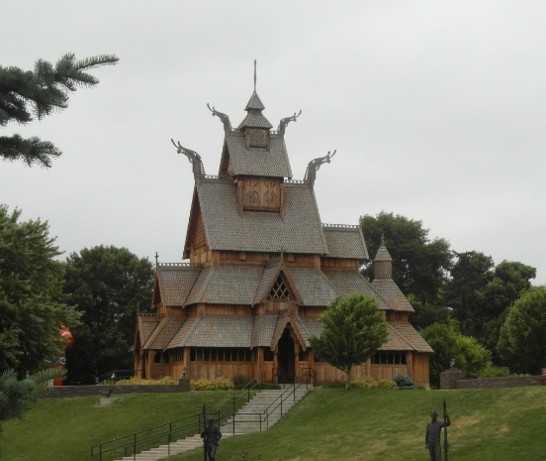
Graphic: Stave Church, Minot, ND, USA. Source: The Age of Wood by Roland Ennos. 2020.

