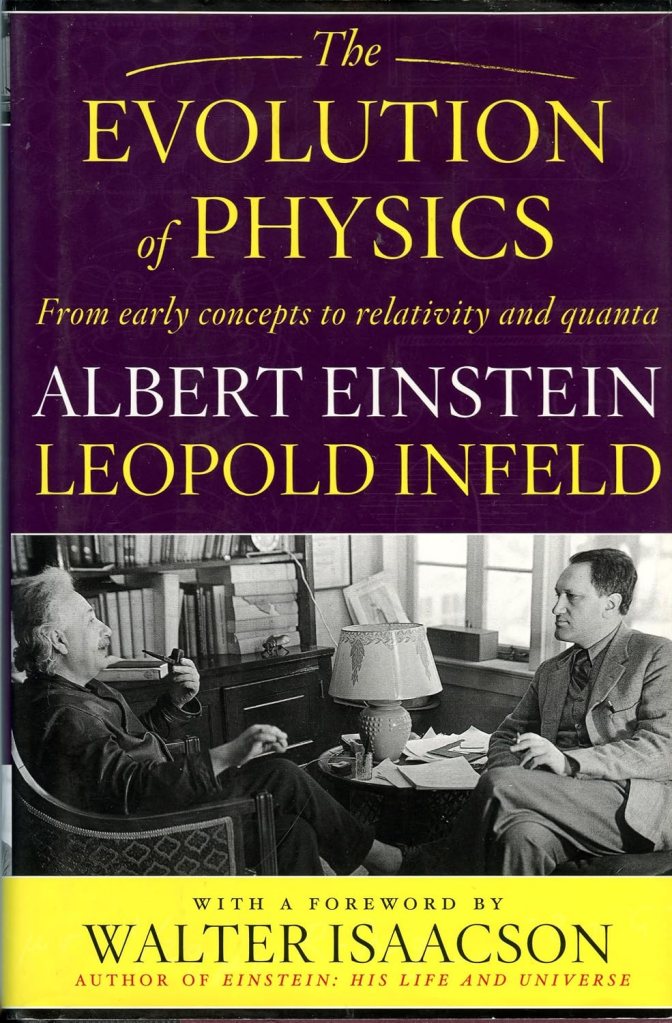
In mid‑2026 a post circulated on social media claiming that without understanding the mathematics: the equations, one could not understand the physics. Einstein and Infeld’s superbly written Evolution of Physics, which traces the development of physical thought from classical mechanics to relativity, stands as a decisive counterpoint to this numerical hubris. The truth is almost the opposite. When one can explain first principles without resorting to complicated equations, then one really does understand the physics.
Einstein and Infeld manage to educate the curious lay reader, including high‑school students, without using a single equation, however simple. Their narrative is so lucid that even the most elusive quantum concepts settle cleanly in the reader’s mind. It is a pedagogical feat achieved only a handful of times in modern scientific writing.
Two other books, that I’m aware of, belong to this rare category where understanding comes first and formalism second. The 1910 classic Calculus Made Easy by Thompson and Gardner remains the book every serious student should read before confronting the thousand‑page, three‑semester tomes that pass for calculus instruction in colleges today. The other is the 2011 first edition of Plate Tectonics by Frisch, Meschede, and Blakey; a pleasure to read and a model of how to teach geology from first principles.
The Evolution of Physics begins where physics itself begins: with experiment guiding theory, and by their reckoning that story starts with Galileo. In a sense, Galileo was Einstein’s intellectual ancestor: his three‑hundred‑year‑younger self pondering many of the same questions that Einstein would later expand and refine. Galileo studied velocity, gravity, and the principle of relativity: the idea that the laws of physics remain the same no matter where one stands. He also invented early military compasses, close cousins to the magnetic instrument that fascinated Einstein as a boy.
Einstein and Infeld emphasize that physics, and science in general, is not static. Discoveries are followed by more discoveries; old theories are supplanted by new ones. “Science arises from a crisis in the old theory,” they write. Crises force attempts to resolve the difficulties, and in doing so physics evolves.
One example of this evolution, not revolution, is the comparison between Newtonian gravity and gravity as articulated in General Relativity. In weak gravitational fields, Newton’s concepts are adequate. But Einstein’s theory removes the ghosts of absolute time and absolute space, replacing them with spacetime geometry. In GR, inertial mass and gravitational mass become identical, light bends in the presence of gravity, Mercury’s orbit is correctly accounted for, and a clock on the Sun ticks differently than one on Earth.
Returning to the theme of understanding without equations, Einstein and Infeld explain the most famous relation in physics, without ever writing it down. Instead of presenting 
The book concludes its romp through scientific discovery from the Renaissance to WWII with a discussion of the then‑new science of quantum mechanics and all its strangeness. Much of it is a loving description of the photon and electron, but it also reminds us that evolution takes time.
As a parenthetical ending, it is worth noting that because The Evolution of Physics was written before WWII, it contains at least one archaic spelling that is amusing in hindsight. Einstein and Infeld repeatedly use the word clue spelled as clew. I had to read it twice before the meaning clicked.
The word goes back to Old English cliewen, meaning a ball of thread or yarn. That is why in Greek myth Ariadne gives Theseus a clew: a ball of thread to help him find his way out of the labyrinth. The metaphor later shifted: a clew became anything that helps one navigate a difficulty, and eventually the modern sense of a hint or piece of evidence.
By the 1700s and 1800s, clew and clue coexisted in literature. By the early 1900s, clew persisted mainly in British writing. By the time of WWII, clew had passed fully into the realm of archaic English. Its appearance in Einstein and Infeld’s prose is thus a small linguistic fossil; a reminder of how even scientific writing carries the imprint of its era.
Source: The Evolution of Physics: From Early Concepts to Relativity and Quanta. 1938. Cambridge University Press.

