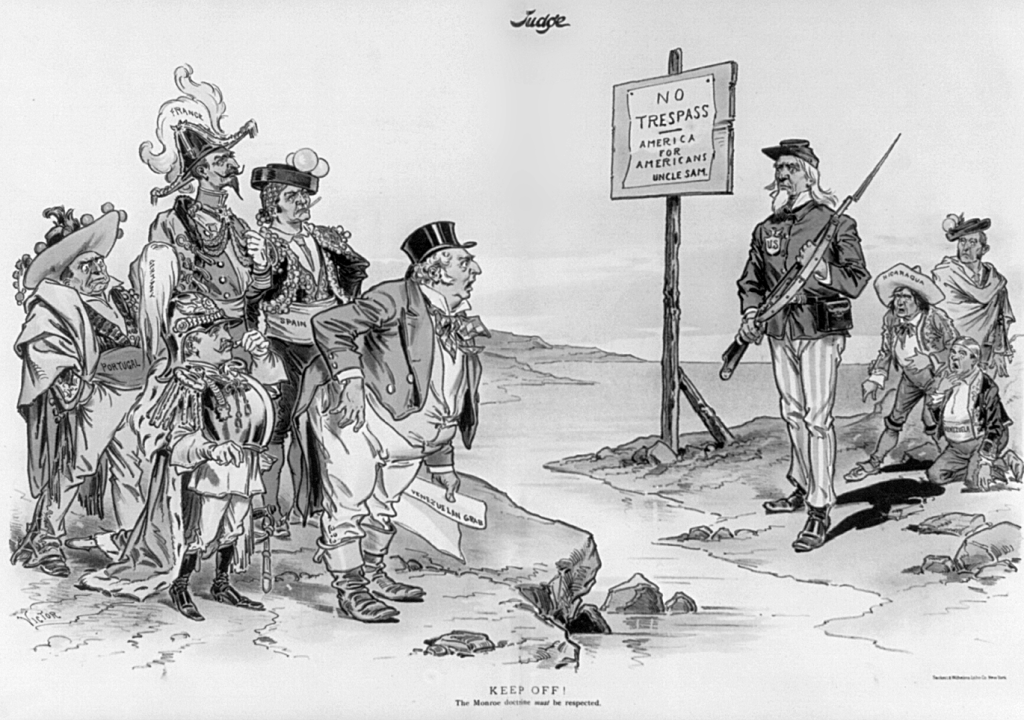
In 1823, President James Monroe issued what became known as the Monroe Doctrine, warning European powers against further colonization or interference in the New World. Though never codified into law or treaty, the doctrine became a guiding principle of U.S. foreign policy, invoked and reinterpreted by successive administrations to assert American influence in the hemisphere. Theodore Roosevelt expanded it, Barack Obama’s administration declared it obsolete, and Donald Trump revived its assertive tone. Its malleability is hailed by some as its strength, denounced by others as its greatest flaw.
The Monroe Doctrine became a symbolic fence around the Western Hemisphere, a firewall against nineteenth‑century imperial powers. Over the next two centuries, it evolved through corollaries, confrontations, and periods of dormancy. Today, in the shadow of Chinese expansion, mainly through its Belt and Road Initiative, Latin American states are drawn to twenty‑first‑century infrastructure with age‑old colonialism lurking in the background. But the Chinese buying influence in the hemisphere is aimed directly at the United States, seeking to erode its traditional dominance and reshape regional loyalties.
The Monroe Doctrine was intended to thwart enemies, potential and real, at the gate. With the exception of Cuba, it largely succeeded through the twentieth century. The 21st century now poses a test of whether the doctrine still has teeth.
If conflict with China is fated, then the United States must first secure its own backyard. The Western Hemisphere cannot be a distraction or a liability, a source of angst and trouble. Before turning its full strategic gaze toward the Middle Kingdom, the U.S. must seal the gates of the New World.
The Monroe Doctrine was written mainly by President Monroe’s Secretary of State, John Quincy Adams. It aimed to support Latin American independence movements from Spain and Portugal, while discouraging Russian influence in the Pacific Northwest and preventing the Holy Alliance: Russia, Austria, Prussia, and France, from restoring monarchs in the Americas. But the doctrine was not all sword: the United States also pledged not to interfere in Europe’s internal affairs or its colonies.
In the early 1800s, the United States lacked the ability to enforce such a bargain militarily. Britain, however, was more than willing to use its naval fleet to guarantee access to New World markets and discourage competition.
By the beginning of the twentieth century, Theodore Roosevelt invoked and expanded the doctrine, effectively making the United States the policeman of the Western Hemisphere. During the Cold War, it was used to counter Soviet influence in Cuba, Nicaragua, and Grenada.
By the 1970s the South American drug trade was declared a national security threat and the War on Drugs began with Colombia the epicenter of hostilities. In 1981, U.S. Congress amended the Posse Comitatus Act to allow military involvement in domestic drug enforcement, extending to Latin America. President Ronald Reagan’s 1986 National Security Decision Directive 221 declared drug trafficking a U.S. national security threat, authorizing military operations abroad, including in Colombia.
After the Cold War, the doctrine faded from explicit policy. In November 2013, Secretary of State John Kerry declared at the Organization of American States that “the era of the Monroe Doctrine is over,” framing a shift toward partnership and mutual respect with Latin America rather than unilateral dominance. By 2020 Colombia’s coca production had hit a new high.
Today, China’s Belt and Road Initiative, port construction and acquisitions, telecom infrastructure, and rare earth diplomacy have carved influence into Latin America and the Caribbean. In this context, the Monroe Doctrine was not asleep but, in a coma, its toes occasionally twitching.
Re-invigorating the Monroe Doctrine is not about making true allies and friends but removing vulnerabilities. The goal is not to bring these nations into the fold but to remove them from Beijing’s orbit.
By mid-2025 official statements claim that ~10% of the U.S. Navy is deployed to counter drug threats, ostensibly from Venezuela and Columbia. But fleet positioning hints at a different story. Most assets are stationed near Puerto Rico, the Virgin Islands, and Guantánamo Bay, closer to Cuba than Caracas. Surveillance flights, submarine patrols, and chokepoint monitoring center on the Florida Straits, Windward Passage, and Yucatán Channel.
This may suggest strategic misdirection. Venezuela is the declared theater, but Cuba is the operational keystone. The U.S. may be deflecting attention from its true concern: Chinese or Russian entrenchment in Cuba and the northern Caribbean.
The Monroe Doctrine began as a warning to monarchs across the Atlantic. In the late twentieth century, it morphed into a war on drugs. Today it reappears as a repurposed drug war, flickering as a warning to Beijing across the Pacific. Whether it awakens as policy or remains sleight of hand, its enduring role is to remind the world that the Western Hemisphere is not a theater for distraction but a stage the United States will guard against intrusion. In the twenty‑first century, its test is not whether it can inspire allies, but whether it can deny adversaries a foothold in America’s backyard.
Graphic: Monroe Doctrine by Victor Gillam, 1896. Public Domain.
 elsToday