Monroe Doctrine

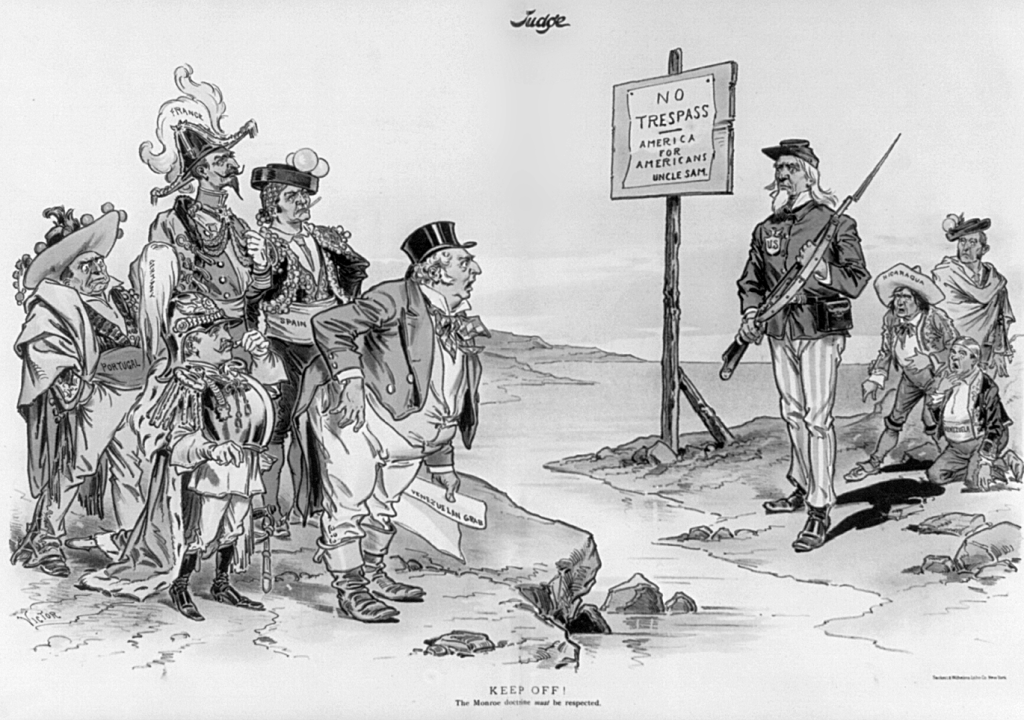
In 1823, President James Monroe issued what became known as the Monroe Doctrine, warning European powers against further colonization or interference in the New World. Though never codified into law or treaty, the doctrine became a guiding principle of U.S. foreign policy, invoked and reinterpreted by successive administrations to assert American influence in the hemisphere. Theodore Roosevelt expanded it, Barack Obama’s administration declared it obsolete, and Donald Trump revived its assertive tone. Its malleability is hailed by some as its strength, denounced by others as its greatest flaw.

The Monroe Doctrine became a symbolic fence around the Western Hemisphere, a firewall against nineteenth‑century imperial powers. Over the next two centuries, it evolved through corollaries, confrontations, and periods of dormancy. Today, in the shadow of Chinese expansion, mainly through its Belt and Road Initiative, Latin American states are drawn to twenty‑first‑century infrastructure with age‑old colonialism lurking in the background. But the Chinese buying influence in the hemisphere is aimed directly at the United States, seeking to erode its traditional dominance and reshape regional loyalties.

The Monroe Doctrine was intended to thwart enemies, potential and real, at the gate. With the exception of Cuba, it largely succeeded through the twentieth century. The 21st century now poses a test of whether the doctrine still has teeth.

If conflict with China is fated, then the United States must first secure its own backyard. The Western Hemisphere cannot be a distraction or a liability, a source of angst and trouble. Before turning its full strategic gaze toward the Middle Kingdom, the U.S. must seal the gates of the New World.

The Monroe Doctrine was written mainly by President Monroe’s Secretary of State, John Quincy Adams. It aimed to support Latin American independence movements from Spain and Portugal, while discouraging Russian influence in the Pacific Northwest and preventing the Holy Alliance: Russia, Austria, Prussia, and France, from restoring monarchs in the Americas. But the doctrine was not all sword: the United States also pledged not to interfere in Europe’s internal affairs or its colonies.

In the early 1800s, the United States lacked the ability to enforce such a bargain militarily. Britain, however, was more than willing to use its naval fleet to guarantee access to New World markets and discourage competition.

By the beginning of the twentieth century, Theodore Roosevelt invoked and expanded the doctrine, effectively making the United States the policeman of the Western Hemisphere. During the Cold War, it was used to counter Soviet influence in Cuba, Nicaragua, and Grenada.

By the 1970s the South American drug trade was declared a national security threat and the War on Drugs began with Colombia the epicenter of hostilities. In 1981, U.S. Congress amended the Posse Comitatus Act to allow military involvement in domestic drug enforcement, extending to Latin America. President Ronald Reagan’s 1986 National Security Decision Directive 221 declared drug trafficking a U.S. national security threat, authorizing military operations abroad, including in Colombia.

After the Cold War, the doctrine faded from explicit policy. In November 2013, Secretary of State John Kerry declared at the Organization of American States that “the era of the Monroe Doctrine is over,” framing a shift toward partnership and mutual respect with Latin America rather than unilateral dominance. By 2020 Colombia’s coca production had hit a new high.

Today, China’s Belt and Road Initiative, port construction and acquisitions, telecom infrastructure, and rare earth diplomacy have carved influence into Latin America and the Caribbean. In this context, the Monroe Doctrine was not asleep but, in a coma, its toes occasionally twitching.

Re-invigorating the Monroe Doctrine is not about making true allies and friends but removing vulnerabilities. The goal is not to bring these nations into the fold but to remove them from Beijing’s orbit.

By mid-2025 official statements claim that ~10% of the U.S. Navy is deployed to counter drug threats, ostensibly from Venezuela and Columbia. But fleet positioning hints at a different story. Most assets are stationed near Puerto Rico, the Virgin Islands, and Guantánamo Bay, closer to Cuba than Caracas. Surveillance flights, submarine patrols, and chokepoint monitoring center on the Florida Straits, Windward Passage, and Yucatán Channel.

This may suggest strategic misdirection. Venezuela is the declared theater, but Cuba is the operational keystone. The U.S. may be deflecting attention from its true concern: Chinese or Russian entrenchment in Cuba and the northern Caribbean.

The Monroe Doctrine began as a warning to monarchs across the Atlantic. In the late twentieth century, it morphed into a war on drugs. Today it reappears as a repurposed drug war, flickering as a warning to Beijing across the Pacific. Whether it awakens as policy or remains sleight of hand, its enduring role is to remind the world that the Western Hemisphere is not a theater for distraction but a stage the United States will guard against intrusion. In the twenty‑first century, its test is not whether it can inspire allies, but whether it can deny adversaries a foothold in America’s backyard.

Graphic: Monroe Doctrine by Victor Gillam, 1896. Public Domain.
Played

Funeral in BerlinM Funeral 1966

Theaters:  December 1966

Streaming:  August 2001

Rated:  NR

Runtime:  102 minutes

Genre:  Action – Classic – Drama – Mystery – Suspense – Thriller

els:  6.5/10

IMDB:  6.9/10

Amazon:  4.1/5 stars

Rotten Tomatoes Critics:  5.9/10

Rotten Tomatoes Audience:  3.5/5

Metacritic Metascore:  NA/100

Metacritic User Score:  NA/10

Awards:

Directed by:  Guy Hamilton

Written by:  Evan Jones (screenplay), Len Deighton (book)

Music by:  Konrad Elfers

Cast:  Michael Caine, Paul Hubschmid, Oscar Homolka, Eva Renzi

Film Locations:  Germany, UK

Budget:  $

Worldwide Box Office:  $

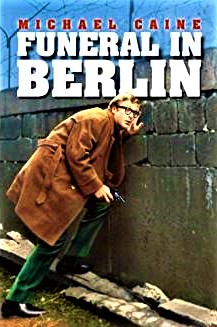
Harry Palmer (Caine), an expendable British spy, is sent to East Germany to bring in  a Russian intelligence colonel, Stok, (Homolka) who is tired of his no-win job providing security for the Berlin Wall and wants to defect to the west. Palmer, a born cynic and an insolent one at that, doesn’t believe the Russian’s story, doesn’t accept that he is seduced, willingly, by a glamorous model, Steel, (Renzi) because of his charm and great looks, and he doesn’t trust his West German contact, Mr. Smooth and Rich, British agent Johnny Vulkan (Hubschmid).  With no good options Palmer just carries on and sees where his strolls at midnight take him.

Funeral in Berlin, written in 1964, is the 3rd spy novel in Len Deighton’s Unnamed Hero series and 2nd one that was made into a movie starring Caine. This book was preceded by The Ipcress File in 1962 and Horse Under Water in 1963.  The 4th book in series was Billion-Dollar Brain published in 1966.  All the books were made into movies except Horse Under Water which was scheduled to be the 4th movie with Caine but was canceled when Billion-Dollar Brain fared poorly with the critics and the box office.

Deighton, part of the popular triumvirate of British spy novelists along with Ian Fleming and John le Carré, wrote his first spy novel, The Ipcress File while living in Dordogne, France, an expat community of Brits, socialists and communists. All 3 not necessarily being the same person. The book was an instant success and it was quickly adapted into a movie of the same name in 1965 which also met with critical success.  His books were hailed for their realistic detail to bureaucratic bumbling and pettiness, germane to all large departments and agencies the world over.

Evan Jones, born to banana farmers in Jamaica, studied in Jamaica and the U.S., taught in the U.S., then moved to England to write for television and film.  Evan Jones loosely followed Deighton’s book when writing the screenplay.  In the book the defector is a Soviet scientist who has been granted approval to leave by the Russian security guru Colonel Stok.

Guy Hamilton, director of 4 James Bond movies, has a deserved reputation for injecting high-brow humor into his action movies and he does not let his viewers down with his, and Evan Jones’, interpretation of the Funeral in Berlin. The action is low-tech with tight scenes of suspense interspersed with Caine’s acerbic cracks at the establishment. Hamilton’s efforts are better than what Ken Russell accomplished in Billion-Dollar Brain but significantly inferior to Sid Furie’s The Ipcress File.

Michael Caine and Oscar Homolka are brilliant in the movie. They play off each others morbid sense of humor and dial the thriller down to a level of fun and games in a world of known mostly for deadly results.

The L.A. Times reported in 2007 that Howard Hughes in a codeine induced haze watched Funeral in Berlin, in the buff, 3 times in row.  Regardless of Hughes critique this is a good movie, not a great movie, but Michael Caine makes it fun to watch.

Out the Double Double

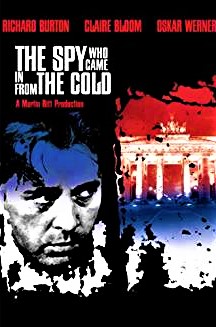
The Spy Who Came in from The ColdM Spy 1965

Theaters:  May 1965

Streaming:  July 2004

Rated:  NR

Runtime:  112 minutes

Genre:  Action – Classics – Drama –  Mystery – Suspense – Thriller

els:  7.5/10

IMDB:  7.7/10

Amazon:  4.3/5 stars

Rotten Tomatoes Critics:  7.7/10

Rotten Tomatoes Audience:  3.7/5

Metacritic Metascore:  NA/100

Metacritic User Score:  NA/10

Awards: 1 Golden Globe

Directed by:  Martin Ritt

Written by:  Paul Dehn and Guy Trosper (screenplay), John le Carré (book)

Music by:  Sol Kaplan

Cast:  Richard Burton, Oskar Werner, Claire Bloom

Film Locations:  Germany, Ireland, Netherlands, UK

Budget:  $

Worldwide Box Office:  $7,600,000

Alec Leamas (Burton), station chief for the British “Circus” in West Berlin, has just lost one of his operatives and is recalled to London.  He is given a new mission in London to play the part of an angry alcoholic, drummed out the secret service, desperately in need of money to get by, and to make his plight as public as possible.  The East Germans take notice of his condition and entice him to defect; trading state secrets for a cushy retirement.  He agrees and is whisked off to East Berlin to be interrogated. His cover story quickly nabs a double agent in the East German spy office but Leamas finds himself a pawn rather than the checking knight.

Germany after WWII was divided into 3 sectors in which Britain, the US and the Soviet Union administered starting in 1944.  From 1944 to 1948, Berlin was administered jointly by the 3 powers but in 1949 the Soviets claimed sole possession of East Berlin and declared it the capital of Germany Democratic Republic. The post-war East Berlin economy was ruined, as it was in West Berlin, but because of Soviet control it was excluded from the Marshall Plan used to rebuild the rest of western Europe.  East Berlin’s centrally planned economy had supposedly the highest standard of living in the Soviet controlled sphere of Europe and Asia but the inhabitants were leaving the city and country in droves, with estimates of 1000 per day leaving in 1960. To stop the emigration and retain skilled workers, up went the wall in 1961 and the East German soldiers were instructed to shoot to kill anyone trying to escape.  The East Germany security forces, the Stasi, formed in 1950, tightened their grip on the East German citizens, spying on everyone to break up any dissent.  Additionally the Stasi extensively infiltrated West Germany to obtain industrial, political, and military secrets, eventually bringing down West German Chancellor Willy Brandt in 1974 because his personal secretary was an East German spy.

David John Moore Cornwell, a British writer of mysteries and spy novels under the pen name of John le Carré, worked for the English secret service until his 3rd novel in 1963, The Spy Who Came in from the Cold, became an international best seller. He quit the service in that year and devoted his time to writing, mainly cold war spy novels dealing with the psychology of gamesmanship and spy craft rather than James Bond type action. His stories usually center around the moral cost of attempting to contain the communist empire without absorbing the stain of their criminality and depravity. Prior to his 1963 novel being published, Heinz Paul Johann Felfe, a German double agent that spied for everyone, Nazis, Soviets, West Germans, Brits; was caught by the West Germans, while in their employ, in 1961, and sent to prison for treason.

Paul Dehn and Guy Trosper wrote the screenplay for the movie and it follows the novel very closely. Dehn was a writer of plays, musicals and movies.  His first screenplay in 1950, Seven Days to Noon, won him an Oscar. Guy Trosper was a writer and producer from Lander, Wyoming best known for this movie and the 1962, Birdman of Alcatraz.

Martin Ritt, actor, director, writer, and producer, gives the viewer a somber message of spy craft without any glamour or gadgets.  Presenting a story about dubious principles and ugly spy results, he sticks to script and makes one of the best spy movies of all time.  This is his 2nd best movie, his 1963 Hud is his best.  The rest of his 30 or so movies are just a rehash of communist talking points and politically correct drivel. Nominated many times for Best Director he never managed to pull down Oscar or a Golden Globe.

The acting in this movie couldn’t get any better.  Richard Burton and Claire Bloom team up to create a tragic series of dichotomies revolving around youth and age, communism and freedom, innocence and cynicism, idealism and debauchery.  In the end they are both occupying the same poles, one learning nothing, the other wanting to learn no more.

This is a movie you need to add to your “Must Watch in My Lifetime” list.

A Little Package of our Past

World History: 50 Key Milestones You Really Need to Know B 50 History

Written by:  Ian Crofton

Published by:  Quercus

Copyright:  © 2011

Attempting to describe 12-15,000 years, since the big ice fields melted, of human endeavors in 200 pages and 50 topics would seem presumptuous and futile, and you would be right, but one has to start somewhere and the first steps can and should be small but decisive.  One can quibble about the exact 50 topics, and I will do just that in a bit, but the author, Ian Crofton, performs the task with aplomb, and provides the maximum amount of useful information possible given the limiting format.

This book is a quick and fun read for both those without a broad or deep introduction to human history or those that just want to refresh their memory on once familiar, but long forgotten topics. Even if you are familiar with all the topics in the book there will be a sufficient amount of new informational tidbits to make it worth your time. For myself, as one example, I found the observation that our ancestral hunter-gather cousins versus the first cereal grain farmers, were healthier, due mainly to their higher protein intake from a meat rich diet, was new and interesting.

Each “idea” or event is developed, chronologically, over 4 printed pages that includes a short thesis, an expansion of that thesis, a timeline of notable events, a famous quote(s) and an ending synopsis of the discussion.  The publisher of this book, Quercus, has published at least 27 other books of a similar nature and format that explore the great topics of the human experience including: architecture, art, astronomy, big ideas, biology, chemistry, the digital world, earth, economics, ethics, the future, genetics, the human brain, literature, management, math, philosophy, philosophy of science, physics, politics, psychology, quantum physics, religion, science, universe, war, and world history. I believe they continue to add more topics as the years go by.  I have several of the topics, listed above on my already too fat reading list.

Not to detract from the topics that the author has chosen, his are all defendable, but for myself I probably would have included 5 different topics devoted to: the Iron Age, Israelites of the 12th century BC, 1st century Christianity, Sumerians development of an alphabet in 300 BC coupled with Guttenberg’s first printing press in the 15th century AD, 18th century BC Babylonian Hammurabi’s, and 7th century BC Greek Draco’s legal codifications, and finally the advent of computers in the 20th century and beyond.  Adding 5 topics requires that 5 be removed. I would likely leave out: Empires and Kingdoms of Africa, The Bubonic Plague, the Vietnam War, integral to the late 20th century US, but will likely be a footnote on communism in the future, and lastly, the Arab-Israeli conflict and the post 9-11 topics, at a minimum, combined into a topic on 21st century divisions in civilization and culture, as if that were something new. On further thought, maybe just leave those last two topics out completely, mainly because they are too fresh to decide their seminality to our future development as a species.

That leaves our list one shy of 50. What topic(s) would you add?