To Boldly Go

On 23 June 2025, after more than three decades of evolution, from a gleam of an idea to detailed planning, exacting execution, and the physical realization of the world’s largest astronomical camera, the Vera C. Rubin Observatory’s Legacy Survey of Space and Time (LSST) in Chile unveiled to the public its first breathtaking images. Among them: razor-sharp mosaics of the Trifid and Lagoon Nebulae, and the sprawling Virgo Cluster, home to millions of galaxies. Captured with world-class light-collecting mirrors, these images marked the beginning of a spectacular ten-year quest to map the known universe and illuminate the 95% we still don’t understand: dark matter and dark energy. An exciting, albeit, Herculean future awaits, built on an equally stunning past where dreams and science converged into one of the most staggering feats of technological achievement in modern astronomy.

Let the future map of the universe tell its own story in due time. The path to the map deserves a chapter all its own.

In 1969 Willard Boyle and George Smith of Bell Labs invented a device capable of detecting and measuring the intensity of light which they named CCD or Charge-Coupled Device: a breakthrough that earned them the 2009 Nobel Prize in Physics. A CCD converts incoming photons into electrical signals, creating a voltage map of light intensity, a digital proxy for the number of photons striking its surface. Initially constructed as a semiconductor chip, it quickly evolved into a pixelated imaging sensor. These sensors quickly became the gold standard for digital consumer and scientific imaging but due to costs, consumer applications such as your phone camera switched over to CMOS sensors due to lower costs. Scientific and surveillance systems, such as the Hubble Telescope, SOAR, and SNAP, still employ CCDs because of their superior image fidelity.

In the late 1980s J. Anthony ‘Tony’ Tyson, an experimental physicist at Bell Labs, focused on developing instrumentation to detect faint optical signals using CCDs. His inspiring contribution to the CCD was to recognize their potential in imaging the heavens and laying the groundwork for digital deep sky surveys. He quickly discovered faint blue galaxies and gravitational lensing using modified CCDs that he helped developed. Additionally, he helped build the Big Throughput Camera that was instrumental in the 1998 discovery of dark energy.

Tyson never thought small. His CCDs were instruments of the infinitesimal, but his dreams were as gargantuan as the universe itself. In fact, his dream was the universe. In 1994 he proposed his “Deep Wide Fast” telescope, a scaleup of his Big Throughput Camera and the forerunner of the LSST. The Deep Wide Fast was a concept that would combine a deep imaging device with rapid cadence, and broad coverage simultaneously. In other words, synoptic realization of the universe in near real time.

Throughout the 1990s, Tyson rallied minds and resources to shape his cosmic vision. John Schaefer of the Research Corporation helped secure early funding. Roger Angel proposed the use of the innovative Paul Baker three-mirror telescope design. Institutions like the Universities of Arizona and Washington, along with the Optical Astronomy Observatory, all hitched their wagons to Tyson’s star-filled dream of mapping the universe.

In 1998 Tyson presented designs for a Dark Matter Telescope and in 1999 the science case was submitted to the Astronomy and Astrophysics Decadal Survey. In 2003 the first formal proposal was sent to the Experimental Program Advisory Committee at SLAC (Stanford Linear Accelerator Center). It consisted of an 8.4-meter mirror with a 2.3-billion-pixel camera capable of surveying the entire visible sky every few nights. The proposal also laid out the NSF–DOE partnership, with SLAC leading the camera development and other institutions handling optics, data systems, and site operations.

In 2004 Tyson left Bell Labs and joined the University of California at Davis as a cosmologist and continued to shepherd the LSST project from there.

In 2007 the project received $30 million in private funding from Charles Simonyi, Bill Gates, and others. The telescope is named the Simonyi Survey Telescope. In 2010 U.S. National Science Foundation (NSF) and Department of Energy (DOE) joined in the quest to view the universe through the sharp eyes of the LSST.

The telescope’s primary 8.4-meter and the 5.0-meter tertiary mirrors were built at the University of Arizona, beginning in 2008, completed in 2015, and stored on-site in Chile since 2019. Fabricated in the U.S., the 3.4-meter secondary was later coated in Germany with nickel-chromium, silver, and silicon nitride, materials chosen to enhance reflectivity, durability, and long-term performance.

In 2015 SLAC, which oversaw the design, fabrication, and integration of the camera, began building the components with assistance from Brookhaven National Laboratory, Lawrence Livermore National Laboratory, and IN2P3/CNRS in France. By 2024 the camera was finished and shipped to Chile. In 2025 the camera was installed and integrated with the telescope. In June of 2025 the first light images were released to the public.

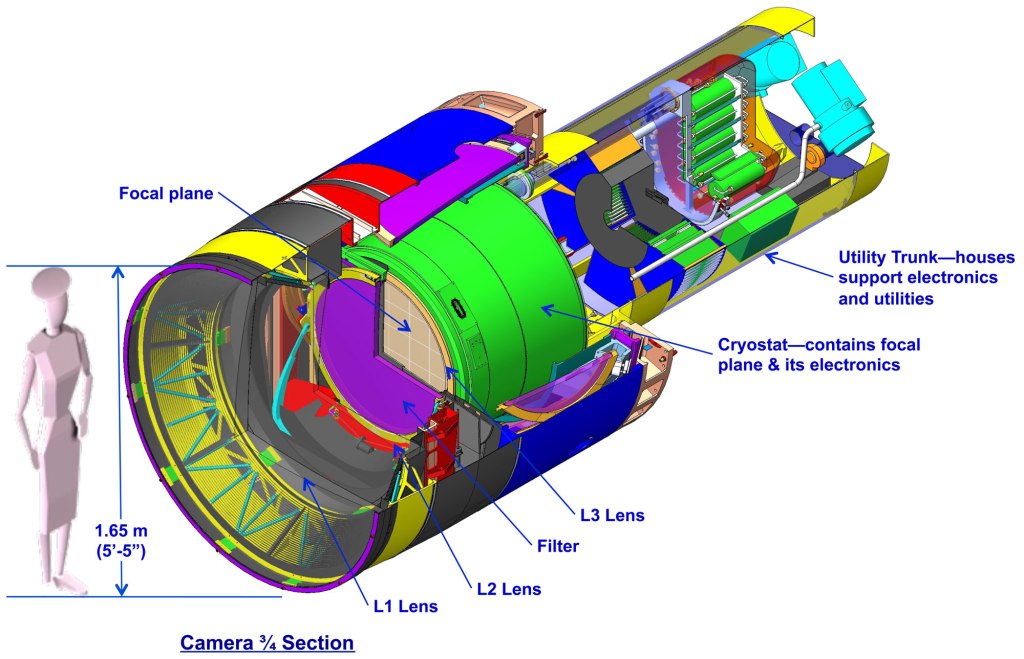
The camera measures roughly 3 meters in length, 1.65 meters in diameter, and weighs 3 metric tons, an imposing instrument, rivaling the bulk of a small car. Its imaging surface, a 64-centimeter focal plane, contains 3.2 billion pixels, each a 10-micron square, roughly one-tenth the width of a human hair. These pixels, etched across 189 custom CCD sensors arranged into 21 modular “rafts,” are laid flat to within 10 microns, ensuring near-perfect focus. The entire array is chilled to –100°C to suppress electronic and thermal noise, enhancing signal fidelity.

Before photons reach the sensor, they pass through three precision-crafted corrective lenses, including the largest ever installed in an astronomical camera, and up to six interchangeable filters spanning ultraviolet to near-infrared. The filter exchange system enables the observatory to target specific wavelength bands, tailored to sky conditions and science goals.

The integrated LSST system is engineered to capture a 15-second exposure every 20 seconds, producing thousands of images per night, tallying approximately 15 terabytes of new data. Each image covers 9.6 square degrees of sky, roughly equivalent to the diameter of 45 full moons, allowing the system to survey the entire visible southern sky every 3–4 nights. Imaging a single field across all six filters can take up to 5–6 minutes, though filters are selected dynamically based on science goals and atmospheric conditions.

The system’s angular resolution is sharp enough to resolve a golf ball from 15 miles away and at the edge of the observable universe, this scales to structures no smaller than a large galaxy; certainly not stars, not planets, nor restaurants. Over its decade-long campaign, LSST is projected to catalogue more than 17 billion stars and 20 billion galaxies, a composite digital universe stitched together from individual photons captured from 3 million images, each snapped every few seconds over the clear night sky of Chile. The LSST will not simply map what’s visible but illuminate the unknown. Beneath the sophisticated hardware and software lies a deeper purpose: to shine the light of curiosity on the 95% of the universe that remains in the shadows of time and space: dark matter and dark energy, the known unknown dynamic force behind galactic formation and cosmic expansion. The LSST is more than a camera. It is a reckoning with the vast unknown, a testament to humanity’s refusal to let mystery remain unexplored and uncharted: to find God.

In 2013 Tyson was named chief scientist of the LSST and is still actively contributing to the intellectual vision of the project and mentoring the next gen of cosmologists and engineers.

Graphic: LSST Camera Schematic and Trifid Nebula by SLAC-DOE-NSF.
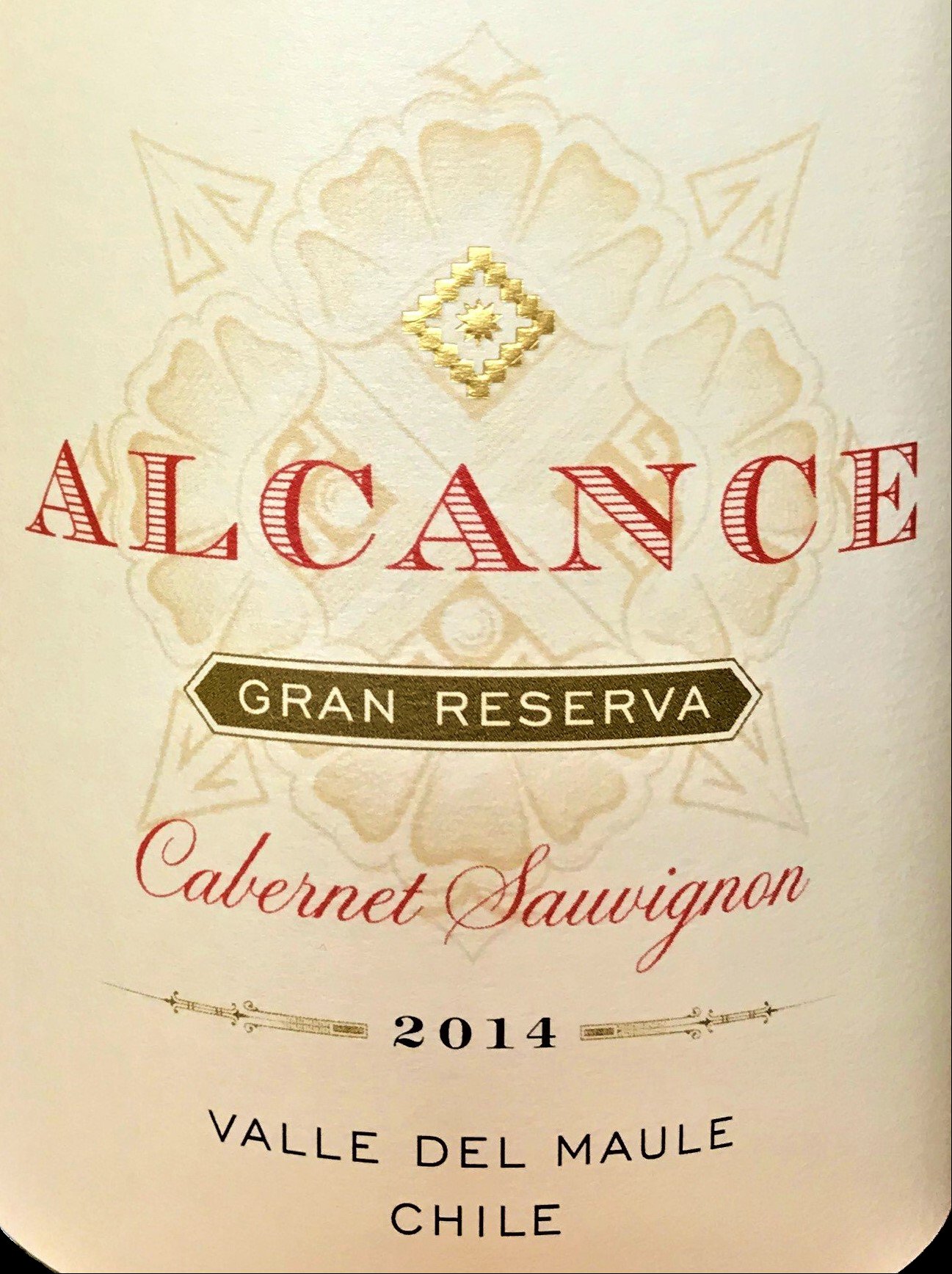
Alcance Gran Reserva Cabernet Sauvignon 2014

W Alcance 2014Cabernet Sauvignon from Maule Valley, Central Valley, Chile
100% cabernet sauvignon

14.5% alcohol

Purchased: 6 March 2017 – $19.99

Opened: 28 Feb 2018

els: 9.0/10

Wine and Spirits: 94

James Suckling: 90

Cellar Tracker: 90

Wine Enthusiast: 87

Maule Valley, the largest wine-producing region in Chile and the southern-most region in Chile’s Central Valley, is tucked in-between the Andes and the Coastal Ranges. The region is named after the east to west flowing Maule River with its headwaters in the western slopes of the Andes Mountains and emptying 50-60 miles downstream into the Pacific Ocean near the small, impoverished city of Constitucion. Due to the Valley’s more southern location in the Central Valley it has cooler temperatures than its northern counterparts but because the Coastal Range’s have lower elevations here the rain shadow is also reduced resulting in more rainfall than up north, particularly in the winter.

The region’s wine history dates back to the mid-1800s when successful Chilean businessmen brought back pre-Phylloxera European vine cuttings to grow in the Valley’s igneous and alluvial soils, primarily along the Maule River. Initially the region grew predominately Pais grapes, generally used for bulk wine sales and table wines but in the recent past most of those vineyards have been replaced with better known selections such as Cabernet Sauvignon, a grape that now accounts for half the 75,000 vine acres planted in the Maule Valley.

Cabernet Sauvignon is a cross, believed to have occurred naturally sometime in the 1600s in southwestern France, between Cabernet Franc and Sauvignon Blanc grapes. It is now the most widely planted grape in the world. Chile is second only to France in the number of acres planted world-wide in this grape. It is a thick-skinned grape that’s relatively easy to grow and maintain, exhibiting high tannins and acidity, producing a distinct bell pepper flavor, especially in cool climates, along with aromas of mint and eucalyptus. The grapes produce a full-bodied and dark-ruby colored wine.

The Alcance winery, founded in 1993, is a Jackson Family enterprise that was instrumental in improving the entire winemaking industry in the Maule Valley.  The family introduced modern techniques to the Valley, through the Alcance winery, and the rest, as they say, is history. The winery started with the lower elevation San Francisco Estate vineyards in the southwestern portion of the Valley. The vines enjoy the cool Pacific winds blowing over their canopy with their roots tapped into soils clogged with large quartz crystals. The growing season temperatures for the San Francisco vineyards ranges from 60-80ºF with rainfall 0.25-1.00″ per month. In 1999 the Jackson Family added the El Maiten Estate winery and vineyards in the southeastern Maule Valley to their Chilean holdings.  The El Maiten vineyards are located in the Andes foothills along the Lircay River, a tributary of the Maule River. The vines grow in a loamy soil containing numerous pebbles and cobbles. The growing season temperatures for the El Maiten area ranges from 60-85ºF with rainfall 0.25-0.75″ per month. Both vineyards total about 200 acres planted in 10 to 20-year-old vines.  The winery produces 5 wines under its Alcance label: Cabernet Sauvignon, Carmenere, Merlot, VIGNO (an old vine Carignan), and Bravura, their celebrated Bordeaux blend.

This wine is produced from a rough 50-50 mix of grapes from both vineyards. The Cabernet Sauvignon vines were 10 to 11-years old for this 2014 vintage. After the grapes are hand harvested, they are hand sorted, cold macerated for 6 days, and fermented in small stainless steel tanks for 20-22 days. Malolactic fermentation is done in French oak barrels for 18 months with 3 intervening racks.

A clear ruby-red wine with a tawny rim. Aromas of cherries and raisins with an oak supplied vanilla in the background. Full-bodied and balanced with a very pleasant, long finish.

Enjoy with a traditional South American stew: Charquican. You will need a pound of cubed beef (cheap to expensive; your choice), a tablespoon of flour, quarter stick of butter, 2 cups of beef stock, a big chopped onion, a teaspoon or two of minced garlic, 2 tablespoons of oil, 1-3 teaspoons of chili peppers finely minced (less or more depending on how spicy you want the stew), 1 cup corn, 1 cup carrots sliced, 2 cups diced potatoes, salt and pepper. Coat the cubes of beef with the flour. Season with salt and pepper. Add to skillet over medium-high heat along with the melted butter. Cook beef until brown. Add the beef stock and simmer for 10 minutes. Transfer the contents of the skillet to a slow cooker.  With the remains of the beef and the beef stock in the skillet add the oil, onion, garlic, chili pepper and cook until the onions are soft. Add the remaining vegetables except the corn to skillet and cook for 5 minutes more. Add the skillet contents to the slow cooker and cook for 6-8 hours. Add in the corn about an hour before serving. Serve over rice.  Delicious. I made this from a modified recipe I found on The Spruce but I left out the squash, beans, and beef jerky; otherwise it was exactly the same:)

An outstanding wine at a fair price. Drink now, but should last until 2023-2025. Decant and aerate for one hour, or more, before drinking.

$15.19-31.49  wine-searcher.com

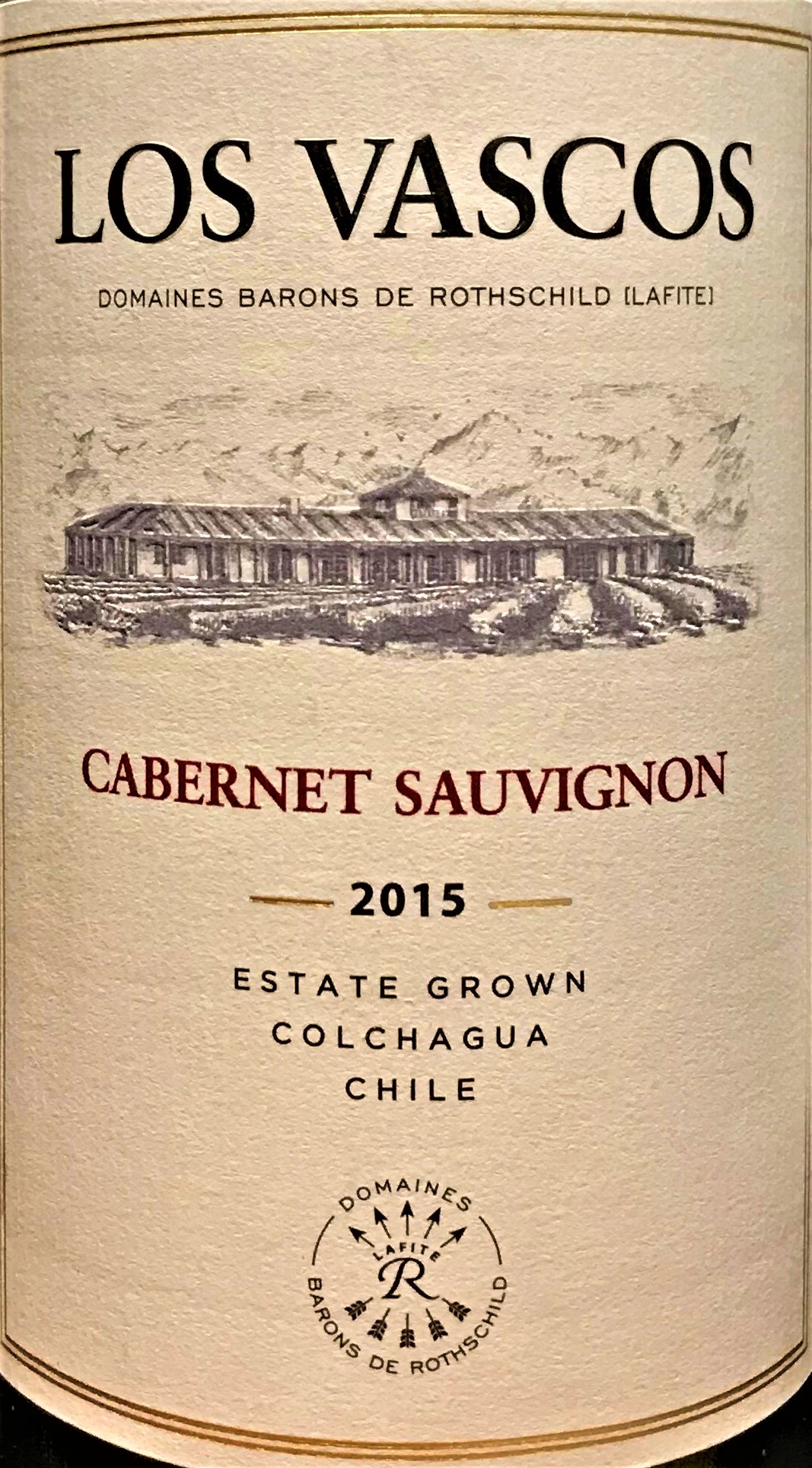
Los Vascos Cabernet Sauvignon 2015

W Los Vascos 2015Cabernet Sauvignon from Colchagua Valley, Rapel Valley, Central Valley Region, Chile
100% cabernet sauvignon

14.0% alcohol

Purchased: 6 March 2017 – $9.99

Opened: 16 Feb 2018

els: 9.0/10

James Suckling: 92

Falstaff Magazin: 91

Decanter: 90

Wine Spectator: 88

Cellar Tracker: 86

Colchagua Valley is in the southern and western portions of Rapel Valley, which itself is located in the middle of the 250 mile long Central Valley, all situated between the Andes to the east and the Coastal Ranges to the west. The northern edge of the Colchagua Valley is defined by the life-giving Rapel River and its main tributaries: the Tinguiririca and Cachapoal Rivers. The valley, sheltered from the cold Pacific winds by the Coastal Ranges, has a mild Mediterranean climate, warm but not too hot, or too cold, with rainfall that averages about 24″ per year, the majority coming in the winter. The main wine of the valley is Cabernet Sauvignon but in recent years Malbec has been added to the vineyards to capitalize on their Argentinian success on the eastern side of the Andes. The better wineries of Colchagua Valley have their vineyards located on the eastern slopes of the Coastal Ranges.

270 years ago the Echenique family, Basque immigrants to Chile, established their vineyards and winery in the Peralillo area of the Colchagua Valley, currently a small commune of less than 10,000 people.  The winery eventually acquired the name of Los Vascos meaning “The Basques” in Spanish. One hundred years later, in the 1850s, the family started to plant French derived vines and grapes which led to a large expansion of the vineyards and the wine industry in the area. In 1988 Domaines Barons de Rothschild (Lafite) acquired a 50% interest and management control of the Los Vascos property. The new management brought in new winery techniques and equipment; replanting many of the vineyards which presently and predominately, grow Cabernet Sauvignon (85%), but also Carmenere (5%), Syrah (4%), Malbec (1%), and Chardonnay (5%) grapes.

Cabernet Sauvignon is a cross, believed to have occurred naturally sometime in the 1600s in France, between Cabernet Franc and Sauvignon Blanc grapes. It is now the most widely planted grape in the world. Chile is second only to France in the number of acres planted of this grape. A thick-skinned grape that’s relatively easy to grow and maintain,  exhibiting high tannins and acidity, along with cool climate-grown aromas of peppers and currants.

The vineyards, encompassing a little less than 1600 acres, range in age from 15-70 years. The vineyards are at about 425′ above sea level with soils of volcanic loams and granitic sands. Although the vineyards are less than 25 miles from the Pacific Ocean they are protected from its cold winds by the Coastal Ranges and enjoy a distinct 4 seasons of Mediterranean climate. Growing season temperatures have a diurnal range of approximately 50-85ºF and rainfall amounts average a very dry 0.5″ per month or less. During the southern hemisphere winters rainfall can exceed, but a still dry, 2″ per month. Because of the arid climate the vineyards are drip irrigated.  The 2015 season saw unusually heavy spring rains which contributed to a late bud break.  The harvest was normal though.

The harvest, mainly by manual hand picking, took place between April 1st and May 13th. The grapes were de-stemmed and crushed immediately after picking and fermentation took place in temperature-controlled stainless steel vats between 77-81°F.  A maceration period ranging from 10-15 days was followed by a malolactic fermentation, also in stainless steel vats: unoaked, ostensibly, for the American palate.

A ruby-red color with a garnet rim. Aromas of red fruits and plums with a touch of herbs.  On the tongue it is bold but balanced. A wonderful wine with a medium, fresh finish.

An outstanding wine at an outstanding price.  A fine wine to pair with a fine, rich meal such as Osso Buco or a rib eye. Drink now, but should last until 2025.  Decant and aerate for one hour before drinking.

$8.99 wine.com


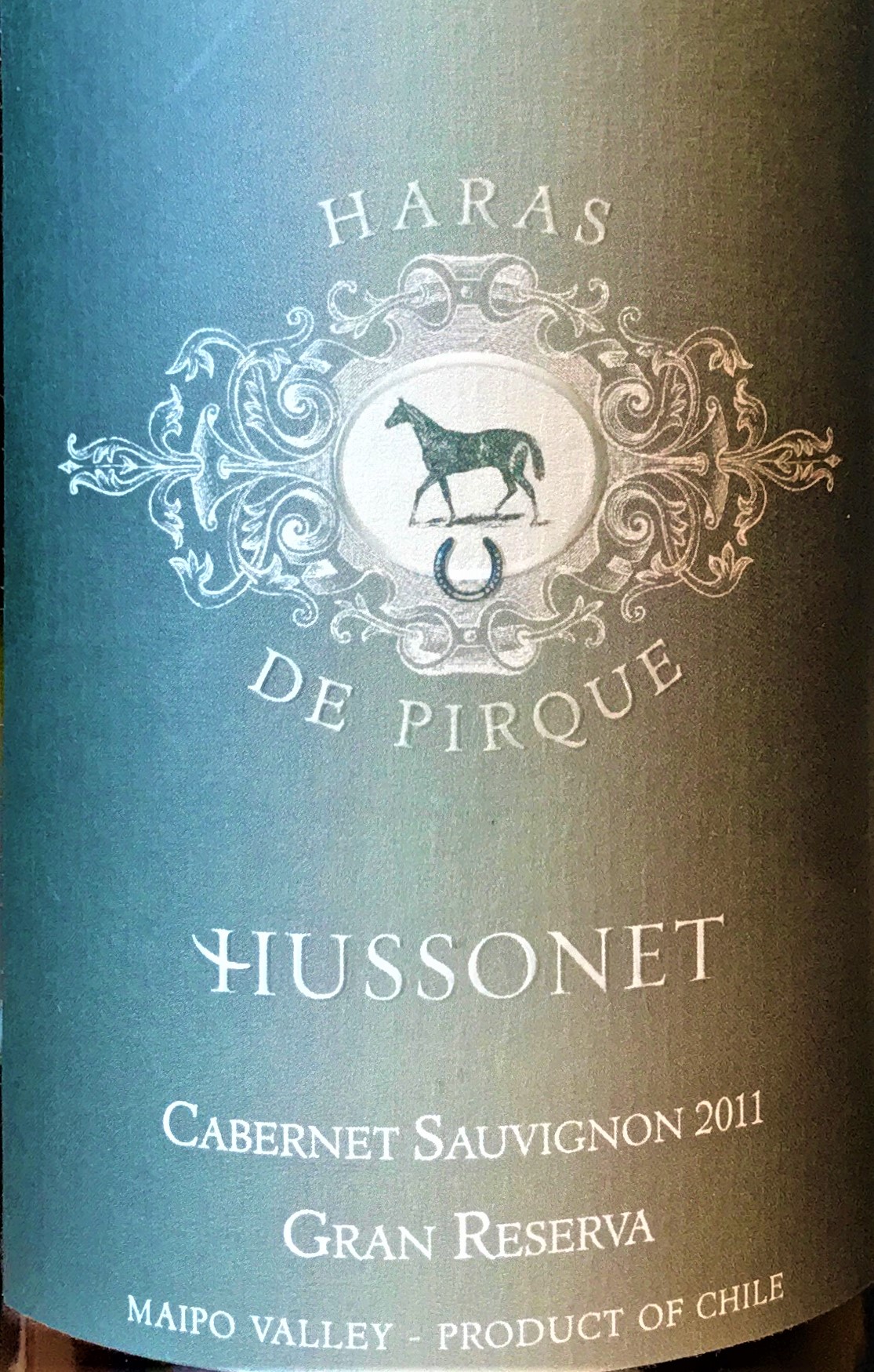
Haras de Pirque Hussonet Gran Reserva Cabernet Sauvignon 2011

W Hussonet 2011Cabernet Sauvignon from Maipo Valley, Central Valley and Andes, Chile
100% cabernet sauvignon

14.0% alcohol

Purchased: 20 Aug 2016 – $12.99

Opened: 11 Feb 2018

els: 8.7/10

James Suckling: 95

Wine Spectator: 88

Cellar Tracker: 88

Eduardo Matte in 1991 purchased an estate he later named Haras de Pirque, a term derived from the combination of a name for a 1892 thoroughbred stud: Haras; which also is the French term for stud farm, and the Chilean commune name for the area: Pirque.  The estate is less than 20 miles southeast from the center of Santiago, Chile in the Maipo Valley and a little over 20 miles east of the Andes Mountain’s year-round snow fields. The estate, eventually growing to encompass approximately 1500 acres, lies on the western edge of a peripheral, Miocene-Pliocene aged, Andes’ thrust fault and has almost 250 acres devoted to growing Cabernet Sauvignon, Merlot, Carmenere, Chardonnay, and Sauvignon Blanc grapes. The remainder of the estate is dedicated to raising horses for racing and show. The Hussonet name comes from a famous eponymous American-Chilean stud, whose offspring have achieved some success as race horses in Chile and Australia.

The vineyards and winery, beginning in 2003, were originally a 50-50 joint venture with the Italian company, Marchesi Antinori, and their first wine was a Bordeaux red blend under the Albis label.  The Hussonet label followed a few years later.

The Antinori family, an ancient clan believing they can trace their blood lines back to the 11th century BC city of Troy, and their winemaking, a more persuasively detailed chronicle, dating back to at least the time of the Florentine Renaissance, bought out Matte’s share in the Harris de Pirque estate in mid-2017 and they plan extensive changes to the winery and vineyards to better reflect their name, which is synonymous with prestigious wines in general and Super Tuscans in particular.

Cabernet Sauvignon is a cross, believed to have occurred naturally sometime in the 1600s in France, between Cabernet Franc and Sauvignon Blanc grapes.  It is now the most widely planted grape in the world.  A thick-skinned grape that’s relatively easy to grow and maintain and it exhibits high tannins and acidity, along with cool climate grown aromas of peppers and currants.

The Haras de Pirque vineyards are located between 1800-2100′ above sea level on the west side of an outlier Andes series of foothills. The soils are clays and loams mixed with large alluvial and colluvial stones. Growing season temperatures have a diurnal range of approximately 50-85ºF and rainfall amounts average a very dry 0.5″ per month or less. During the southern hemisphere winters rainfall can exceed, but still dry, 2″ per month.

There is no useful information available, that I can find, on the actual details of making of this wine.

The wine has ruby-red to purple color with a garnet rim. A bouquet of black currants, pepper, and a hint of vanilla. On the palate the wine is full-bodied, rich in tannins, but slightly drier and more acidic than usual for a Cabernet Sauvignon. The finish is short to medium.

A good wine at a fair price. Pair with a snack of hard cheese and salami.  Not a great wine to add to the menu for an expensive or fancy beef meal. Drink now, but should last until 2021.  Decant and aerate for one hour before drinking.

$9.99-16.12 wine-searcher.com

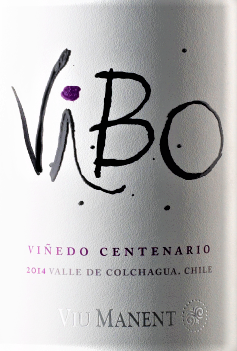
Viu Manent ViBo Vinedo Centenario 2014

W Vibo 2014Bordeaux Red Blend from Colchagua Valley, Rapel Valley, Central Valley, Chile
65% cabernet sauvignon

35% malbec

13.5% alcohol

Opened 31 Jan 2018

els: 9.2/10

Wine Advocate: 91

Colchagua Valley is in the southern and western portions of Rapel Valley, which itself is located in the middle of the 250 mile long Central Valley, all situated between the Andes to the east and the Coastal Ranges to the west. The northern edge of the Colchagua Valley is defined by the life giving, Rapel River and its main tributaries: the Tinguiririca and Cachapoal Rivers. The valley, sheltered from the cold Pacific winds by the Coastal Ranges, has a mild Mediterranean climate, warm but not too hot, or too cold, with rainfall that averages about 24″ per year. The main wine of the valley is Cabernet Sauvignon but in recent years Malbec has been added to the vineyards to capitalize on their Argentinian success on the other side of the Andes. The better wineries of Colchagua Valley have their vineyards located on the eastern slopes of the Coastal Ranges.

In 1935 the Viu family, Catalonian immigrants, founded a Bodega in Santiago, Chile to bottle and market wines locally.   The family, in 1966 purchased a winery and its vineyards in the Colchagua Valley which included very old, pre-Phylloxera, French derived vines.  This purchase marked the beginning of the family’s proprietary production of wine. In 2009, Vibo made its appearance on the Chilean and International markets.

Viu Manent, the Viu family company, operates 3 vineyards, totaling 627 acres, in Colchagua Valley: San Carlos, La Capilla, and El Olivar.  The San Carlos vineyard is 370 acres of 40 year-old plus vines, some more than 100 years old, growing at 800′ above sea level in very thick and porous, silty-sand to clayey-sand soils. The vineyard was established in the 1800s with pre-Phylloxera, French root-stock and vines. The La Capilla vineyard is about 93 acres dedicated to red-wine-only vines growing at 750 feet in a pebbly limestone and limey soil.  The vines are on average 16 years old. The El Olivar is a new land acquisition which the company plans to develop into about 175 acres of vines at an elevation between 500-930′, located on the steep slopes, up to 45°, of the Coastal Range foothills in pebbly-clayey soils.

Vibo Vinedo Centenario is produced from the oldest vines from the San Carlos vineyard. The 2014 growing season was delayed by long spring frosts which eventually led to hot summer days in the low 80s°F but the nights were cooler than normal, resulting in sustained high acidity levels for the grapes until harvest.

The grapes were hand harvested, de-stemmed and crushed in stainless steel tanks. After a 5-day cold water soak the grapes were fermented in natural yeasts.  Malolactic fermentation occurred in oak vats. The wine was aged for 18 months in French oak barrels, about 20% which are new oak.

The wine has ruby-red color with a garnet rim. A bouquet of fruity herbs and spice. The tongue stays happy with a great balance of tannins and acidity.  A wonderful finish.

An outstanding wine at a good price.  Serve with cheese, beef, lamb or duck. Drink now, but should last until 2020-2022. Decant and aerate for one hour before drinking.

$16.99 wine.com

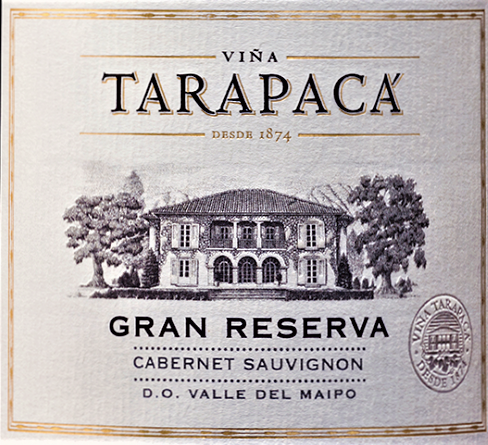
Vina Tarapaca Gran Reserva Cabernet Sauvignon 2013

W Tarapaca 2013Cabernet Sauvignon from Isla de Maipo, Maipo Valley, Central Valley, Chile
100% cabernet sauvignon

14.3% alcohol

Purchased: 12 July 2016  –  $16.99

Opened: 12 July 2017

els:  9.1/10

James Suckling:  92

Decanter:  91

Natalie MacLean:  91

Globe and Mail:  91

Cellar Tracker:  86

The Central Valley wine region, aka, the Inland Valleys, of Chile is a 250-mile north-south region nestled within the 600-mile north-south depression between the western Coastal Ranges and the eastern Andes, all within the central part of country. The wine region extends from northern most, heavily vined, Maipo Valley, near the capital city of Santiago, down to the table wine capital of Maule Valley in the south, which shares its southern border with the Bio-Bio region. Geographically analogous to the California Inland Valleys with the Central Valley bracketed by the Coastal Ranges to the west and the Sierra Nevadas to the east. Unlike the Inland Valleys of California, the Inland Valleys of Chile have a greater diversity of terroir requiring a narrowing of focus before climate, soils and rainfall can be adequately discussed.

Chile is the 8th largest producer of wine, by volume, in the world while the Central Valley wine region produces around 85%, by volume, of all wine in Chile. Cabernet Sauvignon and Merlot, Petit Verdot, Syrah, Carmenere and Carignan grapes dominate the plantings in the Inland Valleys. Cabernet Sauvignon accounts for more than a third of all vines planted in Chile and almost 50% of the vines in Maipo Valley.

Maipo Valley, an area of 276,000 acres has a little more than 11% of those acres dedicated to growing grapes, and Cabernet Sauvignon is the reigning monarch on these regal lands. Most Chilean wines of prestige come from here, often referred to as the Bordeaux of South America. Like the Rioja wine region in Spain, Maipo Valley is divided into 3 sub-regions based on altitude: Alto, Medio or Central, and Bajo or Pacific; Maipo. Alto Maipo vineyards on the western foothills of the Andes are the area’s crown jewels, producing extraordinary Bordeaux blends from vineyards more than 1300′ above sea level, and as high as 2600′. Down slope and to the west from Alto are the Medio Maipo vineyards producing slightly less discriminating wines. Lower down and further west are the wineries, not necessarily the vineyards, of Bajo Maipo; producers of good wines if sourced from the higher elevations to the east.

Cabernet Sauvignon is the most widely grown grape in the world; coming from zero in the mid-1600s, when it was established as a new species by the natural cross-breeding of Cabernet Franc and Sauvignon Blanc grapes, then rapidly ascending to the prominence of being planted in one out of every 16 vine cultivated acres. A black, thick-skinned grape that has multitude of aromas and flavors from pepper to mint to jam.  With its high tannins and medium acidity it possess the potential for a long shelf life of ageing and consumers just can’t get enough of it.

Vina Tarapaca, founded in 1874 in the western foothills of the Andes Mountains, by Don Francisco de Rojas Salamanca which he originally named, Vina de Rojas. In 1892 the winery was sold to Don Antonio Zavala and was renamed Vina Zavala. When the Zavala divorced his wife, Mrs. Mercedes Ulloa, the winery passed to her as part of the settlement and she renamed the winery to Vina Tarapaca Ex Zavala; honoring her divorce lawyer and future president of the country, Don Arturo “The Lion of Tarapaca” Alessandri and spiting her former husband at the same time. Ouch. In 1992 La Compañía Chilena de Fosforos acquired the company and began gearing its production towards the export market. Also in 1992 the company acquired the Maipo Valley property: El Rosario Estate. In 2008 the company entered into a partnership with the VSPT Wine Group to export fine Chilean and Argentinean wines to international markets.

Vina Tarapaca’s winery and vineyards are located in Isla de Maipo, a town along the Maipo River of about 26,000, approximately 25 miles southwest of Santiago.  The estate encompasses about 6400 acres of which 1600 are planted in vines, and are totally surrounded by mountains and the river. The Cabernet Sauvignon vineyards are tucked into a small mountain canyon growing in piedmont or mountain alluvial soils of a gravelly loam that overlays a sandy, gravelly sub-strata. The soil’s drainage is good and the roots can go deep. The growing season diurnal temperature range is about 50-87ºF and the rainfall averages about 0.5″ per month.

The grapes were harvested in the last 2 weeks of April. A pre-fermentation cold maceration period was carried out at 54ºF.  The grapes were then fermented at about 80ºF, followed by another maceration period for 10 days. The wine was then aged for 12 months in new and old, French and American oak barrels.

A deep purple; I always love writing that, wine with an earthy blackberry aroma and a faint herbal scent. Full bodied but the tannins and acidity will not overpower you. It has a well-balanced, nice long finish.

A nice wine to enjoy with my super easy shredded pork soft tacoritoes.  You will need about 1 pound of pork, I usually use boneless pork ribs, 1 medium chopped white onion, 2 tablespoons of minced garlic, 2 packages of taco seasoning, 2 diced tomatoes, sliced jalapeno peppers to taste, 16 ounces of a 3 cheese Mexican mix, and 12-24 flour tortillas. Boil the pork in water, along with the onion, garlic, and 1.5 packages of  the taco seasoning for several hours or until the pork is easily shredded with a fork. Drain off all the water except about a cup and shred the pork.  Add in the tomatoes, jalapeno, and the remaining seasoning and mix.  Add additional liquid if too dry.  Mix thoroughly and slowly simmer for about 10 minutes. Spread 1-2 tablespoons of the pork mixture on a tortilla and roll up.  Top with cheese and microwave until the cheese is melted.  Serve with sides of sour cream, picante sauce and other condiments you usually use for your tacos.

An outstanding wine at a nice price. Drink this year but it likely will be good until 2021-2023. Decant and aerate for one hour, or more, before drinking. A great value wine that is now, rather scarce. The link below had the wine at the time of this posting.

$18.40 wine-searcher.com

Casas del Bosque Gran Reserva Cabernet Sauvignon 2014

W Casa Bosque 2014Cabernet Sauvignon from Maipo Valley, Central Valley, Chile

100% cabernet sauvignon

14.5% alcohol

Purchased: 6 January 2017  –  $15.99

Opened: 3 May 2017

els:  9.0/10

James Suckling: 94

Wine Advocate: 89

Cellar Tracker: 89

The Central Valley wine region, aka, the Inland Valleys, of Chile is a 250-mile north-south region nestled within the 600-mile north-south depression between the western Coastal Ranges and the eastern Andes, all within the central part of country. The wine region extends from northern most, heavily vined, Maipo Valley, near the capital city of Santiago, down to the table wine capital of Maule Valley in the south, which shares its southern border with the Bio-Bio region. Geographically analogous to the California Inland Valleys with the Central Valley bracketed by the Coastal Ranges to the west and the Sierra Nevadas to the east. Unlike the Inland Valleys of California, the Inland Valleys of Chile have a greater diversity of terroir requiring a narrowing of focus before climate, soils and rainfall can be adequately discussed.

Chile is the 8th largest producer of wine, by volume, in the world while the Central Valley wine region produces around 85%, by volume, of all wine in Chile. Cabernet Sauvignon and Merlot, Petit Verdot, Syrah, Carmenere and Carignan grapes dominate the plantings in the Inland Valleys. Cabernet Sauvignon accounts for more than a third of all vines planted in Chile and almost 50% of the vines in Maipo Valley.

Maipo Valley, an area of 276,000 acres has a little more than 11% of those acres dedicated to growing grapes, and Cabernet Sauvignon is the reigning monarch on these regal lands. Most Chilean wines of prestige come from here, often referred to as the Bordeaux of South America. Like the Rioja wine region in Spain, Maipo Valley is divided into 3 sub-regions based on altitude: Alto, Medio or Central, and Bajo or Pacific; Maipo. Alto Maipo vineyards on the western foothills of the Andes are the area’s crown jewels, producing extraordinary Bordeaux blends from vineyards more than 1300′ above sea level, and as high as 2600′. Down slope and to the west from Alto are the Medio Maipo vineyards producing slightly less discriminating wines. Lower down and further west are the wineries, not necessarily the vineyards, of Bajo Maipo; producers of good wines if sourced from the higher elevations to the east.

Cabernet Sauvignon is the most widely grown grape in the world; coming from zero in the mid-1600s, when it was established as a new species by the natural cross-breeding of Cabernet Franc and Sauvignon Blanc grapes, then rapidly ascending to the prominence of being planted in one out of every 16 vine cultivated acres. A black, thick-skinned grape that has multitude of aromas and flavors from pepper to mint to jam.  With its high tannins and medium acidity it possess the potential for a long shelf life of ageing and consumers just can’t get enough of it.

Juan Cuneo Solari, the son of an Italian immigrants, established, in 1993, the Casas del Bosque winery. He located it west of Maipo Valley in Casablanca Valley, smack dab in the middle of the Coastal Ranges.  He has vineyards in the valley but sources the grapes for his Gran Reserva from Maipo Valley to the east.  The winery only produces a limited 90,000 cases of wine, total for all varietals, per year, concentrating on quality over quantity. Their limited production is largely devoted to serving an international clientele via export.

Casas del Bosque produces grapes from 500 acres scattered around Chile’s better viticultural valleys and terroirs. The cooler climate Casablanca vineyards produce their white grapes; Sauvignon Blanc, Chardonnay and Riesling along with the reds; Pinot Noir and Syrah. Premium Gran Reserva Cabernet Sauvignon and Carmenere reds are sourced from the warmer climate Rapel and Maipo Valleys. The Maipo Valley vineyards are located in both the Alto and Medio regions of the valley.

The grapes were harvested at the end of April and the beginning of May.  The grapes were destemmed, crushed, and fermented for 10-15 days at temperatures as high as 90ºF. Following fermentation, an additional 5-day maceration supplied more time for skin color to find its way into the wine. The wine was then aged in new and used French oak barrels for 14-months with 3 intervening racks. The wine was aged for an additional 3-months in bottles before being released to the public.

A very good full-bodied, dark ruby-colored Cabernet Sauvignon with a spicy dried-fruit bouquet. The tannins are smooth and the wine has a long mellow fruity finish. This wine will hold up well for several years to come.

Enjoy with a South American favorite, beef filled empanadas. You can make your own pastry but we usually just use a loaf of frozen bread dough.  I seen others use frozen pizza dough. Let the bread dough thaw and rise.  Heat 1 tablespoon of olive oil, add 1 pound of ground beef, 1 tablespoon of fresh garlic, and cook till well done. Salt to taste. Drain off excess oil and set aside. In the same pan add the remaining olive oil and heat. Add 2 tablespoons of tomato past, 2 teaspoons ground cumin, 1 teaspoon dried oregano, 1-3 teaspoons of tabasco sauce, 5 cloves of garlic, minced, or 1 tablespoon, 1 chopped green and red bell pepper, 1 chopped medium onion and fry it all for about 10 minutes; stirring a lot until everything is soft. Add in the ground beef and simmer for another 5 to 10 minutes.  Salt and pepper to taste.  After the bread dough has risen, cut the 4-6″ diameter tube into 1/4″ slices; less than the thickness of the tip of your little finger. Lay the slices flat and add just enough of the beef mixture to allow you to fold the circle in half creating a bulging half-moon. Crimp the open edge with a fork. Either using a wok or a deep fryer, heat, to 350ºF, sufficient lard or oil to cover several empanadas at one time.  Fry until golden brown, about 5-8 minutes depending on size.  Empanadas actually taste better the next day. Experiment by adding small cubes of boiled potatoes, carrots, or shredded pork. Cover with melted cheese if desired. Dipping in sour cream or guacamole is an added pleasure.

An outstanding wine at a nice price. Drink this year but likely will be good until 2022-2024. Decant and aerate for one hour, or more, before drinking. A great value wine that is now, rather scarce. The link below had the wine at the time of this posting.

$16.95 Atlas Wine Sales