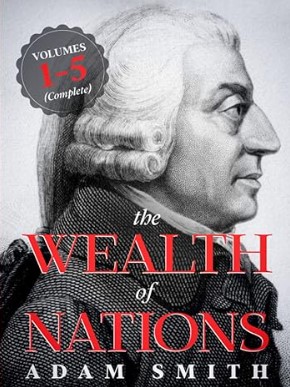
Adam Smith, who published his landmark economic treatise The Wealth of Nations in 1776, created an immense tome that spans around 950 pages of incredibly original theory, but it also disparagingly known for its complex language, lengthy, detailed detours, and economic examples that can seem quaint or enigmatic by today’s standards. The book is worth reading but find an abridged version such as The Wealth of Nations: Abridged, CreateSpace, 2011, 150 pages.
His theories for the efficient running of a country’s economy have become the foundation of classical economics, eventually forming the basis for the capitalist economic system. In his book, he introduced concepts such as the invisible hand, free markets, and laissez-faire economics—principles that are widely accepted in the Chicago and Austrian schools of economic thought today.
The Wealth of Nations is divided into 5 books:
- Economic Efficiency: Discusses the division of labor and how it increases productivity and efficiency in the economy.
- Accumulation of Capital: Focuses on the importance of savings and investment in driving economic growth.
- Economic Growth: Examines the factors that contribute to the prosperity of nations, including labor, land, and capital.
- Economic Theory: Lays out the principles of supply and demand, price mechanisms, and market dynamics.
- The Role of Government: Argues for limited government intervention, emphasizing the protection of property rights, national defense, and the provision of public goods.
Trivia: Smith never used the word capitalist or any of its derivatives. The first English use of the word “capitalism” is believed to have appeared in the novel The Newcomes by William Makepeace Thackeray. The story follows a banking family and their increasing wealth and admittance into the English aristocracy.
Source: The Wealth of Nations by Adam Smith. The Newcomes by Thackeray.
 elsToday