A distant galaxy at the edge of the universe and the beginning of time has revealed a remarkable discovery by Yale researchers. They have identified a variable quasar that rapidly brightens as its astrophysical jets periodically align with the position of Earth.
The researchers believe that this quasar, and others like it, played a significant role in bringing light into the early dark universe, alongside massive early stars which preceded the quasars.
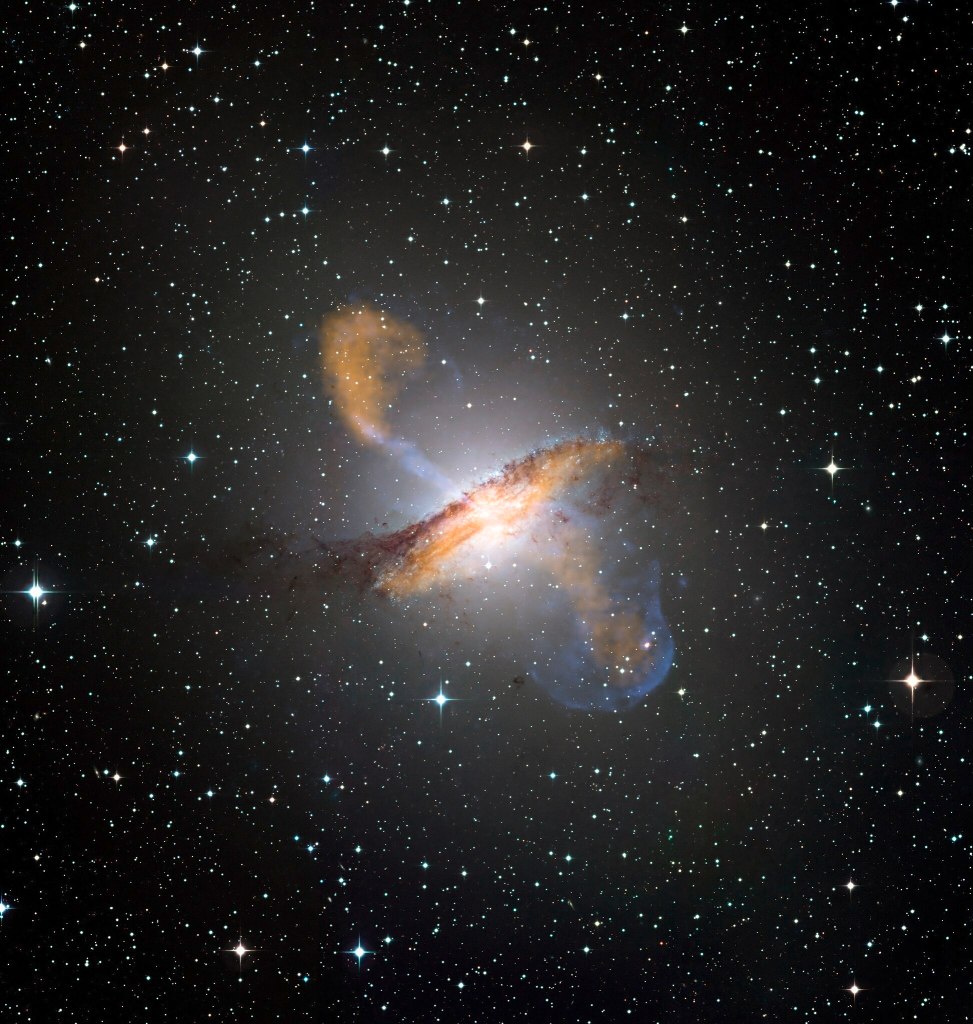
Quasars are supermassive black holes at the centers of early galaxies, spinning at relativistic speeds. These early galaxies contained substantial unincorporated material, primordial gas clouds akin to present-day nebulae, which were easily captured by the black hole’s gravity. Near the event horizon of the black hole, this matter is caught in a ‘turbulent’ vortex, creating massive astrophysical jets. These jets, partially composed of ionized plasmas, are expelled at relativistic speeds, extending up to hundreds of light-years from the black hole and perpendicular to its event horizon. As the ionized hydrogen plasmas capture electrons from the neutral hydrogen in the early universe, photons are released, contributing to the illumination of the cosmos.
Thomas Connor, an astronomer at the Chandra X-Ray Center and co-corresponding author of the study, states, “[This] epoch of reionization is considered the end of the universe’s dark ages.”
Trivia: The song Put Your Lights On was written by Erik Schrody (Everlast) and performed with Santana on his 1999 album Supernatural. He wrote the song while recovering from a heart attack, pondering the hope that exists in life.
Source: This Quasar May Have Helped Turn the Lights on… by Shelton, Yale, 2025. Graphic: Black Hole Outflows from Centaurus A, ESO, 2009.
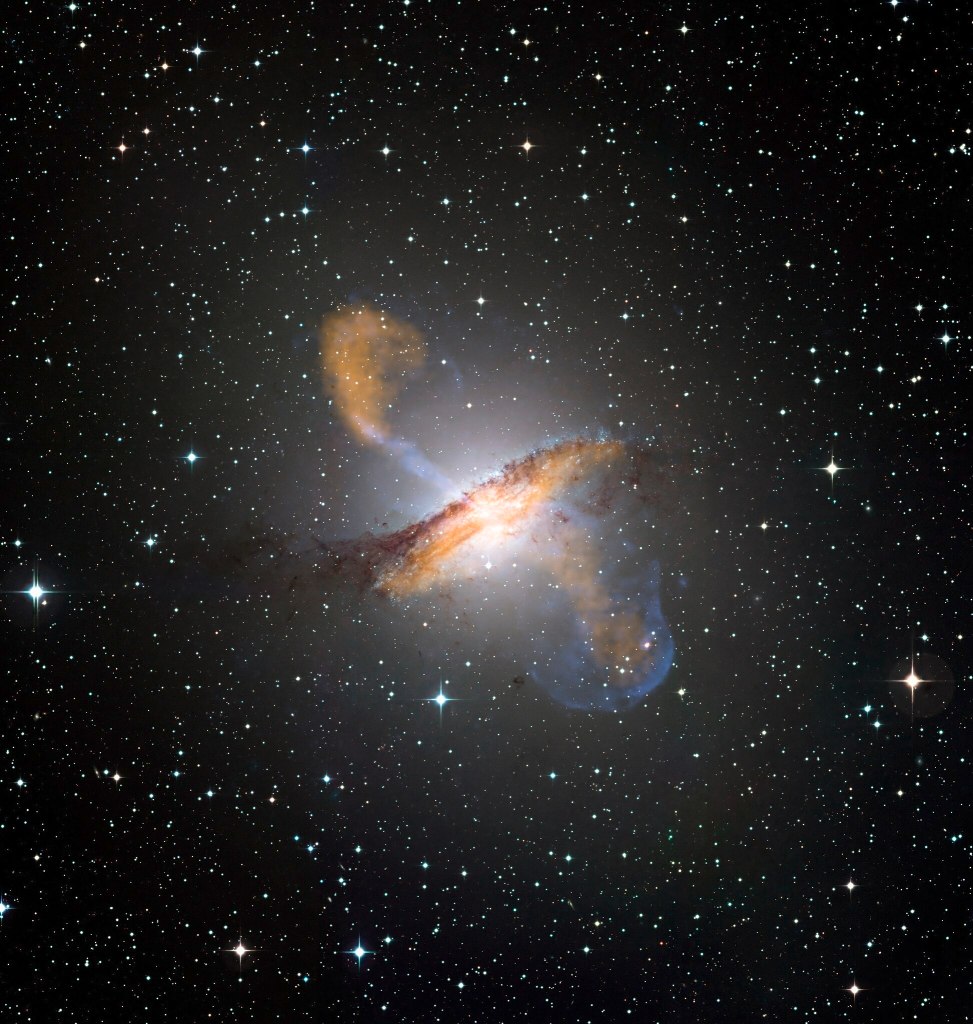
In a galaxy far, far away within the Draco (Dragon) constellation, an international team has, for the first time, observed plasma jets forming in real time and shooting out at relativistic speeds, perpendicular to the plane of a black hole’s event horizon. Plasma jets, composed of ionized matter, are a subset of astrophysical jets—energetic, narrow beams of matter and radiation ejected from various objects, primarily black holes, along their axis of rotation.
These plasma jets were observed in the Milky Way’s gravitationally captured satellite, the Draco Dwarf Galaxy, located 270 million light-years from Earth. The Draco Dwarf Galaxy is home to a black hole that apparently has a white dwarf star companion. A likely scenario is that the white dwarf was once a companion to a much larger star that evolved faster, went supernova, and collapsed into a black hole. Today, the black hole is possibly cannibalizing material from the white dwarf, potentially leading to the plasma jets observed by researchers.
Source: Astronomers observe real-time formation of black hole jets by UMBC, 2025. Graphic: Black Hole Outflows from Centaurus A, ESO, 2009.
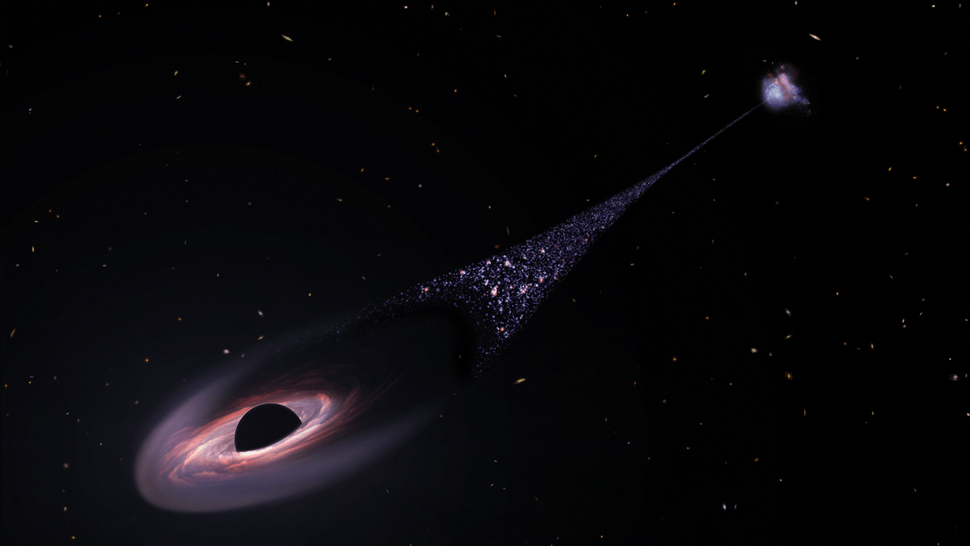
Brandon Specktor with LiveScience reports that ‘in 2023 astronomers reported the detection of something never seen before: a “runaway” black hole…’
The observed black hole with a mass of 20 million suns, is not gravitationally locked to any galaxy. It was spotted streaking darkly through space at more than 3 million miles per hour, or approximately 0.5% the speed of light, dragging a 200,000 light year long string of stars behind it like Christmas lights tied behind Santa’s sleigh.
Possible scenarios that may have sent the black hole on its merry way include various interactions with other massive objects, such as galactic collisions or gravitational recoil of merging black holes.
Source: 5 Space Discoveries that Scientists are Struggling to Explain by Brandon Specktor, LiveScience, 2024. Graphic: NASA, ESA, Leah Hustak (STScl)
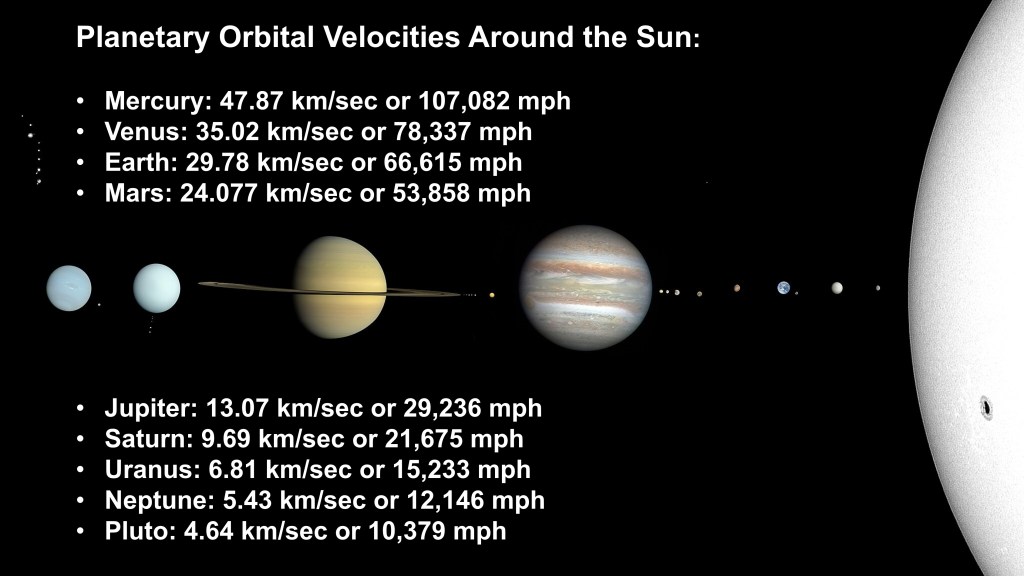
Kepler’s Second Law, first published between 1609 and 1619, describes how a planet’s orbital speed varies along its elliptical orbit around the Sun. As the planet approaches the Sun, the gravitational pull from the Sun is stronger causing the planet to move faster. As a planet moves away from the Sun it slows down.
Kepler’s Second Law in geometric jargon: A line joining a planet and the Sun sweeps out equal areas during equal intervals of time.
Source: Smithsonian, How Things Fly. Graphic of the Planets and the Sun by CactiStaccingCrane 2022.
David Wootton, age 71, is the Anniversary Professor (a named professor in the British system is equivalent to a full professor in the American system…I believe) of History at the University of York in England. His work ranges from the history of the individual to the wider-ranging histories, and philosophies of ideas that shaped our world. His published interests concentrate on the Renaissance but stretch back to the Greeks and forward to the embryonic American experiment. He is an old-school historian with his scholarship supported by the evidence available coupled with the existing mores of the times. His selection of topics that I have read or perused suggests a thorough dearth of confidence in past historical interpretations and a jaundiced view of present sense and sensibilities. Or more succinctly and in his own words, “History is always about a particular time, a particular place; it is always about groups more than it is about individuals; it is always the history of somewhere.” and if I may so boldly add, it is always the history of (some)time.
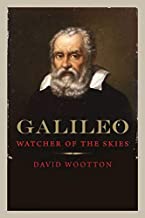
Wootton’s biography of Paolo Sarpi, a contemporary and patron of Galileo, likely provided, albeit 27 years later, the impetus and scholarship for Wootton publishing his second biography in 2006 on that aforementioned watcher of the skies. Sarpi, a devout Copernican and a supposedly not so devout Catholic supported Galileo’s heliocentric theories and shielded him, for a time, from his Roman inquisitors. Parenthetically, Wootton in his book on Galileo almost apologizes for writing biographies mainly because his peers look down on the genre, a sentiment I used to harbor but I now appreciate the category because they provide the who to the what, where, and when.
Bad Medicine, Wootton’s second book, postulates that doctors have dispensed more harm than good, beginning with Hippocrates in the fifth century B.C and continuing through to the present day. Covid or the Wuhan Flu pandemic will not provide the medical profession with the needed catharsis to dispel Wootton’s conjecture.
In The Invention of Science Wootton walks us through the birth of the scientific method starting with a supernova shining in the Renaissance night sky of the 1500s and culminating with Newton’s discovery that visible light contains a plethora, or at least 7 wavelengths and hues in the early 1700s.
In Power, Pleasure, and Profit, Wootton expands on the concept of selfishness driving all human progress. A concept, although anathema to all Christian and Western ethics and morality, was espoused by Machiavelli’s The Prince, published in the early 1500s and Mandeville’s The Fable of the Bees, also known as The Grumbling Hive, first published in 1705.
Wootton’s Besterman Lecture: Adam Smith, Poverty, and Famine, we find out that charity is not a word in Smith’s vocabulary. Academics and maybe the rest us can really get into the weeds.
And finally, before I get into Galileo, The BBC devoted 40 minutes interviewing four guests, Wootton being one of them, on The Fable of the Bees, written initially as a poem, as stated above, by Bernard Mandeville and expanded into a book length dissertation sub-titled Private Vices, Publick Benefits which proposes that personal pleasure and greed drive human progress not altruism or Christian charity.
Galileo, born in the small city of Pisa, Italy in 1564, lived to the astronomical age of 77, some 25 years beyond the average lifespan for that era. He spent his final years blind, serving a life sentence, originally in a papal prison but eventually the prison was exchanged for confinement to his home located in a small village outside of Florence. His crime was for authoring a book defending the heliocentric model of the universe as theorized by Copernicus in 1543 rather than promoting the geocentric model as demanded by the Catholic Church.
Galileo was a tinkerer and thinker more akin to our modern definition of an engineer rather than a scientist, taking innovative ideas and novel inventions to the next level. He didn’t invent the telescope, Hans Lippershay of the Netherlands in 1608 did, but Galileo’s design quickly became the standard and he eventually increased Lippershay’s 3x magnification to 23-30x. His leaden tube with a convex lens in one end and concave lens in the other end discovered the mountains and plains of the moon, the moons of Jupiter, the rings of Saturn, the phases of Venus, possibly the planet Neptune, individual stars of the Milky Way, and sunspots. Today we can purchase a 30x set of binoculars for less than $100 which we use to peep through our neighbors’ windows and watch songbirds in the meadow across the street. All his discoveries aided in the proof of a heliocentric universe, his universe being mostly what we would refer to today as the solar system. Our discoveries prove that our neighbors are weird.
Galileo was a fascinating man and genus who introduced the world to a new way of advancing our knowledge of the world and the universe. His tinkering and thinking were the rudimentary beginnings of what we now call the scientific method–observe, hypothesize, test, repeat.
His proof of Copernicus’ theory was mostly correct. The Church’s defense of the geocentric model wasn’t. The Church admitted their error in 1992.
 elsToday