Color in the Eye of the Beholder

Ansel Adams (1902-1964), photographer of the majestic, was exceptionally elusive when it came to why he preferred black-and-white photographs over color, offering only a few comments on his medium of choice. He believed that black-and-white photography was a “departure from reality” which is true on many levels but that is also true of most artistic efforts and products. He also held the elementary belief that “one sees differently with color photography than black-and-white.” Some have even suggested that Adams said, “…when you photograph them in black and white, you photograph their souls,” but this seems apocryphal since most of his oeuvre was landscape photography.

Adams’s black-and-white photography framed the grandeur of the mountainous West in stark, unembellished terms. Yet without color, a coolness loiters, untouched by human sentiment or warmth. As an unabashed environmentalist, maybe that was his point, the majesty of the outdoors was diminished by human presence. In black-and-white, the wilderness remained unsullied and alone.

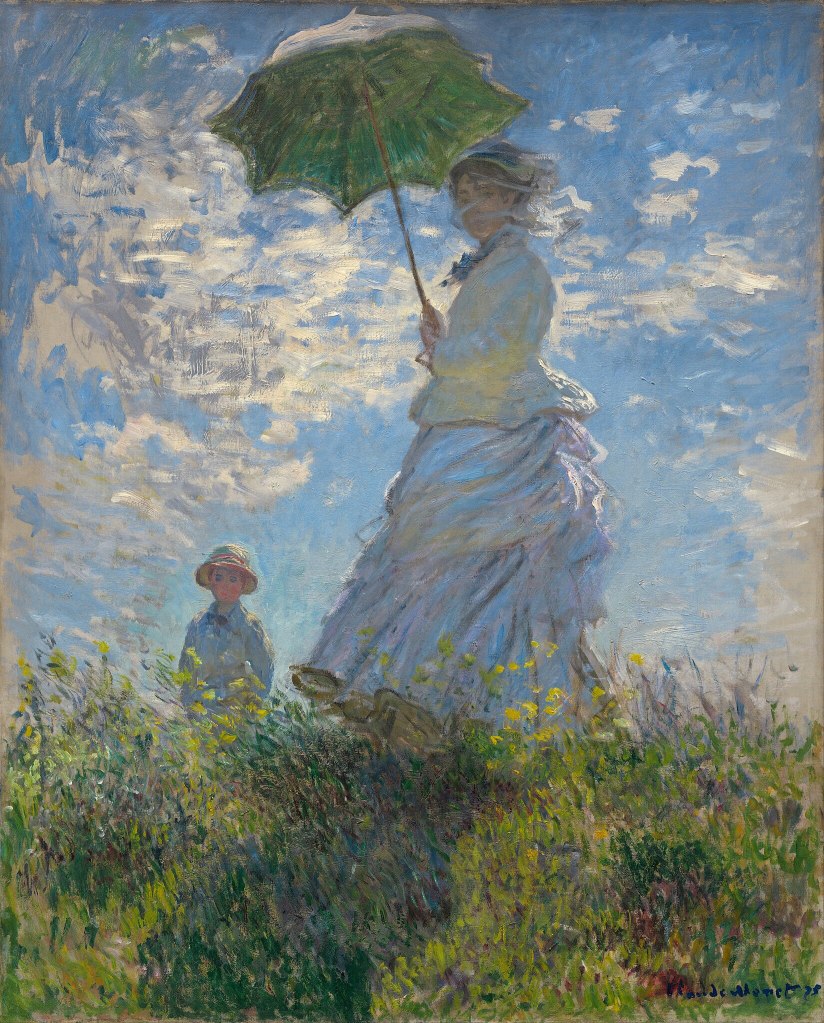
But to Claude Monet (1840-1926), founding French Impressionist, color and light, was everything in his eye. Color defined his paintings, professing that “Color is my day-long obsession, (my) joy…,” he confessed. Color was also a constant burden that he carried with him throughout the day and into the night, lamenting, “Colors pursue me like a constant worry. They even worry me in my sleep.” He lived his aphorism: “Paint what you really see, not what you think you ought to see…but the object enveloped in sunlight and atmosphere, with the blue dome of Heaven reflected in the shadows.” His reality was light and color with a human warming touch.

Adams and Monet’s genius were partially contained in their ability to use light to capture the essence of the landscape, but Monet brought the soul along in living color. Monet’s creed, “I want the unobtainable. Other artists paint a bridge, a house, a boat, and that’s the end…. I want to paint the air which surrounds the bridge, the house, the boat, the beauty of the air in which these objects are located…”

Color is a defining quality of humanity. Without color life would be as impersonal as Adam’s landscapes, beautiful, majestic even, but without passion or pulse. A sharp, stark visual with little nuance, no emotional gradations from torment to ecstasy, just shadows and form.

Understanding color was not just a technical revelation for 19th-century French artists, it was a revolutionary awakening, a new approach to how the eye viewed color and light. The Impressionists and Pointillists brought a new perception to their canvases. And the catalyst for this leap away from the tired styles of Academic Art and Realism was Michel Eugene Chevreul, a chemist whose insight into color harmony and contrast inspired the Monets and Seurats to pursue something radically different in the world of art. His chromatic studies inspired them to paint not for the viewer’s eye, but with it, transforming perception from passive witness into an active collaboration between painter, subject, and observer.

Chevreul’s breakthrough was deceivingly simple. Colors are not static blots on a canvas but relational objects that come alive when surrounded by other hues of the spectrum. A hue in isolation is perceived differently than when seen next to another. Red deepens next to green; blue pulsates with enthusiasm against orange. This principle, simultaneous contrast, revealed that the eye does not just passively accept what it sees but synthesizes it to a new reality.

Chevreul’s theories on complementary colors and optical mixing laid the foundation for painters to forsake rigid outlines, often rendered in the non-color of black, and embrace Impressionism: not merely an art style, but a promise of perception, a collaboration between painter and viewer. Rather than blending pigments on a palette, artists like Monet and Seurat placed discrete strokes side by side, allowing the viewer’s mind to complete the image.

This optical mixing is a product of the way the eye and the brain process the various wavelengths of white light. When complementary colors are adjacent to one another the brain amplifies the differences. Neurons in the eye are selfish. When a photoreceptor is stimulated by a color it suppresses adjacent receptors sharpening the boundaries and contrast. And the brain interprets what it sees based on context. Which is why sometimes we see what is not there or misinterpret what is there, such as faces on the surface of Mars or UFOs streaking through the sky. There is also a theory that the brain processes color in opposing pairs. When it sees red it suppresses green creating a vibrancy of complementary colors when placed together.

The Impressionists intensely debated Chevreul’s concepts then they brushed them to life with paint. They painted not concrete objects, but forms shaped by light and color. Haystacks and parasols within a changing mood of contrasting color. . Interpretation by the eye of the beholder.

Chevreul’s collected research, The Principles of Harmony and Contrast of Colors and Their Applications to the Arts, originally published in 1839, remains in print nearly two centuries later.

Source: The Principles of Harmony and Contrast of Colors and Their Applications to the Arts by Michel Eugène Chevreul, 1997 (English Translation). Graphic: Woman with a Parasol by Monet, 1875. National Gallery of Art, Washington, DC. Public Domain.
A Revolution in Paint

“One must either be one of a thousand or all alone,” declared Edouard Manet (1832-1883). Critics and even some among the Impressionist circle believed Manet lacked the courage to be truly alone, both with his art and his essence. And they were half right. He was an extrovert, a social creature drawn to the vivacious pulse of Parisian life, its salons, cafes, and couture. He wanted to belong.

Through his art he sought recognition. He wanted not necessarily respect, but rather something simpler: acceptance. Yet they misunderstood his paintings. He was alone. His canvass spoke volumes to him, but the critics saw only muted, unfulfilled talent. Paintings adrift in a stylistic wilderness. The arbitrators of French taste, the Salon jury, repeatedly rejected him. In 1875 upon viewing The Laundress, one jury exploded: “That’s enough. We have given M. Manet ten years to amend himself. He hasn’t done so. On the contrary, he is sinking deeper.”

Manet longed for approval, and he could deliver what the critics wanted, but the moment he picked up his brush something else took over. He painted what he saw, but never fully controlled the production. His canvases resisted labels. A modern Romantic, a Naturalist with a Realist bent, urban but Impressionistic. A cypher to the critics but true to himself.

Like his friend Degas, he painted contemporary city life. The country landscapes of Monet, Renoir, and Pissarro couldn’t hold him. The color and light of the Impressionists intrigued him briefly, but stark lighting and unconventional perspective held him fast. He used broad quick solid brush strokes and flat, cutout forms.

Manet’s style was rebellion. The critics sensed it, and hated it, but they never understood it. He couldn’t digest academic art, so revered by the Salon. His mutiny was expressed through paint, not polemic. His only verbal defense was a cryptic comment that “anything containing the spark of humanity, containing the spirit of the age, is interesting.”

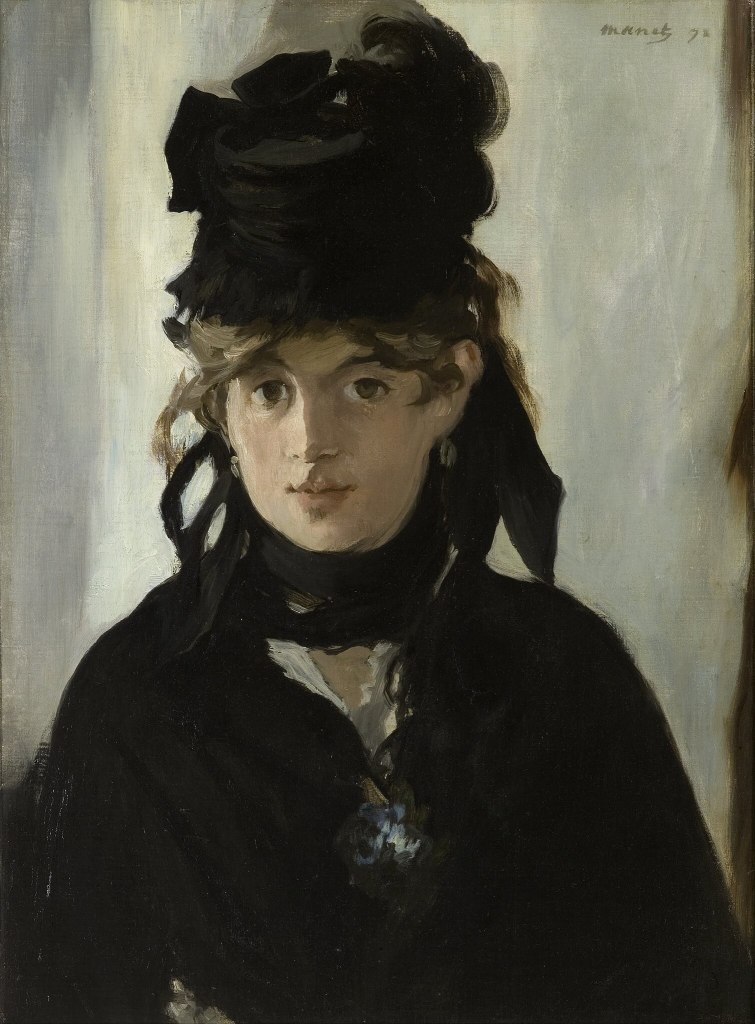
Nowhere is humanity, the spirit of the age, more hauntingly distilled than his masterpiece, his Chef-d’oeuvre: Berthe Morisot with a Bouquet of Violets. Dressed in black, her face half in shadow, Morisot peers questioningly at the viewer, asking what comes next. Manet paints what he sees. And he sees the mystery of femininity. Her green eyes painted black providing an opacity to her gaze, deepening the ambiguity: a comicality behind an expression of curiosity.

Critic Paul Valery wrote, “I do not rank anything in Manet’s work higher than a certain portrait of Berthe Morisot dated 1872.” He likened it to Vermeer, but with more spontaneity that makes this painting forever fresh. It is a timeless, loving portrait that transcends style.

Source: The World of Manet: 1832-1883 by Pierre Schneider, 1968. Graphic: Berthe Morisot with a Bouquet of Violets by Edouard Manet, 1872. Musee d’Orsay, Paris. Public Domain.

Goya: Beauty Unmasked

Francisco de Goya, a late 18th to early 19th century Spanish painter of the Romantic school, is a fascinating study in evolving style, a visual descent into deafness, isolation, and existential dread, though more philosophically, his lifelong disillusionment with civilization’s failure to embody the Enlightenment’s promised ideals of reason, justice, and human dignity. His art swung like a pendulum, from crisp detail to loose rendering to the raw emotion of a mind increasingly separated from reason.

As a court painter to the Spanish monarchy, Goya’s portraits became canvases for cynicism, derision, and paradox. He offered scathing critiques hidden beneath formal composition, and the court loved him for it. They mistook his precision for praise, even as he quietly dismantled their poise and splendor.

His colossal canvas Charles IV of Spain and His Family (110 × 132”) does not illustrate majesty or brilliance; it immerses the senses in familial estrangement and tedium. Awkward poses; lifeless gazes; a composition emotionally hollowed, drained of vitality and intent. These are not confident rulers but bored figures waiting for the dinner bell to summon a distraction: ceremonial chatter over fish soup and presentation of chocolates. In the background of the painting, Goya includes himself, brush in hand, an artist caught in the act of witnessing. It was a nod to Velázquez’s Las Meninas; Goya once said he “had only three masters: Nature, Velázquez, and Rembrandt”; but here, reverence turns to scorn. Goya didn’t flatter his subjects; he distorted the real, undermining not his own reverence for form, but theirs. His royal figures do not speak; they stare blankly, confirming that the emperor wears no clothes. He looked beneath the surface in search of beauty and instead found something far less attractive, an insignificant echo of a tired reality.

Goya’s notion of beauty, conventionally understood, remained intact. But in his subjects, he saw hypocrisy, a lie, elegantly draped, concealing the moral disfigurement beneath. This critique finds haunting expression in his etching Nadie se Conoce (“Nobody recognizes himself”), Plate No. 6 of Los Caprichos, where masked carnival patrons drift like phantoms of untruth. On the reverse of the plate, Goya inscribed his chilling reflection: “The world is a mask; the face, the costume, and the voice are all feigned. Everyone wants to appear what they are not, everyone deceives, and no one knows himself.”

Goya painted the existential. His late works: The Disasters of War, The Black Paintings, The Madhouse, Saturn Devouring His Son, reveal more of his suffering psyche than his technical ability. Anthony Cascardi argues in Francisco de Goya and the Art of Critique that Goya’s entire oeuvre is a sustained confrontation with Enlightenment ideals. Reason and beauty dissolve under his brush. Societal decay no longer whispers, it screams.

In style, Goya stands at the edge of the Impressionist movement, decades before its arrival. His gestural freedom, emotional brushwork, and psychological texture prefigure the rawness of Manet and even hint at Bacon’s existential grotesque. Paint becomes not just medium but mood, an extension of perception unraveling. Form overrides detail. But Goya moved to a darker rhythm, his brushwork shades where theirs shimmered. Where Monet dances with light, Goya wrestles with darkness. The Impressionists chose beauty over Goya’s emotional appeal, which ultimately served to mock his subjects’ feigned grace.

Unlike Picasso’s theatrical mockery, Goya’s assessment is surgical. He dispenses with pretense and seeks truth, not a truth easily embraced, but one rooted in the soul’s unpleasant, hidden recesses. Picasso once echoed a similar sentiment in a 1923 interview with The Arts: “Art is a lie that makes us realize truth, at least the truth that is given us to understand.” Art distorts to reveal what reality conceals, truth not always visible, but deeply felt. Superficial beauty without the soul is not art, it is a lie.

In contrast to today’s symbolic excess, where the subject is buried beneath concept and symbols, Goya’s portraits are revealing to the point of brutality. He doesn’t idealize; he removes the layers of deceit. The beast within becomes the subject. His cynicism is constant, his honesty sometimes absurd, but always truthful.

Goya takes a moral stance. His genius lies in the ability to paint the conscious with the unconscious, to render not just what he saw, but what he felt and feared, the form with the spiritual. His style matched his psyche. He painted the perceived rot beneath grandeur, the weariness behind powdered wigs, the absurdity beneath court spectacle.

Goya’s fame was built and balanced on a knife’s edge: he gave the rich what they wanted in form, while seeding beneath it a quiet, damning truth. That duality, beauty as lure, truth as blade, is Goya’s lasting contribution to art.

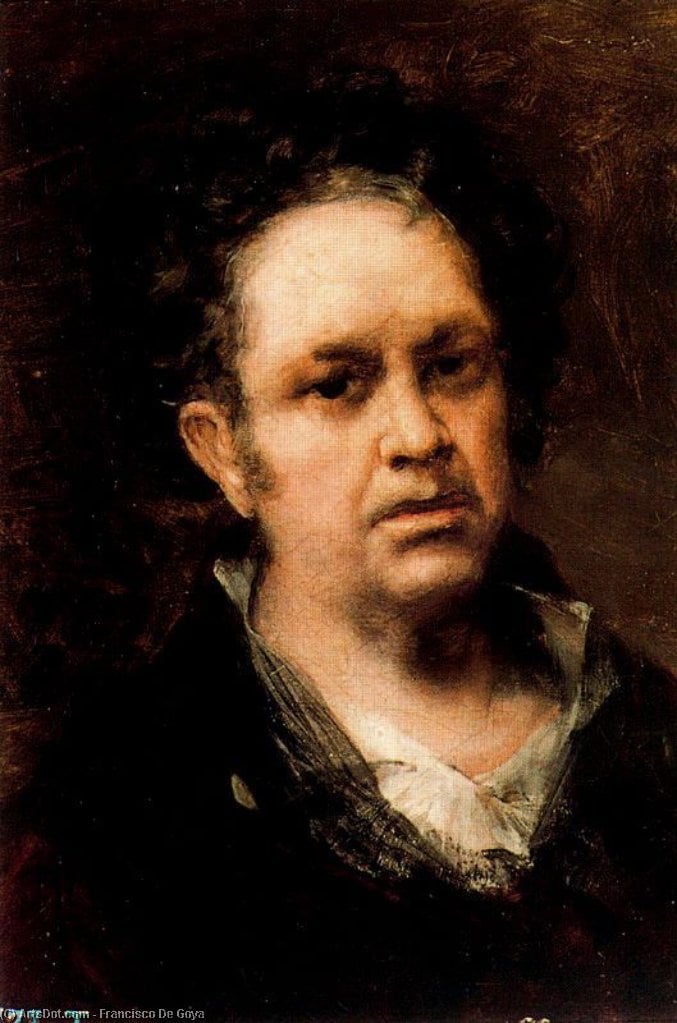
Graphic: Self-Portrait at 69 Years, by Goya, 1815. Museo del Prado-Madrid.

The Many Colors of Slavery

Those who deny freedom to others deserve it not for themselves.”—Abraham Lincoln

Whoever does not have two-thirds of his day for himself, is a slave, whatever he may be: a statesman, a businessman, an official, or a scholar.” — Friedrich Nietzsche

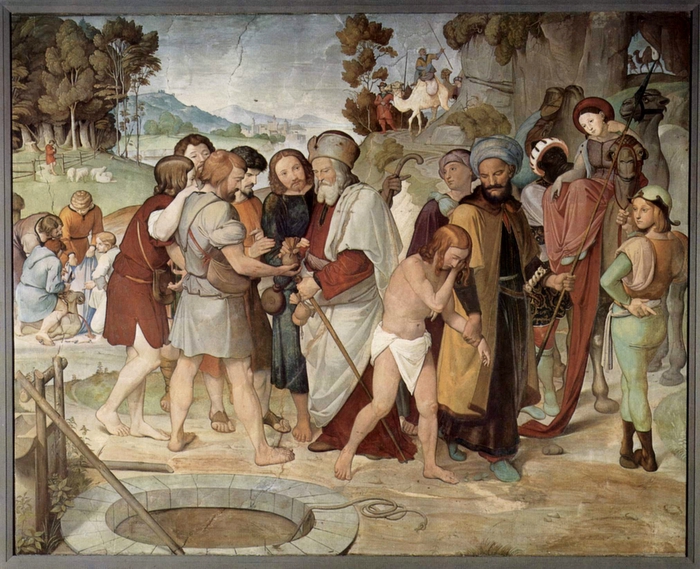
As the great continental glaciers receded at the end of the Pleistocene, fertile land emerged, allowing for the transition from hunting and gathering to agriculture. Farming was labor-intensive, and with the rise of permanent settlements came the demand for constrained and controlled labor. Slavery, likely with first roots in Mesopotamia, though independent manifestation by the Pharaohs in ancient Egypt and other early civilizations, made it ubiquitous, and it has never disappeared.

From the bonded laborers of the Pharaohs to the structured servitude in Greece and Rome, from the transatlantic trade that brutalized African populations to the modern exploitation of migrant workers in sweatshops and the sex trades, slavery has evolved rather than vanished. Each era refines its own form of servitude; forced labor, insurmountable debt, bureaucratic entrapment, or corporate exploitation. It is a practice as ancient as prostitution and taxation, deeply embedded in human society, yet constantly shifting into less visible but equally insidious forms. As long as slavery remains profitable its existence will continue to indelibly stain humanities’ collective soul.

Slavery, and its ultimate contrast, freedom, was a persistent theme in the works of sci-fi author Robert A. Heinlein. With a piercing social awareness, Heinlein, who, in his early years, was described by Isaac Asimov as a ‘flaming liberal’—picked up the theme and horrors of slavery with his 1957 juvenile novel “Citizen of the Galaxy”; bringing the many forms of servitude into the personal history of a precocious kidnapped boy named Thorby. Citizen of the Galaxy is a planet-hopping, spacefaring critique of oppression, class structure, and the nebulous concept of freedom. Heinlein crafts a future where contrasting societies across the galaxy reflect varying degrees of servitude and autonomy, if not necessarily total freedom. Man rarely allows himself complete independence.

Heinlein through the lens of Thorby explores the various shades of slavery, beginning with the brutal, controlling enslavement and continuing to more subtle forms that the individual may not even recognize as confinement. (Partial plot giveaways beyond this point.) Escaping his initial enslavement by the graces of a kindly, strict, but loveable old cripple named Baslim, Thorby moves into a hierarchical, structured existence of spacefaring traders then onto a self-imposed, due to a thirst for justice, straitjacket of a corporate bureaucracy on his birth planet of Terra. A life story of how control can be imposed by others or by ourselves.

As Heinlein’s social perspectives evolved, his libertarian leanings took greater prominence in Citizen of the Galaxy. Through Thorby’s life journey, Heinlein emphasizes personal autonomy, resistance to tyranny, and the moral duty to fight injustice. Baslim, Thorby’s first mentor, symbolizes the idea that one person can stand against oppression and make a difference, even if it takes many miles and years to materialize.

This theme runs through much of Heinlein’s work, but here, it’s especially poignant because Thorby is powerless for much of the novel, making his eventual triumph all the more meaningful. Heinlein’s novels, Farnham’s Freehold, Friday, and Time Enough for Love, explore slavery and control, reinforcing humanity’s inherent need for freedom, or at the very least, breathing space.

Source: Citizen of the Galaxy by Robert A. Heinlein, 1957. Graphic: Joseph Sold into Slavery by Friedrich Overbeck, 1816. Vanderbilt University. Public Domain.

Real Not Real

Have no fear of perfection; you’ll never reach it.” – Dali.

Salvador Dalí was the entertaining, surrealist voice of the masses. His dreamlike spectacle of melting clocks and flamboyant persona captivated popular culture, injecting eccentric brushstrokes into the lives of the disengaged and disinterested. Dalí spoke directly to the public’s fascination with dreams and absurdity, transforming art into a theatrical experience and a giggly poke at the eminent egos on high altars.

Dalí was a 20th-century Spanish artist who drew from influences such as Renaissance art, Impressionism, and Cubism, but by his mid-twenties, he had fully embraced Surrealism. He spent most of his life in Spain, with notable excursions to Paris during the 1920s and 1930s and to the United States during the World War II years. In 1934, he married the love of his life, Gala. Without her, Dalí might never have achieved his fame. She was not just his muse but also his agent and model. A true partner in both his art and life. Together, they rode a rollercoaster of passion and creativity, thrills and dales, until her death in 1982.

Dalí had strong opinions on art, famously critiquing abstract art as “inconsequential.” He once said, “We are all hungry and thirsty for concrete images. Abstract art will have been good for one thing: to restore its exact virginity to figurative art.” He painted images that were real and with context that bordered on the not real, the surreal. For those who believed that modern abstract art had no life, no beauty, no appeal, he provided a bridge back to a coherent emotional foundation with a dreamlike veneer. Incorporating spirituality and innovative perspectives into his dreams and visions of life.

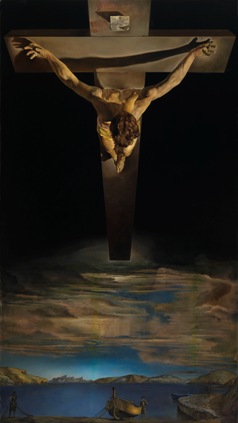
The Persistence of Memory (1931) is Dalí’s most recognizable and famous painting, but his 1951 work Christ of Saint John of the Cross is arguably his most autobiographical and accessible piece. A painting dripping with meaning and perspective, Dalí claimed it came to him in a dream inspired by Saint John of the Cross’s 16th-century sketch of Christ’s crucifixion. The perspective is indirectly informed by Saint John’s vision, while the boat and figures at the bottom reflect influences from La Nain and Velázquez. The triangular shape created by Christ’s body and the cross represents the Holy Trinity, while Christ’s head, a circular nucleus, signifies unity and eternity: “the universe, the Christ!” Dalí ties himself personally to the crucifixion by placing Port Lligat, his home, in the background. He considered this painting a singular and unique piece of existence, one he likely could never reproduce because the part of him that went into the painting was gone forever.That part is shared with his viewers, offering a glimpse into Christ’s pain, Dalí’s anguish, and his compassion: an emotional complexity that transcends mortal comprehension.

Source: Salvador Dali by Robert Descharnes, 1984. Graphic: Christ of Saint John of the Cross, Dali, 1951. Low Res. Copyright Glasgow Corporation.

Swollen Caricatures

Fernando Botero Angulo, 1932-2023, was a Columbian practitioner of figuraism in paint and sculpture, a style where reality is discernable but changed to reflect the artist’s interpretation of his or her world. His unique style has taken on a life of its own and has become known as Boterismo where he exaggerates reality by inflating his objects, mimicking a fat farm on a carbo diet, injecting, according to some, a humor inherent in his plus sized models but it all seems so melodramatic. A melancholic need to explore life’s downsides, forcing the viewer to share not the beauty of life but its complexities and vulnerabilities. There is no happiness in his paintings, just a humorless life.

His style, not far removed from Legar’s Tubism, was the artist’s attempt to find himself and to relieve the self-inflicted anxiety that came from his mode of outward expression not matching his inward vision. He states that “…the moment comes when the painter manages to master the technique and at the same time all of his ideas become clear: at that point his desire to transpose them faithfully onto the canvas becomes so clear and compelling that painting becomes joy itself.”

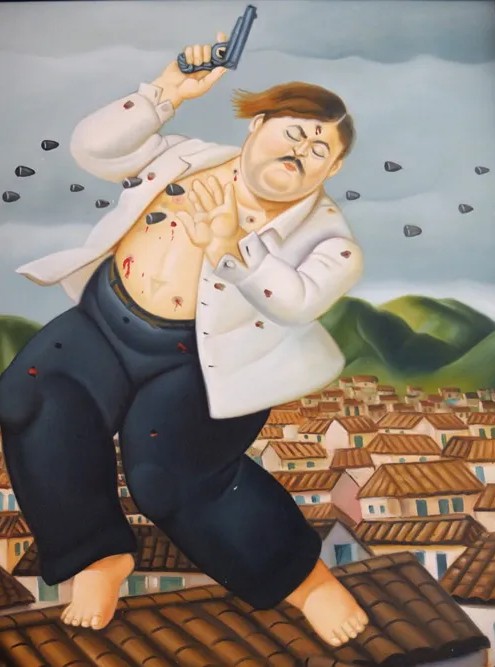
Botero’s 1999 painting, “The Death of Pablo Escobar”, a mafioso interpretation of Chagall’s “Fidler on the Roof”, was an attempt to capture the violence that the drug kingpin brought to Columbia and the world. Standing atop Columbian society, Escobar was laid low by his chosen swordian method of rule: bullets. The artist’s son Juan Carlos Botero states that his father wanted to reflect on the magnitude of the tragedy that Escobar’s actions meant for Columbia, but he also magnified the beast in the man, reminding the world that Columbia and Escobar were once synonymous. A cruel man ruling over a dysfunctional society that he created.

Source: Botero by Rudy Chiappini, 2015. Graphic: The Death of Pablo Escobar by Botero, 1999.

Paris in the Evening

Henri Toulouse-Lautrec, born in 1864, was a unique figure among French nobility and artists. Despite his diminutive stature and aristocratic lineage tracing back to Charlemagne, Lautrec defied conventional expectations with his eccentric, mischievous character, and individualistic style. While influenced by the Impressionists, exemplified by masters like Monet and Degas, he later embraced the Post-Impressionist movement alongside Gauguin and Cézanne, leaving a distinctive mark on the art world. Post-Impressionists diverged from their predecessors by infusing their work with deeper emotion, personal experiences, and greater individualism. Their bold brushwork, exaggerated colors, and unconventional techniques laid the groundwork for the future, anticipating Expressionism.

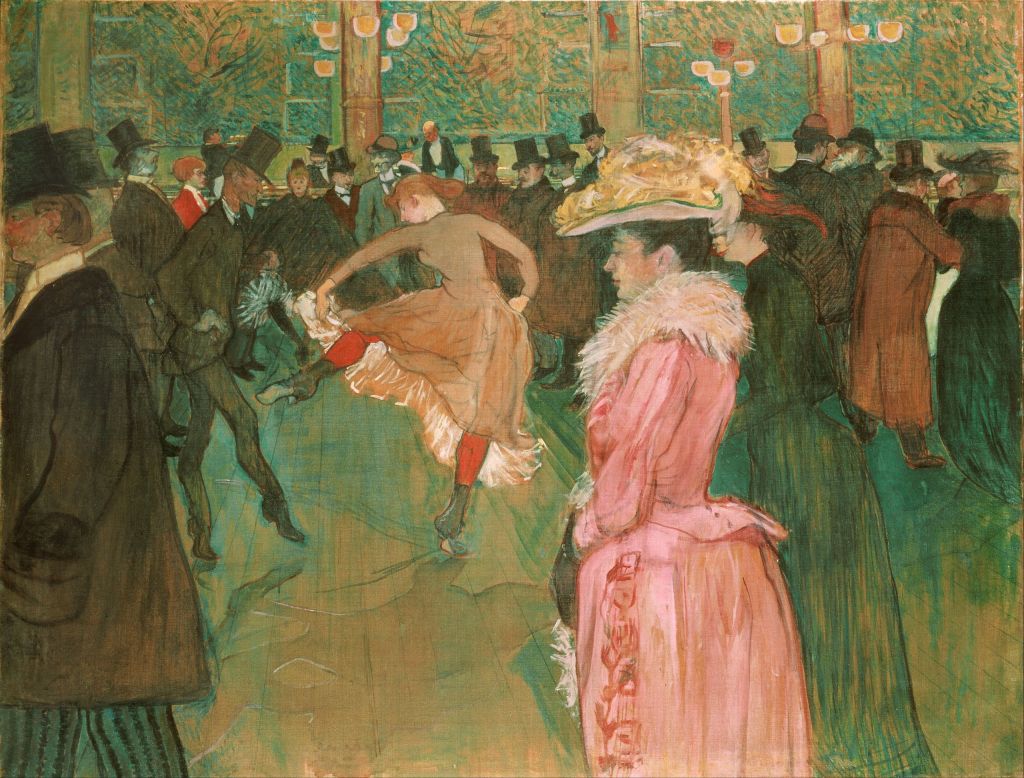
Parisian nightlife was a cornerstone of Lautrec’s art, and At the Moulin Rouge: The Dance stands as his most famous painting, portraying fashionable society and featuring many of his friends and family in a composition of overlapping planes with a perspective that subtly defies reality and logic. The artwork is divided into three distinct planes. The static background features figures such as Lautrec’s father, the poet Yeats, and Jane Avril, a renowned can-can dancer nicknamed “Crazy Jane,” who was both a close friend of Lautrec and a frequent model. In the center, the action unfolds as Valentin le Désossé, a gentleman in a top hat, instructs a cabaret dancer in new steps. The foreground is a detailed study of a contrasting passivity from the central swirl. The viewer’s eye swings between the galloping dancer in earthy tones accented by orange stockings and the quiet, introspective woman in pink.

Lautrec intentionally distorted the painting’s perspective, evident in the mismatched linear lines of the floorboards and fluid, swaying shadows that resemble a confused liquid more than lighting effects. These artistic choices enhance the surreal atmosphere of the scene, amplifying the contrast between the hyper-dynamic dancer and the passive, tranquil surroundings. Through At the Moulin Rouge: The Dance, Lautrec masterfully evokes the opposing vibrant activity and a ‘to be seen’ spirits of Parisian nightlife, providing a vivid outline while inviting viewers to interpret the finer details themselves.

Source: Toulouse-Lautrec by Doughlas Cooper, 1982. Graphic: At the Moulin Rouge: The Dance, Toulouse-Lautrec, 1890. Philadelphia Museum of Art. Public Domain.

Americana

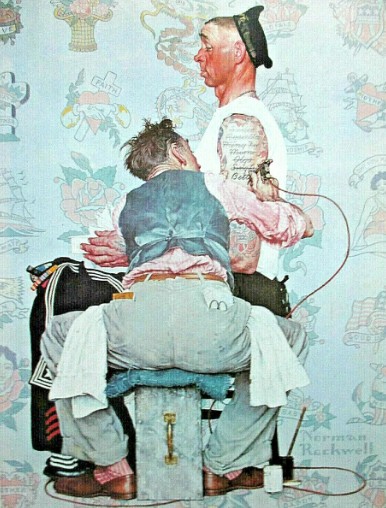
Norman Rockwell, a name synonymous with American Realism, was a master of meticulous detail, yet he never failed to brush a thread of whimsy and rustic existence onto the canvases of his iconic paintings.

Norman Rockwell, an iconic painter of American life, was born on 3 February 1894 into a comfortable New York City family. His father, a lover of Charles Dickens, often sketched illustrations from books, planting early seeds of creativity in young Norman. His mother, overprotective yet proud of her English heritage, spoke often of her artistic but unsuccessful father, whose unrealized dreams seemed to echo in the household. Art wasn’t just a pastime for Rockwell; it pulsed through him, and by age 12, he had resolved to draw for a living, though painting would come later in his journey as an artist.

As a teenager, Rockwell pursued artistic training at the National Academy of Design and later at the Art Students League, where he studied under the influence of Howard Pyle, the renowned illustrator of boys’ adventure tales. Pyle, who had founded the school’s philosophy through his own teachings and legacy, left an indelible mark on Rockwell, shaping his lifelong passion for weaving narrative into art. Before he turned 16, Rockwell landed his first commission—four Christmas cards—a modest start for a boy already dreaming big. By 18, he was painting professionally full-time, his talent unfolding with the quiet determination of youth finding its purpose.

In 1916, Rockwell began his legendary run with The Saturday Evening Post, creating covers that would grace the magazine for the next 47 years. Over that span, 322 of his paintings became what the Post proudly dubbed “the greatest show window in America.” Through these works, Rockwell offered a mirror to the nation—sometimes nostalgic, often tender, always human—reflecting everyday moments that resonated deeply with millions.

While his career soared with the Post, city life never suited him. In 1939, he traded New York’s clamor for the rolling hills of Vermont, and later, in 1953, settled in Massachusetts. These rural landscapes became his muse, dominating his canvases for the first three decades of his career. Rockwell was no haphazard artist; he was methodical, even obsessive, following a rigorous six-step process to bring his visions to life: brainstorming ideas, sketching rough outlines, photographing staged scenes with real people, crafting detailed drawings, experimenting with color studies, and only then committing paint to canvas. Each step was a labor of love, a tip of the hat to the America he loved.

At the heart of his art was a simple, profound drive. As Rockwell himself put it, “Without thinking too much about it in specific terms, I was showing the America I knew and observed to others who might not have noticed.” His paintings weren’t just pictures, they were invitations to see the beauty in the ordinary, the dignity in the overlooked; we see not just an artist, but a storyteller who believed in the quiet goodness of people, brushstroke by brushstroke.

Source: The Norman Rockwell Treasury by Thomas S. Buechner, 1979. Norman Rockwell Museum. Graphic: The Tattooist by Norman Rockwell, 1944, The Brooklyn Museum.

Painter of the Real

Robert Bateman, a Canadian artist from the school of Realism, paints wildlife with the precision of a photographer, leaving the viewer to ponder reality as it is rather than relying on the interpretation of the man with a brush. Bateman, explaining his motives, says, “I try to portray an animal living its own life independent of man.”

His paintings often place the subject tangentially, guiding the line of sight from the center to an edge where the action occurs. This composition suggests a reality beyond all living things, implying that we are all bit players, regardless of our size.

Bateman’s style is reminiscent of fellow Realist Andrew Wyeth, whom he acknowledges as a significant influence. However, Wyeth never entirely let go of his early impressionistic impulses. Roger Tory Peterson noted that while Wyeth froze his subjects in the moment, Bateman’s “subjects are ready to go somewhere else, to fly away,” allowing the reality of the moment to transition to another point in time, to a different reality.

Edgar Degas, an Impressionist Realist who combined realistic details of life with the softening blur of Impressionism, commented that one of the past masters of Realism, Jean-François Millet, painted so realistically that his work almost destroyed the profession. Wallace Stevens, a 20th-century modernist poet, took a different and somewhat counterintuitive view, stating that Realism is a corruption of reality. He believed that Realism reduced the complexity and beauty of the universe to the literal, leaving no room for the experience of humanity.

Both criticize Realism for its lack of emotion and interpretation, failing to observe that a gift from God is perfect as presented.

Source: The Art of Robert Bateman by Ramsay Derry 1981. Graphic: Grizzly at Rest by Robert Bateman, 2006.

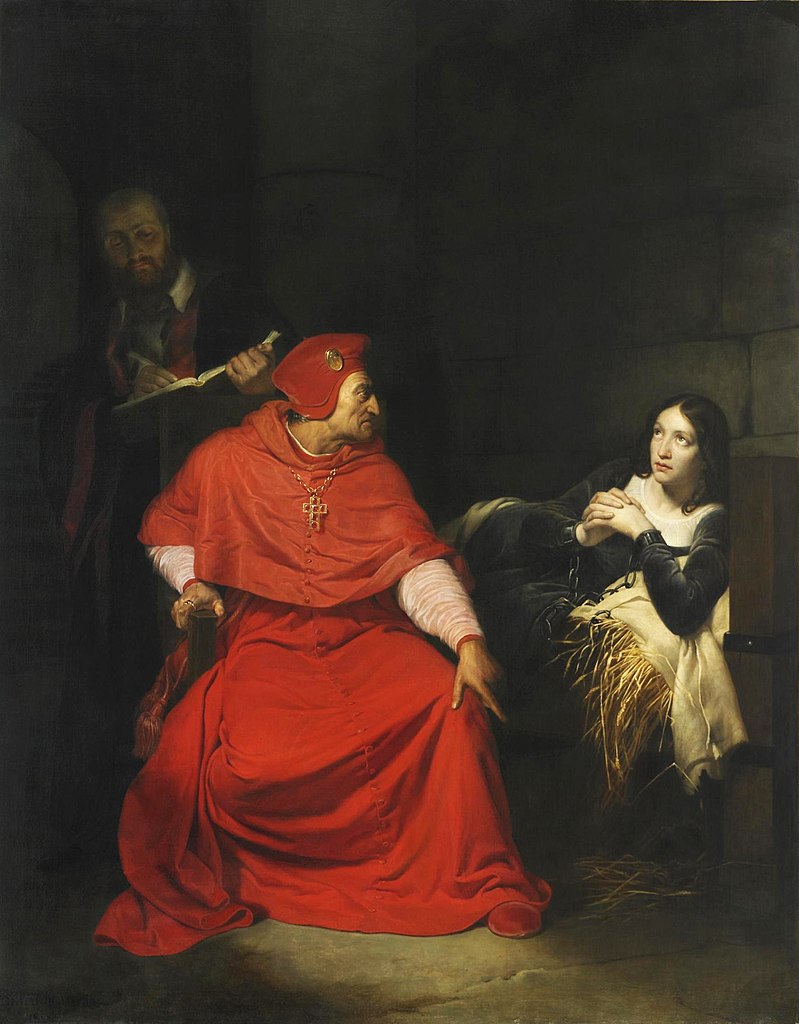
Joan of Arc’s Trial

The trial of Joan of Arc began almost 600 years ago, on 9 January 1431 in Rouen, France. She was captured by allies of the British during the siege of Compiègne in 1430 and tried for heresy. Her interrogation and trial began on 21 February 1431 and concluded on 24 May 1431.

Joan of Arc, also known as the Maid of Orléans, played a crucial role in liberating France from British control during the Hundred Years’ War. For her efforts the British burned her at the stake on 30 May 1431.

Joan of Arc was proclaimed a saint by Pope Benedict XV in 1920, who stated that her life was “proof of the existence of God.” She is the patroness saint of France and women.

Father Chatillon, rector of the Orléans Cathedral, where Joan of Arc attended Mass on 2 May 1429 while in the city to repel the British, commented that she “was a girl who was committed at 17 and died at 19, after having seen her mission through by liberating Orléans and by allowing Dauphin Charles VII to be king of France.”

Source: Tadie, NCR, 2020. Graphic: St. Joan of Arc is Interrogated by The Cardinal of Winchester in her Prison, Paul Delaroche, 1824, Public Domain.