To Boldly Go

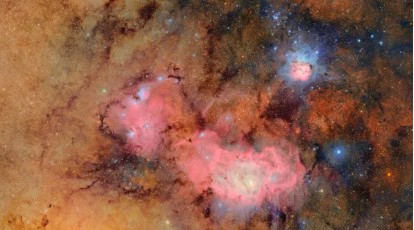
On 23 June 2025, after more than three decades of evolution, from a gleam of an idea to detailed planning, exacting execution, and the physical realization of the world’s largest astronomical camera, the Vera C. Rubin Observatory’s Legacy Survey of Space and Time (LSST) in Chile unveiled to the public its first breathtaking images. Among them: razor-sharp mosaics of the Trifid and Lagoon Nebulae, and the sprawling Virgo Cluster, home to millions of galaxies. Captured with world-class light-collecting mirrors, these images marked the beginning of a spectacular ten-year quest to map the known universe and illuminate the 95% we still don’t understand: dark matter and dark energy. An exciting, albeit, Herculean future awaits, built on an equally stunning past where dreams and science converged into one of the most staggering feats of technological achievement in modern astronomy.

Let the future map of the universe tell its own story in due time. The path to the map deserves a chapter all its own.

In 1969 Willard Boyle and George Smith of Bell Labs invented a device capable of detecting and measuring the intensity of light which they named CCD or Charge-Coupled Device: a breakthrough that earned them the 2009 Nobel Prize in Physics. A CCD converts incoming photons into electrical signals, creating a voltage map of light intensity, a digital proxy for the number of photons striking its surface. Initially constructed as a semiconductor chip, it quickly evolved into a pixelated imaging sensor. These sensors quickly became the gold standard for digital consumer and scientific imaging but due to costs, consumer applications such as your phone camera switched over to CMOS sensors due to lower costs. Scientific and surveillance systems, such as the Hubble Telescope, SOAR, and SNAP, still employ CCDs because of their superior image fidelity.

In the late 1980s J. Anthony ‘Tony’ Tyson, an experimental physicist at Bell Labs, focused on developing instrumentation to detect faint optical signals using CCDs. His inspiring contribution to the CCD was to recognize their potential in imaging the heavens and laying the groundwork for digital deep sky surveys. He quickly discovered faint blue galaxies and gravitational lensing using modified CCDs that he helped developed. Additionally, he helped build the Big Throughput Camera that was instrumental in the 1998 discovery of dark energy.

Tyson never thought small. His CCDs were instruments of the infinitesimal, but his dreams were as gargantuan as the universe itself. In fact, his dream was the universe. In 1994 he proposed his “Deep Wide Fast” telescope, a scaleup of his Big Throughput Camera and the forerunner of the LSST. The Deep Wide Fast was a concept that would combine a deep imaging device with rapid cadence, and broad coverage simultaneously. In other words, synoptic realization of the universe in near real time.

Throughout the 1990s, Tyson rallied minds and resources to shape his cosmic vision. John Schaefer of the Research Corporation helped secure early funding. Roger Angel proposed the use of the innovative Paul Baker three-mirror telescope design. Institutions like the Universities of Arizona and Washington, along with the Optical Astronomy Observatory, all hitched their wagons to Tyson’s star-filled dream of mapping the universe.

In 1998 Tyson presented designs for a Dark Matter Telescope and in 1999 the science case was submitted to the Astronomy and Astrophysics Decadal Survey. In 2003 the first formal proposal was sent to the Experimental Program Advisory Committee at SLAC (Stanford Linear Accelerator Center). It consisted of an 8.4-meter mirror with a 2.3-billion-pixel camera capable of surveying the entire visible sky every few nights. The proposal also laid out the NSF–DOE partnership, with SLAC leading the camera development and other institutions handling optics, data systems, and site operations.

In 2004 Tyson left Bell Labs and joined the University of California at Davis as a cosmologist and continued to shepherd the LSST project from there.

In 2007 the project received $30 million in private funding from Charles Simonyi, Bill Gates, and others. The telescope is named the Simonyi Survey Telescope. In 2010 U.S. National Science Foundation (NSF) and Department of Energy (DOE) joined in the quest to view the universe through the sharp eyes of the LSST.

The telescope’s primary 8.4-meter and the 5.0-meter tertiary mirrors were built at the University of Arizona, beginning in 2008, completed in 2015, and stored on-site in Chile since 2019. Fabricated in the U.S., the 3.4-meter secondary was later coated in Germany with nickel-chromium, silver, and silicon nitride, materials chosen to enhance reflectivity, durability, and long-term performance.

In 2015 SLAC, which oversaw the design, fabrication, and integration of the camera, began building the components with assistance from Brookhaven National Laboratory, Lawrence Livermore National Laboratory, and IN2P3/CNRS in France. By 2024 the camera was finished and shipped to Chile. In 2025 the camera was installed and integrated with the telescope. In June of 2025 the first light images were released to the public.

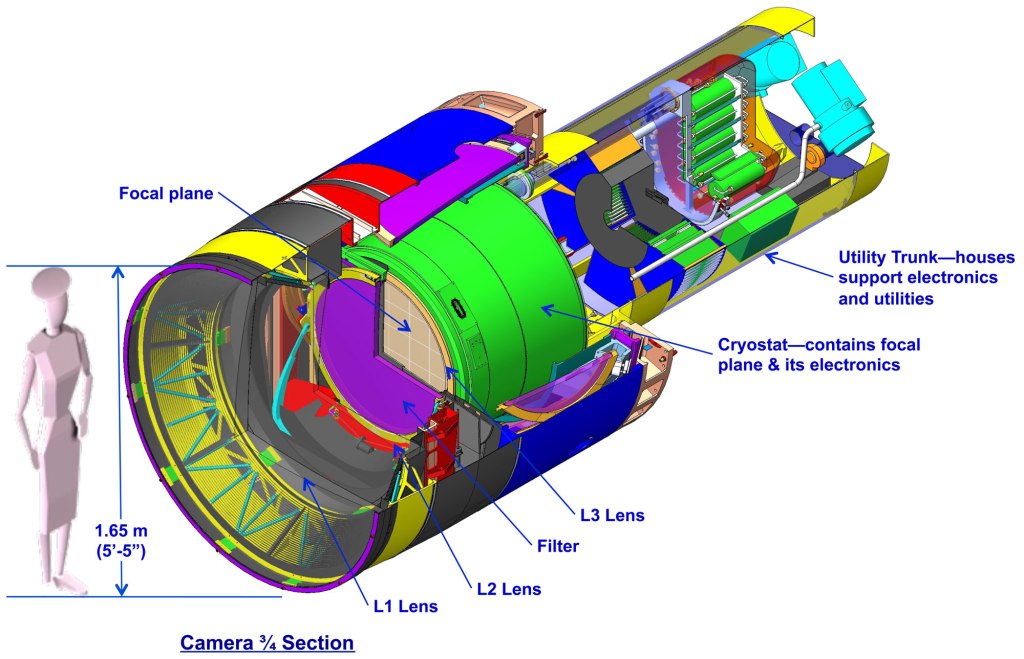
The camera measures roughly 3 meters in length, 1.65 meters in diameter, and weighs 3 metric tons, an imposing instrument, rivaling the bulk of a small car. Its imaging surface, a 64-centimeter focal plane, contains 3.2 billion pixels, each a 10-micron square, roughly one-tenth the width of a human hair. These pixels, etched across 189 custom CCD sensors arranged into 21 modular “rafts,” are laid flat to within 10 microns, ensuring near-perfect focus. The entire array is chilled to –100°C to suppress electronic and thermal noise, enhancing signal fidelity.

Before photons reach the sensor, they pass through three precision-crafted corrective lenses, including the largest ever installed in an astronomical camera, and up to six interchangeable filters spanning ultraviolet to near-infrared. The filter exchange system enables the observatory to target specific wavelength bands, tailored to sky conditions and science goals.
The integrated LSST system is engineered to capture a 15-second exposure every 20 seconds, producing thousands of images per night, tallying approximately 15 terabytes of new data. Each image covers 9.6 square degrees of sky, roughly equivalent to the diameter of 45 full moons, allowing the system to survey the entire visible southern sky every 3–4 nights. Imaging a single field across all six filters can take up to 5–6 minutes, though filters are selected dynamically based on science goals and atmospheric conditions.

The system’s angular resolution is sharp enough to resolve a golf ball from 15 miles away and at the edge of the observable universe, this scales to structures no smaller than a large galaxy; certainly not stars, not planets, nor restaurants. Over its decade-long campaign, LSST is projected to catalogue more than 17 billion stars and 20 billion galaxies, a composite digital universe stitched together from individual photons captured from 3 million images, each snapped every few seconds over the clear night sky of Chile. The LSST will not simply map what’s visible but illuminate the unknown. Beneath the sophisticated hardware and software lies a deeper purpose: to shine the light of curiosity on the 95% of the universe that remains in the shadows of time and space: dark matter and dark energy, the known unknown dynamic force behind galactic formation and cosmic expansion. The LSST is more than a camera. It is a reckoning with the vast unknown, a testament to humanity’s refusal to let mystery remain unexplored and uncharted: to find God.

In 2013 Tyson was named chief scientist of the LSST and is still actively contributing to the intellectual vision of the project and mentoring the next gen of cosmologists and engineers.

Graphic: LSST Camera Schematic and Trifid Nebula by SLAC-DOE-NSF.
Life, the Universe, and Everything: Speculative Musings on the Cutting Edge of Physics

The Higgs boson, theorized in the 1960s, is a massive quantum particle central to the Standard Model of particle physics. It arises from the Higgs field, an invisible sea permeating all of space, which gives fundamental particles, like electrons and quarks, their mass. Unlike electromagnetic fields, created by moving charges like protons, the Higgs field exists everywhere, quietly shaping the universe. In 2012, CERN’s Large Hadron Collider detected the Higgs boson, confirming the field’s existence. While the boson is observable, the field remains invisible, known only by its effects on particle masses.

The Higgs field assigns mass, but gravity governs how that mass behaves across the vast scales of spacetime. Blending gravity with quantum mechanics, which includes the Higgs field, requires a yet-undiscovered theory of quantum gravity. If successful, quantum gravity might untangle physics-defying singularities, points of extreme density, into structured, comprehensible forms. Some theorize it could also reveal how early radiation morphed into matter, possibly influencing the formation and behavior of mysterious dark matter and its potential link to dark energy.

Before the Big Bang, some picture a singularity, a point of extreme density, though not necessarily infinite matter, where known physics and spacetime break down. Quantum gravity, however, hints this wasn’t truly infinite but a transition phase. From what? Perhaps a prior universe or a chaotic quantum state, science doesn’t yet know. This shift, possibly tied to the Higgs field, may have sparked quantum fluctuations, birthing radiation, matter, and the cosmic structure we see today.

What if the universe is cyclic, not a one-time burst? Instead of a singular Big Bang, some speculate a “bounce”, a transition where spacetime contracts, then expands again. Early on, energetic radiation like photons cooled and condensed into heavy particles, or fermions, a million times heftier than electrons. Some theorize these fermions underwent chiral symmetry breaking, like a spinning top wobbling one way instead of both, potentially forming cold dark matter, though evidence is sparse. This invisible web of dark matter stabilized galaxies, keeping them from spinning apart.

The Higgs field might have shaped dark matter by influencing the mass of early fermions, but this link is speculative, lacking direct proof. Dark matter, in turn, may be evolving. If it slowly decays or transitions into dark energy, as some hypothesize, it could drive the universe’s accelerating expansion. Ordinary matter, atoms, molecules, and radiation, also formed via the Higgs field, while energy, mostly electromagnetic radiation, fuels cosmic evolution. These pieces dance within a framework shaped by the Higgs, elusive quantum gravity, and the subtle interplay of dark matter and dark energy.

Could radiation, dark matter, and dark energy be different faces of a single, evolving force? Radiation transitioning to dark matter gradually shifting into dark energy, the universe might unravel, leaving isolated stars drifting in an endless void. Then, fluctuations in the Higgs field and quantum gravity could trigger contraction, setting the stage for another bounce. Rather than destruction, this might be a cosmic recycling, a continuous interplay of forces across time: Life, the Universe, and Everything.

Source: CDM Analogous to Superconductivity by Liang and Caldwell, May 2025, APS.org. Graphic: Cosmic Nebula by Margarita Balashova.

Web of Dark Shadows

Cold Dark Matter (CDM) comprises approximately 27% of the universe, yet its true nature remains unknown. Add that to the 68% of the universe made up of dark energy, an even greater mystery, and we arrive at an unsettling realization: 95% of the cosmos remains unexplained.

Socrates famously said, “The only thing I know is that I know nothing.” Over two millennia later, physicists might agree. But two researchers from Dartmouth propose a compelling possibility: perhaps early energetic radiation, such as photons, expanded and cooled into massive fermions, which later condensed into cold dark matter, the invisible force holding galaxies together. Over billions of years, this dark matter may be decomposing into dark energy, the force accelerating cosmic expansion.

Their theory centers on super-heavy fermions, particles a million times heavier than electrons, which behave in an unexpected way due to chiral symmetry breaking: where mirror-image particles become unequally distributed, favoring one over the other. Rather than invoking exotic physics, their model works within the framework of the Standard Model but takes it in an unexpected direction.

In the early universe, these massive fermions behaved like radiation, freely moving through space. However, as the cosmos expanded and cooled, they reached a critical threshold, undergoing a phase transition, much like how matter shifts between liquid, solid, and gas.

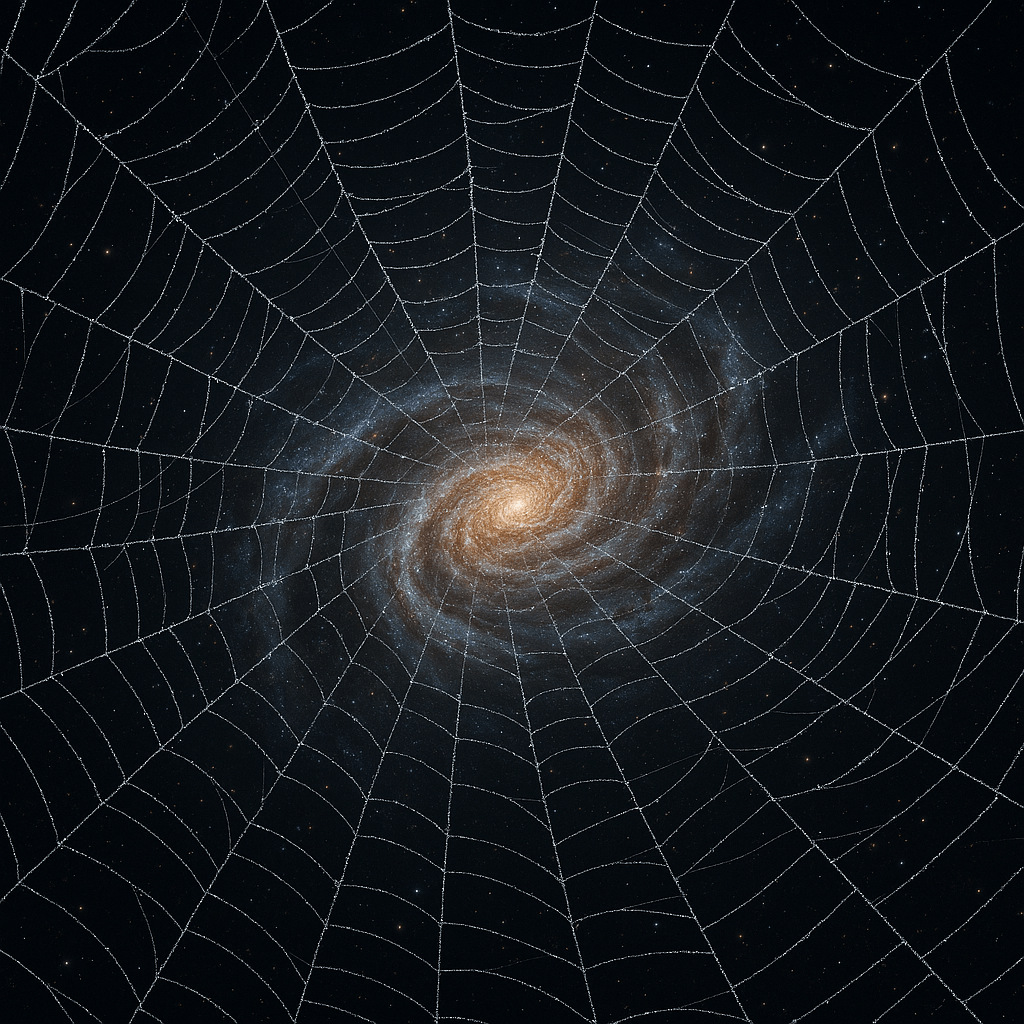
During this transformation, fermion-antifermion pairs condensed—similar to how electrons form Cooper pairs in superconductors, creating a stable, cold substance with minimal pressure and heat. This condensate became diffuse dark matter, shaping galaxies through its gravitational influence, acting as an invisible web counteracting their rotation and ensuring they don’t fly apart.

However, dark matter may not be as stable as once thought. The researchers propose that this condensate is slowly decaying, faster than standard cosmological models predict. This gradual decomposition feeds a long-lived energy source, possibly contributing to dark energy, the force responsible for the universe’s accelerated expansion.

A more radical interpretation, mine not the researchers, suggests that dark matter is not merely decaying, but evolving into dark energy, just as energetic fermion radiation once transitioned into dark matter. If this is true, dark matter and dark energy may be two phases of the same cosmic entity rather than separate forces.

If these hypothesis hold, we should be able to detect, as the researchers suggest, traces of this dark matter-to-dark energy transformation in the cosmic microwave background (CMB). Variations in density fluctuations and large-scale structures might reveal whether dark matter has been steadily shifting into dark energy, linking two of cosmology’s biggest unknowns into a single process.

Over billions of years, as dark matter transitions into dark energy, galaxies may slowly lose their gravitational cage and begin drifting apart. With dark energy accelerating the expansion, the universe may eventually reach a state where galaxies unravel completely, leaving only isolated stars in an endless void.

If dark matter started as a fine cosmic web, stabilizing galaxies, then over time, it may fade away completely, leaving behind only the accelerating force of dark energy. Instead of opposing forces locked in conflict, what if radiation, dark matter, and dark energy were simply different expressions of the same evolving entity?

A tetrahedron could symbolize this transformation:

  • Radiation (Energetic Era) – The expansive force that shaped the early universe.
  • Dark Matter (Structural Phase) – The stabilizing gravitational web forming galaxies.
  • Dark Energy (Expansion Phase) – The force accelerating cosmic evolution.
  • Time (Governing Force) – The missing element driving transitions between states.

Rather than the universe being torn apart by clashing forces, it might be engaged in a single, continuous transformation, a cosmic dance shaping the future of space.

Source: CDM Analogous to Superconductivity by Liang and Caldwell, May 2025, APS.org. Graphic: Galaxy and Spiderweb by Copilot.

Water Everywhere

Two recent Earth science studies by Barrett et al. and Bermingham et al. explore the origins of Earth’s water and indirectly, organic matter, key prerequisites for the development of intelligent life. Their findings support the early delivery of needed chemicals to form water and carbon molecules by inner and outer solar system planetesimals such as asteroids and comets.

Barrett et al. shows that an inner solar system sourced enstatite chondrite (EC) asteroid found in Antarctica is isotopically similar to Earth material, (not surprisingly, this supports the 270-year-old Nebular Hypothesis) capable of delivering substantial hydrogen during Earth’s accretionary phase (~4.56–4.5 billion years ago). The ECs contain hydrogen as H2S in silicate glass, linked to pyrrhotite, sufficient to account for up to 14 times Earth’s ocean mass. This hydrogen was systematically incorporated in the hot inner solar system via nebular processes, suggesting water was an inherent outcome of Earth’s formation, not a later addition. ECs also contain trace organic matter contributing modestly to Earth’s carbon inventory. Despite the chaotic “billiard table” trajectories of early solar system collisions, the stability of H2S in glass ensured survival during violent accretion. This early delivery of water and organics established a foundational habitable environment, priming the Earth’s prebiotic chemistry for the creation and evolution of intelligent life.

Bermingham et al., taking a different investigative track, analyze molybdenum isotopes in meteorites and Earth’s crust, concluding that water was delivered during the Late Heavy Bombardment (LHB: 4.1–3.8 billion years ago) by planetesimals, including inner solar system asteroids and outer solar system comets, as hydrous minerals or brine. This late accretion, post-Moon-forming event (4.5 billion years ago), suggests a stochastic bombardment enriched Earth’s surface volatiles. Comets and carbonaceous chondrites, rich in organic matter, likely delivered significant carbon compounds, enhancing the prebiotic chemical environment. The chaotic early solar system facilitated this influx of outer solar system organics, complementing earlier inputs.

Both studies align with life’s prerequisites by ensuring water and organic delivery to the planet. Barrett et al. provide the bulk water budget and trace organics via ECs, creating an early aqueous environment, while Bermingham et al.’s LHB bombardment added more water and substantial organics, boosting conditions for life’s emergence. They agree on asteroids’ role, possibly including ECs, but differ in timing (early accretion vs. LHB) and outer solar system delivery contributions (minor in Barrett, significant via comets in Bermingham). Barrett et al.’s early delivery of water and organics can be viewed as foundational and Bermingham et al.’s LHB as a surface-enriching supplement, together enabling the chemical and evolutionary path to intelligent life.

Source: Barrett et al, 2025, Icarus. Bermingham et al, 2025, Rutgers. Graphic: Comet Cometh, Grok3.

Cosmic Halo

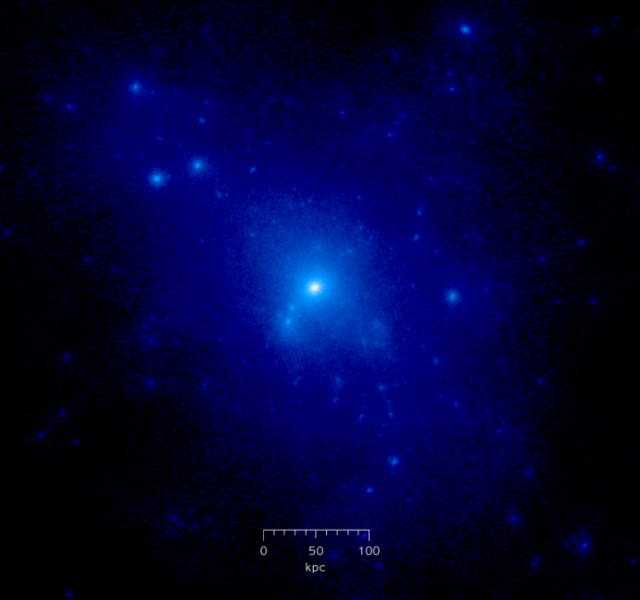
Galactic halos, consisting of a spherical envelope of dark matter along with sparsely scattered stars, globular clusters, and gas, typically surround most spiral galaxies. Current research is investigating the possibility that some halos may exist solely of dark matter. Discovering halos without stellar matter carries profound implications for our understanding of the universe’s structure, galaxy formation processes, and the conditions required for star formation. More importantly, such a discovery would provide a unique laboratory to study dark matter in isolation, free from interference of normal matter. However, new findings suggest that starless halos may be even rarer than previously thought. This scarcity makes detecting such halos particularly challenging, as they are unlikely to be associated with observable galaxies.

Ethan Nadler, of the University of California San Diego, has demonstrated that molecular hydrogen requires significantly less mass for star formation compared to atomic hydrogen. His research shows that molecular hydrogen can cool sufficiently for gravity to initiate star formation at lower mass thresholds. Specifically, while past studies indicated that dark matter halos need between 100 million to 1 billion solar masses of atomic hydrogen to begin star formation, Nadler has revealed that molecular hydrogen can achieve the same result with as little as 10 million solar masses—a reduction by a factor of 10 to 100. While dark matter halos can theoretically form with masses as low as 10⁻⁶ solar masses, depending on the nature of dark matter, those capable of influencing galaxy formation typically require at least 10⁶ solar masses to enable star formation, further highlighting the challenge of finding starless halos. Detecting these small, starless halos would require identifying subtle perturbations in gravitational fields, a difficult task that may yield little if such halos are as rare as current models suggest.

Source: …Galaxy Formation Threshold, Nadler, AAS, April 2025. Graphic: Dark Matter Halo Simulation by Cosmo0. Public Domain.

Geo Anomalies

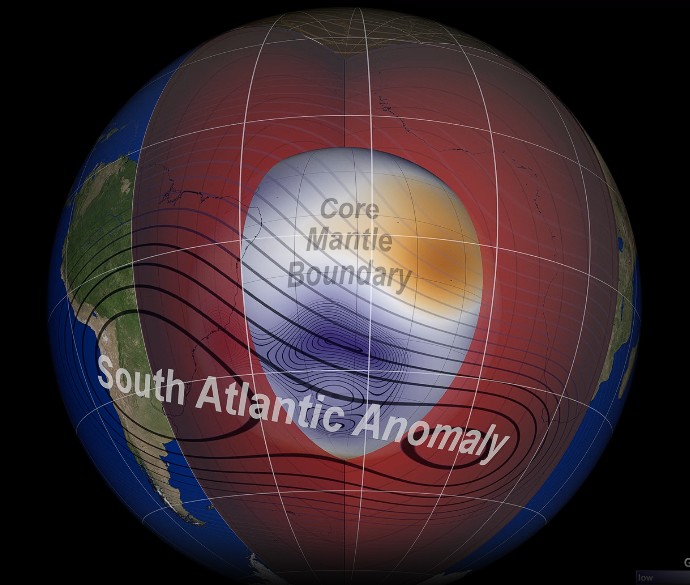
NASA has identified the South Atlantic Magnetic Anomaly (SAA) as a region off the coast of South America, where Earth’s magnetic field is significantly weaker. This weakening reduces magnetic shielding, exposing satellites and spacecraft to higher levels of radiation and posing a risk to their operation. Understanding the causes and implications of the SAA is essential for addressing these LEO challenges.

One hypothesis suggests that irregularities at the core-mantle boundary disrupt the geodynamo, the mechanism generating Earth’s magnetic field. The anomaly’s alignment with submarine volcanic features hints at possible links between mantle-crust interactions and magnetic disturbances. Additionally, a hotspot near the Mid-Atlantic Ridge corresponds to a geomagnetic intensity minimum at the core-mantle boundary, implying that thermal and compositional anomalies in the mantle may affect convection in the molten outer core, creating localized variations in the magnetic field.

Further research using subsurface imaging will help in uncovering the internal processes shaping Earth’s magnetic field and enhancing our understanding of the planet’s protective geodynamo.also assist in predicting magnetic anomalies and their effect on LEO space flight in the future.

Source: NASA. Graphic. Core Geomagnetic Anomaly, NASA.

Fate of the Universe

Astronomers once observed exploding stars (supernovae) and found the universe expanding, driven by a mysterious force called dark energy. This led to the standard cosmological model of the late 1990s, Lambda-CDM, where “Lambda” represents dark energy, assumed constant, and “Cold Dark Matter” (CDM) explains unseen mass shaping cosmic structure. Evidence for CDM includes steady star rotation speeds in galaxies, cosmic microwave background fluctuations, galaxy clustering, and light bending by gravity. Though successful, Lambda-CDM has faced ongoing scrutiny almost from inception of the theory.

Enter the Dark Energy Spectroscopic Instrument (DESI) at Kitt Peak National Observatory in Arizona. With 5,000 robotic fiber-optic sensors, DESI captures light from galaxies and quasars, mapping the universe’s expansion history. A new study, analyzing three years of DESI data, 15 million objects, with plans for 50 million, combines it with cosmic microwave background radiation, supernovae, and weak gravitational lensing data. Fitting all this into Lambda-CDM with a constant dark energy revealed cracks in the model. But if dark energy weakens over time, a “dynamical dark energy“, the model aligns better.

By observing objects up to 11 billion years away, DESI peers deep into cosmic history. Researchers found hints that dark energy’s strength may have peaked around 7 billion years ago, then started weakening, challenging its fixed nature in Lambda-CDM. While not certain, this could rival the 1990s discovery of accelerated expansion, potentially demanding a new model.

The universe’s fate depends on dark energy versus matter. It’s been accelerating, but a weakening dark energy might slow it down, halt it, or, if gravity overtakes sufficiently, trigger a “Big Crunch.” New data from DESI, Europe’s Euclid, NASA’s Nancy Grace Roman, and Chile’s Vera Rubin Observatory could clarify this within five years, possibly nailing dark energy’s role.

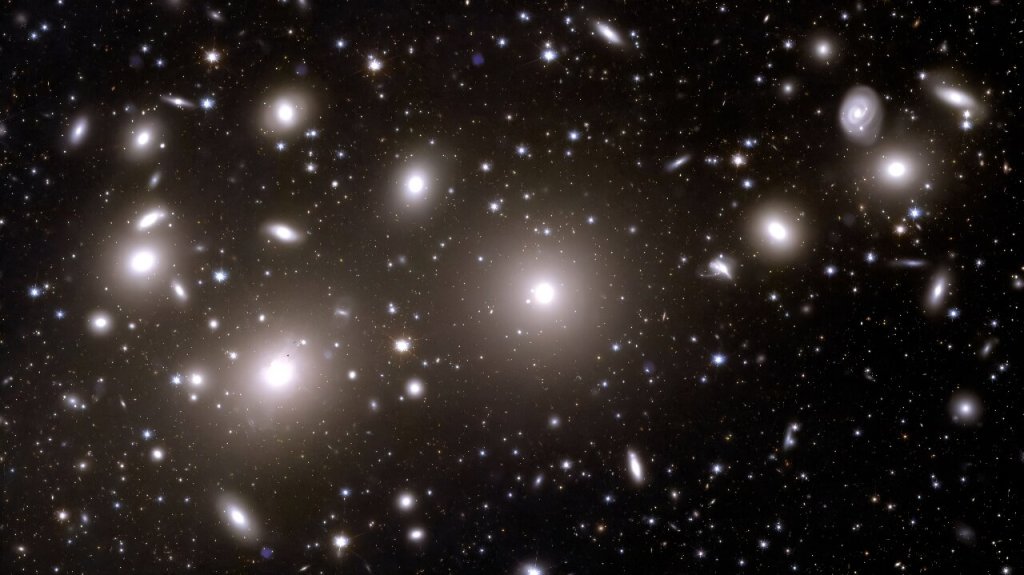
Source: “Dark Energy Seems to Be Changing, Rattling Our View of Universe” by Rey and Lawler, Phys.org, March 2025. Graphic: DESI Collaboration Photo of Galaxies.

White Holes, Black Holes, and the Cosmic Cycle

White holes, theoretical counterparts to black holes, might be two sides of a cosmic coin. Black holes devour matter with relentless gravity; white holes expel it, hurling energy, particles, and possibly time into the universe. Both stem from Einstein’s general relativity, which predicts black holes, proven by solid evidence, while white holes remain elusive, perhaps lurking beyond our Earthly senses. 

To see their link, rethink black holes’ strangest feature and flaw: the singularity. General relativity paints it as a point where spacetime crushes so tight that physics breaks, a bug, not a feature. Exotic matter, with odd traits like negative energy, was once the fix. But the University of Barcelona’s Pablo Bueno and team ditched it, tweaking gravity with higher-curvature corrections to erase singularities. This needs extra dimensions beyond our four, turning black holes from traps into dynamic zones. 

The University of Sheffield adds a twist: the event horizon isn’t sharp. Quantum gravity blurs it into a fuzzy gateway where spacetime bends, not breaks. In 4D, black holes are sinkholes, matter vanishes. In higher dimensions, it slips through, heading elsewhere. Sheffield’s take ties this to dark energy, the universe’s expansion driver. Here, it’s the power plant: quantum fluctuations, fueled by dark energy, replace the singularity with a bounce, flipping spacetime to a white hole. 

Enter white holes, Janus-like transitions, Roman god of gates and duality. Black holes vacuum everything; white holes, linked via higher dimensions, spit it out, maybe far off. Picture Sagittarius A*, the Milky Way’s core black hole, channeling matter 25,000 light-years to the Orion Nebula’s arm. Unseen, white holes might hide in dimensions we can’t touch. 

This hints at a cosmic cycle, like Earth’s water cycle: evaporate, rain, repeat. Black holes swallow, dark energy and quantum gravity bounce it through higher dimensions, and white holes release it back. Barcelona and Sheffield suggest no endpoints, just a recycling of cosmic raw materials across realms we’re barely capable of understanding.

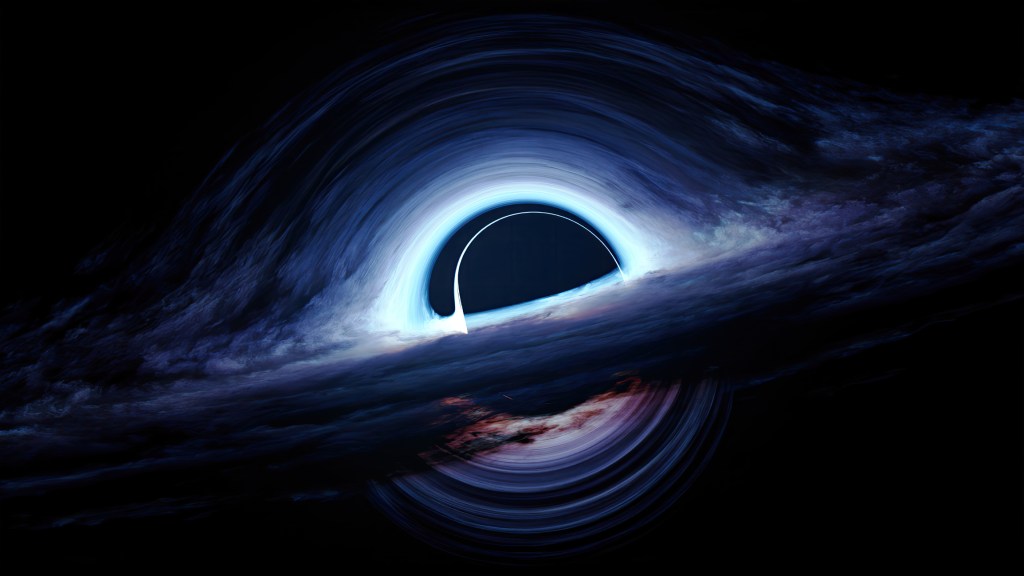
Source: Black Hole Singularity, Gielen and Menendez-Pidal, University of Sheffield, 2025. Regular Black Holes…by Bueno, P. et al, Physics Letter B, February 2025. Graphic: Black Hole Rendering.

Cosmic Gold Rush

Ultra-high-energy cosmic rays (UHECRs) are the universe’s most energetic particles, with energies exceeding 100 quintillion electronvolts (100 EeV)—far beyond anything we can replicate on Earth. First observed over 60 years ago, these particles have puzzled scientists with their immense power and a curious pattern: their energy correlates closely with their electric charge. But where do they come from?

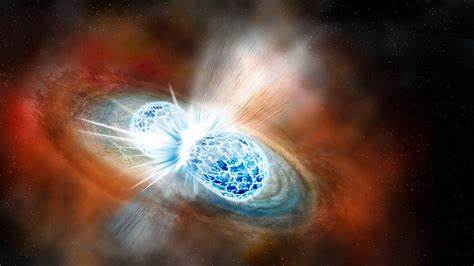
A new theory by physicist Glennys Farrar from New York University offers an answer. She proposes that UHECRs originate in binary neutron star (BNS) mergers—explosive collisions that form a black hole. These events unleash powerful jets of material, acting as cosmic particle accelerators that boost particles to unimaginable energies. The idea links UHECRs’ narrow energy range and charge correlation to a range of combined neutron star mass sufficient to form a black hole.

The theory suggests that the highest-energy UHECRs—those above 100 EeV—could be heavy elements like gold, platinum, or uranium, forged in extreme cosmic events such as supernovae or neutron star collapses (stars can only create elements up to iron through fusion). By tying UHECRs to BNS mergers, Farrar’s work could reveal how precious elements form and deepen our understanding of cosmic cataclysms.

Source: Binary Neutron Star Mergers… by Glennys R. Farrar, Physical Review Letters, 28 February 2025. Graphic: Two Neutron Stars Merging by Universe Today.

Gravity and Vanilla Black Holes

Einstein’s theory of general relativity, which includes gravity, predicts that black holes have a tricky feature: a singularity. This is a point where space and time are squeezed so tightly that the laws of physics break down—think of it as a cosmic “error message.” To fix this, scientists often turn to exotic matter—hypothetical substances with bizarre properties like negative energy—to smooth things out. However, a team from the University of Barcelona, led by Pablo Bueno, found an alternative. They didn’t need exotic matter at all. Instead, they tweaked Einstein’s gravity by adding an infinite series of extra “rules” (higher-curvature corrections) to the math.

Their solution works in spacetimes with more than four dimensions—beyond our usual height, width, depth, and time. In these higher-dimensional worlds, black holes can exist without singularities. This “smooths out” black holes, making them less mysterious and more like regular objects in spacetime—no weird stuff required.

The presence of extra dimensions doesn’t just fix singularities—it can also change how black holes behave. In higher-dimensional spacetimes, black holes might have different event horizon shapes (the boundary beyond which nothing escapes) or other structural quirks. The Barcelona team’s work shows that these altered properties emerge naturally from gravity in more than four dimensions, offering a fresh perspective on these cosmic giants.

Thinking outside the box, is it possible that these extra dimensions link black holes to “a reality outside regular spacetime,” like wormholes (tunnels through spacetime), braneworlds (parallel universes on higher-dimensional “membranes”), or even gateways to white holes (theoretical opposites of black holes that spit stuff out)? Theories like string theory and braneworld scenarios suggest that extra dimensions might allow such connections. For example, a wormhole could theoretically bridge two distant points in our universe—or even lead to a completely different universe.

While the math of higher dimensions opens the door to these possibilities, it’s all conjecture. The Barcelona team’s work is a major step forward in understanding black holes in higher dimensions, but it doesn’t directly prove connections to other realities.

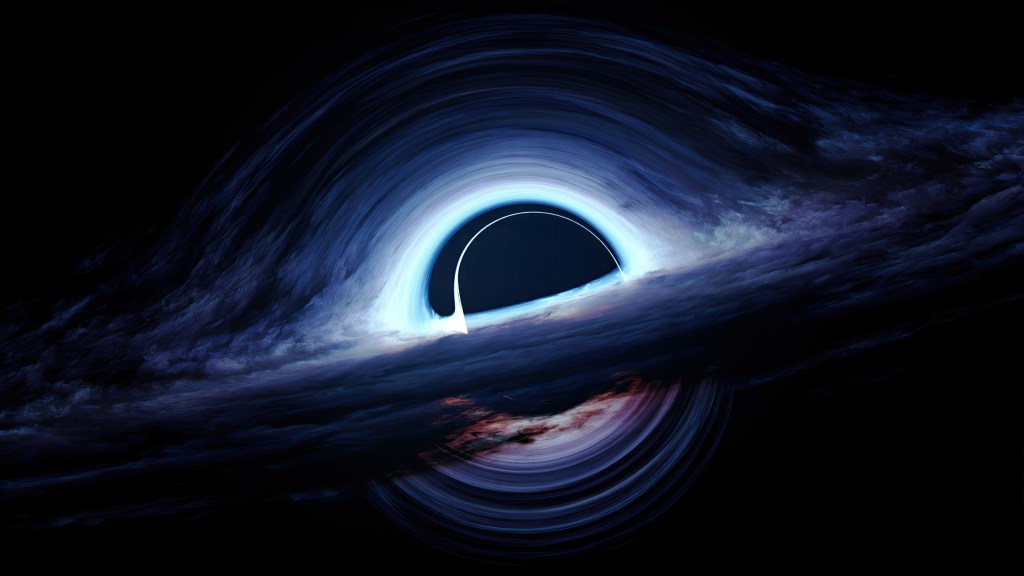
Source: Grok 3. Regular Black Holes… by Bueno, P. et al., Physics Letter B, February 2025. Graphic: Black Hole Rendering, iStock licensed.