Moral Fogs: Machine and Man

(Note: This companion essay builds on the previous exploration of Asimov’s moral plot devices, rules that cannot cover all circumstances, focusing on dilemmas with either no good answers or bad answers wrapped in unforgiving laws.)
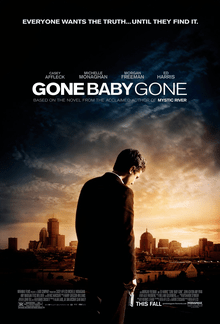
Gone Baby Gone (2007) begins as a textbook crime drama; abduction of a child, but by its final act, it has mutated into something quietly traumatic. What emerges is not a crime thriller, but an unforgiving philosophical crucible of wavering belief systems: a confrontation between legal righteousness and moral intuition. The two protagonists, once aligned, albeit by a fine thread, find themselves, eventually, on opposite ends of a dilemma that law alone cannot resolve. In the end, it is the law that prevails, not because justice is served, but because it is easy, clear, and lacking in emotional reasoning. And in that legal clarity, something is lost, a child loses, and the adults can’t find their way back to a black and white world.

The film asks: who gets to decide for those who can’t decide for themselves? Consent only functions when the decisions it enables are worthy of those they affect.

The film exposes the flaws of blindly adhering to a legal remedy that is incapable of nuance or a purpose-driven outcomes; not for the criminals, but for the victims. It lays bare a system geared towards justice and retribution rather than merciful outcomes for the unprotected victims or even identifying the real victims. It’s not a story about a crime. It’s a story about conscience. And what happens when the rules we write for justice fail to account for the people they’re meant to protect, if at all. A story where it was not humanly possible to write infallible rules and where human experience must be given room to breathe, all against the backdrop of suffocating rules-based correctness.

Moral dilemmas expose the limits of clean and crisp rules, where allowing ambiguity and exceptions to seep into the pages of black and white is strictly forbidden. Where laws and machines give no quarter and the blurry echoing of conscience is allowed no sight nor sound in the halls of justice or those unburdened by empathy and dimensionality. When justice becomes untethered from mercy, even right feels wrong in deed and prayer.

Justice by machine is the definition of law not anchored by human experience but just in human rules. To turn law and punishment over to an artificial intelligence without soul or consciousness is not evil but there is no inherent goodness either. It will be something far worse: A sociopath: not driven by evil, but by an unrelenting fidelity to correctness. A precision divorced from purpose.

In the 2004 movie iRobot, loosely based on Isaac Asimov’s 1950 novel of the same name, incorporating his 3 Laws of Robotics, a robot saves detective Del Spooner (Will Smith) over a 12-year-old girl, both of whom were in a submerged car, moments from drowning. The robot could only save one and picked Smith because of probabilities of who was likely to survive. A twist on the Trolley Problem where there are no good choices. There was no consideration of future outcomes; was the girl humanity’s savior or more simplistic, was a young girl’s potential worth more, or less, than a known adult.

A machine decides with cold calculus of the present, a utilitarian decision based on known survival odds, not social biases, latent potential, or historical trajectories. Hindsight is 20-20, decision making without considering the unknowns is tragedy.

The robot lacked moral imagination, the capacity to entertain not just the likely, but the meaningful. An AI embedded with philosophical and narrative reasoning may ameliorate an outcome. It may recognize a preservation bias towards potential rather than just what is. Maybe AI could be programmed to weigh moral priors, procedurally more than mere probability but likely less than the full impact of human potential and purpose.

Or beyond a present full of knowns into the future of unknowns for a moral reckoning of one’s past.

In the 2024 Clint Eastwood directed suspenseful drama, Juro No. 2, Justin Kemp (Nicholas Hoult) is selected to serve on a jury for a murder trial, that he soon realizes is his about his past. Justin isn’t on trial for this murder, but maybe he should be. It’s a plot about individual responsibility and moral judgment. The courtroom becomes a crucible not of justice, but of conscience. He must decide whether to reveal the truth and risk everything, or stay silent and let the system play out, allowing himself to walk free and clear of a legal tragedy but not his guilt.

Juro No. 2 is the inverse of iRobot. An upside-down moral dilemma that challenges rule-based ethics. In I, Robot, the robot saves Will Smith’s character based on survival probabilities. Rules provide a path forward but in Juro No. 2 the protagonist is in a trap where no rules will save him. Logic offers no escape; only moral courage can break him free from the chains of guilt even though they bind him to the shackles that rules demand. Justin must seek and confront his soul, something a machine can never do, to make the right choice.

When morality and legality diverge, when choice runs into the murky clouds of grey against the black and white of rules and code, law and machines will take the easy way out. And possibly the wrong way.

Thoreau in Civil Disobedience says, “Law never made men a whit more just; and… the only obligation which I have a right to assume is to do at any time what I think right,” and Thomas Jefferson furthers that with the consent of the governed needs to be re-examined when wrongs exceed rights. Life, liberty, and the pursuit of happiness is the creed of the individual giving consent to be governed by a greater societal power but only when the government honors the rights of man treads softly on the rules.

Government rules, a means to an end, derived from the consent of the governed, after all, are abstractions made real through human decisions. If the state can do what the individual cannot, remove a child, wage war, suspend rights, then it must answer to something greater than itself: a moral compass not calibrated by convenience or precedent, but by justice, compassion, and human dignity.

Society often mistakes legality for morality because it offers clarity. Laws are neat, mostly. What happens when the rules run counter to common sense? Morals are messy and confusing. Yet it’s in that messiness, the uncomfortable dissonance between what’s allowed and what’s right, that our real journey towards enlightenment begins.

And AI and machines can erect signposts but never construct the destination.

A human acknowledgement of a soul’s existence and what that means.

Graphic: Gone Baby Gone Movie Poster. Miramax Films.

A Poke in the Eye

A Trip to the Moon (Le Voyage dans la Lune): Astronomers in wizard costumes and pointy hats take an artillery shell rocket safari to the moon, discovering mushrooms and surly aliens.

The 1902 film, inspired by Jules Verne and H.G. Wells’ moon novels among other artistic works, was Georges Méliès’ masterpiece. It incorporated every technique that he could conjure up, including splicing in instant scene changes, fade-ins and fade-outs, tracking shots, and—way ahead of his time—color.

Color was hand-painted onto the film by 200 women, producing up to 60 copies of his various films. A hand-colored version of the film was discovered in 1993 and turned over to the Filmoteca de Catalunya in Barcelona. Although in poor condition, the restoration was completed in 2011 and shown at Cannes in the same year.

Trivia: Although confirmation sources are sparse, Méliès introduced another innovation into the marketing side of movies, which in today’s world of DVDs and streaming seems commonplace: selling copies directly to consumers. He charged up to 1,000 francs (approximately $193 US) for a colorized copy of his films.

Genre: Adventure, Fantasy, Sci-Fi

Directed by: George Melies

Screenplay by: George Melies

Music by: Added Live during Showings. Varied by Location.

Cast: George Melies, Bleuette Bernon, Francois Lallement

Film Location: Montreuil, France

ElsBob: 9.0/10

IMDb: 8.1/10

Rotten Tomatoes Critics: 100%

Rotten Tomatoes Popcornmeter: 90%

Metacritic Metascore: -%

Metacritic User Score: -/10

Theaters: 1 September 1902

Runtime: ~15 minutes at 15 frames per minute        

Budget: 10,000 francs (~$2000 US)

Source: Scifist.com, Rotten Tomatoes, IMDb. Graphic: A Trip to the Moon Trailer.

The Mystic

Rasputin: Dark Servant of Destiny.  Grigori Rasputin, often referred to as the “Mad Monk,” was a peasant with a fondness for madeira, cheap steaks, and prostitutes. He seemingly cured the Tsar’s son, Alexei, returning him to health by a gift from God: the power of faith.

Rasputin, living by the Russian proverb “You can’t avoid that which is meant to happen,” accepted his fate and was welcomed by the Empress and her son into the royal household with open arms. However, he was later expelled from the royal household by the Tsar and his handlers for violating another Russian proverb: “Don’t bring your own rules into someone else’s monastery.”

Rasputin: Dark Servant of Destiny, a 1996 HBO TV movie seen by almost no one, is Alan Rickman’s tour de force. It provides an exquisite emotional interpretation of religious fervor and mystical power. The film brings the myth of Rasputin into the realm of authenticity and historical plausibility.

The film recreates Rasputin’s madness amidst the early 20th-century events that predated and possibly presaged the madness of events set into motion by Lenin in 1917 (Rasputin was murdered towards the end of 1916). These events led to what Orwell succinctly summarized in “Animal Farm” when the new boss replaced the old boss: “The creatures outside looked from pig to man, and from man to pig, and from pig to man again; but already it was impossible to say which was which.

Genre: Biographical, Drama, Historical

Directed by: Uli Edel

Screenplay by: Peter Pruce

Music by: Brad Fiedel

Cast: Alan Rickman, Greta Scacchi, Ian McKellen, Freddie Finlay

Film Location: Budapest, Hungary and St. Petersburg, Russia

ElsBob: 7.0/10

IMDb: 6.9/10

Rotten Tomatoes Critics: -%

Rotten Tomatoes Popcornmeter: 79%

Metacritic Metascore: -%

Metacritic User Score: -/10

Theaters: 23 March 1996

Runtime: 135 minutes

Source: Rotten Tomatoes, IMDb. Graphic: Rasputin Movie Trailer, copyright HBO.

The Count

Nosferatu: A Symphony of Horror: In this 1922 silent film Count Orlok wishes to establish a new outpost in Germany and become acquainted with his real estate agent’s wife. He finds her neck lovely. The film is a fairly close adaptation of Bram Stoker’s Dracula, but due to objections from the author’s family, the names and places were changed to avoid copyright infringement.

In modern times, this film might seem like a curiosity, but it remains essential viewing for true movie buffs. It stands in the pantheon of early film creators, possibly second only to Georges Méliès’ 1902 classic, Le Voyage dans la Lune (the rocket in the eye of the moon movie).

Both movies pioneered special effects, compelling storytelling, and other cinematic techniques that have been refined through the ages, creating a viewing experience still admired and appreciated today. Nosferatu shocks, sexualizes, and instills suspense to great effect. While it wasn’t the first horror movie (that honor likely goes to The Cabinet of Dr. Caligari, released in 1920), it certainly captured the imaginations of viewers back in the roaring ’20s.

Trivia: The word “Nosferatu” originally comes from the Greek nosophoros, meaning “plague carrier.” Old Slavic languages retained this meaning, and it morphed into being synonymous with the undead or vampires in archaic Romanian. In Chapter 18 of Bram Stoker’s Dracula, Professor Van Helsing states, “The Nosferatu do not die like the bee when he stings once.”

Genre: Horror

Directed by: F.W. Murnau

Screenplay by: Henrik Galeen

Music by: Hans Erdmann

Cast: Max Schreck, Gustav von Wangenheim, Greta Schroder

Film Location: Baltic Sea, Germany, Slovakia

ElsBob: 8.0/10

IMDb: 7.8/10

Rotten Tomatoes Critics: 97%

Rotten Tomatoes Popcornmeter: 87%

Metacritic Metascore: 79%

Metacritic User Score: 7.4/10

Theaters: 4 March 1922

Runtime: 65-94 minutes        

Budget: $

Box Office: $

Source: Rotten Tomatoes, IMDb, Metacritic. Graphic: Count Orlok, Film Poster, Public Domain. Nosferatu Trailer.

Odysseus Cometh

The Return: After 20 years of epic battles and mythical monsters, Odysseus (Ralph Fiennes) finally returns to Ithica—an island that seems more like a foreign land than his home. Time hasn’t been kind to our hero, and he’s got a mountain to climb to reclaim his place. Meanwhile, his devoted wife Penelope (Juliette Binoche) clings to hope, even as suitors swarm like wolves to sheep, eager to force her into an unwanted marriage. She faces a grim ultimatum: choose a new husband, or they’ll choose for her—and her son’s life hangs in the balance.

This film is a masterclass in staying true to the source material, with a fresh twist: Odysseus, the weary warrior, must navigate the perils of explaining his prolonged absence and wrestling with a hometransformed by time and neglect.

While the movie may not be packed with non-stop action, it more than compensates with stellar direction from Paolini and powerful performances from Fiennes and Binoche. One medium sized gripe: Fiennes’s tendency for soap operish dramatic pauses, which he also used in excess in “Conclave,” often exceeds the patience of viewers. When William Shatner’s dramatic word chop fades from memory Fiennes Alzheimer pause memes will pick up from that point forward.

Genre: Drama–Great Books–Suspense

Directed by: Uberto Pasolini

Screenplay by: John Coilee, Edward Bond, Uberto Pasolini

Music by: Rachel Portman

Cast: Ralph Fiennes, Juliette Binoche

Film Location: Greece and Italy

ElsBob: 7.0/10

IMDb: 6.2/10

Rotten Tomatoes Critics: 77%

Rotten Tomatoes Popcornmeter: 76%

Metacritic Metascore: 67%

Metacritic User Score: 6.2/10

Theaters: 6 December 2024

Runtime: 116 minutes

Budget: $

Box Office: $899,575

Source: Rotten Tomatoes, IMDb, Metacritic. Graphic: The Return Poster and Trailer, copyright Bleecker Street.

Iron Lion

Kraven the Hunter: Kraven (Aaron Taylor-Johnson) goes on a lion hunt led by his overbearing and unsympathetic widowed father (Russell Crowe). During the hunt, Kraven is fatally mauled by an almost mythic lion but is saved by a potion, mixed with some of the lion’s blood, given to him by a future voodoo priestess, Calypso. The serum grants Kraven superhuman strength, speed, and senses, which he uses to hunt criminals, poachers, and other enhanced baddies.

Kraven could have been a better film. It’s a 95-minute movie crammed into 127 minutes. The most serious flaws are the CGI effects, the ending, and an excess of unnecessary drama. The subpar CGI disrupts the immersion in an action-heavy movie, while the ending focuses too much on setting up sequels and spinoffs, detracting from the action scenes. Resolving his father issues would have served as a fitting end to the movie, but the writers were likely beholden or burdened by the suits on the business end of the studio lot.

Genre: Action—Adventure—Drama–Thriller

Directed by: J.C. Chandor

Screenplay by: Richard Wenk, Art Marcum, Matt Holloway

Music by: Benjamin Wallfisch, Evgueni Galperine, Sacha Galperine

Cast: Aaron Taylor-Johnson, Ariana DeBose, Russell Crowe

Film Location: Iceland, London, Scotland

ElsBob: 5.5/10

IMDb: 5.4/10

Rotten Tomatoes Critics: 16%

Rotten Tomatoes Popcornmeter: 74%

Metacritic Metascore: 35%

Metacritic User Score: 4.5/10

Theaters: 13 December 2024

Runtime: 127 minutes

Budget: $110-130 million

Box Office: $59.5 million

Source: Rotten Tomatoes, IMDb, Metacritic. Graphic: Kraven the Hunter Trailer, copyright Sony.

Diamonds are Forever

Den of Thieves 2: Pantera: Big Nick (Gerard Butler) is tracking Donnie (O’Shea Jackson Jr.) through Europe, eventually catching up with him in Nice, France. There, Donnie and the Panther Mafia are plotting a seemly outrageous style heist at the city’s World Diamond Center. Nick, broke and tired, is eager to get a piece of the action.

Unlike the first Den of Thieves, this movie takes on a lighter, occasionally humorous tone. Big Nick dials down his badass-itude, though not entirely. The film focuses more on the meticulous planning of the heist than the actual event, reminiscent of the Mission: Impossible and Ocean’s film series.

The movie recreates, with creative license, the 2003 Antwerp Diamond Heist (Antwerp is the actual diamond center of the world), where $100 million in diamonds, gold, and other valuables were stolen. The heist was executed by a five-man team, four of whom were captured and imprisoned, but the loot was never recovered. The ringleader, Leonardo Notarbartolo, received a ten-year prison sentence, while his three captured accomplices were each sentenced to five years.

Trivia: The Panther Mafia in Den of Thieves is likely inspired and named after the real-life Pink Panthers, a network of international jewel thieves responsible for some of the world’s most daring and glamorous heists. The Pink Panthers were given their moniker by European police due to the similarities between their crimes and the antics in The Pink Panther film series. Art imitating reality in an unbroken circle.

Genre: Action—Crime—Drama–Thriller

Directed by: Christian Gudegast

Screenplay by: Christian Gudegast

Music by: Kevin Matley

Cast: Gerard Butler, O’Shea Jackson Jr.

Film Location: Canary Islands and United Kingdom

ElsBob: 7.0/10

IMDb: 6.6/10

Rotten Tomatoes Critics: 60%

Rotten Tomatoes Popcornmeter: 79%

Metacritic Metascore: 60%

Metacritic User Score: 6.8/10

Theaters: 10 January 2025

Runtime: 145 minutes

Budget: $40 million

Box Office: $21 million

Source: Rotten Tomatoes, IMDb, Metacritic. Graphic: Den of Thieves 2: Pantera Poster and Trailer, copyright Lionsgate.

Don’t Stop Me Now

Venom: The Last Dance: Eddie (Tom Hardy) and Venom (Tom Hardy), together again, possibly for the last time, battle Symbiotes from Venom’s home planet of Klyntar. Supervillain Knull has sent the Symbiotes to collect Eddie and Venom’s Codex. The Codex will free Knull from his prison, originally created by the Symbiotes long ago. Now, they will help to release him. It’s complicated.

Tom Hardy and his symbiotic, parasitic alter-ego, Venom, make the movie worthwhile. Everything else feels like underemployed extras earning points for existing, about as entertaining as toothpaste attempting an exit from a spray bottle, except for Martin (Rhys Ifans). Martin was a fun diversion.

As with the first two movies, it is worthwhile sitting through the credits. Somewhere between the listing of Executive Producers, Producers, Producers of Second Worth, Producers of Wind, and the Second Gaffer from the Last Good Gaffer, there is a hint of what can be, unburdened by what has been—although Hardy has said maybe not never again, so what can be, may have to be burdened by what has been.

Trivia: “Don’t Stop Me Now”by Queen is played while Venom infests a horse and gallops, with Eddie riding on top, at incredible speed, to get to Area 51.

Genre: Action—Adventure–Comedy—Fantasy—Sci-Fi–Thriller

Directed by: Kelly Marcel

Screenplay by: Tom Hardy, Kelly Marcel

Music by: Dan Deacon

Cast: Tom Hardy, Rhys Ifans

Film Location: Cartagena, Spain

ElsBob: 6.0/10

IMDb: 6.0/10

Rotten Tomatoes Critics: 41%

Rotten Tomatoes Popcornmeter: 81%

Metacritic Metascore: 41%

Metacritic User Score: 5.9/10

Theaters: 21 October 2024

Runtime: 109 minutes

Budget: $120 million

Box Office: $476.4 million

Source: Screen Rant, Rotten Tomatoes, IMDb, Metacritic. Graphic: Venom: The Last Dance Trailer, copyright Columbia Pictures/Sony Pictures.

Looney Toons–Live Action

Kung Fu Hustle: Sing (Stephen Chow), seeking to transcend his timid nature and achieve greatness, attempts to join a 1940s-era criminal gang in Shanghai. Through much pain and failure, he ultimately discovers his true inner self.

The film is a superb achievement in comedy and special effects, referencing, one way or another, dozens of movies and animated features from the past. Looney Tunes takes a central position in the film, along with The Karate Kid, The Shining, Gone with the Wind, The Blues Brothers, The Godfather, The Hulk, countless martial arts movies, and the final scene tips its hat to The Matrix Reloaded with the zillion Agent Smiths attacking Neo-ahh-Sing.

James Gunn, director of the Guardians of the Galaxy series and the upcoming 2025 Superman release, told Allie Capp in 2021, “Although I can, on occasion, be prone to hyperbole, I say without it here: Kung Fu Hustle is the greatest film ever made.

Genre: Action–Comedy–Crime—Fantasy–Martial Arts

Directed by: Stephen Chow

Screenplay by: Stephen Chow, Huo Xin, Chan Man-keung, Tsang Kan-cheung

Music by: Raymond Wong

Cast: Stephen Chan, Yuen Wah, Yuen Qiu, Eva Huang, Leung Siu-lung

Film Location: Shanghai, China

ElsBob: 8.0/10

IMDb: 7.7/10

Rotten Tomatoes Critics: 91%

Rotten Tomatoes Popcornmeter: 89%

Metacritic Metascore: 78%

Metacritic User Score: 8.1/10

Theaters: 23 December 2004

Runtime: 98 minutes  

Budget: $20 million

Box Office: $104.9 million

Source: Rotten Tomatoes, IMDb, Metacritic. Capps Allie Capp, WGTC, 2021.Graphic: Kung Fu Hustle Trailer, 2004, copyright Columbia Pictures/Sony Pictures.

Madness

Don Q: Little Italy in lower Manhattan needs a new Boss. Skateboarders, incompetent waiters, and macho Chinese boyfriends are everywhere, upsetting the idyllic life of the residents. Don Q (Armand Assante), disavowing his drug-controlled sanity, sets out to reclaim his neighborhood from the incorrigible and unwashed, adopting a mafia persona inspired by his vast library of mobster novels and mafioso crime books.

An almost original movie, it catalogs the great cost of a delusional life, not only to oneself but also for those around him, all on the lighter side without becoming preachy. The film is a masterpiece in storytelling—funny, sad, frustrating, if not downright maddening, which is likely the not-so-subtle point of the plot. And the ending is absolutely Hitchcockian; a finish of ambiguity and unease. Schizophrenic, actually.

Don Q” and the early 17th-century Spanish comedic novel “Don Quixote” share a commonality of delusion and a desire to protect those they perceive as vulnerable. Don Quixote sees himself as a chivalrous knight on a quest to defend the helpless, while Don Q envisions himself as a powerful mob boss with a mission to control and safeguard his community.

Trivia: Armand Assante, of Italian/Irish descent, played John Gotti, the Gambino crime boss, in the 1996 HBO TV film “Gotti,” winning a Primetime Emmy Award for Outstanding Lead Actor for his performance. Within the family and the organization, Gotti was referred to as Boss, while to the outside world, he was known as the Godfather.

Genre: Comedy–Crime–Drama

Directed by: Claudio Bellante

Screenplay by: Claudio Bellante, Michael Domino

Music by: Jeremy Adelman

Cast: Armand Assante, Federico Castelluccio, Chuck Zito

Film Location: Little Italy, Manhattan, NYC

ElsBob: 6.0/10

IMDb: 4.7/10

Rotten Tomatoes Critics: –%

Rotten Tomatoes Popcornmeter: –%

Metacritic Metascore: –%

Metacritic User Score: –/10

Theaters: 1 November 2024

Runtime: 84 minutes  

Budget: —

Box Office: —

Source: Rotten Tomatoes, IMDb, Metacritic. Graphic: Don Q Poster and Trailer, copyright Archstone Entertainment.