WIMPs

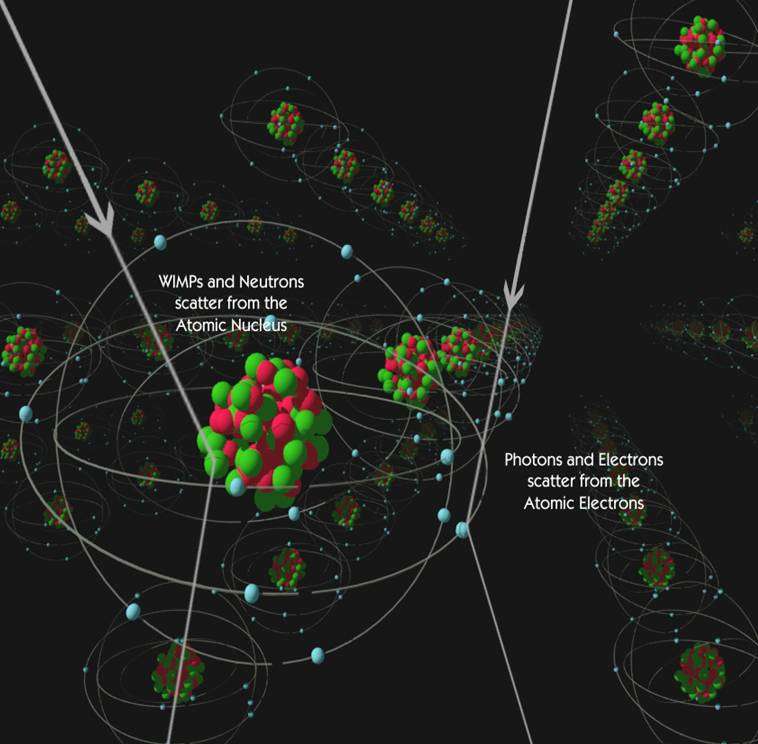
Weakly Interacting Massive Particles or WIMPs are hypothetical dark matter particles that supposedly make up 26-27% of the universe. They are only detectable through their gravitational effects.

In a recent ScienceNews article LUX-ZEPLIN researchers monitoring 10 metric tons of liquid xenon almost a mile below the surface in Lead, South Dakota have reduced the cross-sectional area that WIMPs can interact with normal matter by about 80%.

This reduced area of interaction implies that the particles are even weaker than previously thought. This would make them even harder to detect.  

Triva time: A cube that could hold 10 metric tons of xenon would need to be about 1.5 meters on a side.

Source: The Possibilities for Dark Matter…by Emily Conover, 2024, Science News. Graphic: WIMPs by University of California Berkley, 2013.

Zip It — Zip it Good

Today in 1893 Whitcomb Judson received approval for two patents on his ‘clasp-locker’ invention. An improved version was renamed the ‘zipper’ by B.F. Goodrich in 1923.

Zippers primary use early on was to close boots and tobacco pouches. A few years later they began to show up on jackets and by the late 1930s they replaced buttons on men’s pants.

Graphic: By Dominique Toussaint, 2006, Wikimedia Commons.

The Statue of Zeus at Olympia

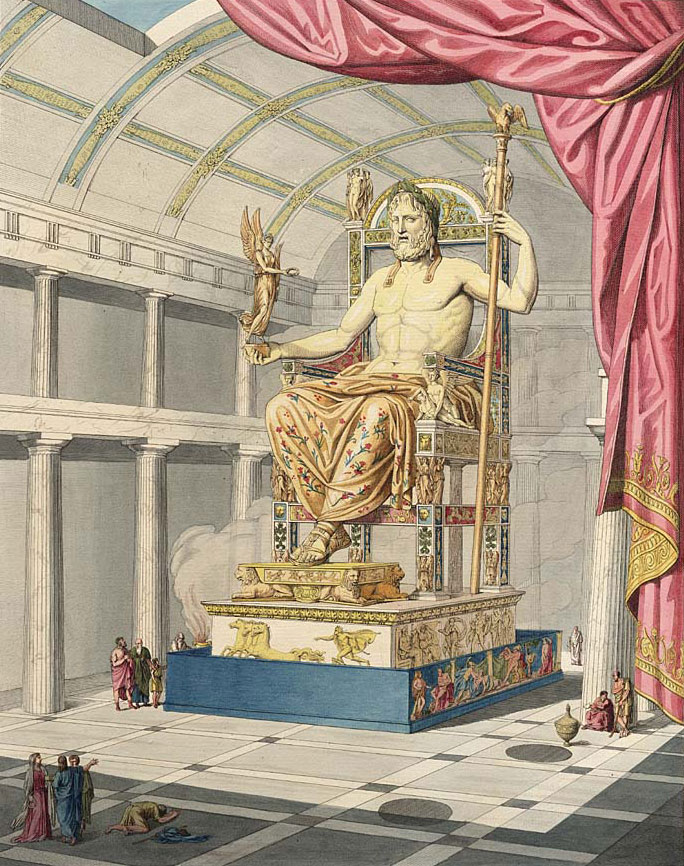
The 40’ tall statue, considered one of the seven wonders of the ancient world, was constructed by the Greek sculptor Phidias around 435 BC during the Golden Age of Athens and the time of Pericles.

The statue was composed of what the ancients called ‘chryselephantine’ or ivory, depicting flesh, and gold, which defined Zeus’ robes and ornaments. The ornaments included his scepter in his left hand and in his right hand he held a statue of Nike, Greek goddess of victory (Bulfinch reverses the hand order in his book on Greek mythology). He is seated on a throne of cedar encrusted with gold and precious stones.

Detailed descriptions of the statue come from the Greek geographer Pausanias and from numerous Greek and Roman coins and engraved gems.

The statue was housed in the Temple of Zeus at Olympia near the western coast of the Peloponnese peninsula and hasn’t been seen since the 5th or 6th century AD. It is believed to have been destroyed by an earthquake and or fire at Temple of Zeus or it was transported to Constantinople and destroyed by a fire there in 474 AD.

Source: Bulfinch’s Mythology edited by Richard Martin, 1991. Statue of Zeus by Britannica, 2024. Graphic: Olympian Zeus Statue as drawn by de Quincy, 1815, Public Domain.

Luckiest Man

When Lou Gehrig delivered his retirement speech to his fans at Yankee Stadium in 1939, he proved, not that he was the greatest baseball player ever, that went without saying, but that he was one of most humble humans to ever walk on this planet. A characteristic sorely missing from our society in the 21st century.

Forced to retire from the game he loved because of ALS, which would take his life two short years later, he told the world that I consider myself the luckiest man on the face of this earth.’

His full speech is listed below (will only take a minute to read).

“Fans, for the past two weeks you have been reading about the bad break I got. Yet today I consider myself the luckiest man on the face of this earth. I have been in ballparks for seventeen years and have never received anything but kindness and encouragement from you fans.

“Look at these grand men. Which of you wouldn’t consider it the highlight of his career just to associate with them for even one day? Sure, I’m lucky. Who wouldn’t consider it an honor to have known Jacob Ruppert? Also, the builder of baseball’s greatest empire, Ed Barrow? To have spent six years with that wonderful little fellow, Miller Huggins? Then to have spent the next nine years with that outstanding leader, that smart student of psychology, the best manager in baseball today, Joe McCarthy? Sure, I’m lucky.

“When the New York Giants, a team you would give your right arm to beat, and vice versa, sends you a gift – that’s something. When everybody down to the groundskeepers and those boys in white coats remember you with trophies – that’s something. When you have a wonderful mother-in-law who takes sides with you in squabbles with her own daughter – that’s something. When you have a father and a mother who work all their lives so you can have an education and build your body – it’s a blessing. When you have a wife who has been a tower of strength and shown more courage than you dreamed existed – that’s the finest I know.

“So I close in saying that I may have had a tough break, but I have an awful lot to live for.”

Source: Lou Gehrig’s Farewell Speech, lougehrig.com. Graphic: Lou Gehrig with the New York Yankees, 1923. Pacific and Atlantic Photos. Public Domain.
King Arthur’s World

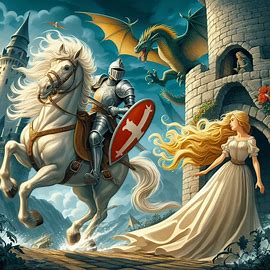
Chivalry ‘framed an ideal of the heroic character, combining…strength and valor, justice, modesty, loyalty to superiors, courtesy to equals, compassion to weakness, and devotedness to [God],’ as defined by Bulfinch in his 1858 ‘The Age of Chivalry, or Legends of King Arthur’.

Chivalry in the Middle Ages was a lifestyle and a philosophy. A lifestyle that guided a knight’s actions and decisions backed-up by a philosophy that defined chivalrous principles and virtues.

Every year the Knights of the Round Table renew their oaths of chivalry as proclaimed by the King Arthur during the Christian holiday of Pentecost.

The time of Pentecost was likely chosen because it was a time of renewal and commitment for Christians.

Source: Bulfinch’s Mythology, 1991. Graphic: Knight Rescuing a Maiden, AI generated.

Monet and Water

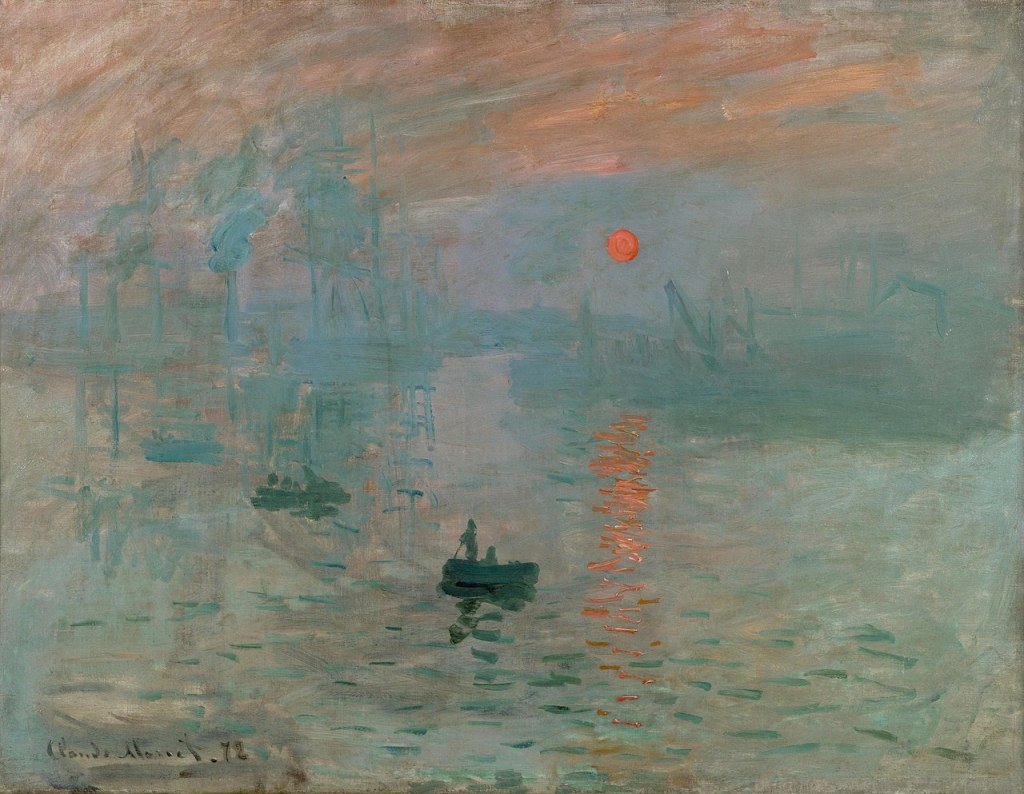
Monet loved water, the sea, lakes, rivers, mist, fog, it didn’t matter. He searched it out and painted it. Plants, people, buildings were extensions of his water.

His 1872 seascape, Impression: Sunrise, from which the style ‘Impressionism’ is derived, is a study of the morning light unsuccessfully trying to break through the mist of solitude surrounding the boaters. Water fills the painting from top to bottom.

Taillandier in his monograph, ‘Monet’ wrote, “His fascination with water was such that he painted leaves, grass, and meadows as he painted water, the brushstrokes like so many quivering waves in the air”.

Monet painted water. Houses were painted like so many waves. The sky rippled. Skin erupted with steam and stones dissolved into mist.

Source: Monet by Yvon Taillandier, 1987. Graphic: Impression: Sunrise by Monet, 1872, Public Domain.

Journalism–Fox Butterfield

Fox Butterfield was a New York Times reporter that wrote several articles in the 1990s expressing total bewilderment about the ‘paradox’ between putting criminals in prison and the subsequent drop in crime. It wasn’t until the year 2000 that Butterfield finally started to acknowledge that locking up the criminals was responsible for the drop in crime in our streets.

James Taranto with The Wall Street Journal invented the term ‘The Butterfield Effect’ for Fox Butterfield and people in general who can’t accept facts or data that run counter to their beliefs. Another term for the ‘Butterfield Effect’ is cognitive dissonance.

Source: The Fox Butterfield Follis, Washington Examiner, 2000. Graphic: Cognitive Dissonance, de Castro, Contemplative Studies, 2020

Burial of the Count of Orgaz

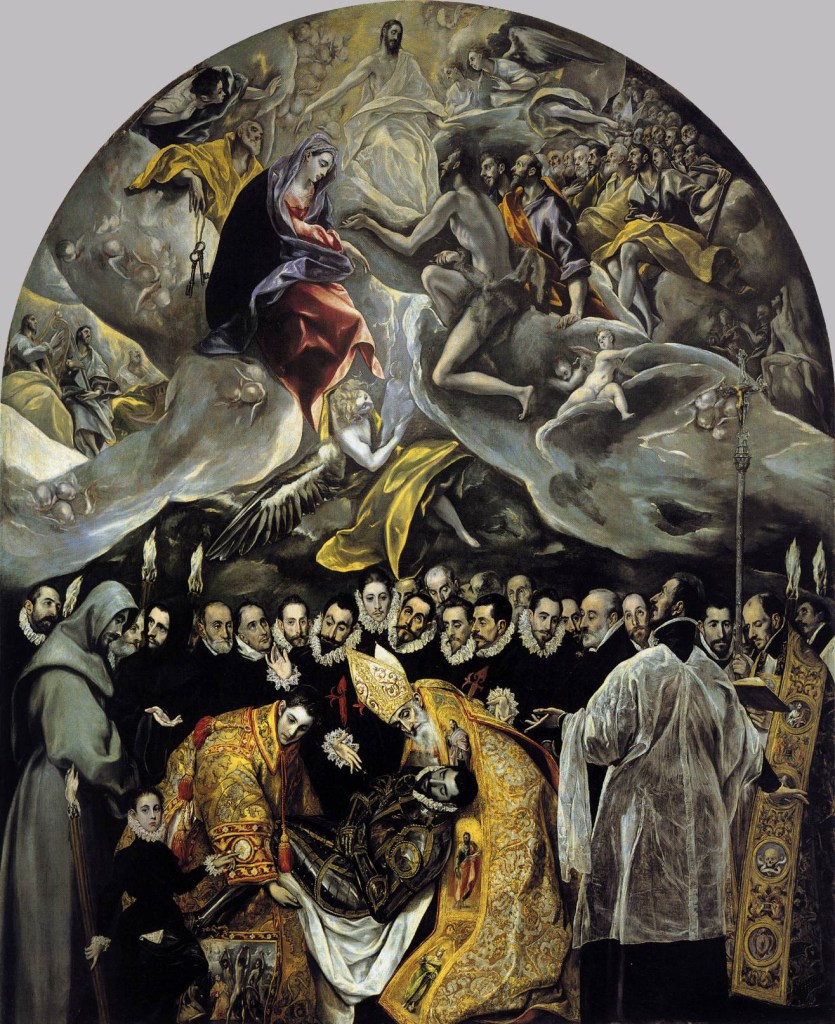
The 1586 painting, Burial of the Count of Orgaz is considered El Greco’s greatest work, which he created during his later mannerist phase of the High Renaissance. Mannerist paintings are known for their exaggerated proportions of figures and structures and the use of very intense colors.

The painting is large, almost 16’ by 12’, oil on canvas divided into two halves with the Count being buried by Saints Stephan and Augustine, per local legend, in the lower half and in the upper half his soul, depicted as a child, is transported to heaven.

The painting was commissioned by El Greco’s parish priest, Andres Nunez de Madrid, to remind Orgaz’s relatives that they were obligated by the Count’s will to provide a yearly donation to his church in Toledo, Spain.

Source: El Greco by Michael Scholz-Hansel, 2016, Taschen. Graphic: Burial of the Count of Orgaz by El Greco, Public Domain

The Divine Comedy:

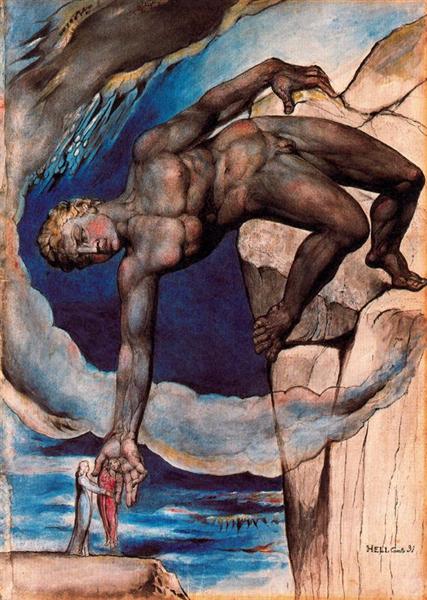
William Blake (1757-1827), in the final years of his life created 102 watercolors and 7 copper plates, most unfinished, for Dante’s ‘The Divine Comedy’. One of the more profound and captivating of these paintings is ‘Antaeus Setting Virgil and Dante into the Ninth Circle of Hell’.

The giant Antaeus, son of Neptune and Gaia, was invincible as long as he remained attached to his mother. Hercules, for his 11th task, had to defeat Antaeus but couldn’t if he touched the Earth, so he lifted him off the ground and strangled him to death.

The Ninth Circle is reserved for the treacherous and is subdivided into 4 rings. The first part is reserved for familial traitors and is named Caina as in Cain and Abel. The second ring, Antenora for Antenora of Troy is for national traitors. Ptolomaea for Ptolemy is the third ring for those who betray their guests. Finally, the inner ring is called Judecca for Judas Iscariot betrayer of Christ and is for the worst traitors: those who turn on their masters. At the center of the Ninth Circle resides Satan.

Finally, as an aside, Dante’s ‘The Divine Comedy’ shouldn’t be interpreted as The Divine Humor, but as The Divine Outcome. The author meant that comedy was the opposite of tragedy. Tragedies begin well and end badly, but Dante’s Comedy begins badly, in Hell, and ends well with Dante reaching his desired destination: Heaven.

Source: Will Blake, The Divine Comedy by David Bindman, 2000. The Divine Comedy by Dante Alighieri, circa 1321. Bulfinch’s Mythology, 1867. Graphic: Antaeus Setting Down Dante and Virgil in the Last Circle of Hell, Blake, 1827, Public Domain.

A Riddle

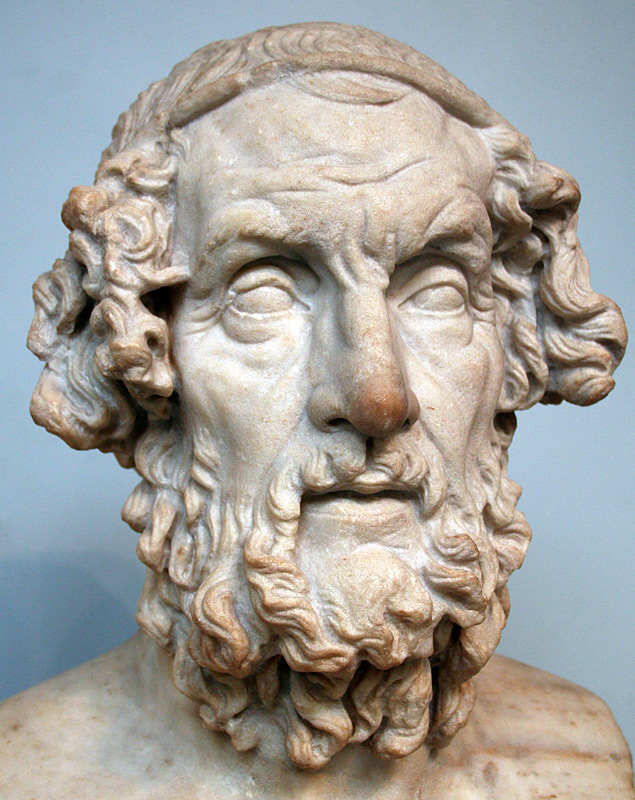
Homer is said to have died of grief or maybe shame when he was unable to solve the riddle posed below by some small children:

‘What do you leave behind if you know you have it and what do you take with you if don’t know you have it?’

Lice.

Almost nothing is known about Homer, including his existance, making everything said about him to be either myth, allegorical, or just made up out of whole cloth.

Source: Bulfinch’s Mythology, 1991 – 1st published 1855. Graphic: Bust of Homer, British Museum, Public Domain