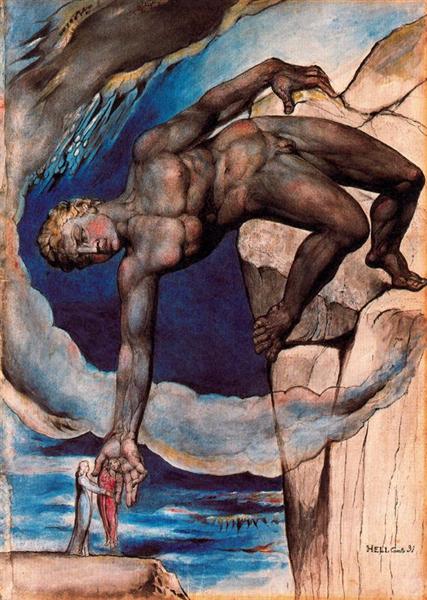
William Blake (1757-1827), in the final years of his life created 102 watercolors and 7 copper plates, most unfinished, for Dante’s ‘The Divine Comedy’. One of the more profound and captivating of these paintings is ‘Antaeus Setting Virgil and Dante into the Ninth Circle of Hell’.
The giant Antaeus, son of Neptune and Gaia, was invincible as long as he remained attached to his mother. Hercules, for his 11th task, had to defeat Antaeus but couldn’t if he touched the Earth, so he lifted him off the ground and strangled him to death.
The Ninth Circle is reserved for the treacherous and is subdivided into 4 rings. The first part is reserved for familial traitors and is named Caina as in Cain and Abel. The second ring, Antenora for Antenora of Troy is for national traitors. Ptolomaea for Ptolemy is the third ring for those who betray their guests. Finally, the inner ring is called Judecca for Judas Iscariot betrayer of Christ and is for the worst traitors: those who turn on their masters. At the center of the Ninth Circle resides Satan.
Finally, as an aside, Dante’s ‘The Divine Comedy’ shouldn’t be interpreted as The Divine Humor, but as The Divine Outcome. The author meant that comedy was the opposite of tragedy. Tragedies begin well and end badly, but Dante’s Comedy begins badly, in Hell, and ends well with Dante reaching his desired destination: Heaven.
Source: Will Blake, The Divine Comedy by David Bindman, 2000. The Divine Comedy by Dante Alighieri, circa 1321. Bulfinch’s Mythology, 1867. Graphic: Antaeus Setting Down Dante and Virgil in the Last Circle of Hell, Blake, 1827, Public Domain.
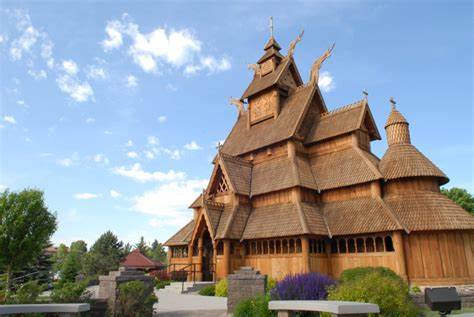
At the Scandinavian Heritage Association’s Heritage Park in Minot, North Dakota there is a full-size replica, built in 2000, of the Gol Stave Church. The original was constructed in Gol, Hallingdal, Norway (~100 miles NW of Oslo) around 1250 AD. It was moved to Bygdoy Park in Oslo, Norway about 100 years ago.
According to Valebrokk et al, inside the church, the corner posts are essential. They are often accentuated and are heavier and more richly decorated than the other structural elements. “They represent the four gospels whose teachings are the supporting foundation of all Christianity” is the description given in a sermon in the thirteenth century. This sermon was held during a church consecration, in which each section of the stave church’s structure was related to spiritual values. The beams upon which the columns rest “signify God’s apostles, the foundation of all Christianity.” The floorboards represent “the humble men who bow in honour; the more they are exposed to the trampling feet of the congregation, the more support they provide.”
The roof surface which protects the church from snow and inclement weather “represents the men…whose prayers protect Christianity from temptation.”
In addition to the replica in Minot, additional replicas exist in the Gordarike Family Park in Gol, which was built in 1995 and in the Norwegian Pavilion in EPCOT, Orlando which was built in 1984.
Source and graphic: scandinavianheritage.org. Excerpts above from Norway’s Stave Churches by Eva Valebrokk and Thomas Thiis-Evensen. Wikipedia.
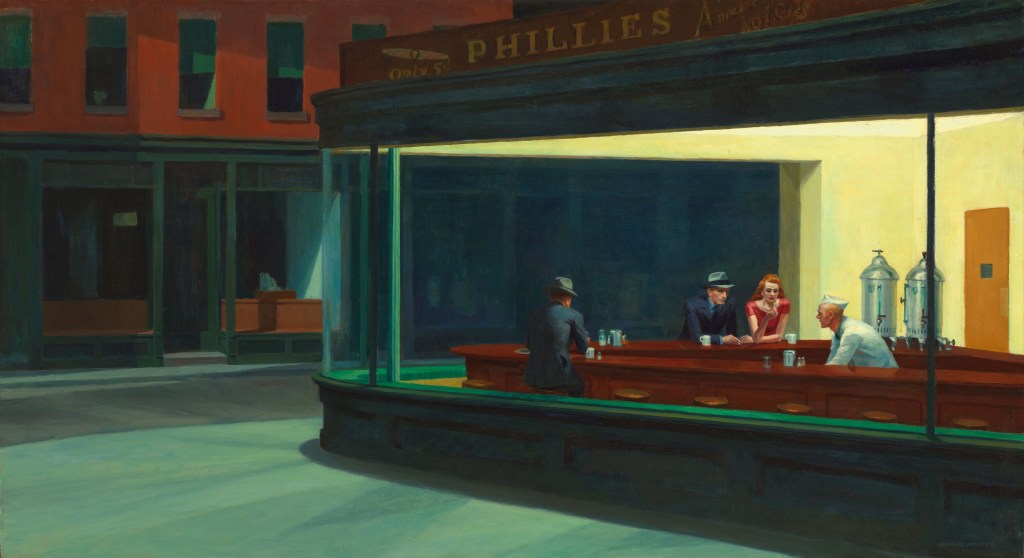
Edward Hopper’s 1942 painting, “Nighthawks” was his best-known piece of art. He commented that, “Nighthawks seems to be the way I think of a night street. I didn’t see it as particularly lonely. I simplified the scene a great deal and made the restaurant bigger. Unconsciously, probably, I was painting the loneliness of a large city.” Later, he again downplayed the loneliness aspect of the painting by stressing that it was just “a restaurant on Greenwich Avenue where two streets meet”.
Source: Hopper by Rolf G. Renner, Taschen, 2020 originally published 1991. Painting, “Nighthawks” by Hopper owned by Daniel Rich. Public domain.
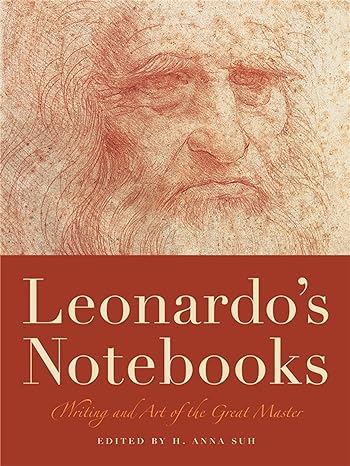
Leonardo Da Vinci and Issac Newton were both consummate note takers. They recorded their thoughts, ideas, and anything else that struck their fancy in innumerable notebooks and loose sheets of paper.
Paper was expensive so they both wrote small and covered every inch of paper with drawings and script.
Newton wrote in Latin, Greek, and English with most subject titles in Latin and the text in Greek. To save space his letters were an eye straining one sixteenth of an inch high. An estimated 4000 pages with around 285,000 words plus drawings of his writings have been found to date.
Leonardo wrote in Tuscan Italian, with the text written in a right to left mirror style which some believe he did because he was left-handed, as, by-the-way so was Newton. 13,000 pages of Leonardo’s notes have been found which is believed to be only about a fifth of the total.
Source: “Isaac Newton” by James Gleick, 2003. “Leonardo’s Notebooks” Edited by H. Anna Suh, 2005. “Leonardo Da Vinci” by Walter Isaacson, 2017. Graphic of da Vinci and Newton AI generated.
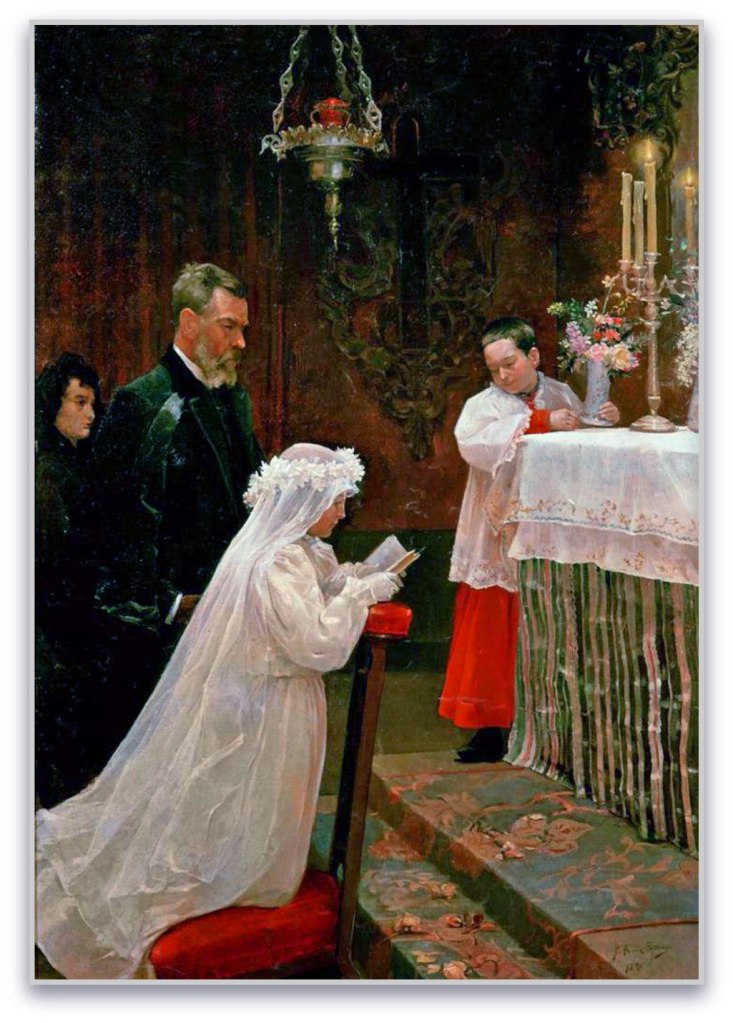
Picasso was recognized as a child prodigy at a very young age. He began to paint with oils when he was eight and by the time he was thirteen he was selling his work. At the age of fourteen, he was admitted to the prestigious Barcelona art school: La Lonja. At the age of fifteen he made his official entry into the professional art world, presenting the painting, “The First Communion” shown to the right, at the Third Exhibition of Fine Arts and Artistic Industries in Barcelona.
“Science and Charity” shown to the left is one of Picasso’s most accessible paintings. He painted it in 1897 at the age of 15. This painting was the culmination of his academic studies and he soon after abandoned this style in pursuit of a more personal, albeit inscrutable, approach to art.
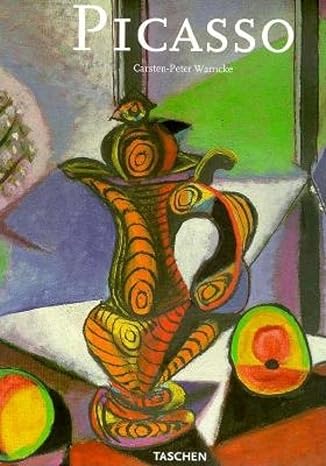
Source: Picasso by Carsten-Peter Warncke. Published 2001. Original publication 1998.
Salvator Mundi, Savior of the World, is believed to have been painted by Leonardo da Vinci sometime between 1499 and 1510 which is considered by historians to be the beginning of the High Renaissance period. The painting was supposedly commissioned by King Louis XII of France and was later recorded in the possession of the English Kings Charles I and II. How the English acquired the painting is unknown. It was then passed onto the Duke of Buckingham in the 1600s after which his son sold it in 1763. The painting then disappeared for 137 years.
It reappeared in 1900, changing hands a few times without anyone realizing it may be an authentic Leonardo. In 2005 a consortium of art dealers and collectors purchased it with the intent to have it cleaned and restored all the while attempting to prove that it was indeed a Leonardo painting. In 2013 most experts agreed that it was an authentic Leonardo allowing it to be sold for $80 million to Swiss art dealer Yves Bouvier which he quickly resold to the Russian Rybolovlev for $127.5 million. This sale quickly became a legal mess with the resolution not entirely clear.
Somehow the legal issues resolved themselves and the painting came to market again in 2017 selling for $450.3 million, making it the most expensive painting ever sold. After much wild and erroneous speculation, it was revealed that Abu Dhabi’s Department of Culture and Tourism bought the painting. It is currently in storage awaiting the completion of the Louvre Abu Dhabi in the United Arab Emirates.
In 2020 the experts have struck again and attribution of the painting to Leonardo is in doubt. Experience says this debate will continue ad infinitum. Meanwhile an extremely expensive art piece supposedly by a gay painter of Jesus Christ resides in the Arab Middle East.
Sources: Leonardo da Vinci by Walter Isaacson published in 2017. Salvator Mundi by Christies published in 2017. Salvator Mundi by ArtNet published in 2020.
There are only meager snippets of biographical information available on Carsten-Peter Warncke. The inside jacket of this volume on Picasso contains the most detail I was able to find, and I quote it in total below:
“Carsten-Peter Warncke was born in Hamburg in 1947, studied art history, classical archaeology and literature in Vienna, Heidelberg, and Hamburg, and received his doctorate from the last university in 1975. He is Professor of Art History at the University of Gottingen.”
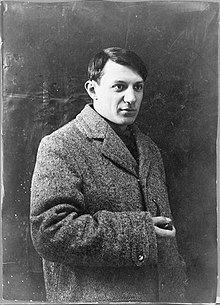
Pablo Picasso was born in Malaga, Spain in 1881 to Don Jose Ruiz Blasco, a painter who taught drawing, and Dona Maria Picasso Lopez. Pablo adopted his mother’s surname somewhere between 1897 and 1901 believing that his paternal surname was too common, plus he was convinced his name needed a double consonant to align with other artists such as Matisse, Poussin, and Rousseau.
Picasso was recognized as a child prodigy at a very young age. He began to paint with oils when he was eight and by the time he was thirteen he was selling his work. At the age of fourteen, he was admitted to the prestigious Barcelona art school: La Lonja. At the age of fifteen he made his official entry into the professional art world, presenting the painting, “The First Communion” at the Third Exhibition of Fine Arts and Artistic Industries in Barcelona.
FootnoteB
In 1900 Picasso exhibited 150 drawings at the Barcelona cafe, “Els Quatre Gats“. The cafe’s name derives from a Catalan expression which means “only a few people” and translates to “The Four Cats”. The expression describes people who are a bit strange or peculiar. The cafe was a popular meeting place for famous artists in the twentieth century including Isaac Albeniz, Gustavo Barcelo, Ramon Casa, Carlos Casegemas, and Santiago Rusinol.
Picasso moved around France and Spain about as often as he experimented with and changed his artistic style. In October of 1900 he moved to Montmartre on the Right Bank of the Seine in Paris to open a studio with Casagemas. Shortly afterward the Paris art dealer, Pedro Manach, offered him 150 francs a month for his 150 aforementioned prints. There is no record of what else was required of Picasso to fulfill the contract, but the contract was either fulfilled or expired at the end of 1902 at which time the painter moved back to Barcelona. Finally, in a Hobbitian maneuver of there and back again, he returned to Paris in 1904 where he stayed until he moved to the French Riviera, initially on a semi-permanent basis, but eventually taking up full time residence in the area in 1952, where he remained until his death in 1973.
FootnoteC
FootnoteD
Picasso was constantly re-inventing himself over the course of his career that spanned three-quarters of a century. He began painting as a realist and gradually morphed into a modern artist laying claim to the greatest surrealist in the twentieth century.
Picasso viewed his art as a diary. He said he had no secrets, sharing his artistic journey with all. He was quoted as saying, “When I paint my object is to show what I have found and not what I am looking for.”
World events, such as war, and personal relationships often influenced his work. Picasso also anticipated the late twentieth century business mindset of “If it ain’t broke, fix it anyway” or more compactly, change for change’s sake. He conceptualized change as “A picture is not thought out and settled beforehand. While it is being done it changes as one’s thoughts change. And when it is finished, it still goes on changing, according to the state of mind of whoever is looking at it.“ This quote has also been paraphrased as “When I know what the picture will be beforehand, why make it?” In the same vein he also stated: “You mustn’t expect me to repeat myself. My past doesn’t interest me. I would rather copy others than copy myself. In that way I should at least be giving them something new. I love discovering things.” Change was religion for Picasso, and he worshiped it.
FootnoteE
Below is listing of the different art periods he laid claim to over the years:
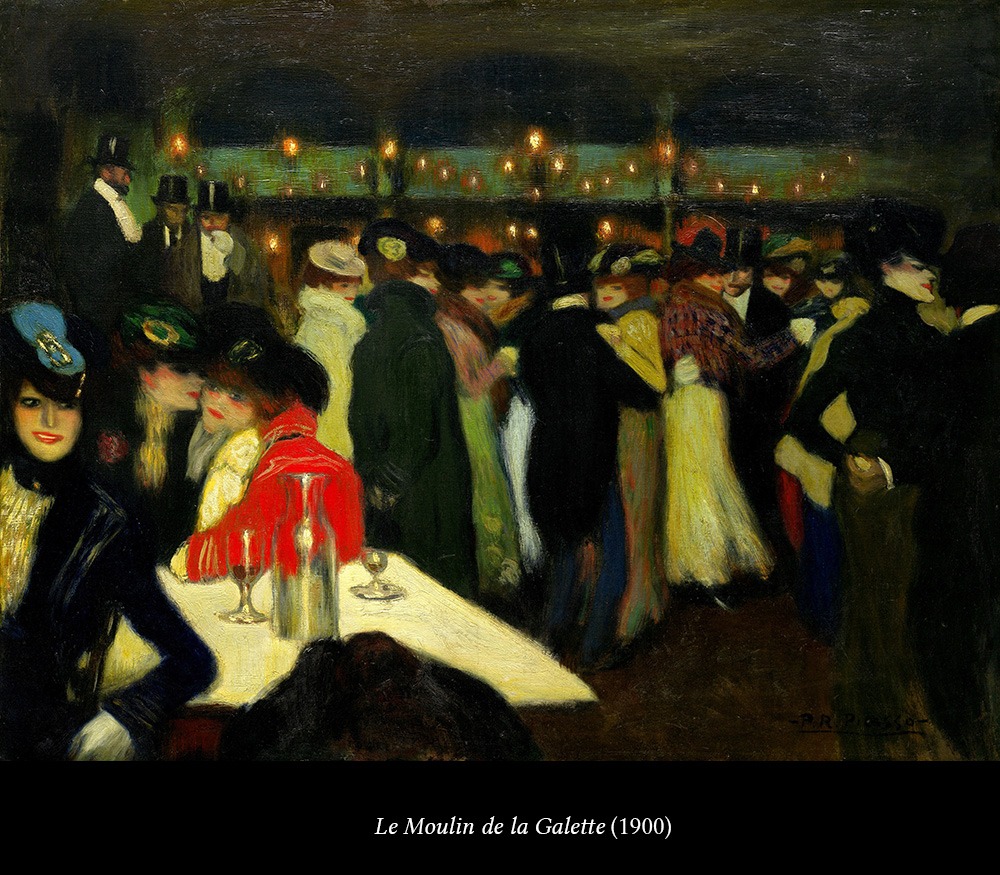
Early Work from 1890-1901: Realistic style influenced by Expressionism and Post-Impressionism. Edvard Munch’s, Expressionist and painter of the 1893 “The Scream“, use of color and various themes resonated with Picasso. Wassily Kandinsky, Expressionist and painter of the 1903 “Blue Rider” moved in the same circles as Picasso and the two likely shared abstract artistic forms and themes. Picasso greatly admired the Post-Impressionist Toulouse-Lautrec with his 1900 “Le Moulin de la Galette” paying homage to Lautrec in style and spirit.
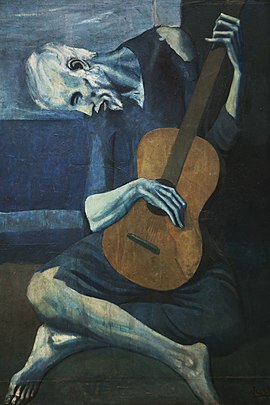
Blue Period from 1901-1904: Monochromatic paintings in shades of blue. Scenes of poverty and despair predominate this period exemplified by one of his most famous paintings from this period; “The Old Guitarist“. The painting, in addition to the characteristic blue, also shows the elongated bodies and fingers which the painter used to evoke emotion and reaction. Poverty and despair weren’t just a stylistic phase for him but a mirror into his personal depression. He was very poor and had lost his close friend Carles Casagemas in 1901. His depression began during his Blue Period and lasted in milder forms till the end of his Cubist Period.
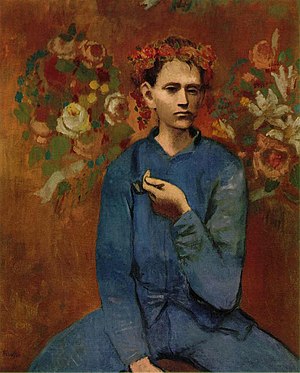
Rose Period from 1904-1906: He used warmer colors than in his Blue Period with more cheerful subjects such as circus performers, clowns, and harlequins. His depression lifted slightly during this period possibly due to his relationship Fernande Olivier, a model and artist that Picasso painted over sixty portraits of. His best-known painting from this period is the 1905 “Boy with a Pipe“. Picasso described the boy, Louis, as an “evil angel” and used the garland of roses on his head to symbolize the blood of the Eucharist. This contrasted with the harsh street life that Louis actually endured along with the innocence of his youth. The garland of roses serves as a powerful symbol in the painting, representing the juxtaposition of innocence and the harsh realities of life. Beauty and thorns, side by side.
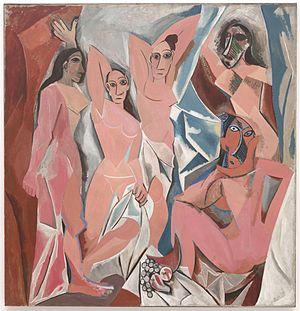
African Influenced Period from 1907-1909: He was inspired by African masks and sculptures. During this period, he experimented with geometric forms and shapes. His best-known work from this period is “The Ladies of Avignon”. This painting is considered a precursor to his Cubist Period and tangentially to his Surrealist Period. Art historian John Richardson said that this painting made Picasso the most pivotal artist in the West. Art Critic Holland Carter said that this work changed history. One can never accuse a critic of being subtle.
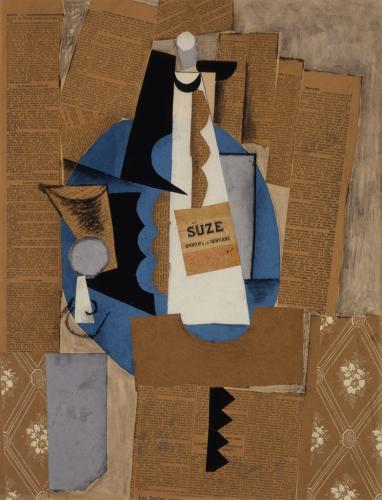
Cubist Period from 1909-1919: This period is divided into two phases: Analytic and Synthetic Cubism. Picasso’s Analytic Cubism from 1907-1912 combined deconstructed objects into overlapping planes from multiple viewpoints using muted colors. His Synthetic Cubism from 1912-1914 eliminated three-dimensional space and introduced extraneous matter mixed with bright subject colors. One of his better-known works during his Cubist Period is “Glass and Bottle of Suze“.
Neoclassicism from 1919-1924: Picasso returned to a more realistic style after WWI. Art critics at the time insisted Cubist art was a product of Germany coupled with the realization that Picasso’s Cubist art promoter was a German, causing the French to reject not only the style but also casting suspicion on the artist. Additionally, Picasso, being Spanish, did not serve in the French military during war causing public opinion to turn against him. To combat the ill feelings toward him he reverted to a more classical style. One of his better-known paintings during this period was “TheLover” which has the appearance of being lifted directly from a Greek or Roman bath.
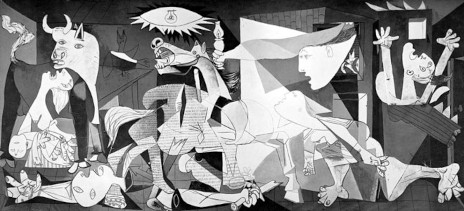
Surrealist Period from 1924-1937: During this period Picasso incorporated elements of the subconscious, dreams, and fantasy into his art, exploring new ways to express emotion and reality. He was particularly interested in eroticism, violence, and primitivism. His art emphasized flowing lines and fragmented bodies which are interpreted to represent Picasso’s personal feelings towards his subjects. His anti-war “Guernica”, a response to Nazi bombing of the Basque town of Guernica during the Spanish Civil War is his most famous Surrealistic painting or possibly his most famous painting in any style. If you didn’t know the story behind the painting and what it represents you would still see and feel the violence flowing from the canvas–knowing full well that supreme evil was in progress, seeping and dripping from the canvass in black and white. Picasso’s approach to Surrealism can be summed up with his words, “I paint objects as I think them, not as I see them.”
Later Work from 1937-1973: Picasso continued to reinvent himself over the last quarter century of his life but with less success in the realm of originality. His paintings remained Surrealistic with occasional bursts of Cubism but were becoming more abstract and confusing. He began to reinterpret the old masters and explore love and death in more exacting detail while also branching out into distinctive and different mediums such as collage, sculpture, ceramics, and printmaking.
FootnoteF
Picasso was a prolific artist, orders of magnitude beyond the output of his contemporaries. As a way of comparison, the post-impressionist Toulouse-Lautrec, who was also considered a prolific painter, painted 737 oil paintings, 275 watercolors, 363 prints, and 5,084 drawings over a period of 20 years while Picasso is estimated to have produced 13,500 paintings, 100,000 prints, 34,000 book illustrations, and three hundred sculptures and ceramics over his 75-year career. On just the painting side of the equation Toulouse-Lautrec created, on average, approximately one painting per week while Picasso finished 3-4 paintings per week. Possibly only QiBaishi, a Chinese painter of whimsical watercolors is known to have created more paintings than him.
The last known estimate of Picasso’s total oeuvre is estimated at over $500 million. Considering that eight of his paintings: “Les Femmes d’Alger” (Cubist/Matisse Adoptive–$179.4 million) “Le Rêve” (Surrealist–$155 million), “Femme à la Montre” (Surrealist–$139.4 million) “Fillette a la Corbeille” (Surrealist–$115 million), “Nude Green Leaves and Bust” (Surrealist–$106.5 million), “Boy with a Pipe” (Blue–$104 million), “Femme Assise Pres d’une Fenetre” (Surrealist–$103.4 million), and “Dora Maar au Chat” (Cubist/Surrealist–$95.2 million) exceed that estimate it would not be unreasonable to conclude that his collection may be worth something approaching 10 times that number or more. Additionally, his art increases in value by about 7.5% per year so the skies the limit.
Literary Criticism:
Warncke’s Picasso attempts the Herculean task of encapsulating the prolific artist in a few hundred pages of text and pictures. It fails but it is probably the best that can be done without overwhelming the reader with his enormous oeuvre. The one person that has attempted a thorough compilation of Picasso’s work is Christian Zervos who spent 46 years at the task. He brought together 16,000 of his paintings and drawings into the thirty-three volume “Pablo Picasso Catalogue Raisonne” which sells for 25,000 Euros (about $27,600). It’s still not everything that Picasso produced but probably more than anyone can digest.
Warncke’s book is a useful romp through the 75 years of the artist’s life, but what was most useful, for me, was the year-by-year biographical breakdown of Picasso’s 33,000 days, plus a few, on this Earth in the back pages of this volume. It provided me with a linear sequence of his progression and growth as an artist. I believe he was at the height of his powers during his Blue Period, but the big money goes to his Surrealistic Period.
Picasso Awards:
FootnoteG
Honorable mention from Madrid exhibition of fine arts, 1897
Gold medal from Malaga provincial exhibition, 1897
Carnegie Prize, 1930
Honorary curator of Prado Museum in Madrid, 1936
Silver Medal of French Gratitude from France, 1948
Order of Polish Renascence commander’s cross from Poland, 1948
Pennell Memorial Medal from Philadelphia Academy of Fine Arts, for lithograph “The Dove of Peace,” 1949
Lenin Peace Prize from Soviet Union, 1950 and 1962
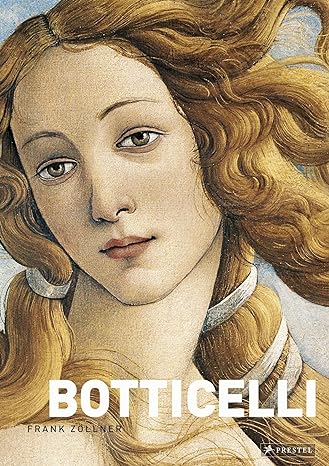
Frank Zollner, born 26 June 1956 in Bremen, Germany, is an art historian specializing in Renaissance painters, specifically Leonardo, but also Michelangelo, Rapheal, and Botticelli. He has been a professor of art history at Leipzig University since 1996.
As an expert in all matters Leonardo, he has been wrapped up in the authenticity of the multiple Mona Lisas that exist around world. The Mona Lisa actually painted by Leonardo that everyone appears to agree on is in the Louvre. Experts also agree that parts of the Isleworth Mona Lisa may have also been painted by Leonardo. Then there is the two Mona Lisas that are most like each other, the Louvre Mona Lisa, and the Prado Mona Lisa in Madrid. The Prado Mona Lisa is acknowledged to have been painted in Leonardo’s workshop but not necessarily by Leonardo himself. The two most famous paintings are the Louvre Mona Lisa and the Washington National Gallery’s Mona Lisa. The National Gallery Mona Lisa is believed to have been painted by one of Leonardo’s followers, possibly Salaì or Francesco Melzi. So, it would appear that there are a lot of Mona Lisa’s floating around but only one fully authentic and completely Leonardo.
Zöllner re-introduced the art world to the ancient concept of aesthetic hedonism. Aesthetic hedonism states that for art to have value one must experience emotional pleasure when viewing or experiencing it. The value related to aesthetic hedonism is derived from empirical observations and experiences. Philosophers, such as Hume and Kant, have argued that aesthetic pleasure is universal, reflecting the intellectual harmony within one’s mind. Plato and others, on the other hand, suggest that empiricism alone is not enough to render value to an object of art. Other subjective factors also need to be considered such as moral, social, or religious values.
Which brings us to an impertinent detour but much needed critique of modern art. Where is the beauty, the pleasure, or at a more essential and primeval level, where is the talent for what passes today as modern art? A deplorable example of modern art totally lacking in artistic talent or merit, unable to provide any visual pleasure, is Vienna’s newest fountain: WirWasser. A cultural devolution that is utterly sad and heartbreaking. Look at the picture of the fountain with the people responsible for that monstrosity. They are smiling. What is wrong with those people?
Botticelli Biography:
“By throwing a sponge soaked with deffernet colors at at a wall one can make a spot in which a beautiful landscape can be seen“…Botticelli.
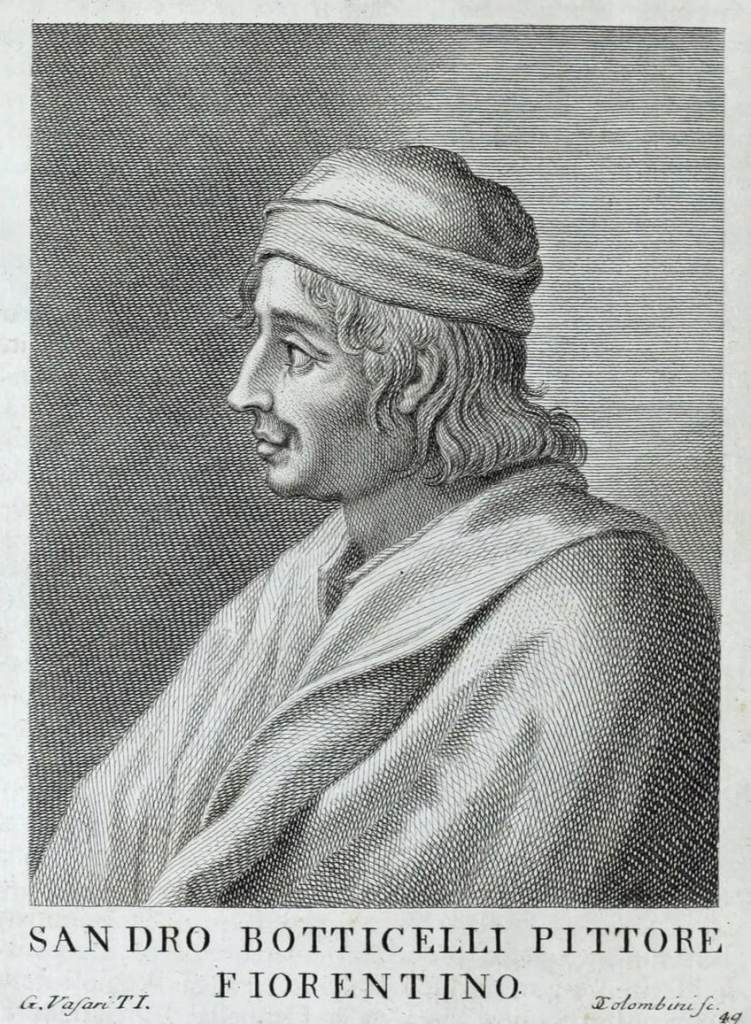
Sandro Botticelli, born Alessandro di Mariano di Vanni Filipep circa 1445, later given the moniker Botticelli by an older brother meaning ‘little barrel’ in Italian, is considered the greatest humanist painter of the Early Renaissance Era.
Botticelli’s art was always about dignity, about maintaining the grace and soulfulness of his subjects. His genus lies in capturing the emotional persona of people populating his paintings along with the technical ability to skillfully show perspective, accurately express anatomy, and the mastery of color and light.
Botticelli died in Florence in 1510 at the age of 64 or 65. His complete oeuvre is unknown but at least 137 artworks have been attributed to him, including panel paintings, works on canvas, frescoes, and drawings for Dante’s Divine Comedy. Among his most famous and recognizable paintings are LaPrimavera (shown above) and the Birth of Venus (shown below), which today, are synonymous with perfection and Early Renaissance art.
The LaPrimavera, shown above, was originally in the possession of one of the younger Medicis and was given as a wedding present to Semiranmide Appiani who married Lorenzo di Pierfrancesco de’ Medici in 1482. The painting depicts, beginning on the far left continuing to far right, Mercury in winged shoes poking at the clouds with a wand, the Three Graces in the company of Mercury creating an atmosphere of beauty and what else, grace. The central figure is Venus. The floating cherub above Venus is Cupid, her son by Mars. To the right of Venus is Flora, goddess of flowers, springtime, and fertility. The woman to the right of Flora is Chloris, originally a virginal nymph who was transformed into Flora by the wind God Zephyr shown floating above ground on the far right. Zephyr raped Flora/Chloris but made amends by making her his wife.
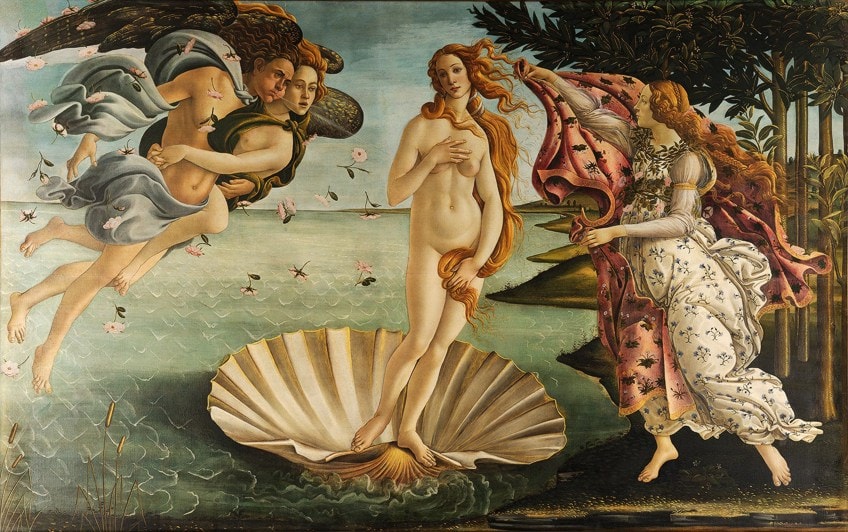
Botticelli’s TheBirth of Venus, referred to by some art critics, including Zollner, as the Arrival of Venus, shows the goddess of love on the shores of the island of Cythera. Botticelli based the painting on a poem by Greek poet Hesiod, describing Venus emerging from the sea, formed from the severed genitals of Uranus. Venus is standing on a giant scallop shell, blown by the wind god Zephyr and his companion Aura, a goddess of breeze, and welcomed by one of the Horae, likely a goddess of spring, who offers her a cloak.
Literary Criticism:
Zollner’s Botticelli is a masterpiece in scholarship and beauty. The reproductions of Botticelli’s art are crisp and clear, but the text brings it all together, biography, provenance, technique, and history. To follow a painting from brush to museum, as Zollner has, is itself a work of art and love.
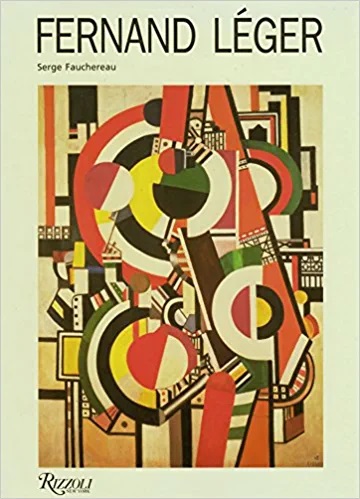
Serge Fauchereau, born on Halloween in 1939 in France, is an art curator; art critic; professor of literature, art history, and writing; and author of artist biographies and art styles. Fauchereau has spent his adult life educating the public on, and extolling, 20th century avant-garde painting and sculpture, specifically the abstract and cubist styles.
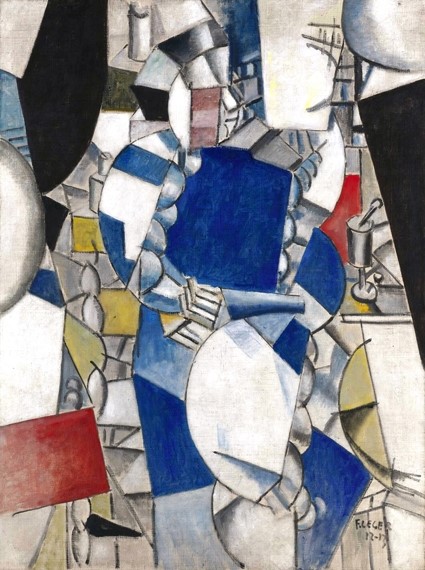
Cubism – The Woman in Blue – Legar 1912
Abstract art attempts to free visual representations of reality from the concrete, expressing form and color spiritually, emotionally, metaphysically without the chains of perspective, fact, or conclusions. Cubism, a mathematical sub-set within the abstract world, takes the whole of reality apart piece by piece, reexamines and reimages the pieces, giving them their own perspective, color, and frame; and then collects the many pieces into something greater than the one. Sometimes this works.
Paul Cézanne, 19th century French post-impressionist painter, is considered the father of Cubism but not actually a Cubist himself. Cezanne stretched the accepted norms of perspective, giving separate objects within his paintings their own reality, their own commentary. Pablo Picasso and Georges Braque, along, to a lesser extent, with Fernand Leger, took their cues from Cezanne, developing a style that became known as Early Cubism in the first 15 years of 20th century.
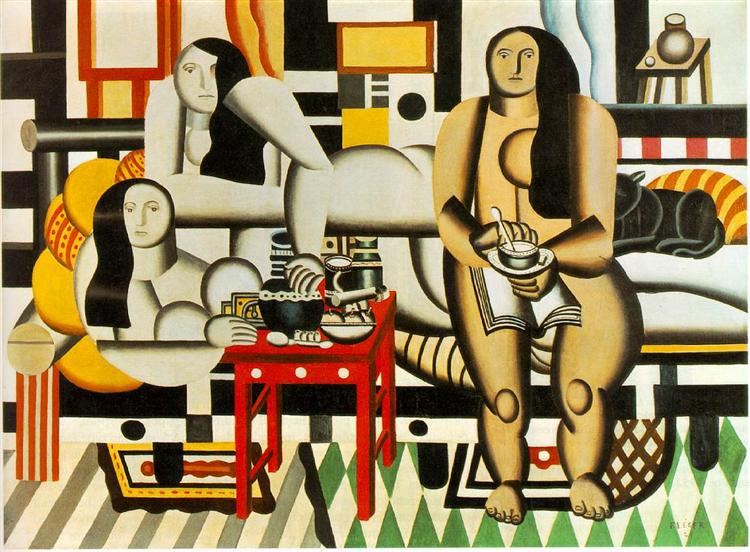
Tubism – Three Women – Legar 1921
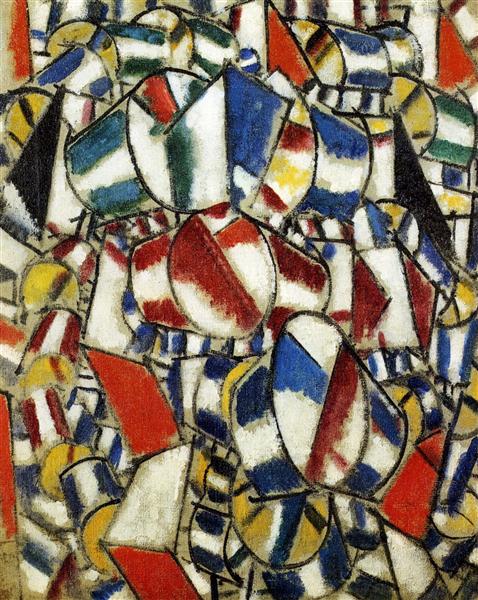
Contrast of Forms – Legar 1913
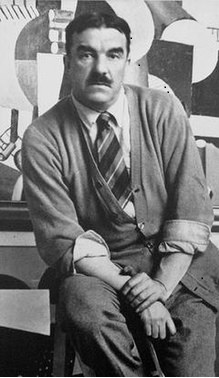
Fernand Leger, born in Normandy, France in 1881, was an extrovert who successfully kept his private life hidden from the public, expressing himself exclusively through his paintings and films. His early works, before 1908, were strongly influenced by the French impressionistic painters. Dissatisfied with his impressionistic efforts he destroyed all his paintings from this period.
Moving on from impressionism, he circulated with the Parisian modern art crowd, where he began to experiment with the Cubist style, finishing his initial works, La Couseuse and Compotier sur la Table in 1909. After WWI, in which he served on the Verdun front and was wounded, he developed his own style, a modified form of Cubism which he called Tubism, more a foray into pop art than a formal artistic movement. Beginning in the early 1920s he collaborates and directs art films beginning with La Roue followed by Skating Rink and Le Ballet Mecanique.
Till the end of his life in 1955 he continued to paint, lecture, exhibit and travel, cementing his reputation as pioneer in the world of modern art. His reputation continues to grow with his Cubist Contrast of Forms selling at a Christie auction in 2017 for $70,062,500.
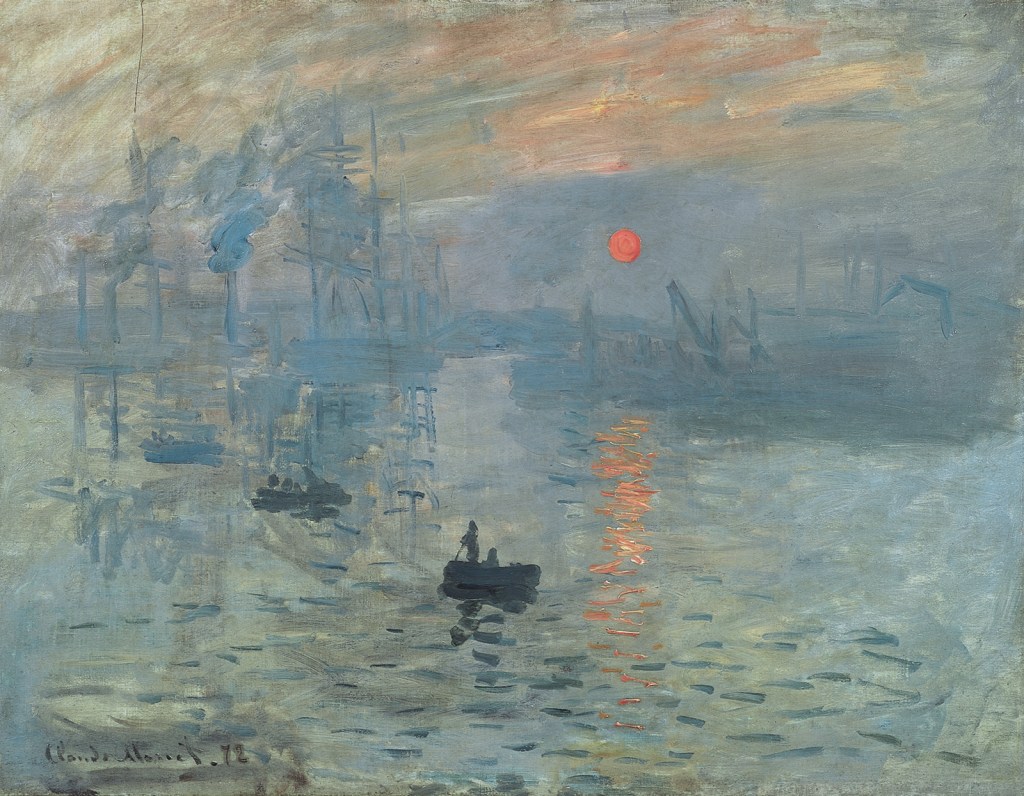
A small coterie of Parisian painters, less than a dozen, mostly French, mostly young and middle class, disillusioned with the elite’s adherence to Neoclassicalism and Romantism, began to experiment in the latter half of 19th century with bold colors and light, loose, broad brushwork and forms, simple, pleasing scenes of everyday life and contentment, landscapes painted in the open air: en plein air, painting what their eyes saw, and their hearts felt. Their style came to be known as Impressionism, a term lifted by an art critic who intended censure and derision from Monet’s painting: ‘Impression, Sunrise’ (shown above right). Impressionism, initially disregarded and rejected by the critics and the public, became the solid foundation for all painting to come; Post-Impressionism, Art Noveau, Cubism, and onto what is today casually labeled modern or contemporary art.
As Impressionism birthed the future of painting in the west, the Realists: Millet, Corot, Corbet, and others created the base for Degas, Manet, Monet to which they added something fresh and enjoyable. Realists painted the world as they perceived it: poor, laboring, dismal, dystopian. The Impressionists kept the Realists’ stage, the world as it is, but added cheerfulness and peace by experimenting with light and form.
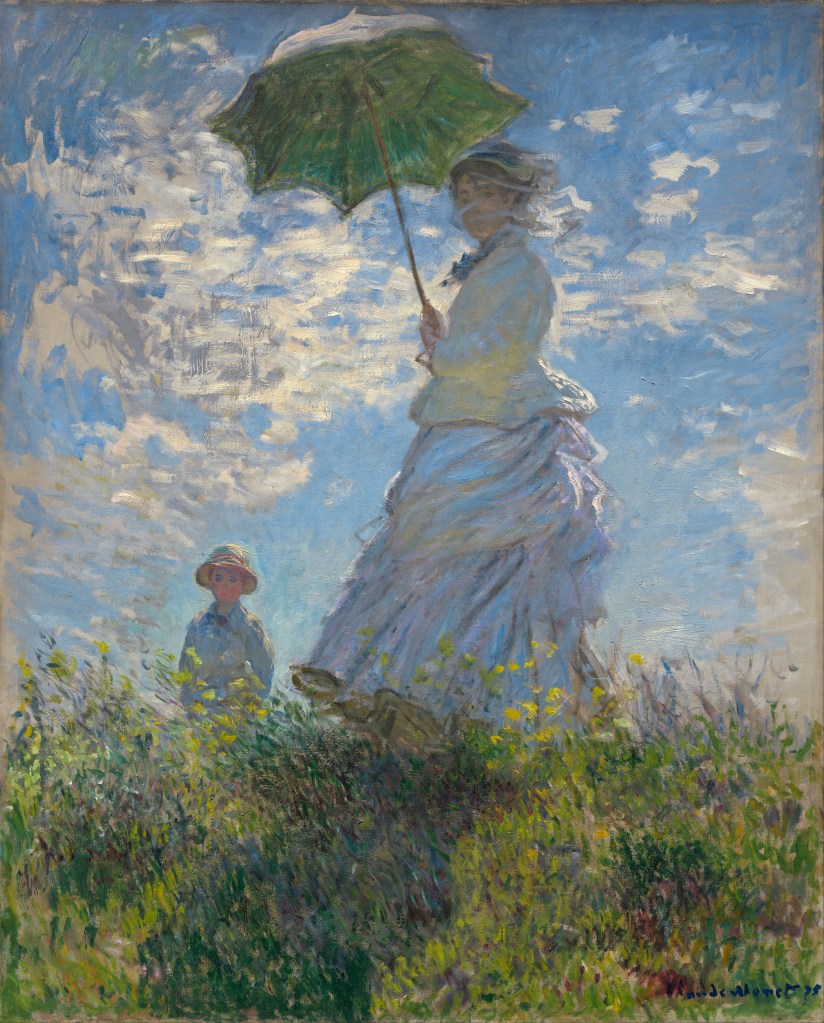
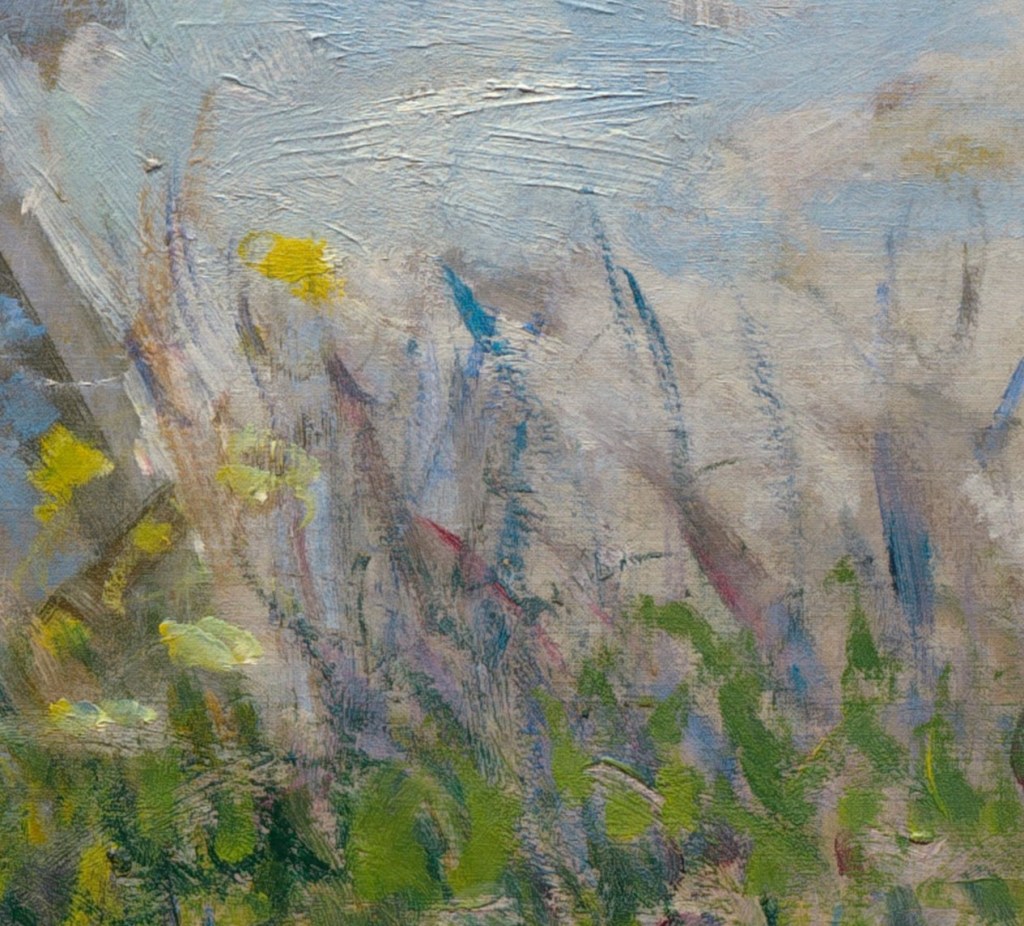
Monet’s genre masterpiece, ‘Woman with a Parasol-Madame Monet and Her Son (shown above left), captures his wife and son in a leisurely stroll around a blustery Argenteuil, a suburb of Paris, in 1875. The woman and son are looking down on the painter with her umbrella blocking out the sun creating an impression of light dancing through the clouds and sky, imparting a stark contrast for the shadows below moving across the grass and flowers. The woman’s vail and dress ripples across her face and body in tune with the breeze. The boy is in the background giving the painting an added sense of depth. The detail of the painting (above right) shows the broad brushstrokes, bold colors and contrasts that came to characterize Impressionistic art.
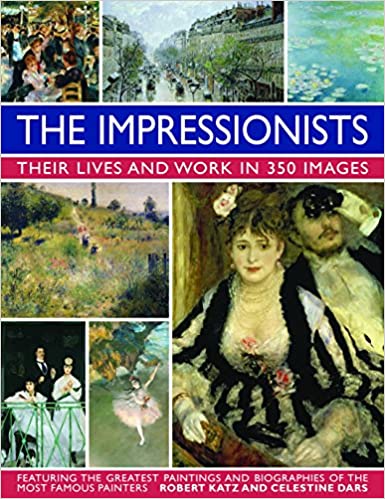
‘The Impressionist’ brings form and substance to the lives of six of the greatest artists of the genre: Pissarro, Manet, Degas, Monet, Renoir, and Sisley, who gave birth to something new.




 elsToday