Love, Class, and Money

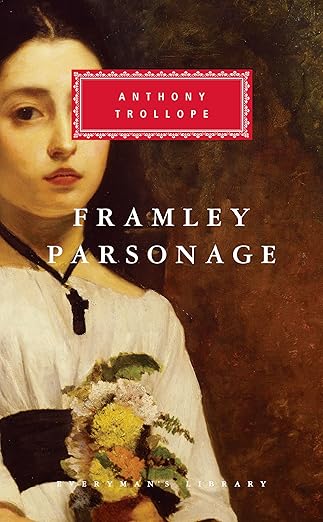
Framley Parsonage, by the Victorian author Anthony Trollope, is the fourth novel in the six-part Chronicles of Barsetshire series. This series is set in the fictional county of Barsetshire in the English countryside and details the social entwinings of the gentry, rich mercantile classes, clergy, and occasionally what we would today refer to as the comfortable middle class. The novels, which can be read in any order, revolve around themes of maintaining social status, finding love, marrying well, and money. Hypocrisy, chicanery, and snobbish attitudes often create dilemmas that Trollope, in a winding but satisfying narrative fashion, concludes as the reader wishes.

Framley Parsonage specifically details the misadventures of the amiable but horribly naive vicar, Mark Robarts, who is a boyhood friend of Lord Ludovic Lufton. Through this friendship, Ludovic’s mother, Lady Lufton, installs Robarts in the Framley Parsonage with a sufficient salary to support his young family’s basic needs. Through a misplaced sense of ambition, Robarts attempts to further his standing in life by associating with a parliament member, charlatan, and aptly named Mr. Sowerby, bringing humiliation and disgrace upon himself.

Trollope displays an absolute sense of enjoyment in writing this novel, skewering the political class with an abundance of wit and satire, along with exploring four marriage sub-plots that he resolves with appropriately deserved denouements of happiness or the lack thereof.

Source and Graphic: Framley Parsonage by Anthony Trollope, Publisher Everyman’s Library, 1994.

No One Shall Sleep

Nessun Dorma,” (No One Shall Sleep) an aria by Giacomo Puccini from the final act of his opera Turandot, is performed by an enigmatic tenor prince who seeks the hand of Princess Turandot. The Princess decrees that any suitor must solve three riddles to win her consent for marriage. The unknown prince answers all the riddles correctly, but the Princess still defers. He then proposes a counteroffer: if she can guess his name, she can have him executed, but if she cannot, she must marry him. In response, the Princess commands that none of her subjects shall sleep until they uncover his name.

Puccini’s opera, left incomplete at his death in 1924, offers a unique interpretation of Carlo Gozzi’s 18th-century play of the same name, which, in turn, drew inspiration from a 12th-century Persian fairy tale by Nizami as part of his poem collection titled Haft Peykar. In the fairy tale, a princess sets impossible riddles for her suitors.

Puccini retains three riddles from Nizami’s tale but alters the third one:

  1. What is born each night and dies each dawn? (hope)
  2. What flickers red and warm like a flame, but is not a flame? (blood)
  3. What is like ice but burns? (Princess Turandot)

(Nizami’s original 3rd riddle: What echoes with countless voices, yet has no voice of its own? (a letter))

Source: Grove Book of Operas edited by Stanley Sadie, 2006. Wikipedia. Graphic: Nessun Dorma by Pavarotti, 2023 copyright Warner Classics.

Cupid and Psyche

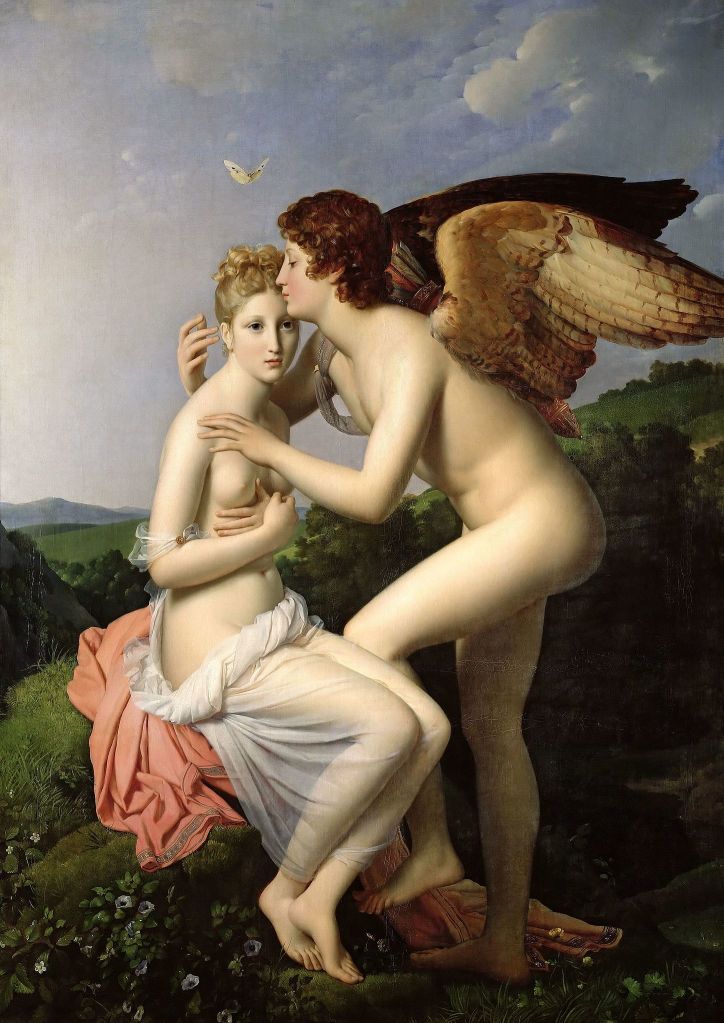
Cupid and Psyche is the timeless tale of love’s conquering power, overcoming all obstacles in its path. It symbolizes the union of the soul with desire, transcending to a love that goes beyond the physical and the mortal.

The only extant writings of Cupid and Psyche is known from Apuleius’s romance “The Golden Ass,” composed in the 2nd century AD. The tale is likely to have been known as early as the 4th century BC, and Cupid is known as far back as the 8th century BC from Hesiod’s “Theogony.”

In the myth of Cupid and Psyche, with Cupid’s mother Venus as the antagonist, the characters metaphorically act out various emotions and experiences, both mortal and immortal.

Psyche,a mortal more beautiful than the goddess Venus, represents the soul (in Greek, Psyche means soul) and its journey from the tragedy of human life to the transformative power of love for everlasting spiritual fulfillment.

Cupid, tasked by his mother Venus to destroy Psyche for possessing beauty beyond that of a mortal, instead falls in love with her. Cupid embodies love and desire, and the emotional power and unpredictability that it brings to a relationship.

Venus, the goddess of love and beauty, represents jealousy and the obstacles that Psyche battles to realize the completion of her quest for emotional and spiritual fulfillment. Her trials for Psyche reflect the ever-present barriers to true love.

Cupid and Psyche is a story of transcendent transformation over the physical to the triumph of love and the immortality of the soul.

Trivia: In the painting by Gerard, the butterfly floating above Psyche’s head represents, rather redundantly, the soul.

Source: The Golden Ass by Apuleius. The Evolution of Cupid, Erlang Shen, Fatelines, 2022. Graphic: Cupid and Psyche by Francois Gerard, 1798, The Louvre, Public Domain.

Sticks His Nose In

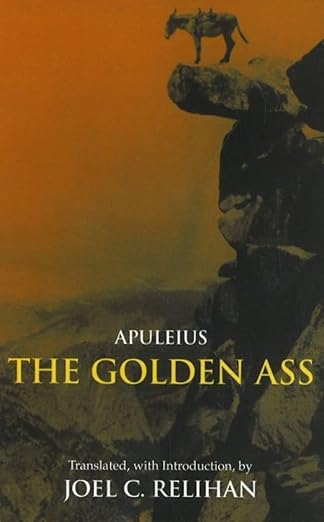
Lucius, the protagonist of the 2nd century AD Latin novel The Golden Ass, cannot suppress his curiosity nor stop meddling in the dark arts of spells and magic. Attempting to flee from the troubles resulting from his inquisitiveness, he accidentally uses the wrong ointment and turns himself into a donkey rather than a bird. This error leads to a series of comical and mostly bawdy misadventures as a beast of burden, who is thoroughly abused and misused due to his intemperate habit of sticking his nose in.

The story, written by the Roman author and philosopher Lucius Apuleius, who hailed from a Roman province in what is now modern-day Algeria, is characterized as a romance—not in the modern Harlequin sense, but in the Greek meaning of a Milesian tale. A Milesian tale consists of a series of adventurous stories, usually short, humorous, and erotic—a romantic narrative for the ancients.

The translator of The Golden Ass, Joel C. Relihan, takes the meaning of a Milesian romance a step further into what Northrop Frye described as secular scripture. Relihan states that the romance in The Golden Ass is: “A survivor’s tale of descent into a nightmare world of loss and eventual recovery of identity.”

Lucius loses his identity, becoming ludicrous and expendable. But in the end, he prays for salvation, which he receives from the goddess Isis. Ultimately, he is initiated into the secrets of the gods. His transformation from misfortune to enlightenment and spiritual fulfillment is, in the end, the ultimate story of a lived life—a maturing into old age with illuminated and learned experience leading to peace and grace.

Trivia: The Golden Ass has been known by various names, including the author’s title, Metamorphoses, Asinus Aureus (a Latin name which translates to “Golden Ass”), The Metamorphosis of Lucius, and the modern title: The Golden Ass or A Book of Changes.

Source: The Golden Ass by Apuleius. Oxford Bibliographies. Graphic: The Golden Ass Book Cover, Hackett Publishing, 2007.

Love and Happiness

The opening line to Tolstoy’s “Anna Karenina”, “All happy families are alike; each unhappy family is unhappy in its own way,” is frequently misunderstood to mean that all unhappy families are sadly similar in that negative dynamics are always present.

What Tolstoy and the original French proverb convey is that unhappy families suffer from unique dysfunctions, such as violence, substance abuse, or incest, while happy families have avoided these destructive traits.

In statistics, this concept is known as the ‘Anna Karenina Principle‘. It states that for an endeavor to be successful, every possible deficiency must be avoided, whereas for it to be unsuccessful, only one negative factor needs to be present.

A similar proverb from 16th or 17th-century Europe, “One bad apple spoils the whole barrel,” began as practical advice to apple farmers and evolved to describe how one negative influence can affect an entire group or family.

Russian authors like Tolstoy and Dostoevsky tend not to write about happy families because, in their view, there is no story, no moral, and no psychological depth without pain and suffering.

English author W. Somerset Maugham brought this idea back into the limelight with a twist when he wrote: “They say that happy people have no history, and certainly a happy love has none. They did nothing all day long and yet the days seemed all too short.”

There is no shame in happiness; life does not need drama or conflict to be meaningful.

Source: Anna Karenina by Tolstoy. Rain and Other South Sea Stories by W. S. Maugham. Graphic: Apple by Tembhekar. Public Domain.

Break Their Hearts

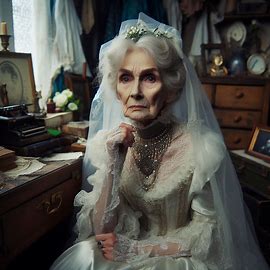
The spinster Miss Havisham (have-a-shame) in Dickens’, Great Expectations, is rejected at the altar, spending her remaining days alone in a decaying mansion wearing her wedding dress. She exists only to hate with a future reserved only for vengeance.

She adopts a girl, Estella, and raises her to emotionally cripple all interested men that may approach.  Miss Havisham whispers her prime dictate into Estella’s ear as the young lady entertains her hopeless – helpless suitor, Pip, ‘Break their hearts, my pride and hope, break their hearts and have no mercy!’

Trivia: Miss Havisham states to Pip towards the end of the book: ‘Ask me no questions and I’ll tell you no lies.’ This line is attributed to Irish playwright, Oliver Goldsmith who used it in his delightful 1773 play She Stoops to Conquer.

Source: Great Expectations by Charles Dickens, 1861. Graphic: Miss Havisham, AI generated.

String a Bow and Thread 12 Axe Rings

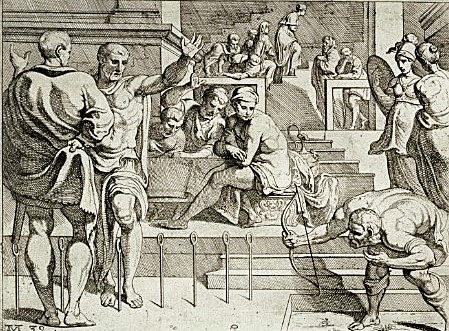
Ulysses upon leaving Troy traveled for 10 years before returning home to his wife Penelope only to find she doesn’t recognize him, and he has a house filled with suitors seeking his wife’s hand in marriage.

To prove he is the rightful husband and king he shoots an arrow through the rings of 12 axe heads. Upon completing the quest, he kills all suitors for his wife’s hand.

An Excerpt from Book 21 of Homer’s Odyssey:

So the great master drew the mighty bow,
And drew with ease. One hand aloft display’d
The bending horns, and one the string essay’d.
From his essaying hand the string, let fly,
Twang’d short and sharp like the shrill swallow’s cry.
A general horror ran through all the race,
Sunk was each heart, and pale was every face,
Signs from above ensued: the unfolding sky
In lightning burst; Jove thunder’d from on high.
Fired at the call of heaven’s almighty Lord,
He snatch’d the shaft that glitter’d on the board
(Fast by, the rest lay sleeping in the sheath,
But soon to fly the messengers of death).

Now sitting as he was, the cord he drew,
Through every ringlet levelling his view:
Then notch’d the shaft, released, and gave it wing;
The whizzing arrow vanished from the string,
Sung on direct, and threaded every ring.

Source: Bulfinch’s’ Mythology, 1867. Odyssey by Homer. Graphic: Ulysses by Theodore van Thulden, 1632, Public Domain.

Dog Days of Summer

Now came the dog days—day after day of hot, still summer, when for hours at a time light seemed the only thing that moved…’ A narrative of peace from Richard Adams’ 1972 novel: ‘Watership Down’ during the interval when Hazel and his fellow rabbits were settling into their new home.

Some Greeks believed that the dog days of summer began when the Dog Star Sirius, thus the name, popped into the night sky on the 19th of July each year. Homer grimly stated that the appearance of the star ‘brought evil portent, …heat and fevers.’

The Old Farmer’s Almanac places the dog days from 3 July through August 11. Others put them from 23 July through 23 August.

Source: Watership Down by Richard Adams, 1972. Iliad by Homer. The Old Farmer’s Almanac. Graphic: Dog Days, AI generated, 2024.

The Divine Comedy:

William Blake (1757-1827), in the final years of his life created 102 watercolors and 7 copper plates, most unfinished, for Dante’s ‘The Divine Comedy’. One of the more profound and captivating of these paintings is ‘Antaeus Setting Virgil and Dante into the Ninth Circle of Hell’.

The giant Antaeus, son of Neptune and Gaia, was invincible as long as he remained attached to his mother. Hercules, for his 11th task, had to defeat Antaeus but couldn’t if he touched the Earth, so he lifted him off the ground and strangled him to death.

The Ninth Circle is reserved for the treacherous and is subdivided into 4 rings. The first part is reserved for familial traitors and is named Caina as in Cain and Abel. The second ring, Antenora for Antenora of Troy is for national traitors. Ptolomaea for Ptolemy is the third ring for those who betray their guests. Finally, the inner ring is called Judecca for Judas Iscariot betrayer of Christ and is for the worst traitors: those who turn on their masters. At the center of the Ninth Circle resides Satan.

Finally, as an aside, Dante’s ‘The Divine Comedy’ shouldn’t be interpreted as The Divine Humor, but as The Divine Outcome. The author meant that comedy was the opposite of tragedy. Tragedies begin well and end badly, but Dante’s Comedy begins badly, in Hell, and ends well with Dante reaching his desired destination: Heaven.

Source: Will Blake, The Divine Comedy by David Bindman, 2000. The Divine Comedy by Dante Alighieri, circa 1321. Bulfinch’s Mythology, 1867. Graphic: Antaeus Setting Down Dante and Virgil in the Last Circle of Hell, Blake, 1827, Public Domain.

Dracula Lives

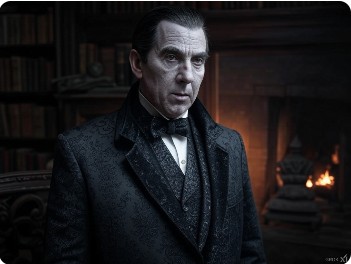
Irish author Bram Stoker wrote the quintessential horror story, Dracula during the early to mid-1890s, publishing it in 1897–except Stoker didn’t write it “as fiction but as a warning of a very real evil” according to J.D. Barker’s history of the book.

Many events in the book were not fiction. The ship Dmitri (Demeter in the book) did run aground in Whitby Harbor, and it was carrying crates of dirt that had originated from the European port of Varna. Mr. and Mrs. Jonathan Harker and Dr. Seward were friends of Stoker who supposedly supplied first person accounts of the tale to the author.

Stoker’s publisher, finding the book too frightening for the public, only agreed to publish the book if the first 101 pages were left out along with extensive revisions to the story which took a very clear story of vampires in our mist to one of fictional horror. In the 1980s the original manuscript showed up in rural Pennsylvania with the first 101 pages still missing and was purchased by Paul Allen of Microsoft fame.

Source: Dracula by Bram Stoker. J.D. Barker, Bram Stocker published by Time.com. Graphic: Bram Stoker, circa 1906, Public Domain.