Dying Young

The Curious Case of Benjamin Button (Theaters – December 2008; Streaming – May 2009) M Button 2008Rated: PG  —  Runtime: 166 minutes

Genre: Drama – Fantasy – Mystery – Romance – Suspense

els – 7.5/10

IMDB – 7.8/10

Amazon – 4.6/5 stars

Rotten Tomatoes Critics – 7.1/10

Rotten Tomatoes Audience – 3.7/5

Metacritic Metascore – 70/100

Metacritic User Score – 7.3/10

Awards:  3 Academy Awards – Nominated for 13

Director:  David Fincher

Written by:  Eric Roth (story and screenplay), Robin Swicord (story), F. Scott Fitzgerald (story)

Music by:  Alexandre Desplat

Cast:  Brad Pitt, Cate Blanchett, Julia Ormond

Film Locations:  Cambodia; Montreal, Canada; India; Burbank, Los Angeles, California – Donaldsonville, Laplace, Mandeville, Morgan City, New Orleans, Louisiana, US; St. Thomas, US Virgin Island

Budget:  $167,000,000

Worldwide Take:  $379,000,000

Mr. Gateau, the best clockmaker in all of the southern US, is commissioned to build a clock for a new train station set to open in 1918. When the clock is unveiled, it is running backwards. Mr. Gateau, who lost a son to the recent war, affirms that it is running as designed; to  grant those lost to the war a way back to life and the living.  On 11 November 1918, Armistice Day, Benjamin Button (Brad Pitt) is born, wrinkled and worn, losing his mother to his birth and his father, abandoning him on the porch of an orphanage. Benjamin is a consistent contradiction, experiencing life in a counter-clockwise direction.

The Curious Case of Benjamin Button took 20 years, 7 potential directors prior to Fincher, 3 lead actors before Pitt, 3 different possible producers, and 2 production companies to finally deliver a product for the viewing public to consume. David Fincher brings his visual effect expertise to the forefront, as he usually does, with this enchanted story of love and time. He balances the CGI with a spellbinding collage of romance and courage that moves beyond the flesh. The visual effects are absolutely stunning, keeping this fantasy real and believable.  Fincher was likely the only director that could make this movie and keep the audience interested.

Brad Pitt contributes a somewhat predictable performance, detached but lovable, low-key and restrained, letting his body language provide the message, more so than his dialogue. It works and adds to the mystic of the film but it’s Cate Blanchett’s Daisy that draws you into this movie.  Daisy is a very complex character and Blanchett handles it with grace, charm, and a natural style that holds you in a delightful, enamored state of wonder throughout the film. Sad that she wasn’t even nominated for her more than deserving efforts by the Academy or the Golden Globes.

Benjamin Button is beautifully made, telling a story of true love that outstrips the concepts of time.


Shrew Taming

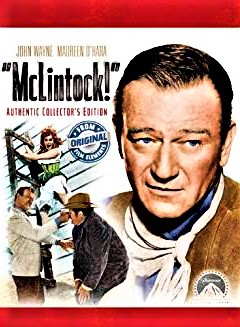
McLintock!  M McLIntock 1963

Theaters:  November 1963

Streaming: July 1997

Rated: NR

Runtime: 127 minutes

Genre: Comedy – Romance – Western

els:  6.0/10

IMDB:  7.3/10

Amazon:  4.5/5 stars

Rotten Tomatoes Critics:  5.1/10

Rotten Tomatoes Audience:  3.9/5

Metacritic Metascore:  NA/100

Metacritic User Score:  NA/10

Awards: NA

Directed by: Andrew V. McLaglen

Written by: James Edward Grant

Music by: Frank De Vol

Cast: John Wayne, Maureen O’Hara

Film Locations: Fairbank – Chiricahua National Monument – Duquesne – Harshaw – Klondyke – Las Cienegas National Conservation Area – Lochiel – Nogales – Patagonia – Ruby – San Raphael Valley – San Xavier – Sonoita – Sonoran Desert – Tucson, Arizona, USA

Budget: $4,000,000

Worldwide Box Office: $14,500,000

Katherine Gilhooley McLintock (Maureen O’Hara) after a 2 year absence returns to her husband, G.W. McLintock (John Wayne) and their ranch outside of the western town of the eponymous McLintock to ask for a divorce, custody of their teenage daughter, and alimony. G.W., still confused about why she left in the first place, just says no to all and proceeds to woo Katherine back to his arms and their ranch.  While G.W. deals with his recalcitrant wife he also faces challenges from dirt farmers trying to farm the unfarmable high plateau, Indians resisting resettlement to the reservation, along with the worthy and not so worthy suitors pursuing the affections of Becky (Stefanie Powers), his daughter. All matters proceed in a slapdash but charming facetiousness.

This movie is all John Wayne. He chose the director, Andrew V. McLaglen, herded the script through completion with scriptwriter, James Edward Grant, had his son Michael produce the movie, and another son, Patrick star in the slightly incestuous role of  a cow-hand courting his movie daughter Becky. The film also marks the beginning of Wayne letting the world know his views on everything from politics to education within the confines of this and his subsequent movies.

The movie reunites John Wayne with his frequent co-star Maureen O’Hara. These two worked together in 4 other movies including the 1950 Rio Grande, the 1952 The Quiet Man, the 1957 The Wings of Eagles, and the 1971 Big Jake. The two had a special working relationship, each able to abide the other’s head strong tendencies, and both could act their parts, from the common “man” to the polish and charm of the upper crust. Their onscreen affection for each other always came through as honest and real, not only a credit to their abilities as actors but also their deportment as a true lady and a true gentleman, all in an age gone by.

A legitimate classic movie with hints of Shakespeare’s comedy, The Taming of the Shrew, the moral education of Father Knows Best, and the real-life tragedy known as the Trail of Tears. John Wayne taming Maureen O’Hara, John Wayne educating his family and friends, John Wayne attempting to reconcile the law with the Indians’ pride and heritage.  John Wayne shows a humorous side in this movie but he is still the big man on the set.

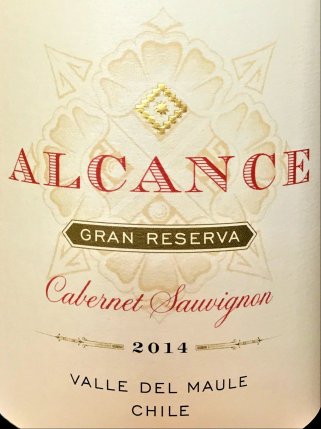
Alcance Gran Reserva Cabernet Sauvignon 2014

W Alcance 2014Cabernet Sauvignon from Maule Valley, Central Valley, Chile
100% cabernet sauvignon

14.5% alcohol

Purchased: 6 March 2017 – $19.99

Opened: 28 Feb 2018

els: 9.0/10

Wine and Spirits: 94

James Suckling: 90

Cellar Tracker: 90

Wine Enthusiast: 87

Maule Valley, the largest wine-producing region in Chile and the southern-most region in Chile’s Central Valley, is tucked in-between the Andes and the Coastal Ranges. The region is named after the east to west flowing Maule River with its headwaters in the western slopes of the Andes Mountains and emptying 50-60 miles downstream into the Pacific Ocean near the small, impoverished city of Constitucion. Due to the Valley’s more southern location in the Central Valley it has cooler temperatures than its northern counterparts but because the Coastal Range’s have lower elevations here the rain shadow is also reduced resulting in more rainfall than up north, particularly in the winter.

The region’s wine history dates back to the mid-1800s when successful Chilean businessmen brought back pre-Phylloxera European vine cuttings to grow in the Valley’s igneous and alluvial soils, primarily along the Maule River. Initially the region grew predominately Pais grapes, generally used for bulk wine sales and table wines but in the recent past most of those vineyards have been replaced with better known selections such as Cabernet Sauvignon, a grape that now accounts for half the 75,000 vine acres planted in the Maule Valley.

Cabernet Sauvignon is a cross, believed to have occurred naturally sometime in the 1600s in southwestern France, between Cabernet Franc and Sauvignon Blanc grapes. It is now the most widely planted grape in the world. Chile is second only to France in the number of acres planted world-wide in this grape. It is a thick-skinned grape that’s relatively easy to grow and maintain, exhibiting high tannins and acidity, producing a distinct bell pepper flavor, especially in cool climates, along with aromas of mint and eucalyptus. The grapes produce a full-bodied and dark-ruby colored wine.

The Alcance winery, founded in 1993, is a Jackson Family enterprise that was instrumental in improving the entire winemaking industry in the Maule Valley.  The family introduced modern techniques to the Valley, through the Alcance winery, and the rest, as they say, is history. The winery started with the lower elevation San Francisco Estate vineyards in the southwestern portion of the Valley. The vines enjoy the cool Pacific winds blowing over their canopy with their roots tapped into soils clogged with large quartz crystals. The growing season temperatures for the San Francisco vineyards ranges from 60-80ºF with rainfall 0.25-1.00″ per month. In 1999 the Jackson Family added the El Maiten Estate winery and vineyards in the southeastern Maule Valley to their Chilean holdings.  The El Maiten vineyards are located in the Andes foothills along the Lircay River, a tributary of the Maule River. The vines grow in a loamy soil containing numerous pebbles and cobbles. The growing season temperatures for the El Maiten area ranges from 60-85ºF with rainfall 0.25-0.75″ per month. Both vineyards total about 200 acres planted in 10 to 20-year-old vines.  The winery produces 5 wines under its Alcance label: Cabernet Sauvignon, Carmenere, Merlot, VIGNO (an old vine Carignan), and Bravura, their celebrated Bordeaux blend.

This wine is produced from a rough 50-50 mix of grapes from both vineyards. The Cabernet Sauvignon vines were 10 to 11-years old for this 2014 vintage. After the grapes are hand harvested, they are hand sorted, cold macerated for 6 days, and fermented in small stainless steel tanks for 20-22 days. Malolactic fermentation is done in French oak barrels for 18 months with 3 intervening racks.

A clear ruby-red wine with a tawny rim. Aromas of cherries and raisins with an oak supplied vanilla in the background. Full-bodied and balanced with a very pleasant, long finish.

Enjoy with a traditional South American stew: Charquican. You will need a pound of cubed beef (cheap to expensive; your choice), a tablespoon of flour, quarter stick of butter, 2 cups of beef stock, a big chopped onion, a teaspoon or two of minced garlic, 2 tablespoons of oil, 1-3 teaspoons of chili peppers finely minced (less or more depending on how spicy you want the stew), 1 cup corn, 1 cup carrots sliced, 2 cups diced potatoes, salt and pepper. Coat the cubes of beef with the flour. Season with salt and pepper. Add to skillet over medium-high heat along with the melted butter. Cook beef until brown. Add the beef stock and simmer for 10 minutes. Transfer the contents of the skillet to a slow cooker.  With the remains of the beef and the beef stock in the skillet add the oil, onion, garlic, chili pepper and cook until the onions are soft. Add the remaining vegetables except the corn to skillet and cook for 5 minutes more. Add the skillet contents to the slow cooker and cook for 6-8 hours. Add in the corn about an hour before serving. Serve over rice.  Delicious. I made this from a modified recipe I found on The Spruce but I left out the squash, beans, and beef jerky; otherwise it was exactly the same:)

An outstanding wine at a fair price. Drink now, but should last until 2023-2025. Decant and aerate for one hour, or more, before drinking.

$15.19-31.49  wine-searcher.com

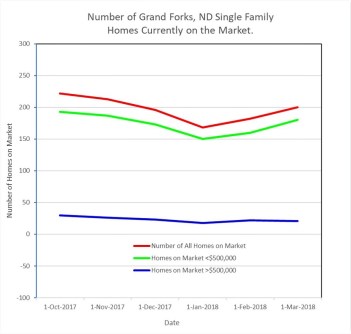
Grand Forks, ND Housing Market: February 2018

RE No March 2018Trends from the previous month:

1) Number of  homes on the market continues to increase except for the high-end market which is experiencing a small long-term decrease.

2) Median price per square foot is essentially flat to slightly decreasing for all price points.

3) Median days on the market continues to decrease for all price points.

4) Median home prices continue to increase.

Data is for single family, single lot homes.  Does not include apartments, condos, mobile homes, townhouses,  twin homes, etc.

RE All March 2018.jpgRE 499 March 2018.jpgRE 500 March 2018.jpg

Top 100 Albums: Average Score

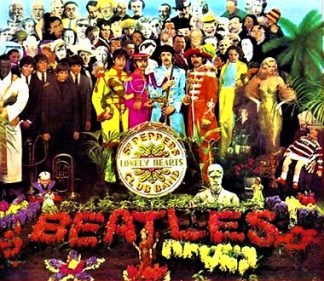
MU Sgt Pepper's 1967A few weeks ago I published a list of Top 100 Albums of all time based on the summed score of all the polls they were listed on. The list was compiled from 88 Top 100 album polls (actually some polls ranked up to a 1000 Albums) from the major aggregators such as: Rolling Stone, New Music Express, Entertainment Weekly and many others. I’ve also included the RIAA top 100 albums by sales for 2012 and 2017. No special reason for the years I chose. The Grammy’s Best Albums of the Year are also included, starting with Henry Mancini’s 1959 album, Music from Peter Gunn, all the way through 2018 with Bruno Mars’ 2016 album, 24K Magic. The polls range in time from 1974 to 2017, with the just stated exception of the Grammys. Every album was assigned a score based on its ranking in the various polls. An album that was ranked number 1 in a particular poll was given a score of 100. An album ranked at 100 was given a score of 1.  The album’s scores from all the polls were then summed.  The album with the greatest sum was ranked as the number 1 album.  The next highest sum was ranked number 2, and so on. The list I posted on 1 February 2018 had The Beatles’ Sgt. Peppers album as 1. It was included in 83 polls with a summed score of 7333.

MU The Night 2008Obviously the more polls an album is listed on, the more likely they will make a list based on its summed score.  To counter this effect I have published below a list based on an album’s average score in the various polls. This was accomplished simply by taking the summed score and dividing it by the number of polls an album is listed on. No surprise, but Sgt. Pepper is still the number one album of all time. It has an average score of 88 (7333 divided by 83) and an average rank of 13.  Some of the exceptions, and there are many, are additions to the list that scored high in individual polls but not in enough polls to get them into the previous list of sums, either because they are too recent or they have fallen out of favor through the years. One example is the fairly recent Kings of Leon’s 2008 album; Only by the Night. It is only listed on 10 polls but scores high on all ten so it shows up in the average list but not the sum list. In a later post I will list the all differences between the sum and average lists.
Now for what it’s worth, agree or disagree, my list:

                  Rank    —    Artist    —    Album     —    Year

1      Beatles  —  The Sergeant Pepper’s Lonely Hearts Club Band  —  1967
2      Beatles  —  Revolver  —  1966
3      Nirvana —  Nevermind —  1991
4      Pink Floyd —  The Dark Side of the Moon —  1973
5      Beatles  —  The White Album  —  1968
6      Bob Dylan  —  Highway 61 Revisited  —  1965
7      Bob Dylan  —  Blonde on Blonde  —  1966
8      Beach Boys  —  The Pet Sounds  —  1966
9      Beatles  —  Abbey Road  —  1969
10    Elvis Presley  —  The Sun Sessions  —  1976
11    Radiohead  —  OK Computer  —  1997
12    U2  —  The Joshua Tree  —  1987
13    Miles Davis  —  Kind of Blue  —  1959
14    Jimi Hendrix  —  Are You Experienced  —  1967
15    Coldplay  —  X and Y  —  2005
16    Sex Pistols  —  Never Mind the Bollocks  —  1977
17    Beatles  —  Rubber Soul  —  1965
18    Muse  —  Origin of Symmetry  —  2001
19    Van Morrison  —  Astral Weeks  —  1968
20    Michael Jackson  —  Thriller  —  1982
21    Pearl Jam  —  Ten  —  1991
22    Rolling Stones  —  Exile on Main Street  —  1972
23    Velvet Underground  —  The Velvet Underground plus Nico  —  1967
24    Clash  —  London Calling  —  1979
25    Stone Roses  — The Stone Roses  —  1989
26    Paul McCartney  —  Band on the Run  —  1973
27    R.E.M.  — Automatic for the People  —  1992
28    Fleetwood Mac  —  Rumours  —  1977
29    Rolling Stones  —  The Let it Bleed  —  1969
30    Bob Dylan  —  Blood on the Tracks  —  1975
31    Live  —  Throwing Copper  —  1994
32    Bruce Springsteen  —  Born to Run  —  1975
33    Radiohead  —  The Bends  —  1995
34    David Bowie  —  The Rise and Fall of Ziggy Stardust  —  1972
35    Tool  —  Aenima  —  1996
36    Kings of Leon  —  Only by the Night  —  2008
37    Television  —  Marquee Moon  —  1977
38    Love  —  Forever Changes  —  1967
39    Queens of the Stone Age  —  Songs for the Deaf  —  2002
40    Who  —  Who’s Next  —  1971
41    Metallica  —  Metallica Black Album  —  1991
42    Marvin Gaye  —  What’s Going On  —  1971
43    Primal Scream  —  Screamadelica  —  1991
44    Joni Mitchell  —  Blue  —  1971
45    Smiths  —  The Queen is Dead  —  1986
46    Arctic Monkeys  —  Whatever People Say I Am That’s What I’m Not  —  2006
47    Band  —  The Band  —  1969
48    Boston  —  Boston  —  1976
49    Supertramp  —  Breakfast in America  —  1979
50    James Brown  —  Live at The Apollo  —  1963
51    Alanis Morissette  —  Jagged Little Pill  —  1995
52    Led Zeppelin  —  IV  —  1971
53    Meat Loaf  —  Bat Out of Hell  —  1977
54    Van Halen  —  Van Halen  —  1978
55    Adele  —  21  —  2011
56    Pink Floyd  —  The Wall  —  1979
57    Smashing Pumpkins  —  Siamese Dream  —  1993
58    David Bowie  —  Hunky Dory  —  1971
59    Patti Smith  —  Horses  —  1975
60    Public Enemy  —  It Takes a Nation of Millions to Hold Us Back  —  1988
61    Guns N’ Roses  —  Appetite for Destruction  —  1987
62    Oasis  —  Morning Glory  —  1995
63    Prince  —  Purple Rain  —  1984
64    Rolling Stones  —  Sticky Fingers  —  1971
65    Prodigy  —  The Fat of the Land  —  1997
66    Michael Jackson  —  Bad  —  1987
67    Rolling Stones  —  Beggars’ Banquet  —  1968
68    Blur  —  Parklife  —  1994
69    Clash  —  The Clash  —  1977
70    Stevie Wonder  —  Innervisions  —  1973
71    Bruce Springsteen  —  Born in The U.S.A.  —  1984
72    John Lennon  —  Plastic Ono Band  —  1970
73    Oasis  —  Definitely Maybe  —  1994
74    Dire Straits  —  Brothers in Arms  —  1985
75    U2  —  The Unforgettable Fire  — 1984
76    Pink Floyd  —  Wish You Were Here  — 1975
77    Portishead  —  Dummy  —  1994
78    Derek and The Dominos  —  Layla and Other Assorted Love Songs  —  1970
79    Jimi Hendrix  —  Electric Ladyland  —  1968
80    Red Hot Chili Peppers  —  Californication  —  1999
81    Bob Marley and The Wailers  —  Legend  —  1984
82    Mike Oldfield  —  Tubular Bells  —  1973
83    Keane  —  Hopes and Fears  —  2004
84    Joy Division  —  Unknown Pleasures  —  1979
85    Queen  —  Innuendo  —  1991
86    Bruce Springsteen  —  Darkness on the Edge of Town  —  1978
87    Ramones  —  Ramones  —  1976
88    Doors  —  The Doors  —  1967
89    Eagles  —  Hotel California  —  1976
90    Moody Blues  —  The Days of Future Past  —  1967
91    Led Zeppelin  —  Led Zeppelin  —  1969
92    Simon and Garfunkel  —  Bridge Over Troubled Water  —  1970
93    My Bloody Valentine  —  Loveless  —  1991
94    Carole King  —  Tapestry  —  1971
95    Captain Beefheart  —  Trout Mask Replica  —  1969
96    U2 —  Achtung Baby  —  1991
97    AC/DC  —  Back in Black  —  1980
98    Paul Simon  —  Graceland  —  1986
99    Steely Dan  —  Aja  —  1977
100  Bruce Springsteen  —  The River  —  1980

Obsession and Reality

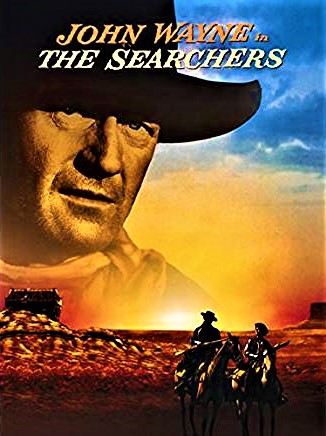
The Searchers (Theaters-March 1956; Streaming-May 1999) Rated: PG  —  Runtime: 119 M Searchers 1956minutes

Genre: Adventure-Drama-Western

els – 8.0/10

IMDB – 8.0/10

Amazon – 4.0/5 stars

Rotten Tomatoes Critics – 8.9/10

Rotten Tomatoes Audience – 4.0/5

Metacritic Metascore – NA/100

Metacritic User Score – NA/10

Awards: 1 Golden Globe

Directed by: John Ford

Written by: Frank S. Nugent (screenplay), Alan Le May (book)

Music by: Max Steiner

Cast: John Wayne, Jeffrey Hunter, Vera Miles, Ward Bond, Natalie Wood

Film Locations: Edmonton, Alberta, Canada: Kayenta – Mexican Water – Monument Valley – Red Mesa – Teec Nos Pos, Arizona; Los Angeles – Culver City, CA; Aspen – Gunnison, Colorado; Goosenecks State Park – Mexican Hat, Utah; USA

Budget: $3,750,000

Worldwide Box Office: $NA (commercial success)

As Martha Edwards (Dorothy Jordan) looks out of her home onto a stretch of Texas scrub and hills, the camera, inside the house, framing her in the door from behind, watches as her long absent brother-in-law, Ethan Edwards (John Wayne) slowly rides on his pony towards the ranch house. Ethan is coming home to his brother’s ranch in 1868, returning after 8 years of war; first as a confederate in the US Civil War and then as a mercenary in the Mexican Revolutionary War. He’s tired and wanting, needing, some peace in his life and to be once again near his secret love, Martha, his brother’s wife. With one night’s rest, Ethan and the rest of the Edward’s family are informed by a company of Texas Rangers that a Comanche raiding party has run off with a neighbor’s cattle. The Rangers, plus Ethan, go after the Indians to retrieve the cows. They soon realize that the theft was a ruse, to draw off the Rangers, with the real crime occurring back at the Edwards’ ranch.  Returning to the ranch they find the buildings burning, Ethan’s brother, wife and son dead, and their 2 young daughters missing, taken by the Comanche for wives and ransom. Ethan, his nephew Martin (Jeffery Hunter), and the Rangers, again set out to find the Indians and retrieve the girls.  Thus begins a five-year odyssey, searching for lost relations but knowing the girls innocence and maybe their lives are lost forever in the Texas hills of sand and scrub.

John Ford created, along with John Wayne, a movie that has transcended its time and its genre to become one of the greatest films ever made. His western landscapes of splendor and greatness have inspired directors ever since. The red sands and blue sky panoramas, the geometries of lines and curves are beyond human capacity to measure; we can only hold our breath and treasure the vision. Ford tells a somber story of a different time, an earlier time when the Comanche were terrorists, a time when the settlers were conquerors. He tells the story with little mercy; raw in emotion, yet, with a large dose of hope.  Roger Ebert believes Ford, in making this movie, was apologizing for the white settlers racism and ethnic cleansing. I believe John Ford knew his history and presented it as it was, maybe unpleasant, but real; not racism: living. The Comanche were battling for their home, their freedom, and in the end, their existence by any means possible, and those possibilities were brutal and savage.  The white settlers for battling for a new beginning, their freedom, their families, their future; and their methods were brutal and savage.

Ethan Edwards was likely John Wayne’s greatest challenge as an actor. A part that wasn’t in his “good guy, tough guy” repertoire. A part where he’s a grim and dark loner, an outcast that has lived too much of his life on the losing side. A part where he still believes in himself, exemplified by the classic line, “That’ll be the day.”, but were time has passed him by and he struggles to find himself; trying to feed an obsession that exists in the past while the world has moved on.  He’s the toughest guy, capable of making the toughest choices but very slowly gaining an appreciation for nuance, for the shades of gray in his black and white world, a world that is constantly testing his beliefs. John Wayne rises to this challenge and produces a character in all the dimensions of good, bad, and yes, ugly, that usually don’t materialize in him or his movies.

In the final scene, the camera focuses on the outdoors from the inside of a house, a door with its straight lines, framing the ill lit inside against the bright outside.  John Wayne, with his back to the camera, steps outside, pauses, and then starts walking away. Wayne as Ethan Edwards, always on the outside but maybe, in the end the stark outline of his shadow is gentler, softer, more at peace with his soul.

This movie is a classic and most likely the greatest Western ever made. Interestingly it keeps rising up the ranking lists with the passing of time, as it should. This is a movie to judge as it was, a chronicle of the past, not an apology, and certainly not a testament to our present.

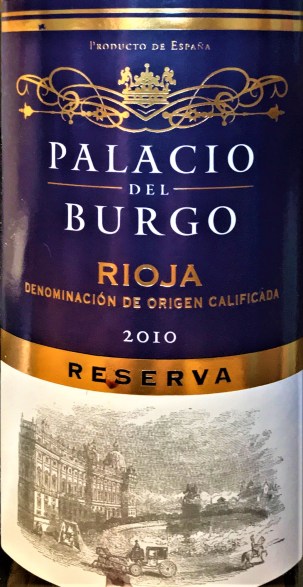
Burgo Viejo Palacio del Burgo Rioja Reserva 2010

W Burgo 2010Red Blend from Alfaro, Rioja Baja, La Rioja, Rioja, Spain

90% tempranillo

10% graciano

13.5% alcohol

Purchased: 12 July 2017 – $18.99

Opened: 20 Feb 2018

els: 9.0/10

Wine Spectator: 93

Stephan Tanzer: 90

Cellar Tracker: 90

Wine and Spirits: 90

Wine Enthusiast: 89

La Rioja, likely the most recognizable, if not the most famous wine region in all of Spain, is located 55-95 miles south of the Spanish-Atlantic coastline in the Ebro River valley, sandwiched between the Pyrenees and Cantabrian Mountains to the north and the Iberian Mountains to the southwest. The history of this area travels back to the time of the Phoenicians, followed by the Romans then the Christian Monks, all intent on producing ever better wines.  Then the French came and the rest is even more history, wine history that is. As phylloxera laid waste to the Bordeaux region in the 1870’s, the unemployed French wine makers migrated into the area and shared their expertise with the local population.

Rioja is divided into three regions: Rioja Alta, Rioja Alavesa, and Rioja Baja. The higher altitude Rioja Alta has alluvial soils of iron and lime, infused clays. Rioja Alavesa, at altitudes lower than Rioja Alta, consists of terraced vineyards growing in a mix of limestone and clays.  Rioja Alta and Alavesa enjoy a continental climate with 4 distinct seasons. Rioja Baja, at the lowest altitude,  has clay soils high in lime and iron growing grapes in a fairly mild Mediterranean climate.  The 3 areas have about 150,000 acres of vineyards producing 4 distinct classifications or categories of Rioja red wines: 1). Rioja wine aged less than a year in oak barrels; 2). Crianza is aged for at least two years, at least one-year of which is in oak; 3). Rioja Reserva is aged for at least three years with at least one-year in oak barrels; 4). Rioja Gran Reserva is aged for at least two-years in oak and three years in bottle. Garnacha, Tempranillo, Viura and Graciano are the main grapes grown in this region of 600 bodegas.

Tempranillo grapes are grown worldwide but Spain grows the lions share, approaching 90% of all acres planted across this blue planet.  Portugal comes in second with less than 10% of the grape’s plantings. The rest of the world occupies a position best described as rounding errors in total acres planted.  Tempranillo is an early ripening black grape with a thick skin, preferring high altitudes that provide hot days and cool nights. The cool nights provide the body and acidity while the hot days stimulate sugar production to higher levels while creating thicker, darker skins. The wines are ruby-red in color, redolent of berries, plum, tobacco, and vanilla.

Carignan, aka Mazuelo, is a red grape, common to southern France and Spain. The grape exhibits aromas of red fruit and spice with high acidity and tannins. It ripens late and produces high yields. The grape is used mostly to add a very deep red color to blends.

Later vintages of this Bodega’s wine have added the Graciano grape to the blend. It is almost exclusively a Spanish red wine grape grown primarily in Rioja. Graciano wine is purple to ruby-red exhibiting aromas of black fruits, cherries and plums.  The grapes love hot dry days.  The wine is generally blended with Tempranillo to add ageing potential and greater structure.

Bodegas Burgo Viejo was founded in 1987 by six Spanish families of La Rioja winemakers which today has grown today to 16 families. The winery is located in Alfaro, a small town of less than 10,000 people situated in the far southeastern edge of the La Rioja region. The town is on the eastern bank of the Ebro River and west of the Yerga Mountain. The Bodegas’ vineyards produce red and white wines in all 4 categories: Rioja, Crianza, Rioja Reserva, and Rioja Gran Reserva.

The almost 500 acres of family vineyards are scattered around the town of Alfaro and the Ebro River growing 90% red, along with 10% combined total of rose and white grapes; including Tempranillo, Mazuelo, Garnacha, Graciano and Viura. The vines are mainly 30 years old but some Garnacha vines exceed 90 years in age. The vines grow in the Rioja Baja terroir; soils of clay and lime at an elevation of approximately 1000′ above sea level. The average growing season temperatures have a range of 45-90ºF with rainfall averaging 2-3″ per month.

The grapes are fermented in controlled temperature, stainless steel tanks. Malolactic fermentation, after the primary fermentation, occurs in temperature stabilized concrete tanks. Once the malolactic fermentation process is over the wine is transferred to stainless tanks or oak barrels depending on the initial quality of the grapes. The Reserva and Gran Reserva wines are transferred to 60 gallon oak barrels; 80-90% American and 10-20% French oak. This wine spent 18 months in the oak barrels.

A clear ruby-red wine with a tawny rim. Aromas of cherries and red berries with vanilla in the background. Medium to full-bodied, very balanced and structured.  The tannins and acidity are working very well together producing a pleasant medium finish.

Enjoy with a Basque Tapas dish such as the very easy to make: Chorizo a la Sidra, or in English, Chorizo with cider.  You only need a couple of uncooked chorizo sausages and a little more than a cup of Spanish cider. Cut up the sausages into bite sized bits and add to a small cooking pan along with the cider. Cook over a medium high heat until the cider begins to exhibit a syrup like consistency. Remove from heat before the sauce gets too thick and arrange on a serving dish.  Dribble some more cider and Spanish spices, such as a crushed Bay leaf and saffron, on the sausages if you wish.  Serve with sour dough to soak up the sauce and Basque country Idiazabal cheese.

An outstanding wine at an OK price. The wine is getting scarce, as such, the price is increasing. Drink now, but should last until 2022-2025. Decant and aerate for one hour, or more, before drinking.

$20.99 wine.com

Falesco Tellus Cabernet Sauvignon 2013

W Tellus 2013Cabernet Sauvignon from Montecchio, Terni Province, Tiber Valley, Umbria, Central Italy, Italy

100% cabernet sauvignon

13.4% alcohol

Purchased: 6 March 2017 – $14.99

Opened: 18 Feb 2018

els: 8.9/10

James Suckling: 92

Wine Advocate: 90

Wine Spectator: 88

Cellar Tracker: 87

Umbria in central Italy is one of the 20 political regions and also one of the 20 wine regions in Italy.  This land-locked area is one of the smallest wine regions, 15th by vine acres planted, and 17th by wine volume produced, in Italy and is totally eclipsed by its larger and more famous adjacent northern neighbor: Tuscany.  This wine region maintains 4 levels of quality: DOCG, DOC, IGT, and table wine. The region grows Sangiovese and Sagrantino in profusion but recently, better known, non-indigenous grapes have successfully taken root in the area such as: Chardonnay, Pinot Nero, and Cabernet Sauvignon. The wine region is famous for its Orvieto wine, a sweet or a dry white wine blend of lesser known grapes such as: Procanico, Verdello, Grechetto, Canaiolo Bianco, and Malvasia Toscana.  This wine is named after the town of its origin, which is also the home of Nobelist: Enrico Fermi.

Cabernet Sauvignon is a cross, believed to have occurred naturally sometime in the 1600s in France, between Cabernet Franc and Sauvignon Blanc grapes. It is now the most widely planted grape in the world. In terms of acreage planted in this grape, Italy has the 8th largest plantings in the world, behind Argentina and ahead of South Africa. A thick-skinned grape that’s relatively easy to grow and maintain, exhibiting high tannins and acidity, along with cool climate-grown aromas of peppers and currants.

Brothers Riccardo and Renzo Cotarella, founded the Falesco winery in 1979 near the southwestern edge of the Umbria region. Falesco provides wines to Leonardo LoCascio Selections, a Winebow Group company that imports and distributes the family’s wines in the US.  The winery produces 4 IGT wines: Chardonnay, Merlot, Cabernet Sauvignon and a white blend. Additionally it produces a DOC white blend based on the Trebbiano grape.

The vineyards are located about a half mile east of the Tiber river and 4 miles west of the Apennines Mountains. There are 925 acres planted with various grapes which produce 2.6 million bottles of wine every year. The Cabernet Sauvignon grapes are grown on 25 acres of calcareous clay at 990′ feet above sea level. The growing season diurnal temperature range is 55-85ºF.  Rainfall is plentiful during the growing season ranging from  1.5-5.5″ per month.  Occasionally, there may be a few days of snow in January or February but it doesn’t accumulate and it shouldn’t have any lasting detrimental affects on the vines.

The grapes are picked in early September then fermented and macerated for 15 days in stainless steel tanks. The wine is then racked into oak barrels for malolactic fermentation. A final 5-month racking, before bottling, occurs in new, 60-gallon French oak barrels. The winery targets a production of 80,000 bottles for this wine. These are young vines and 2013 was the first crop and vintage for the Tellus, a Latin word for Earth, Cabernet Sauvignon label. Not a bad first effort.

A ruby-red wine with a garnet rim. Aromas of blackberries and plums, with a hint of vanilla and spice. A medium-bodied wine with mellow tannins. A very nice, medium finish.

A good wine at a fair price. Try with a traditional Umbra dish of truffles pasta. An easy dish of fettucine, shallots, heavy cream, truffle shavings, truffle butter and butter.  Add some spicy meatballs on the side to complete the meal. Drink now, but should last until 2020-2023.

$10.89-21.99  wine-searcher.com

Boiler Maker Redemption

Small Town Crime (Theaters-NA; Streaming-January 2018) Rated: R  —  Runtime: 91-92 M Small Town 2018minutes

Genre: Crime-Drama-Mystery-Suspense-Thriller

els – 7.0/10

IMDB – 6.6/10

Amazon – 4.0/5 stars

Rotten Tomatoes Critics – 7.0/10

Rotten Tomatoes Audience – 3.9/5

Metacritic Metascore – 68/100

Metacritic User Score – NA/10

Awards: None

Directed by: Eshom Nelms, Ian Nelms

Written by: Eshom Nelms, Ian Nelms

Music by: Chris Westlake

Cast: John Hawkes, Octavia Spencer, Robert Forster, Anthony Anderson

Film Locations:  Utah

Budget: $NA

Worldwide Box Office: $NA

Mike Kendall (John Hawkes) is a big-time drunk and a small-town ex-cop.  A small-town ex-cop because he is a big-time drunk. Riding shotgun, too drunk to drive, with his uniformed partner; occurring immediately before he becomes an ex-cop, in the wee hours of night, they pull over a car and the driver shoots and kills Mike’s partner.  Mike, because he was drunk, is thrown off the force and he sinks further into the bottle but truly believing the police will forgive, forget and hire him back.

Coming around from his nightly bender, Mike finds a badly bloodied girl by the side of the road. He rushes her to the hospital but she soon dies and the death is ruled a homicide.  Seeking redemption, Mike sets out to solve the murder, dragging his family, bartenders, hookers, pimps, grandfathers, and assorted none-too friendly cops along for his burlesque, but borderline professional investigation, into multiple gruesome murders.

The Nelms brothers have woven a fateful crime story worthy of the Cohen brothers’ The Big Lebowski or Fargo. Less comedic than Lebowski and less dramatic than Fargo but all three display the same irreverent contempt for criminals and their slapdash, albeit, serious and consequential, escapades.  The Nelms’ writing and directing are reminiscent of Dragnet’s Friday, just the facts — ma’am.  Watching the movie you wish they would develop some of the more interesting sub-plot lines but in the end the movie does just fine without the added knowledge or clutter.

The acting is superb.  John Hawks is masterful in delivery but he really pulls you in and along with his bumbling style and looks.  His appearance and his face are one with a character that has been on a multi-year drunk.  Gaunt and not too pretty he somehow succeeds in getting you to cheer for him no matter how much his bum nature comes into full gnarly view.

A fun movie, not too serious but captivating just the same.  A worthy addition to pulp fiction and film noir. Escapism with a style all its own.

Mollydooker Carnival of Love 2014

W Love 2014Shiraz from The Gateway, McLaren Vale, Fleurieu Zone, South Australia, Australia

100% shiraz

15.5-16.5% alcohol

Purchased: 14 Feb 2014 – $100.00

Opened: 14 Feb 2018

els: 9.4/10

Wine Spectator: 95

Tasting Panel: 95

Cellar Tracker: 93

Vinous: 70

In the beginning, Australia’s entire stock of vines had to be imported from Europe and South Africa since it does not have any native grape varieties. In the early 1800s John Macarthur, established the first successful vineyards and winery near Sydney. By the early 1820s wine was being produced in sufficient quantities that the first exports were recorded in 1822.  In 1833 James Busby brought additional cuttings from Europe and introduced Shiraz to the fledgling wine industry. By the latter half of the 1800s, Australian wines were garnering world-wide attention and tasting awards.  Then the unspeakable happened. Phylloxera reached Australia around 1875 destroying a majority of vines in the country.  It would take until the 1960s before Australia moved beyond fortified wines and started producing good to great table wines again.

Wine is currently produced in all 6 six of the country’s states which are further divided up into 65 wine regions that contain over 2400 wineries.  The regions creating serious wines, though, are all located in the cooler southern states of Western Australia, South Australia, New South Wales, and Tasmania.

Australia, in 2016, was the 5th largest producer of wine in the world, behind the US and ahead of China, making 343 million gallons of wine or about 4% of the world-wide total.  Australia consumes about 40% of their wine or a little more than 135 million gallons and exports 60%, about 215 million gallons in 2017, and is 4th largest exporter of wine in the world.  The country exports to 126 counties but five of those countries; China, the US, the UK, Canada, and Hong Kong account for 75% of the total wine exports. China is by far the country’s largest market, sending about a 3rd of their total wine exports, by value, to their thirsty northern neighbors.

The country grows over 130 varietals with just a few accounting for the lion’s share of all grapes harvested. The red grapes Shiraz, Cabernet Sauvignon, and Merlot accounted for 85% of all grapes harvested in 2017. Shiraz contributed 47% to that years red grapes total harvest.  Chardonnay is the top white grape harvested in 2017 accounting for 42% of the total.

South Australia is the largest wine area, by acres of vines planted and wine produced, in Australia.  The temperatures vary widely over area, cool along the coast and hot in the interior. The area is consistently dry and requires irrigation almost everywhere. The area first started growing grapes and producing wine back in the 1830s.

The region had almost 190,000 acres planted in 2017, more than half of the country’s total.  The area produced over 160 million gallons of wine in 2017 and exported 135 million gallons. China-Hong Kong, the UK, the US, and Canada are South Australia’s largest export markets.

There are 7 wine zones, further divided up into 20 distinct regions in South Australia. The zones are: Barossa, Fleurieu, Mount Lofty Ranges, Far North, Limestone Coast, Lower Murray, and The Peninsulas.  The 20 regions are all recognized appellations known in the country as Australian Geographical Indications or AGIs.

McLaren Vale, 1 of the 5 regions within the Fleurieu zone, is one of two premier South Australia wine-producing regions in the country; the other being Barossa Valley. McLaren Vale’s wine history goes back at least 175 years to the time of John Reynell and Thomas Hardy and their first grape plantings in the region.  Today’s Accolade Wines traces its beginnings back to the establishment of the Thomas Hardy and Sons winery, in 1853, in Old Reynella, now a suburb of Adelaide. With its Mediterranean climate and well-drained soils, McLaren Vale has 18,000 acres planted in vines and more than 80 wineries. Its star pupil is Shiraz, accounting for 55% of all grapes grown and processed. The region also produces great wines from Cabernet Sauvignon and Grenache grapes.

Australia is the second largest producer of Shiraz or its genetic French twin, Syrah, in the world, France being the first. These are dark-skinned grapes that produce wildly different flavors depending on the terroir they spring from. The cooler climate versions tend towards medium-bodied wines with higher tannins, producing flavors and aromas of pepper and tobacco.  In the hotter climates, such as McLaren Vale, the wine is fuller in body, softer in tannins with notes of leather and velvety chocolate. Ageing potential is 10-15 years.

In 2006, Sparky and Sarah Marquis established their own brand: Mollydooker, and opened their winery the next year just a few miles southwest of Adelaide and a hop, skip, and jump from the Gulf of St. Vincent in The Gateway sub-region of McLaren Vale. From the outset they have produced outstanding wines garnering high 90s ratings and wine of the year accolades, seemingly without effort. The winery includes 3 vineyards: Long Gully Road, Coppermine Road (Steve Earle’s Copperhead Road produced weed and whiskey),  and the Home Block, totaling 114 acres planted in Shiraz, Cabernet Sauvignon and Merlot.

The grapes are cold fermented, below 60ºF, with final fermentation occurring in oak barrels. After fermentation the wine is racked back to tanks for oxygenation. Then back to the barrel for approximately 3 months of malolactic fermentation. The final stage is to rack the wine again into different oak barrels to age some more before finding their way into the colorfully labeled bottles. Even before leaving the cellar these are well-traveled wines.

A dark, dark purple wine with a ruby rim. A bouquet of jammy berries and plums, bursting with chocolate. A very bold wine with medium tannins and acidity.  Luscious silk and velvet on the tongue. A wonderful, lasting, spicy candy finish. A parenthetical aside on the alcohol content.  The bottle states the ABV is 16.5% while the technical sheet states 15.5%.  Either one packs a wallop.

An outstanding wine.  My wife and I had this for our Valentines’ dinner at the Helix Wine and Bites restaurant in Grand Forks, ND. We started the meal off with a terrific morsel of grilled watermelon topped with a pepper spiced shrimp followed by oysters on the half shell heaped with garlic and herbs. The entrees were a medium rare rib eye and a filet of orange roughy tightly wound in herbs and spices.  The wine supremely complemented both of these main dishes. We finished off the wine with a desert of berries and milk chocolate fondue. Actually the wine ran out before we finished the desert forcing us to top off with Bailey’s and Penfolds’ port; life is hard but we try to go along with it.

The wine with the meal was simply astounding. Drink now, but should last until 2025-2029. This is still a young wine so I strongly recommended that you decant and aerate for one hour, or more, before drinking.

$68.99-99.99 wine-searcher.com