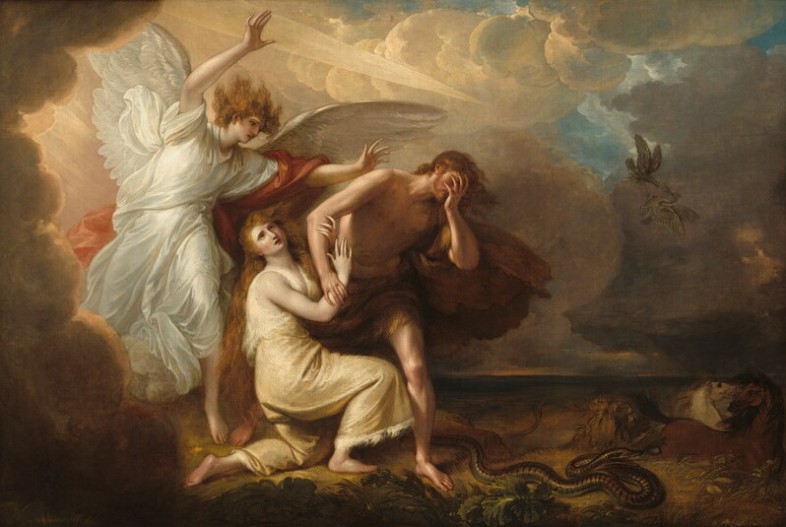
…[God] commanded him, saying: Of every tree of paradise thou shalt eat: But of the tree of knowledge of good and evil, thou shalt not eat. For in what day soever thou shalt eat of it, thou shalt die the death. Genesis 2: 16-17. …And the woman saw that the tree was good to eat, and fair to the eyes, and delightful to behold: and she took of the fruit thereof, and did eat, and gave to her husband who did eat. Genesis 3: 6. …And to Adam he said: Because thou hast hearkened to the voice of thy wife, and hast eaten of the tree, whereof I commanded thee that thou shouldst not eat, cursed is the earth in thy work; with labor and toil shalt thou eat thereof all the days of thy life. Genesis 3: 17.
The command. The Original Sin. The yoke of punishment.
Within the Christian narrative, the Garden of Eden; whether read as fact or parable, is not a catastrophe that condemns humanity but a pedagogical interval in which freedom, purpose, and morality first become visible. Eden is the place where God teaches that a being with a soul cannot thrive in effortless abundance; that freedom requires choice; that purpose emerges only through effort–trial and error, consequence, responsibility, and growth. Original Sin is not an accident but the awakening of the human soul, the moment the lesson begins.
Against this backdrop, William Dembski’s (1960-present) The End of Christianity advances a far more far‑reaching claim: that God imposed suffering and death across the entire 4.5‑billion‑year history of Earth in response to Adam’s sin; an event that, even on the most generous timelines, occurred only a few tens of thousands of years ago. The difficulty with this theory is not merely its scale but its direction. Within the Christian understanding of God’s eternal now, Eden is not an isolated moment but a teaching environment whose possibilities: temptation, failure, growth, are already present to the divine mind. Dembski’s proposal, however, requires suffering to be imposed on the epochs that precede the sin itself. Adam has no predecessors whose guilt could be inherited, and the only antecedent in the narrative is God Himself. This reversal of moral sequence renders the thesis difficult to sustain.
His theodicy survives only at the level of abstraction; once the brush narrows to a single creature or a single moment, the logic collapses. A brontosaurus sinking into Jurassic mud is not a moral agent, nor is a trilobite crushed in a Cambrian landslide. To treat their deaths as the retroactive consequence of a human sin that has not yet occurred is to impose moral causality where no moral subject exists. The moment the argument touches the concrete world: an ecosystem, a predator’s hunger, a tectonic shift, it demands that nature behave like a courtroom, assigning guilt and punishment across epochs that cannot bear such categories.
Nor does the appeal to the serpent resolve the difficulty. To identify the serpent as the origin of evil is to mistake a narrative instrument for a metaphysical explanation. The question is not who tempted Adam, but how the possibility of temptation exists at all within a creation held in the eternal knowledge of God. If evil can arise only through the serpent’s intrusion or Adam’s misstep, then the divine eternity becomes strangely porous, as though God were surprised by a contingency He did not foresee. A coherent theodicy must account for the possibility of evil within the very structure of creation; reducing it to a reptile or a human choice leaves the deeper metaphysical question untouched.
Additionally, he treats death itself as a sin and the result of sin, redefining a creaturely condition as a moral indictment and thereby forcing all pre‑human death into the ledger of Adam’s guilt. Once these premises are set, the argument can proceed only by inverting causality, collapsing divine eternity into creaturely time, and assigning retroactive guilt to a world that existed long before humanity appeared.
A further difficulty remains unaddressed. If God is placed within a temporal sequence, as Dembski’s model requires, then any retroactive application of punishment collapses into divine causation. A temporal God cannot reach backward in time without becoming the direct agent of the suffering He imposes. If Adam’s sin occurs after millions of years of natural history, then all pre‑human suffering occurs before the sin; and if that suffering is nevertheless treated as punishment for Adam, the only possible source of it is God Himself. The attempt to preserve a literal reading of Genesis thus forces the blame for natural evil onto the Creator, a conclusion Dembski never acknowledges and cannot escape.
As the argument unfolds, the incoherence deepens. Dembski appeals to Rabbi Harold Kushner, who resolves the problem of suffering by limiting God’s power, and to Tony Campolo, who suggests that God voluntarily cedes power to human freedom; positions incompatible with a thesis that requires God to exercise maximal power across billions of years to impose retroactive suffering on creation. He suggests that God created a perfect world, that the Son of God somehow disrupted that perfection, and that God was then forced to rewrite the story while it was being undone. Such a view divides the Trinity into competing agents and reduces God’s eternal now to a sequence of creaturely reactions. In attempting to preserve a literal reading of Genesis, Dembski abandons the very doctrines of divine eternity, unity, and immutability that Christianity has always affirmed.
His treatment of Chronos and Kairos only compounds the confusion. He proposes that God creates in Kairos and implements in Chronos, as though the eternal act of God could be divided into a timeless planning phase and a temporal execution phase. But Kairos and Chronos are categories of human experience, not metaphysical compartments within the divine life. By splitting God’s creative act into stages, Dembski collapses divine eternity into creaturely sequence, producing a picture of God who drafts outside of time and then steps into time to carry out the plan. It is a scheme that contradicts both classical doctrine and the logic of his own argument.
The result is a proposal that feels less like a coherent theological model and more like a solution in search of a problem; an attempt to preserve a preferred interpretation rather than a conclusion arising naturally from the metaphysics he invokes. His argument depends on a literal, historical Adam whose single act introduces moral disorder into the entire cosmos, yet he never defends this premise or engages the long tradition that treats Adam as archetype rather than biological progenitor. Nor does he address the scientific evidence that humanity emerged from a population rather than a solitary pair. The entire structure stands on an unexamined foundation.
By contrast, a more coherent theological reading sees Eden as a deliberate environment constructed to teach humanity its telos. God did not create paradise for idle comfort but to reveal that abundance without purpose is not paradise; that safety without responsibility is not fulfillment; that comfort without growth is tedium. The expulsion from Eden is not divine vindictiveness but the extension of the curriculum: a life in which effort–trial and error, consequence, and responsibility become the conditions for virtue. Original Sin is not a permanent stain but the beginning of moral adulthood, an inherited condition whose guilt is washed away in baptism. God does not abandon humanity after the Fall; He immediately promises redemption and sets further boundaries to guide the soul toward righteousness.
In this light, Eden is not the site of global catastrophe but the first classroom of the human spirit. Eden and Adam are not the problem but the beginning of the solution. It is the place where freedom is defined, purpose is revealed, and the long winding road of redemption begins.
Graphic: The Expulsion of Adam and Eve from Paradise by Benjamin West, 1791. Public Domain
 elsToday