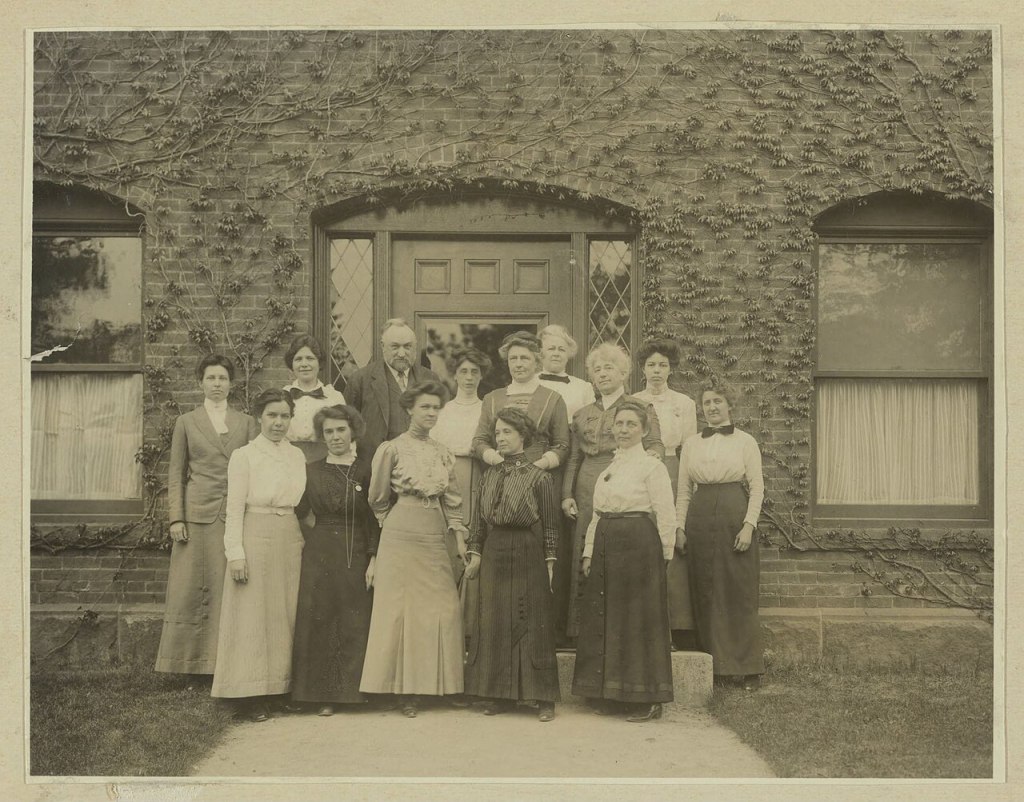
In the halcyon days of yore before digital ubiquity and tonal exactitude, computers were made of flesh and blood, fallibility crossed with imaginative leaps of genius. Photographs etched starlight’s past onto glistening glass and preserved silver. Solid archives where memory endures and future discoveries shimmer with potential, encoded in celestial light of the heavens awaiting the discerning caress of curiosity, intuition, and reason.
In 1613, English poet Richard Brathwait, best remembered for his semi-autobiographical Drunken Barnaby’s Four Journeys, enshrined the word computer into written English while contemplating the divine order of the heavens, calling God the “Truest computer of Times.” Rooted in the Latin computare, meaning “to reckon together,” the term evolved over the next three centuries to describe human minds inimitably attuned to the interpretation of visual data: star fields, spectral lines, geologic cross-sections, meteorological charts, and other cognitive terranes steeped in mystery, teasing initiates with hints of vision and translation. These were not mere calculators nor unimaginative computers, but perceptive analysts, tracing patterns, exposing truths, and coaxing insights from fluid shapes etched into the fabric of nature.
By the time of the Enlightenment and the scientific revolution, human computers had become the invisible deciphering force behind truth seeking laboratories, the unsung partners in progress, cataloging, interpreting, and taming the flood of empirical but seemingly nonsensical data that overwhelmed those without insight. Harvard College Observatory was no exception. With photography now harnessed to astronomy’s telescopes, the observatory could suddenly capture and archive starlight onto glass plates of coated silver, forever changing astronomy from the sketches of Galileo to silver etches of eternal starlight.
But these glass plates, resplendent with cosmic information, remained galleries of dusty, exposed negatives, inert until absorbed and guided by human curiosity and insight.
Enter the women computers of Harvard, beginning in 1875, over 140 women, many recruited by Edward Charles Pickering, processed more than 550,000 photographic plates, the last collected in 1992, bringing much needed coherence and linearity to the chaos of too much. They sorted signal from celestial noise, revealing the hidden order of the universe inscribed in silver, preserved in silica.
In 1875 the initial cohorts, the pioneers, the first names of Harvard women computers, although not exactly given that moniker, to appear on the glass plates were names like Rebecca Titsworth Rogers, Rhoda G. Saunders, and Anna Winlock assisting in the absolutely essential process of what we would now call cross-referencing the glass plate’s ‘metadata’ with the astronomical data. Ascertaining that time and space of the data match the time and space of the metadata. In 1881 Pickering, the observatory’s fourth director, began hiring women specifically as Astronomical Computers, a formal role focused on analyzing and deciphering the growing collection of glass plate photographs.
This shift in 1881 was more than semantic, a fancy title for drudge work and tedious plate cataloging but a structured program where women like Williamina Fleming, Annie Jump Cannon, Henrietta Swan Leavitt, and Cecilia Payne-Gaposchkin were tasked with not just cataloging stars, but studying stellar spectra, and the lights powering life and imagination throughout the universe. Indispensable efforts that lead to the Henry Draper Catalogue, eventually containing the half million plus glass plates, and the foundations of modern stellar classification systems and 21st century astronomy. Their stories are worthy of a Horatio Alger novel, maybe not exactly rags to riches, but certainly humble beginnings to astronomical fame. They were paid peanuts, but they were the elephants in the observatory.
Williamina Fleming, in 1879 arrived in Boston penniless and abandoned by her husband secured a job as a domestic in the home of Edward Pickering, yes that guy. She impressed Pickering’s wife, Elizabeth, with such intelligence that she recommended her for work in the observatory. She quickly outpaced her male counterparts and in 1881 was officially hired as one of the first Harvard Computers.
Studying the photographed spectra of stars, she developed a classification system, the natural human desire to find order in apparent chaos, based on the abundance of hydrogen on the surface of a star or more exact the strength of hydrogen absorption lines from the spectra data. The most abundant stars were classed as A stars, the next most abundant as B stars, and on down to V.
In 1896 Pickering hired Annie Jump Cannon, a physics degree from Wellesley and an amateur photographer, modified Fleming’s stellar classification system based also on the surface temperature of a star rather than hydrogen abundance. Her method was to use the strength of the Balmer absorption lines, electrons excited within hydrogen atoms, like dancers at different tempos, reveal themselves through subtle spectral lines now understood to be differing ionization states of the atom directly tied to the surface temperature of the star.
Her system used the same letters to avoid redoing the entire Harvard catalogue, but she reduced the list down to 7 and reordered them from hottest to coolest: O, B, A, F, G, K, M. Her classification is still in use today. Earth revolves around a G-class star which has a medium surface temperature of about 5800 K (9980 F or 5527 C).
Henrietta Swan Leavitt graduated from Harvard’s Women’s College in 1892 with what we might now call a liberal arts degree. A year later, she began graduate work in astronomy, foundation for employment at the Harvard Observatory. After several extended detours tucked under her petticoats, Edward Charles Pickering brought her back to the Observatory in 1903. She worked initially without pay, later earning an unfathomable 30 cents an hour.
There, Leavitt collaborated with Annie Jump Cannon, in a coincidence of some note both women were deaf, though one is left with the feeling that the absence of sound may have amplified the remaining sensory inputs to their fertile minds. In time, Leavitt uncovered a linear relationship between the period of Cepheid variable stars and their luminosity, a revelation that became an integral part of the cosmic yardstick for measuring galactic distances. The Period-Luminosity relation is now enshrined as Leavitt’s Law.
Cepheid variables form the second rung of the Cosmic Distance Ladder; after parallax, and before Type Ia supernovae, galaxy rotation curves, surface brightness fluctuations, and, finally, the ripples of Einsteinian gravitational waves. Leavitt’s metric would prove essential to Edwin Hubble’s demonstration that the universe is expanding.
Swedish mathematician Gösta Mittag-Leffler considered nominating her for the Nobel Prize in Physics, but his plans stalled upon learning she had died in 1921. The Nobel, then as now, is non-awardable to the dead.
Cecilia Payne-Gaposchkin, a transplanted Brit, joined the Harvard Observatory as an unpaid graduate fellow while working towards her PhD at Radcliffe in astronomy. Upon earning her doctorate, she continued at the Observatory with no title and little pay. By 1938 she was awarded the title of Astronomer and by 1956 was made full professor of Harvard’s faculty.
In her dissertation she accurately showed for the first time that stars are composed primarily of hydrogen and helium, proving that hydrogen was the most abundant element in the universe, overturning long held but erroneous assumptions. But in a twist of fate, astronomer Henry Norris Russell persuaded her to label her conclusions of hydrogen abundance as spurious. Four years later Russell’s research reached the same conclusion, but he barely gave her an honorable mention when he published his results.
She wasn’t the first nor will she be the last to suffer at the hands of egotistical professors, more enamored of self rather than truth, but her elemental abundance contribution to astronomy brushed away the conceit that stars must mimic rocky planets in their composition, much like Galileo ended Earth’s reign as a center of everything. Twentieth century astronomer Otto Struve hailed her dissertation as “the most brilliant PhD thesis ever written in astronomy.”
Undeterred and building on her studies of spectral emissions of stars she turned her gaze to high luminosity and variable stars with husband astronomer Sergi Illarionovich Gaposchkin. After 2 million observations of variable stars, their efforts laid the groundwork for stellar evolution: how stars change over the course of time. From hints of dispersed stardust to starlight and back again. Cycles of stellar life repeated billions of times over billions of years.
Harvard’s astronomical female human computers, initially mere clerks transcribing stars from silver and glass, evolved into interpreters of light, shaping the very foundations of astronomy. Through logic, imagination, and an unyielding devotion to truth, they charted the heavens and opened lighted pathways for generations to follow.
Graphic: The Harvard Computers standing in front of Building C at the Harvard College Observatory, 13 May 1913, Unknown author. Public Domain
 elsToday