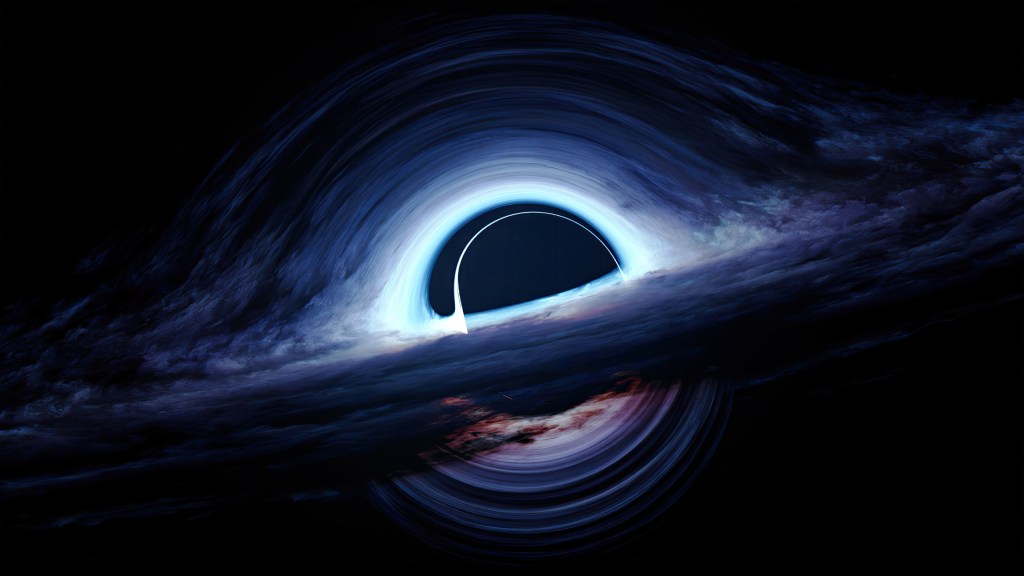
95% of the universe is a mystery. About 68% is dark energy, which is believed to drive the accelerated expansion of the universe, though its exact nature is unknown. 27% is dark matter, which holds galaxies together and is believed to consist of one or more massive, yet unknown, particles.
Science Daily reports that researchers at the University of Michigan and five other institutions “have strengthened the case that matter becomes dark energy when massive stars collapse and become black holes.” This suggests that the universe’s expansion may be partly explained by the expansion of black holes through cosmological coupling. It also implies that black holes can gain mass without consuming matter, directly challenging the Standard Model of particle physics.
This either leads to the Big Freeze—infinite expansion through not quite infinite time—or the Big Crunch, where gravity eventually says ‘Enough!’ and collapses everything back into an infinitesimal point.
To sum up, we may or may not understand 5% of the universe, while the remaining 95% aligns with Socrates’ axiom from 6th century Greece—we essentially know nothing.
Source: University of Michigan. “Evidence Mounts for Dark Energy from Black Holes.” Science Daily. 2024. Graphic: Black Hole.





 elsToday