A Little Big Tale

Little Big Man (Theaters – December 1970; Streaming – April 2003)  Rated: PG  —M Little 1970  Runtime: 139 minutes

Genre:  Adventure – Comedy – Satire – Western

els:  6.5/10

IMDB:  7.6/10

Amazon:  4.5/5 stars

Rotten Tomatoes Critics: 7.9/10

Rotten Tomatoes Audience:  3.8/5

Metacritic Metascore:  63/100

Metacritic User Score:  8.0/10

Awards: NA

Directed by:  Arthur Penn

Written by:  Calder Willingham (screenplay), Thomas Berger (book)

Music by:  John Hammond

Cast:  Dustin Hoffman, Faye Dunaway, Chief Dan George, Richard Mulligan

Film Locations: Calgary, Morely, Alberta, Canada; Billings, Crow Indian Reservation, Hardin, Lame Deer, Little Big Horn Battlefield, Nevada City, Virginia City, Montana – Agoura Hills, Los Angeles, Thousand Oaks, California, US

Budget: $15,000,000

Worldwide Box Office: $31,600,000

An ancient and time-worn Jack Crabb (Hoffman), spending his final days in a nursing home, relates his incongruous life of farce and fate to an interested historian.  At the age of 10 a Pawnee raiding party attacks his family and kills his parents. Later a Cheyenne brave finds him and his sister hiding in their destroyed wagon and takes them back to his tribe.  The tribe’s chief, Old Lodge Skins (Chief Dan George) raises the boy and thus begins a series of improbable events that punctuate Jack’s long and full life. Indian on Indian battles, white on red battles, sexually repressed preacher’s wife battles, gunfighter playing, snake oil selling, drunken despondency; all  in a day in the life of a western meme.

Arthur Penn creates a movie of contrasts that is labeled revisionist history but is no more than a comedy situated in the late 19th century American west, incorporating events of historical interest but not necessarily accurate or correct. The contrasts are established through the lives of the story’s actors, their happenstance encounters and experiences highlighting life’s hypocrisy and charades. Jack as a natural gunfighter that cannot stomach killing, a preacher’s wife that seeks pleasure over salvation, a narcissistic general searching for fame through folly. A tragedy’s lessons told through tongue-in-cheek schtick. An effective delivery of farce that unfortunately passed as truth for millions of viewers.

Hoffman takes top billing as lead actor and he delivers a masterful performance both on-screen and as the voice-over narrator, but it is Chief Dan George who shines, turning an ok script into a wonderful exhibition of cheerful existence in the face of our inhumanity. George was nominated for an Academy Award but unfortunately lost out to John Mills in the totally forgettable Ryan’s Daughter. Richard Mulligan, as Custer, turns in a performance that is remarkable in its absurdity, an under-dog role elevated to a tour-de-force of parody. Faye Dunaway’s hilarious representation as a sexually needy whore and preacher’s wife sets the standard for urgency over love, a role reprised brilliantly by Madeline Kahn as Lili von Shtupp in the 1974 romp, Blazing Saddles.

Little Big Man is a fun chuckle of a movie that should not be confused for history but as a satire of the past. A movie encompassing a large swath of all western tales encapsulated into a few hours of humor and jest.


Dying Young

The Curious Case of Benjamin Button (Theaters – December 2008; Streaming – May 2009) M Button 2008Rated: PG  —  Runtime: 166 minutes

Genre: Drama – Fantasy – Mystery – Romance – Suspense

els – 7.5/10

IMDB – 7.8/10

Amazon – 4.6/5 stars

Rotten Tomatoes Critics – 7.1/10

Rotten Tomatoes Audience – 3.7/5

Metacritic Metascore – 70/100

Metacritic User Score – 7.3/10

Awards:  3 Academy Awards – Nominated for 13

Director:  David Fincher

Written by:  Eric Roth (story and screenplay), Robin Swicord (story), F. Scott Fitzgerald (story)

Music by:  Alexandre Desplat

Cast:  Brad Pitt, Cate Blanchett, Julia Ormond

Film Locations:  Cambodia; Montreal, Canada; India; Burbank, Los Angeles, California – Donaldsonville, Laplace, Mandeville, Morgan City, New Orleans, Louisiana, US; St. Thomas, US Virgin Island

Budget:  $167,000,000

Worldwide Take:  $379,000,000

Mr. Gateau, the best clockmaker in all of the southern US, is commissioned to build a clock for a new train station set to open in 1918. When the clock is unveiled, it is running backwards. Mr. Gateau, who lost a son to the recent war, affirms that it is running as designed; to  grant those lost to the war a way back to life and the living.  On 11 November 1918, Armistice Day, Benjamin Button (Brad Pitt) is born, wrinkled and worn, losing his mother to his birth and his father, abandoning him on the porch of an orphanage. Benjamin is a consistent contradiction, experiencing life in a counter-clockwise direction.

The Curious Case of Benjamin Button took 20 years, 7 potential directors prior to Fincher, 3 lead actors before Pitt, 3 different possible producers, and 2 production companies to finally deliver a product for the viewing public to consume. David Fincher brings his visual effect expertise to the forefront, as he usually does, with this enchanted story of love and time. He balances the CGI with a spellbinding collage of romance and courage that moves beyond the flesh. The visual effects are absolutely stunning, keeping this fantasy real and believable.  Fincher was likely the only director that could make this movie and keep the audience interested.

Brad Pitt contributes a somewhat predictable performance, detached but lovable, low-key and restrained, letting his body language provide the message, more so than his dialogue. It works and adds to the mystic of the film but it’s Cate Blanchett’s Daisy that draws you into this movie.  Daisy is a very complex character and Blanchett handles it with grace, charm, and a natural style that holds you in a delightful, enamored state of wonder throughout the film. Sad that she wasn’t even nominated for her more than deserving efforts by the Academy or the Golden Globes.

Benjamin Button is beautifully made, telling a story of true love that outstrips the concepts of time.


Shrew Taming

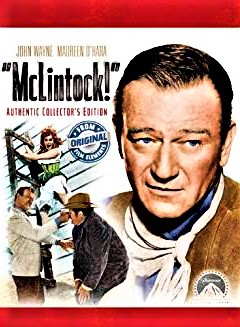
McLintock!  M McLIntock 1963

Theaters:  November 1963

Streaming: July 1997

Rated: NR

Runtime: 127 minutes

Genre: Comedy – Romance – Western

els:  6.0/10

IMDB:  7.3/10

Amazon:  4.5/5 stars

Rotten Tomatoes Critics:  5.1/10

Rotten Tomatoes Audience:  3.9/5

Metacritic Metascore:  NA/100

Metacritic User Score:  NA/10

Awards: NA

Directed by: Andrew V. McLaglen

Written by: James Edward Grant

Music by: Frank De Vol

Cast: John Wayne, Maureen O’Hara

Film Locations: Fairbank – Chiricahua National Monument – Duquesne – Harshaw – Klondyke – Las Cienegas National Conservation Area – Lochiel – Nogales – Patagonia – Ruby – San Raphael Valley – San Xavier – Sonoita – Sonoran Desert – Tucson, Arizona, USA

Budget: $4,000,000

Worldwide Box Office: $14,500,000

Katherine Gilhooley McLintock (Maureen O’Hara) after a 2 year absence returns to her husband, G.W. McLintock (John Wayne) and their ranch outside of the western town of the eponymous McLintock to ask for a divorce, custody of their teenage daughter, and alimony. G.W., still confused about why she left in the first place, just says no to all and proceeds to woo Katherine back to his arms and their ranch.  While G.W. deals with his recalcitrant wife he also faces challenges from dirt farmers trying to farm the unfarmable high plateau, Indians resisting resettlement to the reservation, along with the worthy and not so worthy suitors pursuing the affections of Becky (Stefanie Powers), his daughter. All matters proceed in a slapdash but charming facetiousness.

This movie is all John Wayne. He chose the director, Andrew V. McLaglen, herded the script through completion with scriptwriter, James Edward Grant, had his son Michael produce the movie, and another son, Patrick star in the slightly incestuous role of  a cow-hand courting his movie daughter Becky. The film also marks the beginning of Wayne letting the world know his views on everything from politics to education within the confines of this and his subsequent movies.

The movie reunites John Wayne with his frequent co-star Maureen O’Hara. These two worked together in 4 other movies including the 1950 Rio Grande, the 1952 The Quiet Man, the 1957 The Wings of Eagles, and the 1971 Big Jake. The two had a special working relationship, each able to abide the other’s head strong tendencies, and both could act their parts, from the common “man” to the polish and charm of the upper crust. Their onscreen affection for each other always came through as honest and real, not only a credit to their abilities as actors but also their deportment as a true lady and a true gentleman, all in an age gone by.

A legitimate classic movie with hints of Shakespeare’s comedy, The Taming of the Shrew, the moral education of Father Knows Best, and the real-life tragedy known as the Trail of Tears. John Wayne taming Maureen O’Hara, John Wayne educating his family and friends, John Wayne attempting to reconcile the law with the Indians’ pride and heritage.  John Wayne shows a humorous side in this movie but he is still the big man on the set.

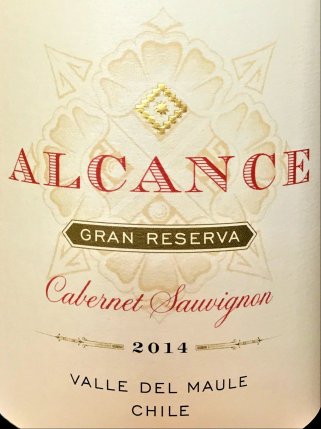
Alcance Gran Reserva Cabernet Sauvignon 2014

W Alcance 2014Cabernet Sauvignon from Maule Valley, Central Valley, Chile
100% cabernet sauvignon

14.5% alcohol

Purchased: 6 March 2017 – $19.99

Opened: 28 Feb 2018

els: 9.0/10

Wine and Spirits: 94

James Suckling: 90

Cellar Tracker: 90

Wine Enthusiast: 87

Maule Valley, the largest wine-producing region in Chile and the southern-most region in Chile’s Central Valley, is tucked in-between the Andes and the Coastal Ranges. The region is named after the east to west flowing Maule River with its headwaters in the western slopes of the Andes Mountains and emptying 50-60 miles downstream into the Pacific Ocean near the small, impoverished city of Constitucion. Due to the Valley’s more southern location in the Central Valley it has cooler temperatures than its northern counterparts but because the Coastal Range’s have lower elevations here the rain shadow is also reduced resulting in more rainfall than up north, particularly in the winter.

The region’s wine history dates back to the mid-1800s when successful Chilean businessmen brought back pre-Phylloxera European vine cuttings to grow in the Valley’s igneous and alluvial soils, primarily along the Maule River. Initially the region grew predominately Pais grapes, generally used for bulk wine sales and table wines but in the recent past most of those vineyards have been replaced with better known selections such as Cabernet Sauvignon, a grape that now accounts for half the 75,000 vine acres planted in the Maule Valley.

Cabernet Sauvignon is a cross, believed to have occurred naturally sometime in the 1600s in southwestern France, between Cabernet Franc and Sauvignon Blanc grapes. It is now the most widely planted grape in the world. Chile is second only to France in the number of acres planted world-wide in this grape. It is a thick-skinned grape that’s relatively easy to grow and maintain, exhibiting high tannins and acidity, producing a distinct bell pepper flavor, especially in cool climates, along with aromas of mint and eucalyptus. The grapes produce a full-bodied and dark-ruby colored wine.

The Alcance winery, founded in 1993, is a Jackson Family enterprise that was instrumental in improving the entire winemaking industry in the Maule Valley.  The family introduced modern techniques to the Valley, through the Alcance winery, and the rest, as they say, is history. The winery started with the lower elevation San Francisco Estate vineyards in the southwestern portion of the Valley. The vines enjoy the cool Pacific winds blowing over their canopy with their roots tapped into soils clogged with large quartz crystals. The growing season temperatures for the San Francisco vineyards ranges from 60-80ºF with rainfall 0.25-1.00″ per month. In 1999 the Jackson Family added the El Maiten Estate winery and vineyards in the southeastern Maule Valley to their Chilean holdings.  The El Maiten vineyards are located in the Andes foothills along the Lircay River, a tributary of the Maule River. The vines grow in a loamy soil containing numerous pebbles and cobbles. The growing season temperatures for the El Maiten area ranges from 60-85ºF with rainfall 0.25-0.75″ per month. Both vineyards total about 200 acres planted in 10 to 20-year-old vines.  The winery produces 5 wines under its Alcance label: Cabernet Sauvignon, Carmenere, Merlot, VIGNO (an old vine Carignan), and Bravura, their celebrated Bordeaux blend.

This wine is produced from a rough 50-50 mix of grapes from both vineyards. The Cabernet Sauvignon vines were 10 to 11-years old for this 2014 vintage. After the grapes are hand harvested, they are hand sorted, cold macerated for 6 days, and fermented in small stainless steel tanks for 20-22 days. Malolactic fermentation is done in French oak barrels for 18 months with 3 intervening racks.

A clear ruby-red wine with a tawny rim. Aromas of cherries and raisins with an oak supplied vanilla in the background. Full-bodied and balanced with a very pleasant, long finish.

Enjoy with a traditional South American stew: Charquican. You will need a pound of cubed beef (cheap to expensive; your choice), a tablespoon of flour, quarter stick of butter, 2 cups of beef stock, a big chopped onion, a teaspoon or two of minced garlic, 2 tablespoons of oil, 1-3 teaspoons of chili peppers finely minced (less or more depending on how spicy you want the stew), 1 cup corn, 1 cup carrots sliced, 2 cups diced potatoes, salt and pepper. Coat the cubes of beef with the flour. Season with salt and pepper. Add to skillet over medium-high heat along with the melted butter. Cook beef until brown. Add the beef stock and simmer for 10 minutes. Transfer the contents of the skillet to a slow cooker.  With the remains of the beef and the beef stock in the skillet add the oil, onion, garlic, chili pepper and cook until the onions are soft. Add the remaining vegetables except the corn to skillet and cook for 5 minutes more. Add the skillet contents to the slow cooker and cook for 6-8 hours. Add in the corn about an hour before serving. Serve over rice.  Delicious. I made this from a modified recipe I found on The Spruce but I left out the squash, beans, and beef jerky; otherwise it was exactly the same:)

An outstanding wine at a fair price. Drink now, but should last until 2023-2025. Decant and aerate for one hour, or more, before drinking.

$15.19-31.49  wine-searcher.com

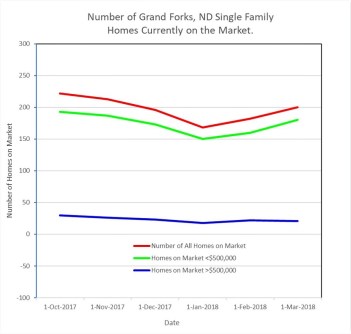
Grand Forks, ND Housing Market: February 2018

RE No March 2018Trends from the previous month:

1) Number of  homes on the market continues to increase except for the high-end market which is experiencing a small long-term decrease.

2) Median price per square foot is essentially flat to slightly decreasing for all price points.

3) Median days on the market continues to decrease for all price points.

4) Median home prices continue to increase.

Data is for single family, single lot homes.  Does not include apartments, condos, mobile homes, townhouses,  twin homes, etc.

RE All March 2018.jpgRE 499 March 2018.jpgRE 500 March 2018.jpg