Galactic Emptiness

I like the quiet.

From the dark, an enigmatic mass of rock and gas streaks inward. Discovered by the ATLAS telescope in Chile on 1 July 2025, it moves at 58 km/s (~130,000 mi/hr), a billion-year exile from some forgotten, possibly exploded star, catalogued as 3I/Atlas. The press immediately fact-checks then shrieks alien mothership. Harvard’s Avi Loeb suggests it could be artificial, citing its size, speed: “non-gravitational acceleration”, and a “leading glow” ahead of the nucleus. Social media lights up with mothership memes, AI-generated images, and recycled Oumuamua panic.

Remaining skeptical but trying to retain objectivity, I ask; is it anything other than a traveler of ice and dust obeying celestial mechanics? And it is very difficult to come up with any answer other than, no.

NASA’s flagship infrared observatory, the James Webb Space Telescope (JWST) spectra show amorphous water ice sublimating 10,000 km from the nucleus. The Hubble telescope resolves a 13,000-km coma (tail), later stretching to 18,000 km that is rich in radiation forged organics: tholins, and fine dust.

The “leading glow” is sunlight scattering off ice grains ejected forward by outgassing. The “non-gravitational acceleration” is gas jets, not engines. Loeb swings and misses again: ‘Oumuamua in 2017, IM1 in 2014, now this. Three strikes. The boy who cried alien is beginning to resemble the lead character in an Aesop Fable.

Not that I’m keeping score…well I am…sort of. Since Area 51 seeped into public lore, alien conspiracies have multiplied beyond count, but I still haven’t shaken E.T.’s or Stitches’ hand. No green neighbors have moved next door, no embarrassing probes, just the Milky Way in all its immense, ancient glory remaining quiet. A 13.6-billion-year-old galaxy 100,000 light-years across, 100–400 billion stars, likely most with host planets, and us, alone on a blue dot warmed by a middle-aged G2V star, 4.6 billion years old, quietly fusing hydrogen in the Orion Spur, between the galaxy’s Sagittarius and Perseus spiral arms.

No one knocking. But still, I like the quiet.

An immense galaxy of staggering possibilities, where the mind fails to comprehend the vastness of space and physics provides few answers.  The Drake Equation, a probabilistic 7 term formula used to estimate the number of active, communicative extraterrestrial civilizations in the Milky Way galaxy yields an answer of less than one (0.04 to be exact) which is less than the current empirical answer of 1, which is us on the blue dot.

For the show me crowd here’s the Drake Equation N = R* × f_p × n_e × f_l × f_i × f_c × L and inserting 2025 consensus for the parameters: Two stars born each year. Nearly all with planets. One in five with Earth‑like worlds. One in ten with life. One in a hundred with intelligence. One in ten with radio. A thousand years of signal. And the sum is: less than one.

For the true optimist let’s bump up N to 100.  Not really a loud party but enough noise that someone should have called the police by now.

No sirens. I like the quiet.

But now add von Neumann self-replicating probes traveling at relativistic speeds, one advanced civilization could explore the galaxy in 240 ship-years (5,400 Earth years). A civilization lasting 1 million years could do this 3000 times over. Yet we see zero Dyson swarms, zero waste heat, zero signals. Conclusion: Either N = 0, or every civilization dies before it advances to the point it is seen by others. That leaves us with a galaxy in a permanent civilizational nursery state, or existing civilizations have all died off before we had the ability to look for them, or we are alone and always have been.

Maybe then, but not now. Or here but sleeping in the nursery. I like the quiet.

But then I remember Isaac Asimov’s seven‑novel Foundation saga. The Galactic Empire crumbles. Hari Seldon’s psychohistory predicts collapse and rebirth. The Second Foundation manipulates from the shadows. Gaia emerges as a planet‑wide mind. Robots reveal they kept it going: Daneel Olivaw, 20,000 years old, guiding humanity. And the final page (Foundation and Earth, 1986) exposes the beginning: Everything traces back to Earth. A radioactive cradle that forced primates to evolve repair genes, curiosity, and restlessness. We are radiation’s children. We didn’t find aliens. We are the aliens.

We are the cradle. We are the travelers. I still like the quiet.
To Boldly Go

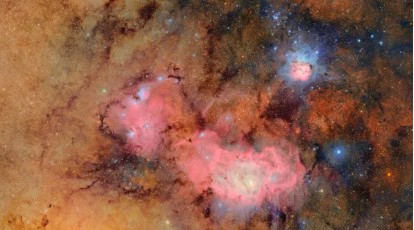
On 23 June 2025, after more than three decades of evolution, from a gleam of an idea to detailed planning, exacting execution, and the physical realization of the world’s largest astronomical camera, the Vera C. Rubin Observatory’s Legacy Survey of Space and Time (LSST) in Chile unveiled to the public its first breathtaking images. Among them: razor-sharp mosaics of the Trifid and Lagoon Nebulae, and the sprawling Virgo Cluster, home to millions of galaxies. Captured with world-class light-collecting mirrors, these images marked the beginning of a spectacular ten-year quest to map the known universe and illuminate the 95% we still don’t understand: dark matter and dark energy. An exciting, albeit, Herculean future awaits, built on an equally stunning past where dreams and science converged into one of the most staggering feats of technological achievement in modern astronomy.

Let the future map of the universe tell its own story in due time. The path to the map deserves a chapter all its own.

In 1969 Willard Boyle and George Smith of Bell Labs invented a device capable of detecting and measuring the intensity of light which they named CCD or Charge-Coupled Device: a breakthrough that earned them the 2009 Nobel Prize in Physics. A CCD converts incoming photons into electrical signals, creating a voltage map of light intensity, a digital proxy for the number of photons striking its surface. Initially constructed as a semiconductor chip, it quickly evolved into a pixelated imaging sensor. These sensors quickly became the gold standard for digital consumer and scientific imaging but due to costs, consumer applications such as your phone camera switched over to CMOS sensors due to lower costs. Scientific and surveillance systems, such as the Hubble Telescope, SOAR, and SNAP, still employ CCDs because of their superior image fidelity.

In the late 1980s J. Anthony ‘Tony’ Tyson, an experimental physicist at Bell Labs, focused on developing instrumentation to detect faint optical signals using CCDs. His inspiring contribution to the CCD was to recognize their potential in imaging the heavens and laying the groundwork for digital deep sky surveys. He quickly discovered faint blue galaxies and gravitational lensing using modified CCDs that he helped developed. Additionally, he helped build the Big Throughput Camera that was instrumental in the 1998 discovery of dark energy.

Tyson never thought small. His CCDs were instruments of the infinitesimal, but his dreams were as gargantuan as the universe itself. In fact, his dream was the universe. In 1994 he proposed his “Deep Wide Fast” telescope, a scaleup of his Big Throughput Camera and the forerunner of the LSST. The Deep Wide Fast was a concept that would combine a deep imaging device with rapid cadence, and broad coverage simultaneously. In other words, synoptic realization of the universe in near real time.

Throughout the 1990s, Tyson rallied minds and resources to shape his cosmic vision. John Schaefer of the Research Corporation helped secure early funding. Roger Angel proposed the use of the innovative Paul Baker three-mirror telescope design. Institutions like the Universities of Arizona and Washington, along with the Optical Astronomy Observatory, all hitched their wagons to Tyson’s star-filled dream of mapping the universe.

In 1998 Tyson presented designs for a Dark Matter Telescope and in 1999 the science case was submitted to the Astronomy and Astrophysics Decadal Survey. In 2003 the first formal proposal was sent to the Experimental Program Advisory Committee at SLAC (Stanford Linear Accelerator Center). It consisted of an 8.4-meter mirror with a 2.3-billion-pixel camera capable of surveying the entire visible sky every few nights. The proposal also laid out the NSF–DOE partnership, with SLAC leading the camera development and other institutions handling optics, data systems, and site operations.

In 2004 Tyson left Bell Labs and joined the University of California at Davis as a cosmologist and continued to shepherd the LSST project from there.

In 2007 the project received $30 million in private funding from Charles Simonyi, Bill Gates, and others. The telescope is named the Simonyi Survey Telescope. In 2010 U.S. National Science Foundation (NSF) and Department of Energy (DOE) joined in the quest to view the universe through the sharp eyes of the LSST.

The telescope’s primary 8.4-meter and the 5.0-meter tertiary mirrors were built at the University of Arizona, beginning in 2008, completed in 2015, and stored on-site in Chile since 2019. Fabricated in the U.S., the 3.4-meter secondary was later coated in Germany with nickel-chromium, silver, and silicon nitride, materials chosen to enhance reflectivity, durability, and long-term performance.

In 2015 SLAC, which oversaw the design, fabrication, and integration of the camera, began building the components with assistance from Brookhaven National Laboratory, Lawrence Livermore National Laboratory, and IN2P3/CNRS in France. By 2024 the camera was finished and shipped to Chile. In 2025 the camera was installed and integrated with the telescope. In June of 2025 the first light images were released to the public.

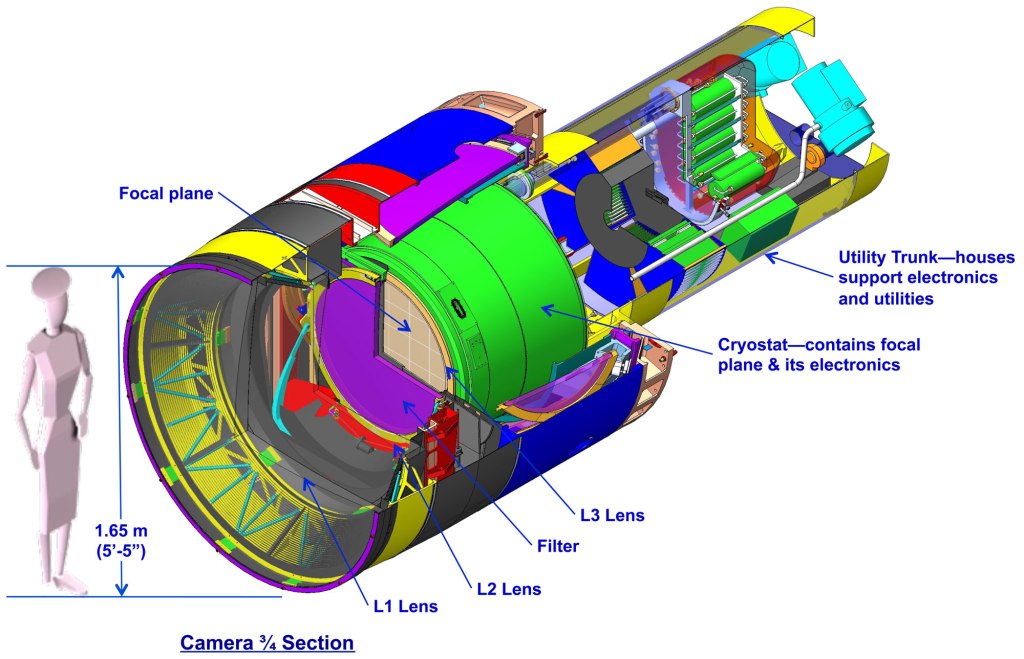
The camera measures roughly 3 meters in length, 1.65 meters in diameter, and weighs 3 metric tons, an imposing instrument, rivaling the bulk of a small car. Its imaging surface, a 64-centimeter focal plane, contains 3.2 billion pixels, each a 10-micron square, roughly one-tenth the width of a human hair. These pixels, etched across 189 custom CCD sensors arranged into 21 modular “rafts,” are laid flat to within 10 microns, ensuring near-perfect focus. The entire array is chilled to –100°C to suppress electronic and thermal noise, enhancing signal fidelity.

Before photons reach the sensor, they pass through three precision-crafted corrective lenses, including the largest ever installed in an astronomical camera, and up to six interchangeable filters spanning ultraviolet to near-infrared. The filter exchange system enables the observatory to target specific wavelength bands, tailored to sky conditions and science goals.

The integrated LSST system is engineered to capture a 15-second exposure every 20 seconds, producing thousands of images per night, tallying approximately 15 terabytes of new data. Each image covers 9.6 square degrees of sky, roughly equivalent to the diameter of 45 full moons, allowing the system to survey the entire visible southern sky every 3–4 nights. Imaging a single field across all six filters can take up to 5–6 minutes, though filters are selected dynamically based on science goals and atmospheric conditions.

The system’s angular resolution is sharp enough to resolve a golf ball from 15 miles away and at the edge of the observable universe, this scales to structures no smaller than a large galaxy; certainly not stars, not planets, nor restaurants. Over its decade-long campaign, LSST is projected to catalogue more than 17 billion stars and 20 billion galaxies, a composite digital universe stitched together from individual photons captured from 3 million images, each snapped every few seconds over the clear night sky of Chile. The LSST will not simply map what’s visible but illuminate the unknown. Beneath the sophisticated hardware and software lies a deeper purpose: to shine the light of curiosity on the 95% of the universe that remains in the shadows of time and space: dark matter and dark energy, the known unknown dynamic force behind galactic formation and cosmic expansion. The LSST is more than a camera. It is a reckoning with the vast unknown, a testament to humanity’s refusal to let mystery remain unexplored and uncharted: to find God.

In 2013 Tyson was named chief scientist of the LSST and is still actively contributing to the intellectual vision of the project and mentoring the next gen of cosmologists and engineers.

Graphic: LSST Camera Schematic and Trifid Nebula by SLAC-DOE-NSF.

Sunny Side Up: Gömböc, Bille, and the Geometry of Falling

In Shel Silverstein’s poem “Falling Up,” a child trips on his shoelace and soars skyward instead of tumbling down. A delightful inversion of reality, a child’s imagination conjuring tomorrow’s focus. In the world of mathematics and physics, a similar inversion has captivated minds for decades: can you design an object that always falls the same way, always sunny side up, no matter how it starts, like a cat landing on all fours.

In the realm of numbers and materials this is the problem of monostability: creating a shape that, when placed in any orientation, will always return to a single, stable resting position. It’s a deceptively simple question with grudgingly difficult solutions. And it has at least two very different answers.

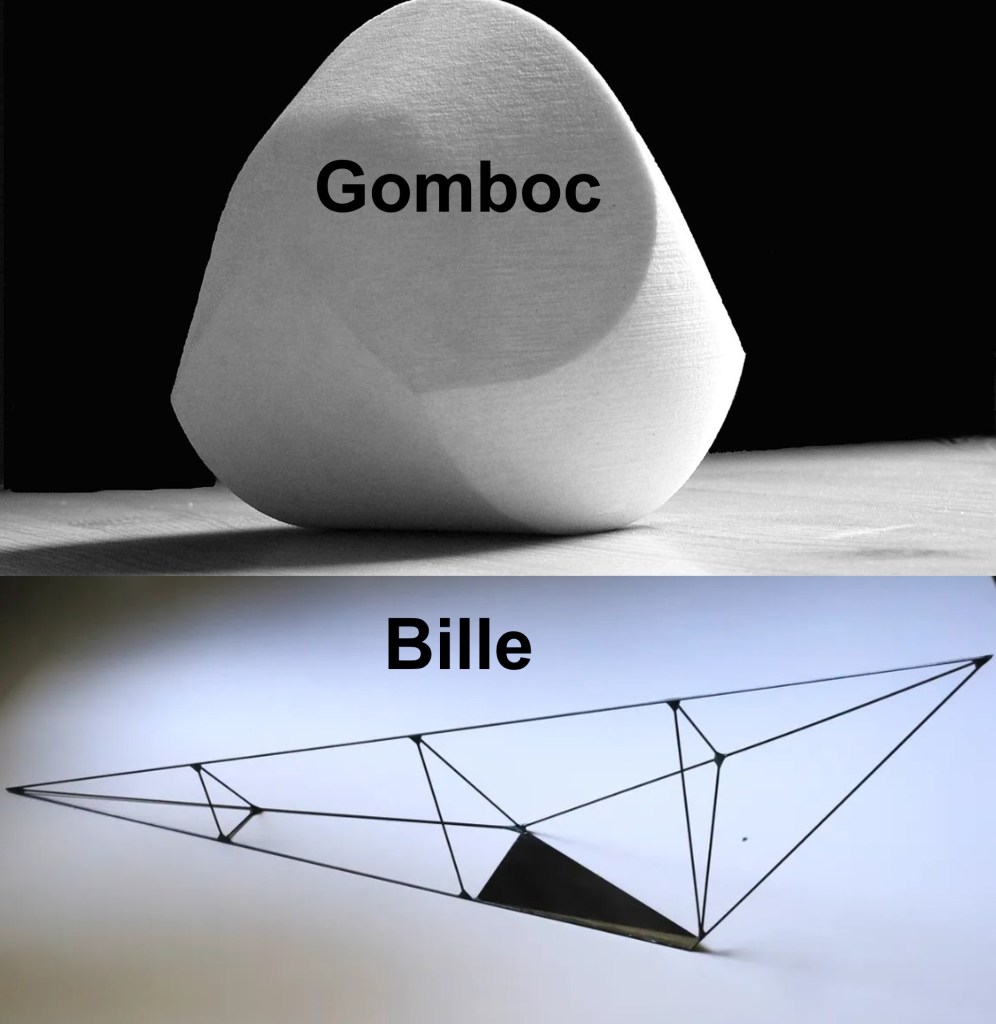
The first answer to the cat landing on all fours came in 2006 with the discovery of the Gömböc, a smooth, convex, homogeneous shape that rights itself without any differential weighting or moving parts. Invented by Hungarians Gábor Domokos and Péter Várkonyi, the Gömböc, meaning “little sphere or roundy” in Hungarian, has only one stable and one unstable equilibrium point. No matter how you place it, it will wobble and roll until it settles in its preferred orientation.

The Gömböc is a triumph of pure geometry. It solves the monostability problem using only shape, no tricks, no hidden weights but some serious math. It’s been compared to a mathematical cat: always landing on its feet, a design with a natural convergence toward the domed asymmetry of tortoise shells, whose shapes nature may have unconsciously optimized for self-righting.

Although uses for Gömböc are still being explored, some have developed designs for passive orientation systems, and the name has been co-opted for a company that is building self-correcting cloud infrastructure.

The second answer came recently in June of this year, when Gergő Almádi, Robert Dawson, and Gábor Domokos, of Gomboc fame, constructed a monostable tetrahedron, a four-faced scalene or irregular polyhedron that always lands on the same face which they named Bille: “to tip or to tilt” in Hungarian. A solution to a decades-old conjecture by John Conway, a Princeton polymath professor, with a talent for finding tangible solutions to abstract problems.

In this case, unlike the geometric solution of the Gömböc, geometry enables self-righting only when paired with carefully engineered mass distribution: a lightweight carbon-fiber frame and a dense tungsten-carbide core, precisely positioned to shift the center of gravity into a narrow “loading zone.” It’s a hybrid of form and force, where the shape permits monostability, but the mass forces the issue.

Unlike the Gömböc, which might inspire real-world designs, the monostable tetrahedron is too fragile, too constrained, and too dependent on ideal conditions to be practical. It’s a mathematical curiosity, not an engineering breakthrough. But like numerous mathematical solutions, practicality may occupy some interesting spaces in the future because landing on your feet is a useful function in many areas of commerce and science.

In space exploration lunar landers have recently had a bad, and expensive habit of falling over. In marine safety, users of escape pods and lifeboats prefer them to remain upright and watertight. Come to think most occupants of any watercraft prefer to remain upright and dry. Robots and drones benefit from shapes that naturally return them to a functional position without motors or sensors.

In the end, both the Gömböc and the weighted tetrahedron are about their inevitable position and stability. They are objects that always know where they stand. One does it with elegance; the other with abstraction and compromise. One is a cat. The other is a clever box of lead and air.

And maybe that’s the real lesson of “falling up”: that sometimes, the most interesting ideas aren’t the ones that solve problems, but the ones that reframe the question, and quietly remind us that some problems, left alone, reveal their own solutions.

As Calvin Coolidge once observed, “If you see ten troubles coming down the road, you can be sure that nine will run into the ditch before they reach you.” Meaning he didn’t need to attack and solve 10 problems, just the persistent one. The Gömböc and Bille didn’t wait for the problem to develop, they honored the ditch. Their designs never left the ditch. The problem never materialized in the first place.

Source: Mon-monstatic Bodies by Varkonyi and Domokos, Springer Science, 2006. Bulilding a Monostable Tetrahedron by Almadi et al, arXiv, 2025.

Cosmic Halo

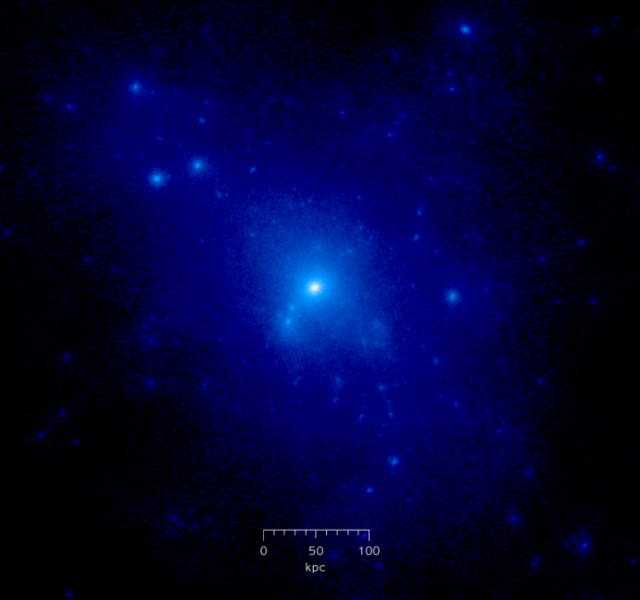
Galactic halos, consisting of a spherical envelope of dark matter along with sparsely scattered stars, globular clusters, and gas, typically surround most spiral galaxies. Current research is investigating the possibility that some halos may exist solely of dark matter. Discovering halos without stellar matter carries profound implications for our understanding of the universe’s structure, galaxy formation processes, and the conditions required for star formation. More importantly, such a discovery would provide a unique laboratory to study dark matter in isolation, free from interference of normal matter. However, new findings suggest that starless halos may be even rarer than previously thought. This scarcity makes detecting such halos particularly challenging, as they are unlikely to be associated with observable galaxies.

Ethan Nadler, of the University of California San Diego, has demonstrated that molecular hydrogen requires significantly less mass for star formation compared to atomic hydrogen. His research shows that molecular hydrogen can cool sufficiently for gravity to initiate star formation at lower mass thresholds. Specifically, while past studies indicated that dark matter halos need between 100 million to 1 billion solar masses of atomic hydrogen to begin star formation, Nadler has revealed that molecular hydrogen can achieve the same result with as little as 10 million solar masses—a reduction by a factor of 10 to 100. While dark matter halos can theoretically form with masses as low as 10⁻⁶ solar masses, depending on the nature of dark matter, those capable of influencing galaxy formation typically require at least 10⁶ solar masses to enable star formation, further highlighting the challenge of finding starless halos. Detecting these small, starless halos would require identifying subtle perturbations in gravitational fields, a difficult task that may yield little if such halos are as rare as current models suggest.

Source: …Galaxy Formation Threshold, Nadler, AAS, April 2025. Graphic: Dark Matter Halo Simulation by Cosmo0. Public Domain.

Geo Anomalies

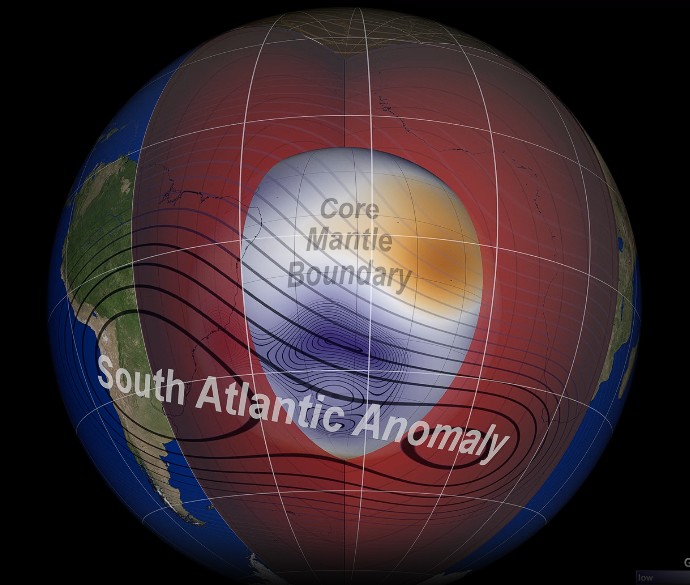
NASA has identified the South Atlantic Magnetic Anomaly (SAA) as a region off the coast of South America, where Earth’s magnetic field is significantly weaker. This weakening reduces magnetic shielding, exposing satellites and spacecraft to higher levels of radiation and posing a risk to their operation. Understanding the causes and implications of the SAA is essential for addressing these LEO challenges.

One hypothesis suggests that irregularities at the core-mantle boundary disrupt the geodynamo, the mechanism generating Earth’s magnetic field. The anomaly’s alignment with submarine volcanic features hints at possible links between mantle-crust interactions and magnetic disturbances. Additionally, a hotspot near the Mid-Atlantic Ridge corresponds to a geomagnetic intensity minimum at the core-mantle boundary, implying that thermal and compositional anomalies in the mantle may affect convection in the molten outer core, creating localized variations in the magnetic field.

Further research using subsurface imaging will help in uncovering the internal processes shaping Earth’s magnetic field and enhancing our understanding of the planet’s protective geodynamo.also assist in predicting magnetic anomalies and their effect on LEO space flight in the future.

Source: NASA. Graphic. Core Geomagnetic Anomaly, NASA.

Priorities

NASA has farmed out a considerable portion of its science and engineering programs to the private sector so it can concentrate on the critical issues that will get some of humanity’s eggs off this planet.

NASA’s budget for 2023 was $25.4 billion.

Source: Briley Lewis, Popular Science, 22 May 2024. Graphic: DALL.E 3 generated.

Explorations 20: Again, You Speak

The United States Air Force commissioned the Massachusetts Institute of Technology’s Lincoln Laboratory to design and build a series of satellites, known as Lincoln Experimental Satellite (LES), that would test both devices and techniques for satellite communication. The stated goal was to increase the downlink transmission capabilities of small satellites. The development phase of the program ran from 1965 to 1976 but the last satellite developed, LES-9, continued to transmit data for 44 years until it was decommissioned in the year 2020.

FootnoteA

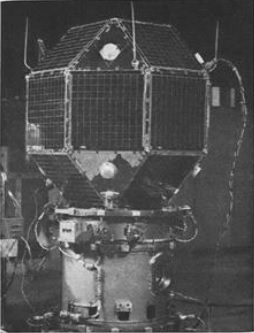
The first satellite the Lincoln Laboratory developed was the LES-1. It was designed to test a solid-state X-band transmitter while in orbit above the Earth. A ground-based mobile receiver was also part of the test package.

The LES-1 was a 26-sided polyhedron, with eighteen square faces and eight triangular faces. Also known as a rhombicuboctahedron, a small rhombicuboctahedron, or an Archimedean solid, if you really must know. It had a diameter of 61 cm (24 inches) and a mass of 31 kg (68 lbs.). The square faces were covered with 2,376 solar cells generating a minimum of 26 W in sunlight. The eight triangular faces held Earth and Sun sensors and eight semi-directional horn antennas.

FootNoteB

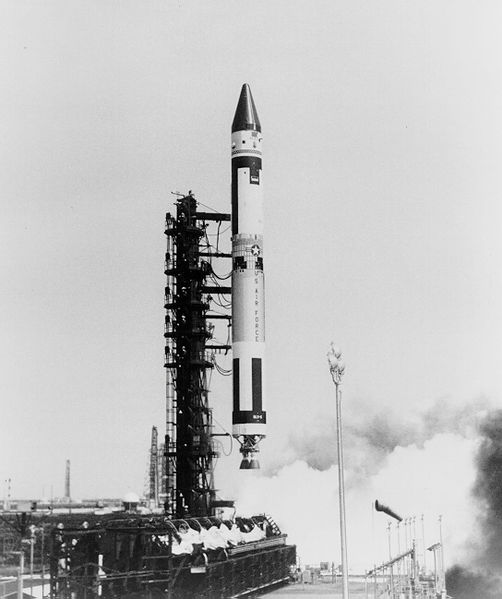
The satellite was launched on a Titan 3A rocket which was a modified two-stage Titan 2 ICBM with a third stage added. The rocket lifted off from Kennedy Space Center on 11 February 1965 and the first two stages performed their mission successfully. The third stage after its first burn placed the satellite into its planned 185-kilometer (115 mile) orbit. The second burn of the third stage moved the satellite into a 2,777 by 2806 kilometer (1726 by 1744 miles) slightly elliptical orbit. At this point, the satellite was deployed with a destination of 18,500-kilometer (11495 mile) apogee orbit. Because of a malfunction the smaller attached satellite rocket didn’t fire, and the satellite remained in its 2,777-kilometer orbit. Despite this failure, the project was still able to collect some useful data, but the satellite was spinning out of control making continued operations difficult. The LES 1 was shut down in 1967.

On 18 December 2012, the satellite woke up after 46 years of silence. A signal from LES 1 was detected in North Cornwall, England by an amateur radio operator. It is believed that a short developed in the satellite which allowed its power system to reach the transmitter directly. The signal being transmitted is believed to be a test tone but because the satellite is tumbling it sounds ghostly and garbled.

As of 2022 the satellite is still transmitting. It is now referred to as a zombie satellite.

References and Readings:

Abandoned in Space in 1967, a U.S. Satellite Started Transmitting Again in 2013. By Stefan Andrews. The Vintage News. 2017

Zombie Satellites: The Tale of Lincoln Experimental Satellite 1. By Andrew LePage. Drew Ex Machina. 2022

NSSDCA/COSPAR ID: 1965-008C. By Unknown. NASA. Date Unknown

FootNotes:

FootNoteA: LES 1 with Kick Motor. U.S. Air Force photo. Public Domain

FootNoteB: Launch of the first Titan IIIA from Pad 20, 1 Sept 1964. U.S. Air Force photo. Public Domain.