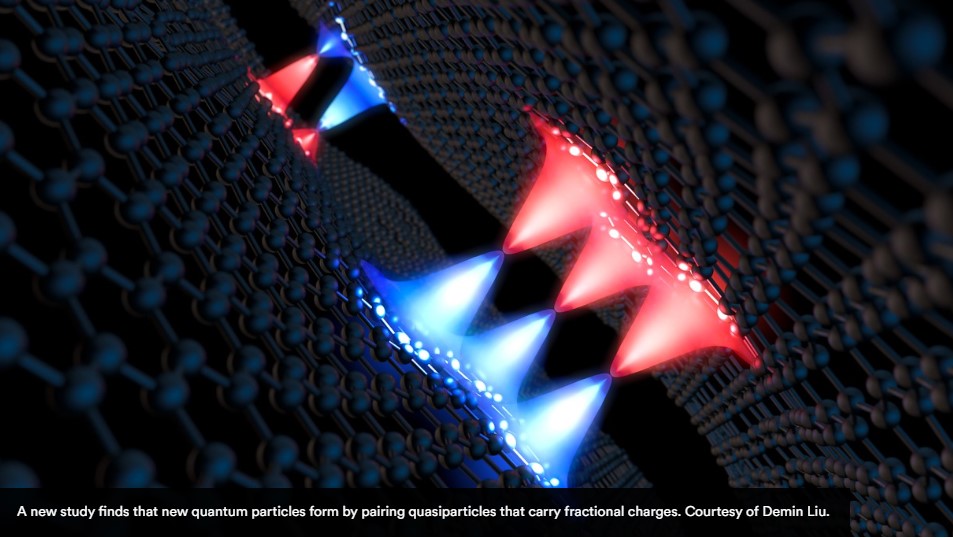
Physicists at Brown University have recently observed a new class of quantum particles called fractional excitons.
Excitons consist of an electron and an electron hole (a quasiparticle, a concept, representing the absence of an electron where one should exist). They allow for energy transfer in a lattice, such as in a transistor. Applying voltage to a transistor influences the movement of electrons and holes through the material. Simplified, this movement can turn the current flow on and off, forming a logic gate.
Despite being composed of fermions, excitons exhibit bosonic behavior and follow bosonic statistics. Fractional excitons, however, show behaviors that don’t fully align with either fermions or bosons. This suggests they belong to a new class of particles with previously unobserved quantum properties.
The researchers speculate that these fractional excitons may lead to advances in quantum computing.
Source: Excitons, Zhang et al, Nature, 2025. Graphic: Quasiparticles, Demin Liu, Brown University 2025.
 elsToday