Monroe Doctrine

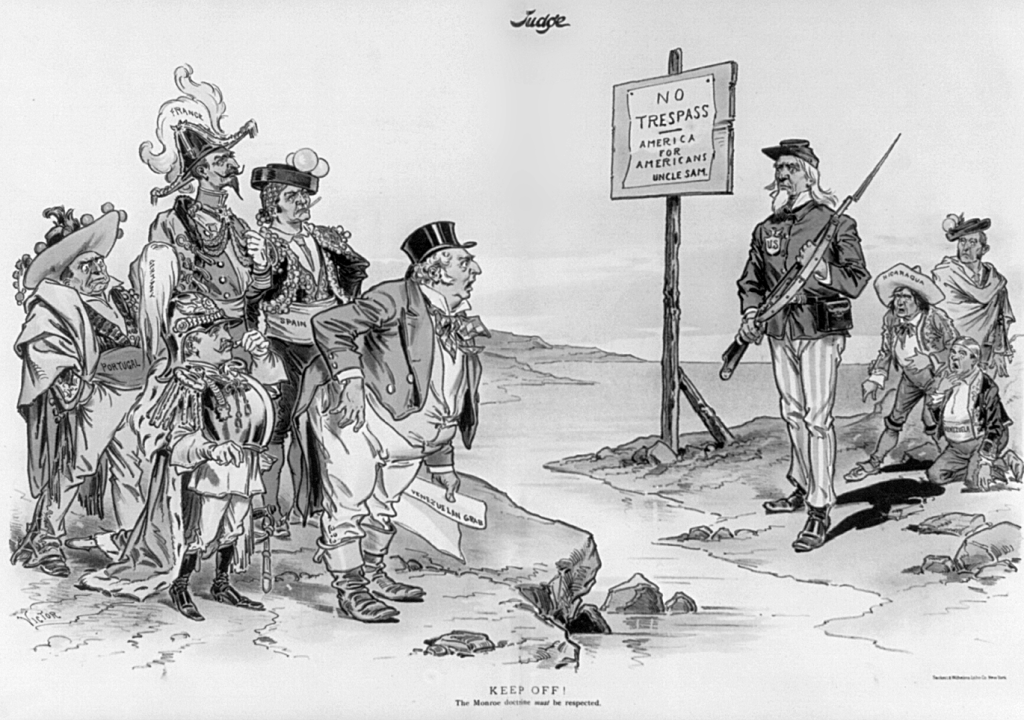
In 1823, President James Monroe issued what became known as the Monroe Doctrine, warning European powers against further colonization or interference in the New World. Though never codified into law or treaty, the doctrine became a guiding principle of U.S. foreign policy, invoked and reinterpreted by successive administrations to assert American influence in the hemisphere. Theodore Roosevelt expanded it, Barack Obama’s administration declared it obsolete, and Donald Trump revived its assertive tone. Its malleability is hailed by some as its strength, denounced by others as its greatest flaw.

The Monroe Doctrine became a symbolic fence around the Western Hemisphere, a firewall against nineteenth‑century imperial powers. Over the next two centuries, it evolved through corollaries, confrontations, and periods of dormancy. Today, in the shadow of Chinese expansion, mainly through its Belt and Road Initiative, Latin American states are drawn to twenty‑first‑century infrastructure with age‑old colonialism lurking in the background. But the Chinese buying influence in the hemisphere is aimed directly at the United States, seeking to erode its traditional dominance and reshape regional loyalties.

The Monroe Doctrine was intended to thwart enemies, potential and real, at the gate. With the exception of Cuba, it largely succeeded through the twentieth century. The 21st century now poses a test of whether the doctrine still has teeth.

If conflict with China is fated, then the United States must first secure its own backyard. The Western Hemisphere cannot be a distraction or a liability, a source of angst and trouble. Before turning its full strategic gaze toward the Middle Kingdom, the U.S. must seal the gates of the New World.

The Monroe Doctrine was written mainly by President Monroe’s Secretary of State, John Quincy Adams. It aimed to support Latin American independence movements from Spain and Portugal, while discouraging Russian influence in the Pacific Northwest and preventing the Holy Alliance: Russia, Austria, Prussia, and France, from restoring monarchs in the Americas. But the doctrine was not all sword: the United States also pledged not to interfere in Europe’s internal affairs or its colonies.

In the early 1800s, the United States lacked the ability to enforce such a bargain militarily. Britain, however, was more than willing to use its naval fleet to guarantee access to New World markets and discourage competition.

By the beginning of the twentieth century, Theodore Roosevelt invoked and expanded the doctrine, effectively making the United States the policeman of the Western Hemisphere. During the Cold War, it was used to counter Soviet influence in Cuba, Nicaragua, and Grenada.

By the 1970s the South American drug trade was declared a national security threat and the War on Drugs began with Colombia the epicenter of hostilities. In 1981, U.S. Congress amended the Posse Comitatus Act to allow military involvement in domestic drug enforcement, extending to Latin America. President Ronald Reagan’s 1986 National Security Decision Directive 221 declared drug trafficking a U.S. national security threat, authorizing military operations abroad, including in Colombia.

After the Cold War, the doctrine faded from explicit policy. In November 2013, Secretary of State John Kerry declared at the Organization of American States that “the era of the Monroe Doctrine is over,” framing a shift toward partnership and mutual respect with Latin America rather than unilateral dominance. By 2020 Colombia’s coca production had hit a new high.

Today, China’s Belt and Road Initiative, port construction and acquisitions, telecom infrastructure, and rare earth diplomacy have carved influence into Latin America and the Caribbean. In this context, the Monroe Doctrine was not asleep but, in a coma, its toes occasionally twitching.

Re-invigorating the Monroe Doctrine is not about making true allies and friends but removing vulnerabilities. The goal is not to bring these nations into the fold but to remove them from Beijing’s orbit.

By mid-2025 official statements claim that ~10% of the U.S. Navy is deployed to counter drug threats, ostensibly from Venezuela and Columbia. But fleet positioning hints at a different story. Most assets are stationed near Puerto Rico, the Virgin Islands, and Guantánamo Bay, closer to Cuba than Caracas. Surveillance flights, submarine patrols, and chokepoint monitoring center on the Florida Straits, Windward Passage, and Yucatán Channel.

This may suggest strategic misdirection. Venezuela is the declared theater, but Cuba is the operational keystone. The U.S. may be deflecting attention from its true concern: Chinese or Russian entrenchment in Cuba and the northern Caribbean.

The Monroe Doctrine began as a warning to monarchs across the Atlantic. In the late twentieth century, it morphed into a war on drugs. Today it reappears as a repurposed drug war, flickering as a warning to Beijing across the Pacific. Whether it awakens as policy or remains sleight of hand, its enduring role is to remind the world that the Western Hemisphere is not a theater for distraction but a stage the United States will guard against intrusion. In the twenty‑first century, its test is not whether it can inspire allies, but whether it can deny adversaries a foothold in America’s backyard.

Graphic: Monroe Doctrine by Victor Gillam, 1896. Public Domain.

Hamlet Goes to Milwaukee—A Tragicomedy in Five Acts

Prolepsis’ Prologue:

The Chorus enters. A single spotlight. A single Damocles’ bullet hangs in the air like a haunted ghost spinning to history’s rhythms and trajectories.

CHORUS:

John Schrank shoots Theodore Roosevelt, 113 long and mostly forgotten years ago, in Milwaukee, Wisconsin on a sharp and chilled Monday, coats pulled tight, 14 October 1912.

That’s the end, my friend, or so it seems. But tragedy demands context, and context demands sacramental passings. Let us reset and reconfigure the scene, with a sentimental barbershop quartet interlude of ‘Moonlight Bay’ drifting in the background and summon the ghosts of campaigns past and the raving refrains of the mad, all served with a bullet.

Act I: The Bull Rising

Before the Bull Moose and the bullet there was tradition and restraint. Before Roosevelt charged up the hill and across the plains, there was McKinley’s calm firmament.

William McKinley, 25th President of the United States, governed with a philosophy of calculated prosperity and protective nationalism, fittingly called the Ohio Napoleon, holding folksy court on America’s front porch. He was deliberate and firm but never rash, he was a Republican loyalist second, leader first, and a quiet expansionist, A Civil War veteran and devout Methodist, McKinley championed high tariffs, the gold standard, and industrial growth as the pillars of American strength.

His first term (1897–1901) unfolded as an economic recovery from Grover Cleveland’s faltering presidency and the Panic of 1893. It was marked by economic stabilization, the Spanish-American War, and the acquisition of overseas territories: Puerto Rico, Guam, the Philippines, and Hawaii, all additions to America’s imperial structure.

His vice president, Garret Hobart died, of heart failure in 1899 at the age of 55. With no constitutional mechanism to fill the vacancy, the office remained vacant until McKinley’s re-election. It wasn’t until the ratification of the 25th Amendment in 1967 that a formal process was established to replace a vice president.

In 1900, Theodore Roosevelt, then Governor of New York and war hero of the San Juan Hill, was chosen as McKinley’s running mate. His nomination was largely a strategy of containment: an attempt to temper his reformist zeal beneath the inconsequential and ceremonial weight of the vice-presidency.

Act II: Bull Cometh

The Bull Moose was buried beneath ceremony, but symbols cannot contain momentum. The front porch would give way to the lists and charging steeds.

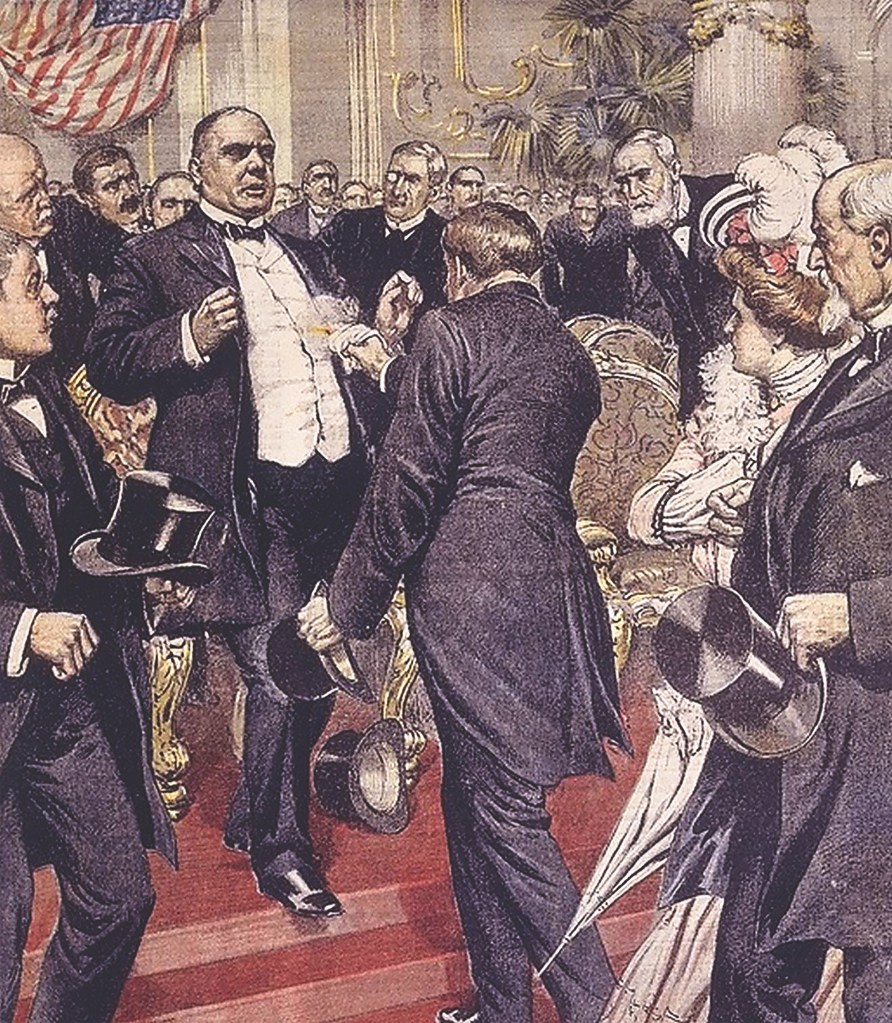
On September 6, 1901, President William McKinley stood beneath the vaulted glass of the Temple of Music at the Pan-American Exposition in Buffalo, New York, an American shrine to progress, electricity, and imperial optimism. There, in the charged glow of modernity, he was shot twice in the abdomen by Leon Czolgosz, a Polish American self-declared anarchist and bitter subject of the Panic of 1893 and its resultant mill closures, strikes and wage collapse, etched into his disillusioned psyche.

Czolgosz had been baptized in the radical writings of Emma Goldman, a Lithuanian emigree and firebrand of the American radical left. Goldman championed anarchism, women’s rights, and sexual liberation. She founded Mother Earth, a journal that became an infamous intellectual hearth for dissent and revolutionary analysis.

To Czolgosz, Mckinley was the embodiment of oppression: capitalism, imperialism, and state violence. His answer to these perceived provocations was violence. Concealing a revolver wrapped in a handkerchief, he fired at close range during a public reception, just as McKinley extended his hand in welcome.

Initially, doctors believed McKinley would recover. But gangrene developed around the damaged pancreas, and he died on 14th of September. His death was slow and tragic, a symbolic collapse of the front porch presidency.

Roosevelt, just 42, stepped up and became the youngest president in U.S. history (JFK was 43). With containment at an end, the Bull broke loose. And he mounted the stage with an agenda.

Act III: The Charge of the Bull

The Bull builds a protective legacy of words and stick, sweat and blood.

Roosevelt’s early presidency honored McKinley’s legacy: trust-busting, tariff moderation, and economic expansion. But he soon added his own signature: conservationism, progressive reform, and a bold, moralistic foreign policy.

He preserved 230 million acres of public land and established the U.S. Forest Service, 5 national parks, 18 national monuments, 150 national forests and a constellation wildlife refuges. Stewardship of the land became a sacred ideal that continues to present day.

In foreign affairs, Roosevelt extended the Monroe Doctrine with his Roosevelt Corollary (1904), asserting that the U.S. had the right to intervene in Latin America to prevent “chronic wrongdoing.” It was a doctrinal pivot from passive hemispheric defense against European imperialism to active imperial stewardship, cloaked in the language of civilization and order. America became the self-appointed policeman of the Western Hemisphere.

The corollary was a response to incidents like the 1902 Venezuelan debt crisis where European navies blockaded ports to force repayment. In Cuba, unrest was quelled with U.S. troops in 1906. Nicaragua, Haiti, and Honduras saw repeated interventions to protect U.S. interests and suppress revolutions. If Latin American failed to maintain order or financial solvency, the U.S. would intervene to stabilize rather than colonize.

The doctrine justified the U.S. dominance of the Panama Canal and set the precedent for Cold War interventions, neutralizing the American back yard while containing Soviet expansion in the east.

Act IV: Hamlet in Milwaukee

Heads of kings rest uneasy. Ghosts of injustice haunt. Princes fall prey.

After winning a full term in 1904, Roosevelt honored his promise not to seek reelection in 1908. But disillusioned with his successor, William Howard Taft, Roosevelt returned to politics in 1912, forming the Progressive Party, nicknamed the Bull Moose Party.

Enter stage left, John Schrank, a former barkeep plagued by visions and imagined slights. In the early morning hours of 15 September 1901, 6 days after McKinley was shot and 2 days before he died, the bar tender dreamt that the slain President rose from his casket and pointed to a shrouded figure in the corner: Roosevelt. “Avenge my death”, the ghost spoke. Schrank claimed to forget the dream for over a decade, until Roosevelt’s bid for a third term in 1912 reawakened the vision, which he now interpreted as a divine command.

Schrank believed Roosevelt’s third-term ambition was a betrayal of American tradition set forth in Washington’s Farewell Address. He hated Roosevelt and feared that he would win the election, seize dictatorial power, and betray the constitutional republic. In his delusional state, he believed Roosevelt was backed by foreign powers and was planning to take over the Panama Canal; an anachronistic fear, given total U.S. control of the canal since 1904. Schrank interpreted the ghost’s voice as God’s will: “Let no murderer occupy the presidential chair for a third term. Avenge my death.”

At his trial for the attempted assassination of Roosevelt, Schrank was remanded to a panel of experts to determine his mental competency. They deemed him insane, a “paranoid schizophrenic”, in the language of the time. He was committed to an asylum, where he remained until his death 31 years later.

Schrank’s madness parallels the haunted introspection of Hamlet, Prince of Denmark. Shakespeare’s longest and most psychologically complex tragedy that revolves around a ghost’s command: “Revenge my foul and most unnatural murder.” Hamlet, driven by the specter’s charge, spirals into feigned (and perhaps real) madness, wrestling with betrayal, duty, mortality, and metaphysical doubt. His uncle, the murderer, has married his mother; an Oedipal inversion within the world’s most enduring tragedy.

On 14 October 1912, as Roosevelt stood outside Milwaukee’s Gilpatrick Hotel, Schrank stepped forward and fired. The bullet pierced his steel glasses case and a folded 50-page tome of a speech, slowing its path. Bleeding, a bullet lodged in his chest, Roosevelt refused medical attention. He stepped onto the stage and spoke for 90 minutes, although it is said that due to his loss of blood, he shortened his speech out of necessity. Whether for himself or the audience is lost to history.

Unlike Hamlet, who dithers and soliloquizes his way toward a graveyard of corpses, Schrank shoots, hits, and leaves Roosevelt standing. Hamlet’s tragedy ends in death and metaphysical rupture. Schrank’s farce begins with the demands of a ghost and ends with a 90-minute speech. One prince takes his world with him into death. The other absorbs a bullet and keeps talking.

Act V: Ghosts and Republics

Ghosts and Republics are ephemeral. At the end of time; those fleeting moments, short and long; some, as Proust says, more and more seldom, are best treated with humor and grace.

In tragedy and near calamity, a man’s soul becomes visible. Some are seen darkly, others, bright, clear, unshaken and unafraid of new beginnings even if that beginning is death.

Roosevelt had already charged up San Juan Hill, bullets and fragments whistling past like invitations to a funeral ball. Each a death marker. So, when a solitary bullet from a madman struck him in Milwaukee, it was merely an inconvenience. He quipped: “Friends, I shall ask you to be as quiet as possible. I don’t know whether you fully understand that I have just been shot, but it takes more than that to kill a Bull Moose.”

Sixty-eight years later, Reagan too survived a bullet to the chest. As he was wheeled into the emergency room at George Washington University Hospital, he said he’d “rather be in Philadelphia,” a throwback to his vaudeville days, a gag line used on fake tombstones: “Here lies Bob: he’d rather be in Philadelphia.” W.C. Fields once requested it as his epitaph. He’s buried in California. To the surgeons, Reagan added: “I hope you’re all Republicans.”

Where Roosevelt offered mettle, Reagan offered mirth. Both answered violence with theatrical defiance: natural-born and unshakable leaders, unbothered by the ghosts that tracked them.

They were not alone. Jackson, beat his would-be-assassin with a cane. Truman kept his appointments after gunfire at Blair house. Ford faced two attempts in seventeen days and kept walking. Bush stood unfazed after a grenade failed to detonate. They met their specters with grace, a joke, and a shrug.

The assassins and would-be assassins vanished into the diffusing whisps of history. The leaders of men left a republic haunted not by ghosts, but by a living memory: charged with the courage to endure and to imagine greatness.

Graphic: Assassination of President McKinley by Achille Beltrame, 1901. Public Domain.

Decline Post Bretton Woods

Bretton Woods, a monetary system established during World War II, sought to stabilize the global economy by making the US dollar the central currency for international trade. Other currencies were pegged to the dollar, which foreign governments could convert into gold bullion at a fixed rate. This framework functioned effectively for decades, however, by the late 1960s, inflationary pressures stemming from the Vietnam War and the domestic spending initiatives of the “guns and butter” era, coupled with a growing accumulation of US dollars in foreign accounts, strained the system’s stability. In 1971, the United States suspended the dollar’s gold convertibility, effectively collapsing the Bretton Woods framework and transitioning to a market-based system of freely floating exchange rates, setting the stage for the dollar’s decline.

Since the demise of Bretton Woods, the US dollar has lost approximately 85% of its purchasing power due to inflation, a monetary phenomenon driven by increases in the money supply. Free trade has exacerbated US economics, including the loss of 6.8 million manufacturing jobs between 1979, the peak of manufacturing employment, and 2019. Many of these jobs shifted to China after its entry into the World Trade Organization in 2001. Middle-class wages have stagnated, remaining at an average of $40,000 per year (adjusted for inflation) since 1970, while housing costs have tripled to $400,000. Meanwhile, the rising costs of child-rearing, $310,000 per child in 2023, have contributed to a declining fertility rate, which has fallen from 2.5 to 1.6 children per woman.

China’s role in US economic decline is significant with a trade deficit of $263 billion in goods and services for 2024 alone. Chinese tariffs protect key industries such as steel and electronics, leaving US manufacturing unable to compete. Federal Reserve policies, including a 40% increase in the M2 money supply since 2020, have inflated asset prices like homes and stocks but failed to meaningfully raise middle-class wages. Wealth inequality has intensified, with the top 1% controlling 40% of the nation’s wealth while Middle America’s share continues to shrink. Trade deficits reached $1.2 trillion in 2024.

Trump’s tariffs can be seen as a reaction to these trade imbalances and loss of domestic manufacturing. Additionally, new measures are seeking to rewrite regulatory and fiscal policies, to address these global inequalities. By 2030, projections suggest 2 million new jobs could be created, including 200,000 to 300,000 directly tied to tariffs, with blue-collar median wages rising to around $60,000. A stronger dollar, inflation below 2%, and a revived manufacturing base could potentially revive the American middle-class, making families more optimistic about the future. Continuing on the same trajectory as the past 50 years risks further erosion of the American dream.

The Fable of the Turkey

Drum, a plump turkey, trusted his caring master, Strum, who fed him daily and cooed, “You’re the finest bird here.” Drum, a data geek, tracked his weight, 18 pounds on day 300, projecting 24 by day 400. On day 364, a Wednesday, he lost his head and some weight. By Thursday, day 365, Strumpf found him tasty, and his weight hit zero. Blind trust in trends can carve you up.

The Census Bureau’s 2023 Population Projections for the U.S. to 2100 play the same game. This “projection, not prediction” uses births (Total Fertility Rate, TFR, at 1.6), deaths, and net migration, spinning four population scenarios: Zero Immigration (333 million today drops to 226 million, down 32%), Low (down to 317 million), Main (up to 369 million), and High Immigration (435 million with 1–1.5 million newcomers yearly). Only immigration increases the population; births and deaths stay flat. It’s 78 years built on 2–3 years of data; no risks, no “what ifs,” no alternatives.

This is a house of cards sold as insight. Projections might hold up in the short term, but 78 years? Please. The Census Bureau, I assume, pitches this study for policy, budgets, districts, but it’s a narrative push: immigration or bust. Zero immigration craters us to 226 million; 1.5 million new bodies annually swells the population to 435 million. Yes, immigration boosts numbers, but why’s it the only solution? No probe into low births, no fixes beyond “import more bodies.” It’s not analysis, just bait for Congress and the public.

A growing or declining population has consequences. A 30% drop could tank GDP and programs such as Social Security. Or yield cheaper homes and a leaner U.S., like Japan (96 million by 2050, still thriving). Growth has costs too, more support for Social Security but more sprawl, maybe more crime, resource strains but the Census skips over those trade-offs. And a low TFR isn’t fate. The WWII generation raised four kids on $60,000 (adjusted) when homes were $12,700. Now we have $420,000 homes, $65,000 wages, and $10,000-per-kid childcare, maxing out affordable families at two. Inflation (2%+ since ‘71) and $36 trillion in debt, increasing by a trillion every 3 months, destroyed the dollar and concomitantly the Federal Reserve and government killed big families.

Increasing family size is a choice. Possible solutions to reverse the trend are tax credits at $5,000 per kid, or even an expanding credit for each additional child above 2, could lift TFR from 1.6 to 2.1 by 2035. That’s 700,000–1 million extra births annually within a decade, millions more Americans by 2050, no immigration spike needed. Cut housing costs by slashing senseless regs, open land to building, drop mortgage rates to 1%) and one income might work again. A declining family size is a choice, not a given.

The Census Bureau releases raw numbers, no “why,” no debate. Immigration’s one fix but not the only one. The government broke the system; it can unbreak it. Next time, Mr. Census Bureau, ask some questions, beyond just slinging spurious stats to support a preferred narrative.

Source: Census Bureau, The Black Swan, Fable of the Bees.  Graphic: Population Projections by the Census Bureau.

14th Amendment

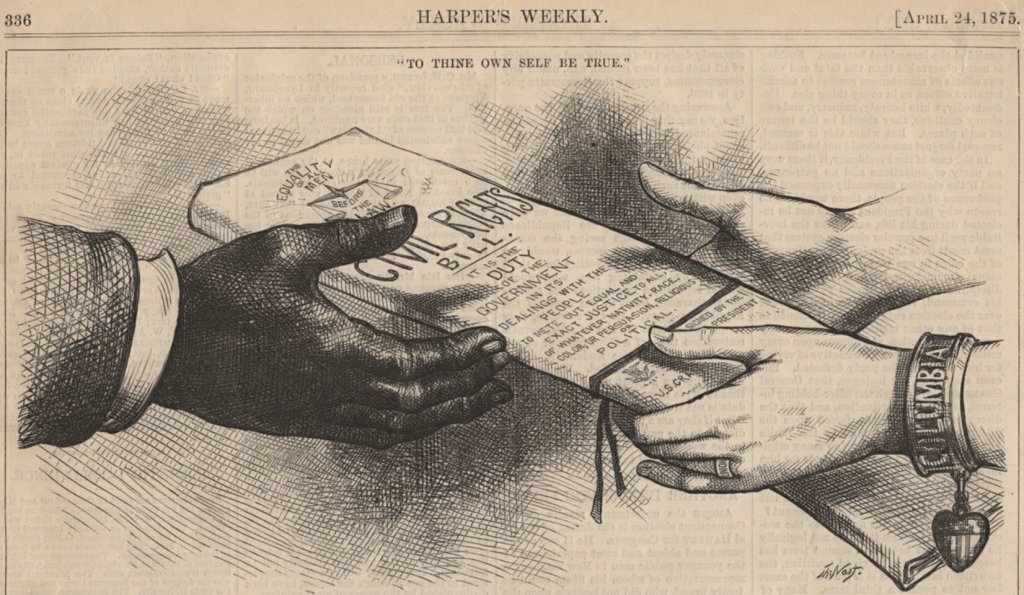
The 14th Amendment, introduced during the Reconstruction era, was crafted to address legal and constitutional deficiencies exposed after the U.S. Civil War. Its first sentence; “All persons born or naturalized in the United States, and subject to the jurisdiction thereof, are citizens of the United States and of the State wherein they reside“, has become a focal point for competing interpretations. Much like the Second Amendment, its wording has sparked legal and grammatical debates, particularly surrounding the clause “and subject to the jurisdiction thereof.”

The Second Amendment faced similar scrutiny for over 200 years, particularly its prefatory clause, “A well-regulated Militia.” This ambiguity was finally addressed in District of Columbia v. Heller (2008), where the Supreme Court clarified that the historical record and documents like the Federalist Papers supported the right of private citizens to own firearms. The Court also ruled that the prefatory clause did not limit or expand the operative clause, “the right of the people to keep and bear Arms, shall not be infringed.

Likewise, the 14th Amendment’s clause “and subject to the jurisdiction thereof” remains unsettled, awaiting similar historical and grammatical scrutiny to solidify its interpretation. Initially aimed at protecting freed slaves and securing their citizenship, this provision has since invited broader interpretations in response to modern challenges like immigration.

The framers’ intent during Reconstruction was to ensure equality and citizenship for freed slaves and their descendants, shielding them from exclusionary laws. At the time, the inclusive principle of jus soli (birthright citizenship) aligned with the nation’s need to address the injustices of slavery and foster unity among the country’s existing population. However, changing migration patterns and modern cultural dynamics have shifted the debate. The ambiguity of “subject to the jurisdiction thereof” now raises questions about its application, such as how jurisdiction applies to illegal immigrants or children of foreign diplomats, in a globalized world.

Legal precedents such as United States v. Wong Kim Ark (1898) affirmed that nearly all individuals born on U.S. soil are citizens, regardless of whether their parents’ immigration status is legal or illegal. While this aligns with the practical interpretation of jurisdiction, it has spurred debates about the fairness and implications of modern birthright citizenship practices.

Immigration today involves a broader spectrum of cultures and traditions than during earlier waves, when newcomers often shared cultural similarities with the existing population. Assimilation, once relatively seamless, now faces greater challenges. Nations like Britain and Germany have recently revised their jus soli policies to prioritize the preservation of societal norms. The unresolved question of how to address declining populations further complicates the debate; a debate with the citizens that has not occurred much less resolved.

While originally crafted to address the systemic exclusion of freed slaves, the 14th Amendment’s principle of birthright citizenship continues to evolve in its application.

Graphic: 14th Amendment Harper’s Weekly.

Locke and Citizenship

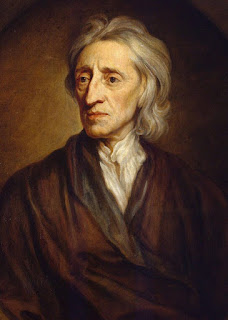
John Locke, the intellectual and philosophical father of modern Western democracies, argues in his Second Treatise of Government that membership in a political society—and thus citizenship—is not automatically granted by birth on a country’s soil alone. Instead, it depends on the concept of consent, whether explicit or tacit, and the allegiance of the parents. Locke asserts that a child’s status is tied to the political community of the parents rather than merely the geographic location of their birth. Citizenship to Locke was not a right but a contract between the governed and the government. A summation of his reasoning follows:

  1. Voluntary Consent as the Basis of Citizenship: Locke begins with the premise that all individuals are born free and equal in a state of nature. Political society emerges only through the voluntary consent of individuals to join together. For Locke, citizenship is not an inherent trait but a contractual relationship. A child born on foreign soil to non-citizen parents has not entered this contract, nor have their parents done so on their behalf.
  • Parental Influence on Political Identity: Locke suggests that a child’s initial political identity derives from their parents. He describes the natural subjection of children to parental authority, implying that their political allegiance aligns with that of their parents until they reach an age where they can consent for themselves. If the parents are foreigners—not members of the political society where the child is born—they owe no allegiance to that country’s government, and thus neither does the child by extension.
  • Rejection of Jus Soli: Unlike later theories of jus soli (right of the soil), Locke does not consider birth on a territory sufficient for citizenship. He distinguishes between temporary presence and permanent allegiance. A foreigner residing in a country does not automatically become a member of its commonwealth unless they explicitly consent to its laws and government. A child born to such foreigners, being incapable of agreeing to these terms, does not acquire citizenship through birth alone.
  • Tacit Consent and Its Limits: Locke acknowledges that tacit consent—such as owning property or residing long-term in a country—can signal allegiance. However, a newborn child cannot provide consent, tacit or otherwise. If the parents are merely visitors or temporary residents, their presence does not imply a commitment to the political community, and thus the child does not gain citizenship by default.
  • An Illustrative Analogy: Locke reinforces his argument with an example: a child born to English parents in France does not become a French subject simply because of the location of birth. Instead, the child remains tied to the English commonwealth through the parents’ allegiance. This reflects Locke’s view that citizenship stems from political bonds, not just physical geography.

In summary, Locke’s arguments about citizenship, consent, and political society in his Second Treatise of Government are deeply rooted in his broader natural law framework. Natural law, for Locke, is a set of universal moral principles derived from reason and human nature, which govern individuals in the state of nature—before the establishment of organized political societies.

Locke contends that a child born on foreign soil to non-citizen parents is not a citizen of that country because citizenship requires consent and allegiance, which the child inherits from the parents’ status rather than the place of birth. Furthermore, a minor lacks the capacity to consent to the laws and allegiance of a foreign land. Locke’s reasoning underscores individual agency and the contractual nature of political membership, prioritizing these over a purely territorial basis for citizenship.

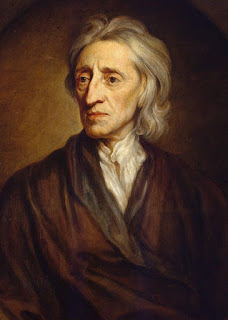
Source: Second Treaties of Government by John Locke, 1690. Graphic: John Locke by Godfrey Kneller 1697.  Public Domain.

Locke and Jefferson

John Locke’s theory on the social contract is a cornerstone of his political philosophy and western democracies, as outlined in his work “Second Treatise of Government.” According to Locke, the social contract is an agreement among individuals to form a government that will protect their natural rights to life, liberty, and property. The social contract is a compromise between man’s inherent natural rights and the need to preserve and protect those rights.

Thomas Jefferson, in his Declaration of Independence builds on Locke’s concepts, tweak is probably a better word. Locke writes that people have “natural rights” to “life, liberty, and estate” (property), and if a government violates these, it’s “dissolved,” giving people the right to form a new one. Jefferson writes into the Declaration its famous “life, liberty, and the pursuit of happiness”—swapping “property” for a broader, aspirational feel. Locke’s idea that government derives legitimacy from the “consent of the governed” shows up when Jefferson lists grievances against King George III, arguing the king’s abuses justify breaking away. And Locke’s justification for revolution—“when a long train of abuses” threatens these rights, people can resist—mirrors Jefferson’s “whenever any Form of Government becomes destructive of these ends, it is the Right of the People to alter or to abolish it.”

Locke’s key points in his Second Treatise:

  1. State of Nature: Locke believed that in the state of nature, individuals are free and equal, governed by natural law, which dictates that no one should harm another in their life, health, liberty, or possessions. Anarchy with adherence to God’s moral code.
  2. Natural Rights: Locke argued that individuals have inherent rights to life, liberty, and property. These rights are inalienable and must be protected by any legitimate government.
  3. Consent of the Governed: Locke emphasized that government derives its authority from the consent of the governed. People agree to form a government to protect their natural rights, and this consent is the basis of political legitimacy.
  4. Limited Government: Locke’s social contract theory advocates for a government with limited powers, designed to serve the common good and protect individual rights.
  5. Right to Revolution: Locke believed that if a government becomes tyrannical and or violates the social contract, the people have the right to revolt and establish a new government that will better protect their rights.

Source: Second Treaties of Government by John Locke, 1690. Graphic: John Locke by Godfrey Kneller 1697.  Public Domain.

The Mystic

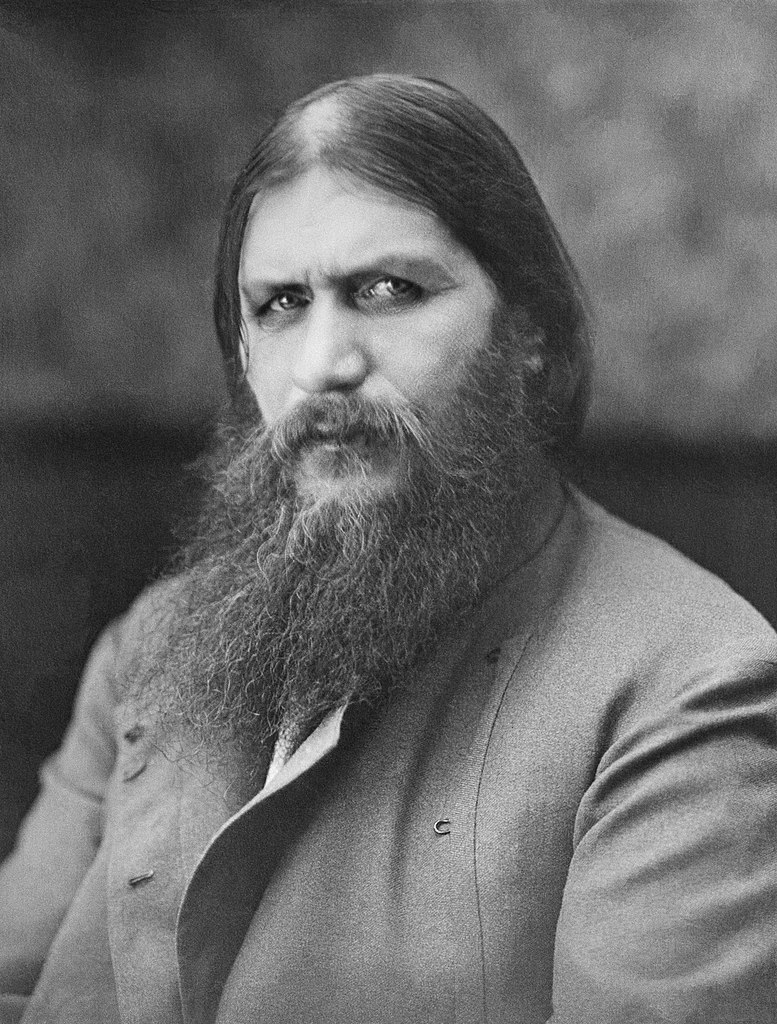
Rasputin: Dark Servant of Destiny.  Grigori Rasputin, often referred to as the “Mad Monk,” was a peasant with a fondness for madeira, cheap steaks, and prostitutes. He seemingly cured the Tsar’s son, Alexei, returning him to health by a gift from God: the power of faith.

Rasputin, living by the Russian proverb “You can’t avoid that which is meant to happen,” accepted his fate and was welcomed by the Empress and her son into the royal household with open arms. However, he was later expelled from the royal household by the Tsar and his handlers for violating another Russian proverb: “Don’t bring your own rules into someone else’s monastery.”

Rasputin: Dark Servant of Destiny, a 1996 HBO TV movie seen by almost no one, is Alan Rickman’s tour de force. It provides an exquisite emotional interpretation of religious fervor and mystical power. The film brings the myth of Rasputin into the realm of authenticity and historical plausibility.

The film recreates Rasputin’s madness amidst the early 20th-century events that predated and possibly presaged the madness of events set into motion by Lenin in 1917 (Rasputin was murdered towards the end of 1916). These events led to what Orwell succinctly summarized in “Animal Farm” when the new boss replaced the old boss: “The creatures outside looked from pig to man, and from man to pig, and from pig to man again; but already it was impossible to say which was which.

Genre: Biographical, Drama, Historical

Directed by: Uli Edel

Screenplay by: Peter Pruce

Music by: Brad Fiedel

Cast: Alan Rickman, Greta Scacchi, Ian McKellen, Freddie Finlay

Film Location: Budapest, Hungary and St. Petersburg, Russia

ElsBob: 7.0/10

IMDb: 6.9/10

Rotten Tomatoes Critics: -%

Rotten Tomatoes Popcornmeter: 79%

Metacritic Metascore: -%

Metacritic User Score: -/10

Theaters: 23 March 1996

Runtime: 135 minutes

Source: Rotten Tomatoes, IMDb. Graphic: Rasputin Movie Trailer, copyright HBO.

Exploits in Dying

Grigori Rasputin, a Russian mystic, met an inglorious, improbable, and inexplicable end in 1916 at his assassin’s Moika Palace in Saint Petersburg. Although accounts vary, Rasputin’s executioners ostensibly made multiple attempts to murder him. They began with cyanide-laced cakes, which did not achieve their desired outcome. Next, in an attempt to reach a different result with the same measures, they offered him wine fortified with more cyanide. This attained the same result as the first attempt.

Following this, they shot him multiple times, but he continued to move, eventually attacking his would-be murderers. Finally, they wrapped him up in a carpet and tossed him into a freezing river, where he supposedly died of hypothermia.

A less imaginative account of his death suggests that he died from a single bullet to the head.

Rasputin supposedly left a letter, which was read by Alexandra, the wife of Tsar Nicholas II, prophesizing that if he was killed by Russian nobles, the Russian Tsar’s family would be executed within a few years.

Source: Biography, 2021. Graphic; Rasputin, c1910, Russian Empire, public domain. 

Journalism – New York Times 2008

In February 2008, The New York Times published an anonymously sourced front-page story accusing Senator and Republican presidential candidate John McCain of having an improper relationship with telecommunications lobbyist Vicki Iseman. Both McCain and Iseman denied the allegations.

Critics blasted the paper for running a front-page story based on slender and anonymous sourcing. Steve Schmidt, McCain’s campaign advisor, sneered, “It was something that you would see in The National Enquirer.” A few days after the story ran, Times ombudsman Clark Hoyt criticized it for being short on facts, writing, “If you cannot provide readers with some independent evidence, I think it is wrong to report the suppositions or concerns of anonymous aides…

Vicki Iseman sued The New York Times for defamation in December 2008. The case was settled a few months later, but the Times did not issue a retraction. They did, however, publish a clarifying note stating that they did not intend to imply an improper relationship between Iseman and McCain. John Dean, writing for Verdict, commented on the absurdity of the defamation agreement, stating, “Rather than apologize and/or retract, they [the Times] would merely say what they said is not what they meant, and that readers should not be fooled into understanding what they read as saying what everybody thought it said.

Source: Times Hit Piece Dying on Media Vine by Clay Waters, 2008. Who Won…by John Dean, Verdict, 2013.