Contrived

Conclave: The Pope has died, and Cardinal-Dean Thomas Lawrence (Ralph Fiennes) must convene a Conclave of the College of Cardinals to choose a new Pope. A Conclave acknowledging not so much the guiding hand of God but the vanities of man.

Conclave features stunning visuals and competent acting, yet it is undermined by a script full of amateurish, contrived plot twists designed, supposedly, to advance the writers’ Robert Harris and Straughan’s feverish dreams of utopian Church doctrine rather than create a compelling narrative of suspense detailing the fallibility of man. After 120 minutes of an unending, stacked series of Deus ex machina plot devices, the fatigue reaches a smothering comatose level. Mercifully, the movie ends not with applause but with a resounding sigh of relief that your cinematic suffering is over.

Trivia: According to John Mulderig, under canon law in pectore appointments end with the pope’s death. Cardinal Benitez would not have been allowed into the Conclave.

Genre: Drama-Mystery-Suspense-Thriller

Directed by: Edward Berger

Screenplay by: Peter Straughan

Music by: Volker Bertelmann

Cast: Ralph Fiennes, Stanley Tucci, John Lithgow

Film Location: Rome

ElsBob: 3.0/10

IMDb: 7.5/10

Rotten Tomatoes Critics: 93%

Rotten Tomatoes Popcornmeter: 85%

Metacritic Metascore: 79%

Metacritic User Score: 6.8/10

Theaters: 25 October 2024

Runtime: 120 minutes

Budget: $20 million

Box Office: $34.8 million

Source: Rotten Tomatoes, IMDb, Metacritic.Catholic Review. Graphic: Concave Poster and Trailer, copyright Focus Features

A Twisted and Twisty Tale:

Strange Darling: A film portraying a one-night stand of innocent fun and desire in the same bloody vein as craving a joyride in a van full of Stephen King clowns. Misdirection, mayhem, and murder—oh my.

The movie’s story unravels in a non-linear manner, much the same as Tarantino’s ‘The Hateful Eight’, creating mystery and suspense by concealing the true nature of the characters and the plot until later in the film.

It has been noted that the Coen’s ‘No Country for Old Men’ came the closest to featuring the personality of a true psychopath: the irredeemable Anton Chigurh as played by Javier Badem. The antagonist in ‘Strange Darling’ easily moves Chigurh to a distant second place.

Trivia: The opening credits and Mollner hint, during interviews, that the movie may be based on actual events but there are no known serial killer incidents to support this. Mollner also comments that “…to me, it’s all real—inside my head and inside my heart.” Yikes.

Trivia II: The song ‘Love Hurts’ by Bryant and Bryant, is prominently played in the movie and was also featured in Rob Zombie’s remake of ‘Halloween’ and ‘Halloween II’.

Genre: Horror—Mystery–Suspense–Thriller

Directed by: JT Mollner

Screenplay by: JT Mollner

Music by: Craig DeLeon

Cast: Willa Fitzgerald, Kyle Gallner

Film Locations: Oregon, USA

ElsBob: 7.0/10

IMDb: 7.2/10

Rotten Tomatoes Critics: 95%

Rotten Tomatoes Popcornmeter: 85%

Metacritic Metascore: 80%

Metacritic User Score: 6.9/10

Theaters: 23 August 2024

Runtime: 96 minutes  

Budget: $4-10 million

Box Office: $3.8 million

Source: Rotten Tomatoes, IMDb, Metacritic. Graphic: ‘Strange Darling’ Poster and Trailer, Miramax

Caged

Longlegs: Lee Harker (Maika Monroe), mildly clairvoyant, rookie FBI agent, tackles a satanic serial-killer case with the enthusiasm of a vampire seeking high noon.

The movie possesses a few good, creepy scares molded around a very predictable plot with characters needing the IQ of twigs to make the story work.

Nicholas Cage elevates the movie to watchable while simultaneously establishing a serious deficiency in talent for the remainder of the cast that chose to perform in front of the camera.   Unfortunately, his acting is not enough to salvage this flick.

Trivia: Three songs by Marc Bolan’s band, T-Rex are woven into the Longlegs’ plot: Get It On, Jewel, and Planet Queen. All three songs provide a creepy, lyrical cadence to the horror that is Longlegs.

More Trivia: Zilgi who is credited with the music score is Osgood Perkins brother, Elvis Perkins, both of whom are the sons of the late actor and director Anthony Perkins.

Genre:  Crime–Horror—Mystery—Suspense–Thriller

Directed by: Osgood Perkins

Screenplay by: Osgood Perkins

Music by:  Zilgi

Cast: Nicolas Cage, Maika Monroe, Blair Underwood, Alicia Witt

Film Locations:  Vancouver, British Columbia, Canada

Els: 5.0/10

IMDb:  6.8/10

Rotten Tomatoes Critics:  85

Rotten Tomatoes Audience:  60

Metacritic Metascore: 77

Metacritic User Score:  6.3/10

Theaters: 12 July 2024

Runtime: 101 minutes

Budget:  <$10 million

Worldwide Box Office:  $104.1 million

Source: IMDb. Rotten Tomatoes. Metacritic. Graphic: Movie trailer, copyright Neon.

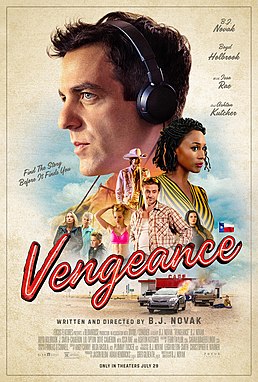
Vengeance

A New York writer’s hookup girlfriend dies, possibly murdered, and he is emotionally coerced into attending her funeral in the sticks of Texas, followed up by a less than enthusiastic investigation of her death.

A film that clicks on all cylinders, screenplay, acting, directing, and social commentary of all things—too bad it died at the box office. It really is a great movie to watch if for no other reason than to see and hear the philosophy of Ashton Kutcher.Theaters: 29 July 2022

Streaming: 16 September 2022

Runtime: 107 minutes

Genre:  Comedy — Crime – Mystery — Thriller

ElsBob:  7.0/10

IMDB:  6.8/10

Rotten Tomatoes Critics:  82/100

Rotten Tomatoes Audience:  86/100

Metacritic Metascore:  65/100

Metacritic User Score:  6.4/10

Directed by: B.J. Novak

Screenplay by: B.J. Novak

Music by:  Finneas O’Connell

Cast: B.J. Novak, Boyd Holbrook, J. Smith-Cameron, Ashton Kutcher

Film Locations:  New Mexico

Budget: $22 million

Box Office: $4.4 million

Source: IMDb. Rotten Tomatoes. Metacritic. Graphic: Vengeance Movie Poster 2022, Focus Features copyright.

Coens’ First

Blood Simple.

Theaters: 12 October 1984

Streaming: 6 December 2022

Runtime: 96 minutes

Genre:  Crime – Drama — Mystery — Neo-Noir — Thriller

Els:  7.5/10

IMDB:  7.5/10

Rotten Tomatoes Critics:  95/100

Rotten Tomatoes Audience:  8.3/100

Metacritic Metascore:  84/100

Metacritic User Score:  8.0/10

Directed by: Joel Coen

Screenplay by: Joel and Ethan Coen

Music by:  Carter Burwell

Cast: John Getz, Francis McDormand, Dan Hedaya

Film Locations:  Austin and Round Rock, Texas

Budget:  $1.5 Million

Worldwide Box Office:  $2.7 Million

Blood Simple is a twisted Texas tale of a honky-tonk owner, a cheating wife, contract killings, misunderstandings, and violence.

This is the Coen brothers’ first movie along with the first major film for Barry Sonnenfeld and Francis McDormand. A classic neo-noir crime film setting the stage for Fargo and No Country for Old Men down the road.

The film was ranked at number 98 on AFI’s 2001 movie listing of the top 100 Thrills in American cinema. In case you are wondering Hitchcock’s 1960 film, Psycho was first.

Source: IMDB. Rotten Tomatoes. Metacritic. Wikipedia. Graphic: Movie Poster, Circle Releasing.

Boo in the Night

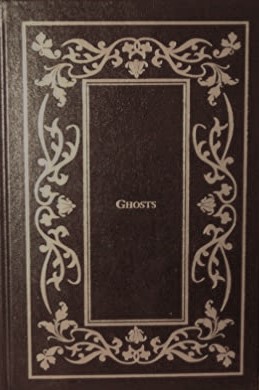
Ghosts: A Treasury of Chilling Tales Old and New

Edited By Marvin Kaye

Published by Borders Classics

Copyright: © 2005

A ghostly collection of 53 short stories of the supernatural by authors known and unknown, many memorable, a few best forgotten, the frightening mingled with the ridiculous, overall, a compilation worthy of nighttime reading and bedtime frights.

This selection of stories mainly spans from the 1850s through the 1980s, with the big gun authors of Dickens, Wilde, Irving, Asimov, and Collins providing the most entertaining accounts of ghosts and their distressed victims. Dickens supplies the best punch line ending – ever in the ‘The Tale of Bagman’s Uncle”. Wilde’s ‘The Canterville Ghost” keeps it on the light side with a ghost slowly losing his mojo. Washington Irving’s contribution is from one of his lesser known, but delicious tales: ‘The Tale of the German Student’, a cautionary story for the good Samaritan. ‘Legal Rites’ is a tongue in check, but altogether a very original story by the sci-fi master Isaac Asimov featuring a ghost deciding that an imaginative lawyer trumps a milquetoast haunting.

There is more in this book of short stories, much more with plenty of authors that you have known since your younger years and a few that will turn out to be new friends in the future. The tales are all fun and short enough to read to go to sleep by. Sweet dreams.

Lawyer Stories Three

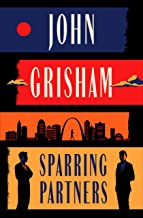
Sparring Partners

By John Grisham

Published by Doubleday

Copyright: © 2022

A trilogy of quick read novellas, although the form is closer to that of short stories; few characters with limited development and abrupt, into the concrete wall endings, detailing new tales of old friends and old tales of corrupt and feeble lawyers all wrapped around a common theme of dysfunctional families.

Digressing a bit, estimates for the number of books ever written, from Gilgamesh and the Book of Genesis, 3500-4000 years ago to the present day exceed 100,000,000 to maybe 150,000,000 with a couple million new titles added every year. I insert this tidbit of data into the discussion because I seldom read anything current in fiction for the simple reason that the catalogue of available books is unimaginably vast, hopelessly unreadable quantities with literature quality spanning parsecs of space and ink. Books of fiction that remain in print for 25-30 years and longer commonly have survived because a large audience has voted favorably on the work. Waiting for others to pass judgement relieves me of the painful task choosing good reads.

Returning to Grisham’s Sparring Partners, as I was hopping around Texas spending uneventful nights alone in uninteresting hotels, I went looking for a quick read from a known author in a shop selling mainly current best sellers. From the cover of this book the publishers state that Grisham has an unbroken string of 47 best sellers, a decent record for believing that the Sparring Partners would provide a fair bit of entertainment, possible reading enjoyment. The jury is still out but reverting to reading old books seems prudent.

Slow Sadness

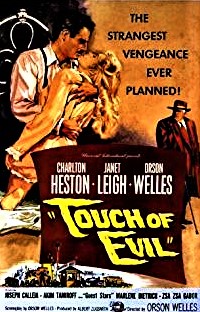
Touch of EvilM Touch 1958

Theaters:  February 1958

Streaming:  October 2000

Rated:  NR

Runtime:  95 minutes

Genre:  Classics – Crime – Drama –  Film Noir – Mystery – Suspense – Thriller

els:  8.5/10

IMDB:  8.1/10

Amazon:  4.4/5 stars

Rotten Tomatoes Critics:  8.9/10

Rotten Tomatoes Audience:  4.2/5

Metacritic Metascore:  NA/100

Metacritic User Score:  NA/10

Awards:

Directed by:  Orson Welles

Written by:  Orson Welles (screenplay), Whit Masterson: aka Robert Wade and Bill Miller (book)

Music by:  Henry Mancini

Cast:  Orson Welles, Charlton Heston, Janet Leigh, Marlene Dietrich, Zsa Zsa Gabor

Film Locations:  US

Budget:  $829,000

Worldwide Box Office:  $2,247,465

A man runs through a parking lot in a small Mexican town along the US border carrying a small package, placing it in the trunk of convertible moments before the owner and driver, Rudy Linnekar (Jeffery Green) and his young girlfriend Zita (Joi Lansing) arrive.  With the bomb ticking in the trunk of the car, Linnekar slowly drives through the town, filled with tourists and locals enjoying the cool night, heading for the nearby US border and home.  As they are driving, they pass the strolling newly married couple of Mike Vargas (Heston), a Mexican drug cop, and his American wife Susie (Leigh). The car crosses the border into the US and explodes.

Captain Quinlan (Welles), an obese cop with a bum leg, walking with the aid of a cane, arrives to take over the investigation of bombing. He quickly surmises that Sanchez (Victor Millan), who is secretly married to Rudy Linnekar’s daughter Marcia (Joanna Cook Moore), is the prime suspect.  Quinlan’s partner Pete Menzies (Joseph Calleia) plants incriminating evidence in Sanchez’s apartment and he is arrested. Vargas knows that the evidence against Sanchez was planted and begins to investigate the bombing and Quinlan, while letting his wife spend her honeymoon alone in some cheap deserted hotel in the dry scrublands of the American southwest.

Welles loosely based the movie’s screenplay on a 1956 Red Badge Mystery serial novel, Badge of Evil by Whit Masterson. The crime novel slowly solves the mystery of who killed Rudy Linnekar by blowing up his house with dynamite. The murder is investigated by police officers Hank Quinlan and Leron McCoy along with an assistant district attorney.  The 2 cops quickly make an arrest of Ernest Farnum, who soon commits suicide, even though incriminating dynamite was found in the apartment of Linnekar’s future son-in-law Delmont Shayon.

Whit Masterson is a pseudonym for 2 authors: Robert Allison “Bob” Wade and H. Bill Miller.  The pair, good friends since the age of 12, wrote more than 30 novels in their lifetimes with at least 6 adapted for movies.  Two other well received movies adapted from their books, in addition to this movie, were the 1942 All Through the Night with Humphrey Bogart, and The Yellow Canary starring Pat Boone.

Orson Welles, director, writer, actor, producer, and occasional illusionist was born an entertainer.  Shakespeare and presenting visual interpretations of the classic books were his passions. His colossal talent spanned the stage, radio, and movies, bequeathing an artistic ensemble to the world that increases in stature every year. In 1938, Welles produced, directed, and acted in Caesar, an updated version of Shakespeare’s Julius Caesar. The play was a monumental success. In the same year he narrated Mercury Theater’s adaptation of  H. G. Wells’, The War of Worlds, bringing him instant fame or at least infamy. In 1941 Welles, wrote, produced, directed, and acted in his greatest gift to movie goers everywhere: Citizen Kane.  A critical success on opening but financially not too great, held back by the Hearst’s family distaste and advertising boycott of the movie. Its impact on the public, though, has increased over time and by 2017 it was considered the greatest film ever made. He is also considered the 2nd greatest director of all time, with only Hitchcock ranking above him.

A Touch of Evil was Welles’ last Hollywood movie and one of the last in the film-noir genre, at least in the era of Hitchcock, Wilder, and Huston.  It ranks as one of his finest. Filmed in black and white, his use of upward shots, long sequences, and garish, crowded scenes gives the movie a dark and sinister look, foretelling from the beginning an ending of bleakness and sorrow.

Welles and Dietrich steal the show.  They are the 800 pound gorillas among the lesser greats of Heston, Leigh, and Cotton.  Heston’s acting is worthy of his name and this movie but casting him as a Mexican is a head scratcher.  Every time he appears in a scene you have to think about why he is portraying someone he clearly isn’t.

A Touch of Evil expresses the shadows of our lives that we all try to suppress, not by standing in the light but hiding them in our dark lonely places. Quinlan always getting his man regardless the cost, Vargas forsaking his wife to play the good cop, crime bosses sinking lower, night watchmen to afraid to do the right thing.  A tale of crossroads, with the right and left forks leading to the same forlorn scene of heartache and grief.

This is a movie you need to add to your “Must Watch in My Lifetime” list.  It is a great film-noir movie consistently ranking as one of the top 100 movies of all time.
Out the Double Double

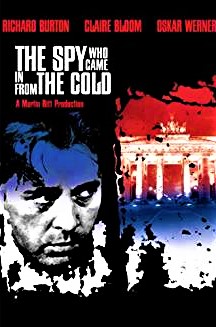
The Spy Who Came in from The ColdM Spy 1965

Theaters:  May 1965

Streaming:  July 2004

Rated:  NR

Runtime:  112 minutes

Genre:  Action – Classics – Drama –  Mystery – Suspense – Thriller

els:  7.5/10

IMDB:  7.7/10

Amazon:  4.3/5 stars

Rotten Tomatoes Critics:  7.7/10

Rotten Tomatoes Audience:  3.7/5

Metacritic Metascore:  NA/100

Metacritic User Score:  NA/10

Awards: 1 Golden Globe

Directed by:  Martin Ritt

Written by:  Paul Dehn and Guy Trosper (screenplay), John le Carré (book)

Music by:  Sol Kaplan

Cast:  Richard Burton, Oskar Werner, Claire Bloom

Film Locations:  Germany, Ireland, Netherlands, UK

Budget:  $

Worldwide Box Office:  $7,600,000

Alec Leamas (Burton), station chief for the British “Circus” in West Berlin, has just lost one of his operatives and is recalled to London.  He is given a new mission in London to play the part of an angry alcoholic, drummed out the secret service, desperately in need of money to get by, and to make his plight as public as possible.  The East Germans take notice of his condition and entice him to defect; trading state secrets for a cushy retirement.  He agrees and is whisked off to East Berlin to be interrogated. His cover story quickly nabs a double agent in the East German spy office but Leamas finds himself a pawn rather than the checking knight.

Germany after WWII was divided into 3 sectors in which Britain, the US and the Soviet Union administered starting in 1944.  From 1944 to 1948, Berlin was administered jointly by the 3 powers but in 1949 the Soviets claimed sole possession of East Berlin and declared it the capital of Germany Democratic Republic. The post-war East Berlin economy was ruined, as it was in West Berlin, but because of Soviet control it was excluded from the Marshall Plan used to rebuild the rest of western Europe.  East Berlin’s centrally planned economy had supposedly the highest standard of living in the Soviet controlled sphere of Europe and Asia but the inhabitants were leaving the city and country in droves, with estimates of 1000 per day leaving in 1960. To stop the emigration and retain skilled workers, up went the wall in 1961 and the East German soldiers were instructed to shoot to kill anyone trying to escape.  The East Germany security forces, the Stasi, formed in 1950, tightened their grip on the East German citizens, spying on everyone to break up any dissent.  Additionally the Stasi extensively infiltrated West Germany to obtain industrial, political, and military secrets, eventually bringing down West German Chancellor Willy Brandt in 1974 because his personal secretary was an East German spy.

David John Moore Cornwell, a British writer of mysteries and spy novels under the pen name of John le Carré, worked for the English secret service until his 3rd novel in 1963, The Spy Who Came in from the Cold, became an international best seller. He quit the service in that year and devoted his time to writing, mainly cold war spy novels dealing with the psychology of gamesmanship and spy craft rather than James Bond type action. His stories usually center around the moral cost of attempting to contain the communist empire without absorbing the stain of their criminality and depravity. Prior to his 1963 novel being published, Heinz Paul Johann Felfe, a German double agent that spied for everyone, Nazis, Soviets, West Germans, Brits; was caught by the West Germans, while in their employ, in 1961, and sent to prison for treason.

Paul Dehn and Guy Trosper wrote the screenplay for the movie and it follows the novel very closely. Dehn was a writer of plays, musicals and movies.  His first screenplay in 1950, Seven Days to Noon, won him an Oscar. Guy Trosper was a writer and producer from Lander, Wyoming best known for this movie and the 1962, Birdman of Alcatraz.

Martin Ritt, actor, director, writer, and producer, gives the viewer a somber message of spy craft without any glamour or gadgets.  Presenting a story about dubious principles and ugly spy results, he sticks to script and makes one of the best spy movies of all time.  This is his 2nd best movie, his 1963 Hud is his best.  The rest of his 30 or so movies are just a rehash of communist talking points and politically correct drivel. Nominated many times for Best Director he never managed to pull down Oscar or a Golden Globe.

The acting in this movie couldn’t get any better.  Richard Burton and Claire Bloom team up to create a tragic series of dichotomies revolving around youth and age, communism and freedom, innocence and cynicism, idealism and debauchery.  In the end they are both occupying the same poles, one learning nothing, the other wanting to learn no more.

This is a movie you need to add to your “Must Watch in My Lifetime” list.

Innocence Lost

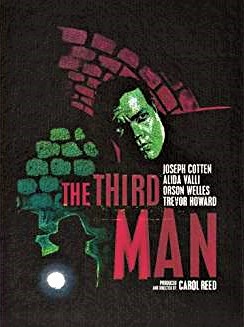
The Third Man M Third 1950

Theaters:  September 1949

Streaming:  November 1999

Rated:  NR

Runtime:  93-108 minutes

Genre:  Classic – Crime – Drama – Film Noir – Mystery – Suspense – Thriller

els:  8.5/10

IMDB:  8.2/10

Amazon:  4.2/5 stars

Rotten Tomatoes Critics:  9.3/10

Rotten Tomatoes Audience:  4.3/5

Metacritic Metascore:  NA/100

Metacritic User Score:  NA/10

Awards: 1 Oscar

Directed by:  Carol Reed

Written by:  Graham Greene (screenplay and book)

Music by:  Anton Karas

Cast:  Joseph Cotton, Trevor Howard, Orson Wells, Alida Valli

Film Locations:  Austria, UK

Budget:  $

Worldwide Box Office:  $618,173

Holly Martins (Cotton), an American writer of 3rd rate westerns, broke and drunk more often than not, is invited to post-WWII Vienna by his old friend Harry Limes (Welles). Martins arrives in Vienna in time to witness Limes’ funeral.  Martins begins to ask around about the death of his friend and slowly becomes suspicious that the official account of his death, a traffic accident, is cover for a murder. Martins, an innocent fool, sets out to discover the truth about his friend’s death, stumbling through a city filled with experienced cynics, thugs, and kriminelle.

Nazi Germany annexed Austria, known as Anschluss Oesterreichs, in March 1938 with significant support of the Austrian public.  In 1943 the Allied powers; Britain, France, US, and the USSR, agreed to nullify the German annexation and have it revert back to an independent country at the end of the war.  The Allies, in 1945, divided Austria and Vienna into 4 sectors with each sector controlled by one of the 4 powers.  This arrangement was to last until 1955 when the country agreed to maintain eternal neutrality. The allied powers initially stationed 260,000 troops in the country after 1945, which was entirely paid for by the Austrian people. The cost of the occupation coupled with the war-destroyed industries and poor harvests lead to wide-spread hunger, lack of heating for homes and businesses, and unemployment.  The post-war years of 1945-46, with little in the way of an Austrian police force, saw crime spiral out of control with Soviet troops responsible for 90% of all reported crimes. The underground economy flourished with little or no regulation or oversight.

Graham Greene, considered as the greatest English writer of the 20th century and with the publication of his 1940 novel, The Power and the Glory, cemented his reputation as one of the best writers of his generation. Early in life he joined the communist party and a few years later converted to Catholicism. He initially wrote a short novel for The Third Man, not intending to publish it, but to provide background for the screenplay. The novella was eventually published under the same name as the movie, The Third Man in 1950. The book is not very good, basically because it is in an unfinished state. Ignore the book and watch the movie.  Greene, in 1948, personally researched the book and screenplay by exploring the streets, nightclubs, and sewers of Vienna along with immersing himself into the clandestine black-markets within the city.

MU Zither 2018A pedestrian movie filmed in Vienna would require a musical score relying heavily on orchestral waltzes with dance scenes showing gay Venetians circling the glossy dance floors of resplendent Viennese palaces. Well this movie isn’t pedestrian by any means; no waltzes, no orchestras, and no palaces make an appearance.  The entire score is delivered by a single instrument; the Zither, a multi-stringed, wooden instrument played either in an upright position or laid flat on one’s lap. The movie opens with the Anton Karas playing  an instrumental on a Zither. It is initially foreign and harsh to the ear but as the movie progresses you warm to its sound and melody, eventually succumbing to its hypnotic effects, realizing in the end that no other musical approach or sound would have worked.

Carol Reed took Greene’s ok screenplay and transformed it into the greatest British film ever made.  The black and white scenes of mountainous mounds of Viennese bombed rubble, the back-lit monstrous shadows, tilted horizons that change the normal perspective to an austere strangeness fitting of the black undertones of the movie; effects that add to the downbeat story of innocence lost in the harsh glare of a crooked reality.   The movie begins and ends with a funeral, letting you know that the only happiness you will find in post-war Vienna comes with death: death of desire, death of devotion, death of decency.

The acting in this movie is superb. Joseph Cotton’s innocence, Trevor Howard’s natural stoic acceptance of a world gone bad, Alida Valli’s stubborn attachment to love, but its Orson Welles that stands out as the films larger than life anti-hero.  An auteur with only acting credits in this movie, but he still insists on bringing along his own style, ad-libbing his lines when it suited him, inserting one of the most memorable lines in the movie:

You know what the fellow said – in Italy, for 30 years under the Borgias, they had warfare, terror, murder and bloodshed, but they produced Michelangelo, Leonardo da Vinci and the Renaissance. In Switzerland, they had brotherly love, they had five hundred years of democracy and peace – and what did that produce? The cuckoo clock.

It doesn’t really matter that it was the German’s who invented cuckoo clocks and the Swiss were content with being bankers, sans the Hapsburgs, and providing mercenaries to the other European powers’ wars.

This is a movie you need to add to your “Must Watch in My Lifetime” list.