Sticks His Nose In

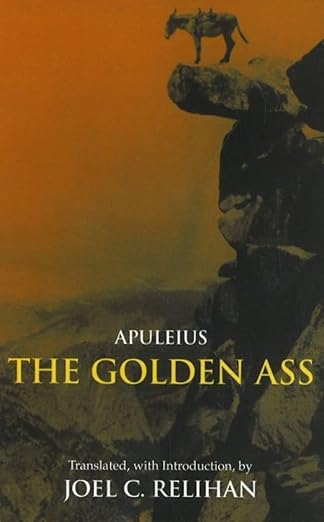
Lucius, the protagonist of the 2nd century AD Latin novel The Golden Ass, cannot suppress his curiosity nor stop meddling in the dark arts of spells and magic. Attempting to flee from the troubles resulting from his inquisitiveness, he accidentally uses the wrong ointment and turns himself into a donkey rather than a bird. This error leads to a series of comical and mostly bawdy misadventures as a beast of burden, who is thoroughly abused and misused due to his intemperate habit of sticking his nose in.

The story, written by the Roman author and philosopher Lucius Apuleius, who hailed from a Roman province in what is now modern-day Algeria, is characterized as a romance—not in the modern Harlequin sense, but in the Greek meaning of a Milesian tale. A Milesian tale consists of a series of adventurous stories, usually short, humorous, and erotic—a romantic narrative for the ancients.

The translator of The Golden Ass, Joel C. Relihan, takes the meaning of a Milesian romance a step further into what Northrop Frye described as secular scripture. Relihan states that the romance in The Golden Ass is: “A survivor’s tale of descent into a nightmare world of loss and eventual recovery of identity.”

Lucius loses his identity, becoming ludicrous and expendable. But in the end, he prays for salvation, which he receives from the goddess Isis. Ultimately, he is initiated into the secrets of the gods. His transformation from misfortune to enlightenment and spiritual fulfillment is, in the end, the ultimate story of a lived life—a maturing into old age with illuminated and learned experience leading to peace and grace.

Trivia: The Golden Ass has been known by various names, including the author’s title, Metamorphoses, Asinus Aureus (a Latin name which translates to “Golden Ass”), The Metamorphosis of Lucius, and the modern title: The Golden Ass or A Book of Changes.

Source: The Golden Ass by Apuleius. Oxford Bibliographies. Graphic: The Golden Ass Book Cover, Hackett Publishing, 2007.
Elephants, Magicians, and Zombies: Oh My

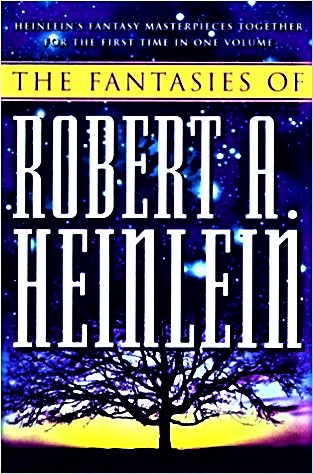
The Fantasies of Robert A. Heinlein B Fantasies Heinlein

Written by:  Robert A. Heinlein

Published by:  Tom Doherty Associates

Copyright:  © 1999

Robert A. Heinlein, the dean of science fiction writers during his lifetime, the first among equals, the first among the 20th century big three: Asimov, Clark, and Heinlein; began his writing and publishing career with short stories and novellas. He first appeared in print with a 1939 short story titled Life Line, published in the pulp fiction magazine, Astounding Science Fiction. He published 29 short stories and novellas before publishing his first novel in 1947, Rocket Ship Galileo.  (Heinlein did write a novel in 1939, For Us, The Living: A Comedy of Customs, but it remained unpublished until 2003, 15 years after his death.)

The Fantasies of Robert A. Heinlein is a collection of 8 short stories and novellas written between 1940 and 1959, illustrating why he was selected as the first Grand Master, in 1974, by The Science Fiction Writers of America.  The line between fantasy and sci-fi is a fine one: the majority of these stories have one foot in each realm with the scales tipping towards the fantastic. I had read all these stories individually many years ago, and I enjoyed them then, but they are still fresh and fun to read today, maybe more so, since they are all packaged together, chronologically, allowing the reader to assess Heinlein’s progression as a writer and story-teller through the years. Below are the short stories and novellas contained in this compilation.

Magic, Inc., © 1940, with an alternate title of The Devil Makes the Law. Magic, Inc. makes the rules until Amanda and Archie take charge.

–And He Built a Crooked House, © 1940. You may run out of time when building your house or maybe your house will run into time.  The title to story was a spoof on the English nursery rhyme:

There was a crooked man, and he walked a crooked mile.
He found a crooked sixpence upon a crooked stile.
He bought a crooked cat, which caught a crooked mouse,
And they all lived together in a little crooked house.

They–, © 1941.  Just because you’re paranoid doesn’t mean your mentally ill.

Waldo, © 1942, written under the pseudonym of Anson MacDonald. Anson was Heinlein’s middle name. Magic makes the world go around.

The Unpleasant Profession of Jonathan Hoag, © 1942. Artistic endeavors usually need some touch up paint.

Our Fair City, © 1948.  It’s hard to dance with a whirlwind when you have crooked feet.

The Man who Traveled in Elephants, © 1957.  A good life, a few good friends, great beginnings. Heinlein considered this his best story.

“–All You Zombies–“, © 1959. Punctuation-wise, word-wise, a strange title; you need to read a few words short of the end to figure it out.  While you are reading, Ella Fitzgerald may be appropriate background music; spring, …time, can really hang you up the most.