“What was the worst thing you’ve ever done?” “What is the worst thing that has ever happened to you?”
So begins the story of the Chowder Society nightmare. Five men bound since their youth, destined purposefully together by life and consequence, later joined by the main protagonist Don Wanderley, drawn into an A.M. horror with no single name and a thousand shifting labels. Their lives become a tangle of stories within stories, the past bleeding into the present, each tale circling a separate Dantean ring of terror.
Peter Straub (1943–2022) builds “Ghost Story” out of the shadows of man’s dreams of dread and death. Drawing on a century of horror in literature, visual arts, and psychology to create a world of insinuation, illusion, and fear; where nothing is ever said just once, nothing is ever said plainly, and nothing settles. Straub’s references to books, photos, and films, often through Wanderley, but not exclusively, are not decorative touches or character shading. They are physical clues. Each reference is a lens through which the plot becomes clearer.
Don Wanderley’s name is the novel in miniature: this is a tale about a man who wanders through illusions and a town that wanders through its own lies. As the heir to the Chowder Society’s buried horror, Wanderley carries the past into the present, through his criticism of art and letters, through his misreadings of life, and through belief in the oldest self‑deception of all, the belief that the women who charm you are the ones who love you.
As a lecturer at Berkeley, Wanderley teaches Hawthorne’s “The House of the Seven Gables” and encounters R.P. Blackmur’s essay on the novel, which argues: “When every possibility is taken away, then we have sinned.” Wanderley finds that this idea radiates throughout Hawthorne’s work, and he “could connect the novels and stories by this black Christianity,” an impulse or more directly, a desire for nightmares. Hawthorne himself writes that he sometimes achieved a “singular and not unpleasing effect” by imagining incidents in which “the spiritual mechanism of the faery legend” is fused with “the characters and manners of everyday life.”
In modern terms: the ghost and the haunted are part of the same mechanism. Straub uses this to signal that Don and the Chowder Society are haunted not by an external force, but by themselves.
Wanderley extends this line of thought through D.H. Lawrence’s critique of Hawthorne, which ties Blackmur’s concept of sin to lust, and to the New England lineage of Hawthorne, Poe, James, Lovecraft, and King:
And the first thing she does is seduce him.
And the first thing he does is to be seduced.
And the second thing they do is to hug their sin in secret, and gloat over it, and try to understand.
Which is the myth of New England.
Although Straub never states it outright, Stephen King does so in his introduction to “Ghost Story:” this lineage leads directly to Henry James’s “The Turn of the Screw,” which asks whether the supernatural is real or a projection of the psyche. James refuses to resolve the question. Straub resolves it by refusing to choose. His haunting functions like a double‑slit experiment: both interpretations are true simultaneously. The horror is real and psychological. It exists because the Chowder Society created the conditions for it.
Hawthorne fused the supernatural with everyday life. James separated them and let the reader decide. Straub makes them inseparable, a melding of spirit and mind, a duality of horror.
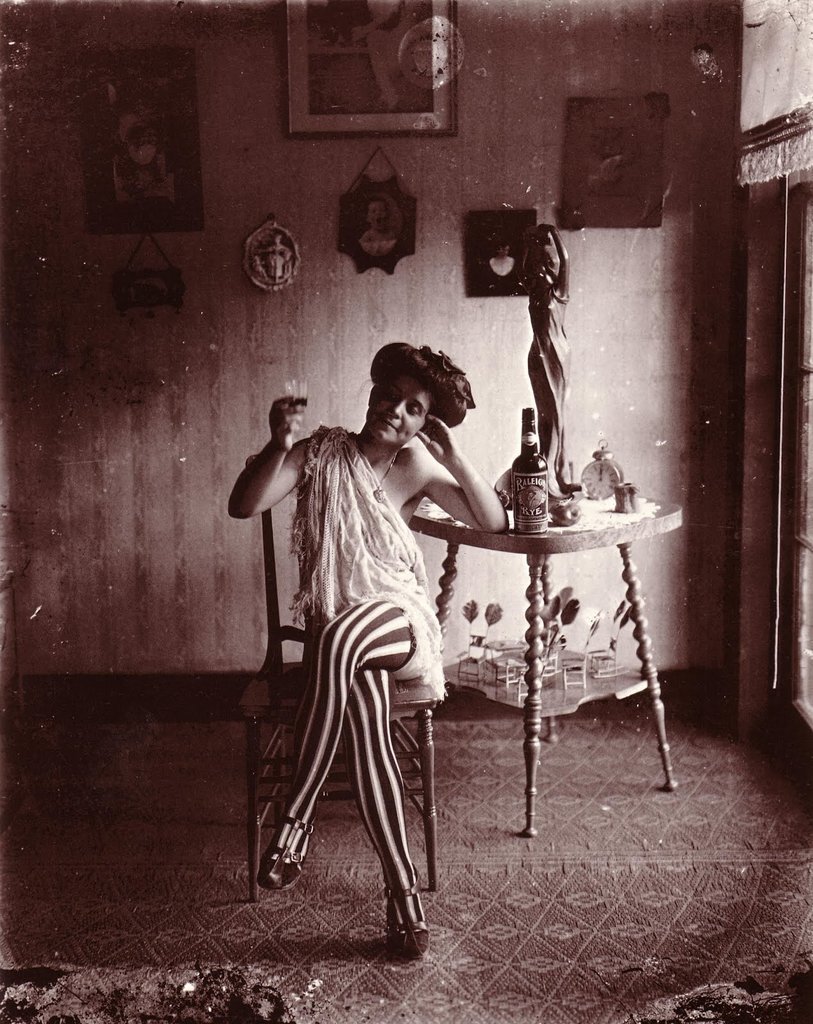
Continuing this duality, Wanderley describes a sudden vision of Alma: “Then suddenly and shockingly, she [Alma] lifting a spoonful of mint-green avocado to her mouth, I had another vision of her. I saw her as a whore, a 1910 Storyville prostitute, her hair exotically twisted, her dancer’s legs drawn up–her naked body was very clear for a moment. Another image of professional detachment, I supposed, but that did not explain the force of the vision.” A vision of Alma or from Alma?
Alma as a “1910 Storyville prostitute” is not a literary allusion but a visual one. Straub is invoking the E.J. Bellocq photographs of New Orleans prostitutes in Storyville around 1910: stark, intimate portraits rediscovered in the 1970s and now held in major museums such as MoMA. These images show women posed in small, bare rooms, sometimes clothed, sometimes nude, their expressions shifting between defiance and vulnerability. They carry an aura of theatrical melancholy: present yet absent, exposed yet unknowable.
It is a perfect portrait of Alma. And Wanderley misses the meaning entirely. The vision is not “professional detachment.” It is the novel’s gears revealing itself: Alma appears as a figure who is both real and unreal, historical and spectral, seductive and annihilating; the very embodiment of Straub’s fused supernatural psychology of mind and ghost.
Enhancing the contradictions Straub has Don Wanderley bring Alama to a showing of Renoir’s “La Grande Illusion.” The film is about the collapse of the structures that once defined Europe: class, nation, aristocratic codes, the belief that enemies and friends can be cleanly separated. Straub’s novel is about the collapse of the structures that once defined the Chowder Society: honor, memory, guilt, the belief that the past can be buried. It’s not a casual reference; it’s Straub subtly telling the reader how to understand the plot of “Ghost Story.”
In La Grande Illusion, friends are enemies and enemies are friends. A French aristocrat and a German aristocrat share more with each other than with the men they command. Working‑class soldiers form bonds that ignore borders. The “grand illusion” isn’t war; it’s the belief that the old hierarchies still matter in the face of modernity. Renoir uses the prison‑camp setting not for escape‑movie suspense (though there is an escape), but to dissect a social order already dying.
Straub mirrors this logic. “Ghost Story” is a deadly illusion of its own: heroes and villains circle one another, and to know one is to find the other. Evil is a ghost from the past, a supernatural entity and a moral consequence brought to the present. The men who see themselves as honorable are the ones who committed the original sin. The woman they loved is the monster they created and honored. The past they buried is the thing hunting them.
Like Renoir’s war film without battles, Straub builds a ghost story without medieval props of vampires and werewolves, although there is that. The real haunting is psychological. The real prison is memory. The real war is the struggle between the stories the men tell about themselves, the truth they refuse to face, and the nightmares that consume them.
Both works, the film and the novel, strip away the expected genre scaffolding, war without battles, society without walls; ghosts without haunted houses, horror without the supernatural. What remains is the same core revelation: the structures we trust to define us are illusions, and when they collapse, the truth steps forward. “When every possibility is taken away, then we have sinned.”
Alma tells Waverley everything and he misses it entirely. “I (Alma) know some people who are interested in the occult.”…It can’t be…Ordo Templi Orientis.” …They were known to be cruel, even savage.” …”I saw a ghost” …[or] did Alma actually say, “I am a ghost?”
Then the mists begin to dissipate. Don begins to see. “…my second lecture was a disaster. I brought out secondhand ideas unsuccessfully, tried to relate them and got lost in my notes: I contradicted myself. …I said that “The Red Badge of Courage” was a great ghost story in which the ghost never appears. He begins to see ghosts. But Waverley misreads the book just as Henry Fleming in Badge of Courage misreads himself. Fleming was a coward and courageous, he lied and acted with honor, and he was neither hero nor villain. Straub tells the reader that Wanderley is tactically brilliant in seeing ghosts but strategically misreading Alma, and his fears, and his courage, and his guilt. He misses the moral and ocular truth in front of him.
Then Straub moves the deception from Wanderley to the weakest link in the original Chowder Society: Dr. Jaffery. Straub begins Jaffery’s end with a normal scene morphing into the long hidden truth: “The fading wallpaper…the table bearing neat piles of coins, a library book (The Making of a Surgeon) and a lamp…In this room, at once familiar and unreal, he could not stay…Jesus she moved.” This is the moment the author moves beyond Wanderley’s thematic deception onto Jaffrey and the entire Chowder Society’s moral deception.
And “The Making of a Surgeon” is all about moral clarity, facing consequences, and accepting responsibility. It’s a memoir of professional responsibility and moral courage. And the Chowder Society is finally reaching across the abyss of denial and confronting the horror or their past.
Finally, Edward Wanderley, Don Wanderley’s uncle, an original Chowder, enters the story mostly as a memory, but he is the caretaker of all those haunting memories. He is unwitting biographer of their past, recording moments of truth that reveal nothing, saving no one. Edward preserved the past in perfect detail, and like his nephew, it all remained unexamined, redeeming no one.
Readers often describe Ghost Story as wandering, uneven, or prone to detours, a criticism echoed in contemporary reviews that note Straub’s tendency to drift away from the main plot or indulge in seemingly irrelevant texture. But what looks like narrative drift on the surface is, on a deeper reading, the novel’s strongest logic. Straub isn’t losing the thread; he’s showing us what a haunting feels like. He shows that the lies we tell ourselves are the horrors that destroy us.
Straub’s haunting is not linear. It circles and returns. Like Asimov’s hidden Earth — the point “as far away as possible” that turns out to be the origin — Straub’s details repeat endlessly, drift, and seem meaningless until the moment the circle closes back to the beginning and the truth stands revealed. Straub builds his novel out of these arcs, fragments of a circumference that seem disconnected until the circle closes. He hides this map inside the tangents, and once you see the pattern: Hawthorne’s nightmare impulse, Lawrence’s seduction‑and‑sin pattern, Crane’s “ghost story without a ghost,” James’s ambiguity, Renoir’s collapsing social order. Don Wanderley’s literary misreadings are not digressions but the novel’s diagnostic tools. Each failed interpretation reveals the flaw that defines him: he wanders through texts the way he wanders through life, intelligent but unanchored, perceptive but myopic.
Straub refuses to lead the reader by the hand. He insists that you find your own way through the misty, musty traces of arts and letters. He trusts us to assemble meaning the way the Chowder Society must: by piecing together fragments, memories, misreadings, and half‑buried truths. What appears astray is actually ghostly context; the white space in which the novel’s real shape emerges. The wandering is the haunting. The arcs of irrelevances are the clues. The men believe they buried the past, but Straub shows that nothing buried stays buried; it simply waits at the farthest point of the circle to be met again.
The worst thing is the horror circling your mind.
Graphic: 1910 Storyville Photographs by Bellocq. Source: Ghost Story by Peter Straub. Copyright 1979.
 elsToday