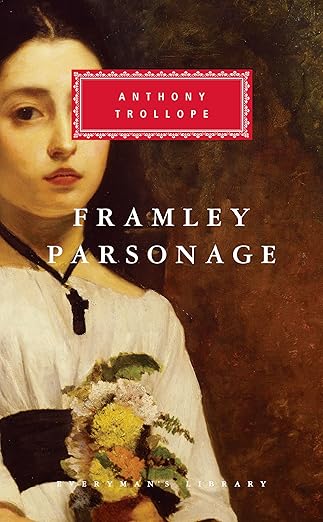
Framley Parsonage, by the Victorian author Anthony Trollope, is the fourth novel in the six-part Chronicles of Barsetshire series. This series is set in the fictional county of Barsetshire in the English countryside and details the social entwinings of the gentry, rich mercantile classes, clergy, and occasionally what we would today refer to as the comfortable middle class. The novels, which can be read in any order, revolve around themes of maintaining social status, finding love, marrying well, and money. Hypocrisy, chicanery, and snobbish attitudes often create dilemmas that Trollope, in a winding but satisfying narrative fashion, concludes as the reader wishes.
Framley Parsonage specifically details the misadventures of the amiable but horribly naive vicar, Mark Robarts, who is a boyhood friend of Lord Ludovic Lufton. Through this friendship, Ludovic’s mother, Lady Lufton, installs Robarts in the Framley Parsonage with a sufficient salary to support his young family’s basic needs. Through a misplaced sense of ambition, Robarts attempts to further his standing in life by associating with a parliament member, charlatan, and aptly named Mr. Sowerby, bringing humiliation and disgrace upon himself.
Trollope displays an absolute sense of enjoyment in writing this novel, skewering the political class with an abundance of wit and satire, along with exploring four marriage sub-plots that he resolves with appropriately deserved denouements of happiness or the lack thereof.
Source and Graphic: Framley Parsonage by Anthony Trollope, Publisher Everyman’s Library, 1994.
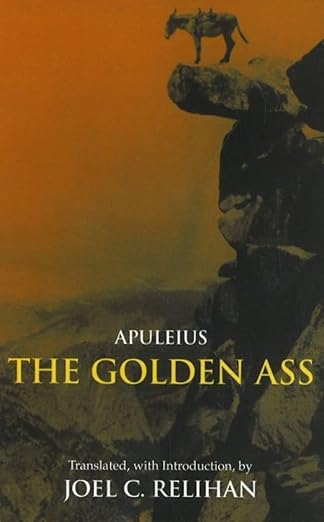
Lucius, the protagonist of the 2nd century AD Latin novel The Golden Ass, cannot suppress his curiosity nor stop meddling in the dark arts of spells and magic. Attempting to flee from the troubles resulting from his inquisitiveness, he accidentally uses the wrong ointment and turns himself into a donkey rather than a bird. This error leads to a series of comical and mostly bawdy misadventures as a beast of burden, who is thoroughly abused and misused due to his intemperate habit of sticking his nose in.
The story, written by the Roman author and philosopher Lucius Apuleius, who hailed from a Roman province in what is now modern-day Algeria, is characterized as a romance—not in the modern Harlequin sense, but in the Greek meaning of a Milesian tale. A Milesian tale consists of a series of adventurous stories, usually short, humorous, and erotic—a romantic narrative for the ancients.
The translator of The Golden Ass, Joel C. Relihan, takes the meaning of a Milesian romance a step further into what Northrop Frye described as secular scripture. Relihan states that the romance in The Golden Ass is: “A survivor’s tale of descent into a nightmare world of loss and eventual recovery of identity.”
Lucius loses his identity, becoming ludicrous and expendable. But in the end, he prays for salvation, which he receives from the goddess Isis. Ultimately, he is initiated into the secrets of the gods. His transformation from misfortune to enlightenment and spiritual fulfillment is, in the end, the ultimate story of a lived life—a maturing into old age with illuminated and learned experience leading to peace and grace.
Trivia: The Golden Ass has been known by various names, including the author’s title, Metamorphoses, Asinus Aureus (a Latin name which translates to “Golden Ass”), The Metamorphosis of Lucius, and the modern title: The Golden Ass or A Book of Changes.
Source: The Golden Ass by Apuleius. Oxford Bibliographies. Graphic: The Golden Ass Book Cover, Hackett Publishing, 2007.
Vincent Di Fate, born 1945 in Yonkers, is a New Yorker and American artist known for his depictions of science fiction, fantasy, and realistic space art. He has an MA from Syracuse University.
People Magazine noted the Di Fate is, “one of the top illustrators of science fiction…” His specialty is imaging technologies and environments in the nether regions of space and the universe. His clients include NASA, IBM, Scientific American, and The National Geographic Society. James Lizowski, Omni Magazine critic, noted that Di Fate, “combines the skills of a masterful painter with the fierce demand of an uncompromising artist to create visions of the future that are precise, powerful, and dazzling to the eye“.
His numerous awards include the: Hugo, Sklark, Lensman, Chesley, and Rondo Awards, among others for illustration of science fiction and fantasy subjects. He was inducted into the Science Fiction Hall of Fame in 2011 and the Illustrator’s Hall of Fame in 2019. He has consulted for MCA/Universal, 20th Century Fox, Walt Disney, MGM/United Artists.
Di Fate has also written three books and is currently working on his fourth. His second book Infinite Worlds was the first comprehensive history of science fiction art in America. Listed below are some of the books of fiction he has illustrated. Additionally, he has illustrated hundreds of sci-fi and fantasy book covers in his four decades as an artist.
Di Fate Book Illustrations (Partial):
2001: A Space Odyssey by Arthur C. Clarke
Prelude to Foundation by Isaac Asimov
The Demolished Man by Alfred Bester
The Fabulous Riverboat by Philip José Farmer
The Dark Design by Philip José Farmer
The Magic Labyrinth by Philip José Farmer
The World of Null-A by A.E. van Vogt
Rules of Engagement by Elizabeth Moon
The Time Traders by Andre Norton
The Godmakers by Frank Herbert
Di Fate Bibliography:
Di Fate’s Catalog of Science Fiction Hardware 1980
Infinite Worlds: The Fantastic Visions of Science Fiction Art 1997
The Science Fiction Art of Vincent Di Fate 2002
Clement Biography:
“Human beings are prone to believe the things they wish were true.” – Hal Clement
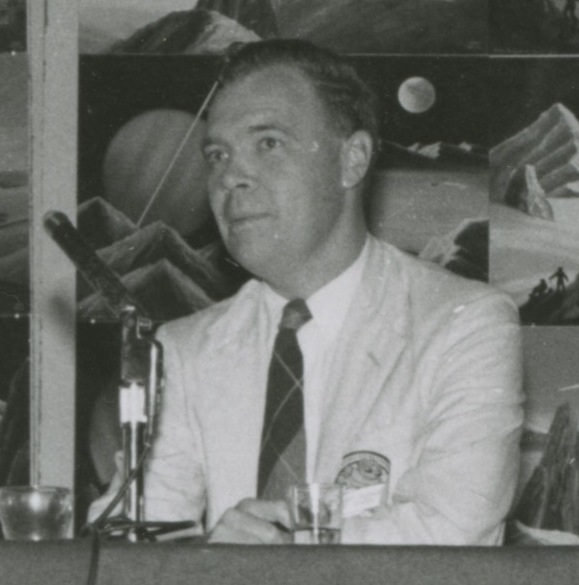
Hal Clement, born in 1922, in Massachusetts, passing away in 2003, was an American science fiction writer and a leader of the hard science fiction subgenre. Hard science, as it was defined in 1957 by P. Schuyler Miller, is characterized by scientific accuracy and logic. Hard science fiction is strongly rooted to known physical laws in the natural universe. In an interview with “The Science Fiction Radio Show” in the early 1980s Clement said that he had “…trouble writing something unless, I can, more or less convince myself it might happen.” In the old days before computers, he was known to whip out his slide rule and run through the calculations to make sure his stories passed the law of physics test.
FootNoteB
Clement received a degree in astronomy from Harvard University in 1943, an M.Ed. from Boston University in 1946, and eventually an M.S. in chemistry from Simmons College in 1963. He was a B-24 Liberator, a heavy bomber, pilot during WWII, flying combat missions over Europe, finishing his Air Force career after the war in the Air Force Reserve, retiring as a colonel. He taught astronomy and chemistry at the high school level in Massachusetts.
Clement while working towards his B.S. at Harvard wrote and published his first piece of science fiction, a short story called “Proof“. The story first appeared in a 1942 issue of Astounding Science edited by his mentor John W. Campbell. Campbell was known as the leader of the hard science wing of the science fiction genre which Clement admits affected his writing standards. Clement’s first three novels were Astounding Science serials under Campbell: Needle in 1950, Iceworld in 1953, and Mission of Gravity, his best-known novel, in 1954. Clement followed up Needle and Mission of Gravity with the sequels: Through the Eye of a Needle in 1978 and Star Light in 1971, respectively. He also wrote two additional short story sequels for Mission of Gravity: Lecture Demonstration in 1973 and Under in 2000.
In addition to his writing, Clement also painted astronomically oriented artworks under the name George Richard. In 1998, he was inducted into the Science Fiction and Fantasy Hall of Fame and was named the 17th SFWA Grand Master by the Science Fiction and Fantasy Writers of America in 1999.
Hal Clement wrote over 120 novels, novellas, short stories, and collections. Below is a listing of just his novels.
Clement Bibliography (Novels Only, Shorter Fiction not Listed):
Needle 1950
Iceworld 1953
Mission of Gravity 1954
The Ranger Boys in Space 1956
Cycle of Fire 1957
Close to Critical 1958
Natives of Space 1965
Star Light 1971
Left of Africa 1976
Through the Eye of a Needle 1978
The Nitrogen Fix 1980
Intuit 1987
Still River 1987
Fossil 1993
Half Life 1999
The Essential Hal Clement, Volume 1: Trio for Slide Rule and Typewriter 2007
The Essential Hal Clement, Volume 3: Variations on a Theme by Sir Isaac Newton 2007
Heavy Planet 2002
Noise 2003
Hal Clement SF Gateway Omnibus 2014
Mission of Gravity:
Mission of Gravity was first published in serialized form in The Astounding Science Fiction Anthology of 1953 with the hardcover coming out in 1954 followed by the paperback in 1958.
The story takes place on the planet Mesklin, an object thought to be in the 61 Cygni system, eleven light years from Earth. Mesklin is a super-giant bowl-shaped planet, flattened at the poles, an oblate spheroid, with an extreme rotation that allows for 18-minute days or approximately 9 minutes of daylight. The high spin rate creates gravity that equals about 3g at the equator and 700g at the poles. Clement eventually re-calculated the gravity over the planet and changed the polar regions to 200g. For comparison purposes the Sun has a gravity of 28g or 28 times that of Earth.
Earth has sent a probe to Mesklin to study its extreme gravity and other matters of value, but it became stranded in the high gravity areas of a pole ruling out a rescue by a human team. Earth wants to recover the probe at all costs to learn what secrets it contains.
The planet is populated by an intelligent species of centipedes that come in assorted sizes, but the ones be-friended by the Earth visitors are about three feet long. An Earth spacemen, Charles Lackland travels to the equator of the planet where he can just manage the 3g environment and meets Barlennan a captain of a sailing raft named the Bree. The Bree and its crew are on a trading voyage in the equatorial areas making a profit by bartering goods from isolated populations all over the planet. After Barlennan learns English, a deal is arranged for him and his crew to retrieve the probe at the poles and return it to the equator where the humans can pick it up. So begins the centipedes’ journey to the pole.
Literary Criticism:
As with all science fiction, Mission of Gravity suffers from futuristic technology that outdates itself in a few years. A quaint process in mapping the surface of Mesklin involves taking a series of high altitude photographs, displaying them of photo paper and trying to put them all together like a giant jig-saw puzzle. No GPS coordinates, no digital, just 1950 Earth tech and methodology. Leaving that aside though, the story is well worth reading. The science as presented is sound, mostly, the story telling and plot is a page turner, and the characterization of the alien’s life-forms is plausible and interesting. It will be worth your time and at 223 pages a quick read.
The Victorian Era produced some of the greatest literature the world has ever had the pleasure to read. Any list of the greatest books ever written always contains, or should, Dickens, Bronte, Eliot, and Conrad, who was Polish but wrote in English from England, with an occasional inclusion of Wilde, Hardy, Wells, Trollop, and Stevenson. Bibliophiles would not forget to include Stroker, Barrie, Thackeray, Butler (everyone should read the poorly titled ‘The Way of All Flesh’), and Carroll. Stretching the definition of Victorian, one could bring in the Russians Tolstoy and Dostoyevsky, Americans Twain, Poe, Cooper, and Melville along with the French authors Hugo, Flaubert, and Dumas.
Victorian literature is loosely defined as being written during the reign of Queen Victoria who ruled over the United Kingdom and Ireland for 63 years from 1837 to 1901, parenthetically, a reign exceeded in longevity only by Queen Elizabeth’s 70 years on the throne. The Victorian Era was bookended by the Industrial Revolution which ended around the 1840s and the beginning of the Technological Revolution that began in the 1870s and continued to the start of WWI. The era witnessed the beginning of the end of the labor intensive agricultural and mining sectors, with a subsequent weakening of the guild and manor systems. The hermetic British class system also sustained a permanent leak with the advent of a true middle class brought about by an unconstrained rise in economic fortunes and personal incomes.
All this brought about a renegotiation and a realignment of the social structures in place since the time of the pharaohs. Serfs and slavery gave way to agricultural innovations and the introduction of a managerial class in business. The existing economic and social fabrics were torn asunder with the way forward less than clear, but the status quo would not endure for long. The ensuing social upheaval provided a bonaza of topics and plots for the Victorian Era authors. Dickens wrote about poverty and children, Hardy plotted about morality and money, Trollop’s novels took on class and money, Emily Bronte took on immorality, class, and money, and Thackeray discussed hypocrisy. None of the subjects the authors approached were exclusive to their times, but in the Victorian age contrasts had sharp edges. Victorian times were either-or with little in between. Grey was tea, which incidentally dates to the Victorian Era.
Apologies for the preamble to this post which was meant to be just a listing of Victorian authors but somehow, I digressed into a brief discussion of 19th century all things British. The following table is a composite of other lists and sources dealing with Victorian authors, whether prose, poetry, or plays, fiction or non-fiction. The table below initially had additional information about the authors, but WordPress does not give the space needed to display them so squeeze the sides of table I did. Also, I initially was listing all authors, regardless of nationality, within the Victorian Era but that grew too large for web page. Finally, the “Best Sellers” column is subjective in that it may be the critics’ choice, or it may be based on current sales, and sometimes it’s just what I liked the most. As an example, the critics always list ‘Great Expectations’ or ‘The Tale of Two Cities’ as his best but I’ve always preferred ‘Oliver Twist’ and ‘A Christmas Carole’ which led me to list ‘Great Expectations’ and ‘A Christmas Carole’.
Name
Nationality
Born
Died
“Best Sellers”
Ainsworth, William Harrison
English
1805
1882
Windsor Castle
Arnold, Matthew
English
1822
1888
The Scholar Gipsy
Bagehot, Walter
English
1826
1877
The Economist
Ballantyne, Robert Michael
Scottish
1825
1894
The Coral Island
Barlas, John
Scottish
1860
1914
Bloody Heart – Phantasmagoria
Barr, Amelia
English
1831
1919
Remember the Alamo
Barrie, J.M.
Scottish
1860
1937
Peter Pan
Beerbohm, Max
English
1872
1956
Zuleika Dobson
Benson, A.C.
English
1862
1925
Basil Netherby
Besant, Walter
English
1836
1901
All in a Garden Fair
Blackmore, R.D.
English
1825
1900
Lorna Doone
Blunt, Wilfred Scawen
English
1840
1922
The Dream King: Ludwig II of Bavaria
Boucicault, Dion
Irish
1820
1890
The Bastile
Braddon, Mary Elizabeth
English
1835
1915
Lady Audley’s Secret
Bradley, Edward
English
1827
1889
The Adventures of Mr. Verdant Green
Bray, Anna Eliza
English
1790
1883
Trelawneys of Trelawne
Brontë, Anne
English
1820
1849
Agnes Grey
Bronte, Charlotte
English
1816
1855
Jane Eyre
Bronte, Emily
English
1818
1848
Wuthering Heights
Browning, Elizabeth Barrett
English
1806
1861
A Drama of Exile
Browning, Robert
English
1812
1889
The Ring and the Book
Buchanan, Robert
Scottish
1841
1901
The Shadow of the Sword
Bulwer-Lytton, Sir Edward
English
1803
1873
England and the English
Burney, Frances
English
1752
1840
Evelina
Butler, Samuel
English
1835
1902
Erewhon – The Way of All Flesh
Caine, Hall
English
1853
1931
The Blind Mother – The Last Confession
Caird, Mona
English
1854
1932
The Wing of Azrael
Carlyle, Thomas
Scottish
1795
1881
Sartor Resartus
Carroll, Lewis
English
1832
1898
Alice’s Adventures in Wonderland
Chesterton, G.K.
English
1874
1936
Father Brown – The Man Who was Thrusday
Clare, John
English
1793
1864
The Shepherds Calendar
Clough, Arthur Hugh
English
1819
1861
The Bothie of Tober-na-Vuolich
Coleridge, Mary
English
1861
1907
The Lady on the Drawingroom Floor
Collins, Wilkie
English
1824
1889
The Woman in White – The Moonstone
Conrad, Joseph
Polish
1857
1924
Heart of Darkness – Lord Jim
Corelli, Marie
English
1855
1924
The Romance of Two Worlds
Corvo, Baron
English
1860
1913
Hadrian the Seventh
Craik, Dinah Mulock
English
1826
1887
John Halifax, Gentleman
Darwin, Charles
English
1809
1882
On the Orgin of Species
Davies, W.H.
English
1871
1940
The Autobiography of a Super-tramp
Dickens, Charles
English
1812
1870
A Christmas Carol – Great Expectations
Disraeli, Benjamin
English
1804
1881
Sybil; or, the Two Nations
Dobell, Bertram
English
1842
1914
The Poetical Works of Thomas Traherne
Dowson, Ernest
English
1867
1900
Vitae Summa Brevis (Days of Wine and Roses)
Doyle, Sir Arthur Conan
English
1859
1930
Sherlock Holmes
Dunsany, Lord
Irish
1878
1957
A Dreamers Tale
Eliot, George
English
1819
1880
Middlemarch
Ewing, Juliana Horatia
English
1841
1885
Christmas Crakers and other Christmas Stories
Farningham, Marianne
English
1834
1909
Girlhood – Brothers and Sisters
Farrar, Frederic William
English
1831
1903
Life of Christ
Gaskell, Elizabeth
English
1810
1865
North and South – Ghost Stories
Gilbert, William Schwenck
English
1836
1911
H.M.S. Pinafore – The Pirates of Penzance
Gilchrist, Robert Murray
English
1867
1917
The Stone Dragon and Other Tragic Romances
Gissing, George
English
1857
1903
The Nether World
Gore, Catherine
English
1798
1861
Manners of the Day
Gosse, Edmund
English
1849
1928
Father and Son
Gosse, Philip
English
1810
1888
A Naturalist’s Rambles on Devonshire Coast
Grossmith, George
English
1847
1912
The Diary of a Nobody
Haggard, H. Rider
English
1856
1925
King Solomon’s Mines
Hallam, Arthur Henry
English
1811
1833
The Poems of Arthur Henry Hallam
Hardy, Thomas
English
1840
1928
The Mayor of Casterbridge
Harkness, Margaret
English
1854
1923
Assyrian Life and History
Helps, Sir Arthur
English
1813
1875
Leaves from the Journal of Our Life
Hemans, Felicia
English
1793
1835
Casabianca – Coeur De Lion at the Bier
Henley, William Ernest
English
1849
1903
Invictus
Hood, Thomas
English
1799
1845
The Bridge of Sighs – The Song of the Shirt
Hopkins, Gerard Manley
English
1844
1889
Binsey Poplars
Hornung, E.W.
English
1866
1921
Raffles Stories
Housman, A.E.
English
1859
1936
The Collected Poems of A.E. Housman
Housman, Laurence
English
1865
1959
The Field of Clover
Howitt, Mary
English
1799
1888
The Spider and the Fly
Howitt, William
English
1792
1879
The History of the Supernatural
Hubback, Catherine
English
1818
1877
The Younger Sister
Hughes, Thomas
English
1822
1896
Tom Brown School Days
Huxley, Thomas Henry
English
1825
1895
Man’s Place in Nature
James, M.R.
English
1862
1936
Ghost Stories
Jefferies, Richard
English
1848
1887
The Story of My Heart
Jennings, Louis
English
1836
1893
Mr. Gladstone
Jerome, Jerome
English
1859
1927
Three Men in a Boat
Jerrold, Douglas William
English
1803
1857
Black-Eyed Susan
Jewsbury, Geraldine
English
1812
1880
The Half-Sisters
Kingsley, Charles
English
1819
1875
Westward Ho!
Kingston, William Henry Giles
English
1814
1880
In the Rocky Mountains
Kipling, Rudyard
English
1865
1936
The Jungle Book – Kim
Landon, Letitia Elizabeth
English
1802
1838
The Poetical Works of Miss Landon
Landor, Walter Savage
English
1775
1864
Imaginary Conversations – Rose Aylmer
Le Fanu, Joseph Sheridan
Irish
1814
1873
Ghost Stories
Lear, Edward
English
1812
1888
The Complete Nonsense of Edward Lear
Lever, Charles
Irish
1806
1872
The Martins of Cro’Martin
Levy, Amy
English
1861
1889
The Romance of a Shop
Lewes, George Henry
English
1817
1878
The Spanish Drama
Linton, Eliza Lynn
English
1822
1898
The True History of Joshua Davidson
Macaulay, Thomas Babington
English
1800
1859
Lays of Ancient Rome
MacDonald, George
Scottish
1824
1905
The Princess and the Goblin
Marryat, Captain Fredrick
English
1792
1848
The Privateersman
Marshall, Emma
English
1830
1899
Under Salisbury Spire
Massey, Gerald
English
1828
1907
Ancient Egypt Light of the World
Maurier, George du
French
1834
1896
Trilby
Mayhew, Henry
English
1812
1887
London Labour and the London Poor
Melville, George John
Scottish
1821
1878
The Queen’s Maries: A Romance of Holyrood
Meredith, George
English
1828
1909
The Egoist – Diana of the Crossways
Mill, John Stuart
English
1806
1873
On Liberty
Molesworth, Mary Louisa
English
1839
1921
The Cuckoo Clock
Moore, George
Irish
1852
1933
Esther Waters
Moore, Thomas
Irish
1779
1852
Minstrel Boy – The Last Rose of Summer
More, Hannah
English
1745
1833
Sorrows of Yamba
Morley, Henry
English
1822
1894
English Writers
Morris, Francis Orpen
English
1810
1893
A History of British Butterflies
Morris, William
English
1834
1896
The Wood Beyond the World
Morrison, Arthur
English
1863
1945
The Adventures of Martin Hewitt
Newman, John Henry
English
1801
1890
Apologia Pro Vita Sua
Norton, Caroline
English
1808
1877
The Sorrows of Rosalie: A Tale with Other Poems
Oliphant, Margaret
Scottish
1828
1897
Supernatural Collection
Ouida (Maria Louise Ramé)
English
1839
1908
Under Two Flags – A Dog of Flanders
Pater, Walter
English
1839
1894
Studies in the History of the Renaissance
Patmore, Coventry
English
1823
1896
The Angle in the House
Potter, Beatrix
English
1866
1943
The Tale of Peter Rabbit
Rands, William Brighty
English
1823
1882
Lilliput Levee
Reade, Charles
English
1814
1884
Peg Woffington – Masks and Faces
Reynolds, George
English
1814
1879
Wagner the Werewolf – The Necromancer
Rogers, Samuel
English
1763
1855
Table-Talk and Recollections – Toils and Struggles
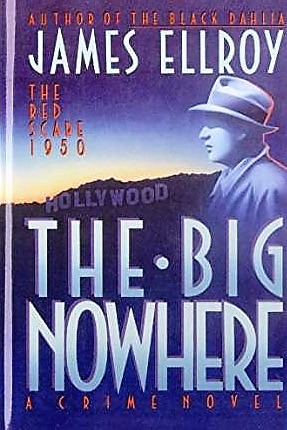
When there are no heroes, no good guys, no morals worth fighting for, then you’ve walked into The Big Nowhere. There are no prizes here so Sam Spade took the night train out of L.A., and Mike Hammer’s 45 would have melted by the 9th chapter, leaving a rather skinny book with a sloppy ending. No one, no thing is redeemable in this novel, possibly not even the reader, who is captivated, disheartened, engrossed, disgusted on the raw truth presented as living without a soul, trying to make sense of this hell on earth, wishing never to come anywhere near The Big Nowhere.
…thinking Coleman’s Upshaw fixation would break him down on his homosexuality, stymie and stalemate him. He was wrong. Coleman picked up Augie Duarte at a downtown bar, sedated him and took him to an abandoned garage in Lincoln Heights. He strangled him and hacked him and ate him and emasculated him like Daddy and the others had tried to do to him…
Everyone deserves to die, sooner rather than later, in this l.a. l.a. land; the protagonists, if there are any, the antagonists, the groupies, the followers and the hanger-ons, everyone.
The Big Nowhere is the second, and likely the best, of Ellroy’s L.A. Quartet which includes:
James Michener, an adopted child of a Pennsylvania Quaker, instilled his fictional Tales of the South Pacific from his garrisoned experiences as a Lieutenant Commander in the US Navy during the latter half of his WWII tour of duty. From 1944-1946, he was stationed mainly on Espiritu Santo, a small island on the eastern edge of the Coral Sea, as a naval historian, but he frequently visited other tropical islands in the area.
The short stories collected in this book, which Michener won the 1948 Pulitzer Prize in Fiction, probe the symbiosis and bonds between the American G.I. and frequently, female Pacific Islanders. The tales revolve around mostly the same characters, with a commander generally filling in as the first person narrator, and a few common plot lines such as a forthcoming, but fictitious island invasion.
Michener’s descriptive prose can be captivating and luxurious, sometimes almost hypnotic, such as the sketch of the local song birds on the protagonist’s lover’s plantation in the poignant love story, Our Heroine:
…Their harsh cries were modified by the delicate chirping of a graceful swallowlike bird that flew in great profusion among the cacao trees. This gracious bird was sooty black except for a white breast and belly. Gliding and twisting through the shadows it looked like a shadow itself. Then bursting into the sunlight, its white body shone brilliantly…
The composition is good, probably better than anything else he wrote later in life but it does not reach the level of a master story-teller such as what Joseph Conrad attained in his Heart of Darkness or a Jack London story, for instance: All Gold Canyon:
…The red-coated many-antlered buck acknowledged the lordship of the spirit of the place and dozed knee-deep in the cool, shaded pool. There seemed no flies to vex him and he was languid with rest. Sometimes his ears moved when the stream awoke and whispered; but they moved lazily, with foreknowledge that it was merely the stream grown garrulous at discovery that it had slept…
Tales of the South Pacific is the antithesis of Michener’s future product; short stories versus monstrously thick and wordy novels, crisp and straightforward plot lines versus cloudy and cumbersome themes, and finally a compassionate acknowledgement for his reader’s attention rather than a dismissive condescension for those not willing to commit to consuming his turgid volumes of fictional excess.
Michener wrote one good book: Tales of the South Pacific.



 elsToday