For more than a century, the independence of the Federal Reserve has been treated as the holy grail of policy dogma. Economists defend it as the firewall shielding monetary policy from the passions of electoral politics and politicians. Journalists speak of it with the same reverence they reserve for constitutional rights. Yet beneath this vow of righteousness and infallibility lies an implicit assumption. That fiat money is a stable, coherent, self‑sustaining system. Once this assumption begins to decay, the entire debate over Fed independence reveals itself as no more than a side-show distraction; a nonsensical argument about who gets to captain a grounded ship.
To understand why, one must begin with the nature of fiat itself. Fiat money is often described as being “backed by the full faith and credit of the government,” and faith is the key word. Fiat is a belief system. Not belief in metaphysical truths or moral principles, but belief in a story. A narrative about competence, stability, continuity, and trust. Fiat works when people believe that the institutions issuing it are capable stewards of their money and future. It works when inflation is low enough to ignore, debt stays at acceptable levels, political institutions appear stable, and the public assumes that tomorrow will be much like today. And, a really big and, above all, the Fed must appear to know what it’s doing. “Forever QE” and transitory inflation are not words of assurance, but policy choices to mask underlying problems.
Belief is the core mechanism to fiat. It is the glue that holds the system together. And it is very, very fragile. Fiat has no basis in physical reality. It is not tied to energy, or production, or land, or gold, or work, or any measurable capacity of the world. It exists entirely on expectations. And the expectations are inherently psychological and political. When the story is coherent and the holders feel safe, fiat, like Plato shadows on the wall remain acceptable and real. When the story becomes visibly illogical with inflation and high debt coming into sharp focus, belief drifts from acceptance to catastrophic loss. Gradually at first, and then suddenly, as Hemingway described bankruptcy. Bankruptcy of everyone all at once.
The Federal Reserve’s role is to maintain the story of competence and solvency. Its tools: interest rates, liquidity operations, forward guidance, balance‑sheet adjustments, do not directly control the real economy. They shape expectations. The Fed is, in a very real sense, the narrator of the monetary story. Its independence is meant to signal that the narrator is trustworthy, competent, that the story is objective, that the governing institution stands above politics. Cutting the federal funds rate on the eve of an election can shatter that trust and illusion of independence in an instant. And when the story itself begins to lose coherence, the independence of the narrator becomes irrelevant. The problem is not who tells the story. The problem is that the story no longer matches people’s experience. At that point, belief collides with reality, and reality wins: holders of paper lose.
Over the past several decades, the narrative foundation of fiat has weakened precipitously. Inflation, once subdued after the Fed Chairman Volcker era, has returned in unpredictable waves. Sovereign debt has grown to levels that strain the imagination. Political polarization has eroded institutional trust and effectiveness. Global supply chains have been revealed as suppressors of the middle-class and gross vulnerabilities to national resilience. Geopolitical tensions have dissipated the assumption of a unified global monetary order. And digital alternatives, however imperfect, have demonstrated that fiat’s monopoly is not certain. Crypto’s rise is not evidence of crypto’s strength; it is evidence of fiat’s weakness. Gold’s relentless upward march mirrors fiat’s decline. Gold is a search for monetary stability: an anchor to stop loss of value in a monetary system. BRICS nations are attempting to offer an alternative narrative, but their proposals remain variations on the same theme. The world is searching for a different narrative, a new anchor, something beyond blind faith.
Both the United States and BRICS are trapped in the same deception: that the future will be won by whoever controls the existing fiat narrative. Each is fighting to preserve a version of monetary primacy that no longer commands the world’s confidence. The deeper problem is not mismanagement but design: fiat systems decay because their value depends on political restraint, institutional credibility, and collective belief. All these factors erode over time. Fiat invites the very forces it claims to contain: short‑termism, opportunism, fiscal excess, and the slow erosion of incentives. Whether issued by Washington or by BRICS, a fiat regime remains vulnerable to the same pressures of politics, greed, and narrative manipulation. The real challenge is not choosing the next steward of fiat but recognizing that the architecture itself guarantees monetary decline and eventual failure.
Gold once provided stability but lacked liquidity; it could not expand fast enough to support a growing credit economy. Fiat solved the liquidity problem but forfeited stability, allowing credit to expand faster than real output. The mechanism changed, but the boom‑and‑bust cycles did not. A century of data shows that recessions occur with almost the same frequency as before. The tools of modern central banking: interest‑rate adjustments, balance‑sheet expansion, crisis intervention, can shape expectations temporarily, but they cannot alter the deeper forces that drive credit economies.
This is why the debate over Federal Reserve independence is the wrong question. Independence gives the Fed room to act, but it does not give it the power to cure the system’s structural instability. Modern monetary policy resembles a doctor endlessly adjusting a patient’s blood‑pressure medication: the dosage changes constantly, the treatment never ends, and the underlying condition remains untouched. When inflation rises, the Fed tightens; when markets wobble, it loosens. These actions contradict each other because they target symptoms, not causes. The Fed cannot control the human impulses that generate leverage, speculation, fear, political pressure, and herd behavior. It can only dampen the consequences, usually at the cost of accelerating fiat’s long‑term decline.
The persistence of recessions before and after the Fed reveals the deeper reality: the problem is not the monetary mechanism but the nature of a credit‑based economy itself. Gold failed because it was too rigid; fiat struggles because it is too flexible; Bitcoin, more commodity than money, will fail for the same reasons gold failed, its supply is perfectly inelastic and its price too volatile. And Stablecoins add nothing new; they are simply fiat in a crypto wrapper. Every architecture confronts the same contradiction: money must be stable enough to be trusted yet elastic enough to support lending, investment, and crisis response. No system has ever resolved this conflict because the real driver of instability is not gold, fiat, or Bitcoin. It is the cycle of human behavior interacting with credit. Until that changes, the mechanism will change its shape, but the outcomes will remain the same.
If fiat is losing its narrative monopoly, what replaces it? Crypto attempted to answer this question with mathematics and a limited supply. Gold answered it with geology and limited supply. Commodity baskets answered it with diversification around hard assets. But none of these fully solve the problem. Crypto is digital gold. Gold is rigid and insufficient for a modern credit economy. Commodities are volatile and become incoherent during panics. Attempting to replace human need with symbols fails every single time.
A deeper insight emerges when you step back and view civilization as a physical system rather than a financial abstraction. The true foundation of economic value is not mathematics, geology, or diversification. It is the capacity to perform work. Work is force or energy moving mass.
Civilization runs on energy generation, energy storage, energy transmission, industrial capacity, logistics networks, and computational infrastructure: organic or silicon. These are the engines of real productivity. They are scarce, measurable, auditable, and grounded in physics. They cannot be printed, inflated, or conjured by policy. They are the physical substrate of economic life. Without energy, life reverts to the stone age before fire. And energy is the force that moves economies. In the financial world, economic work is an incentive force (wages, etc.) producing goods and services.
Money is not merely a measuring stick; it is an incentive field. People work because they receive something in return. Money is barter with flexibility, a universal IOU that aligns human behavior with the physical work civilization requires to survive. Any monetary system that ignores incentives collapses (socialism), because incentives are the bridge between physics and behavior (selfishness). They determine whether capacity is created, maintained, or abandoned.
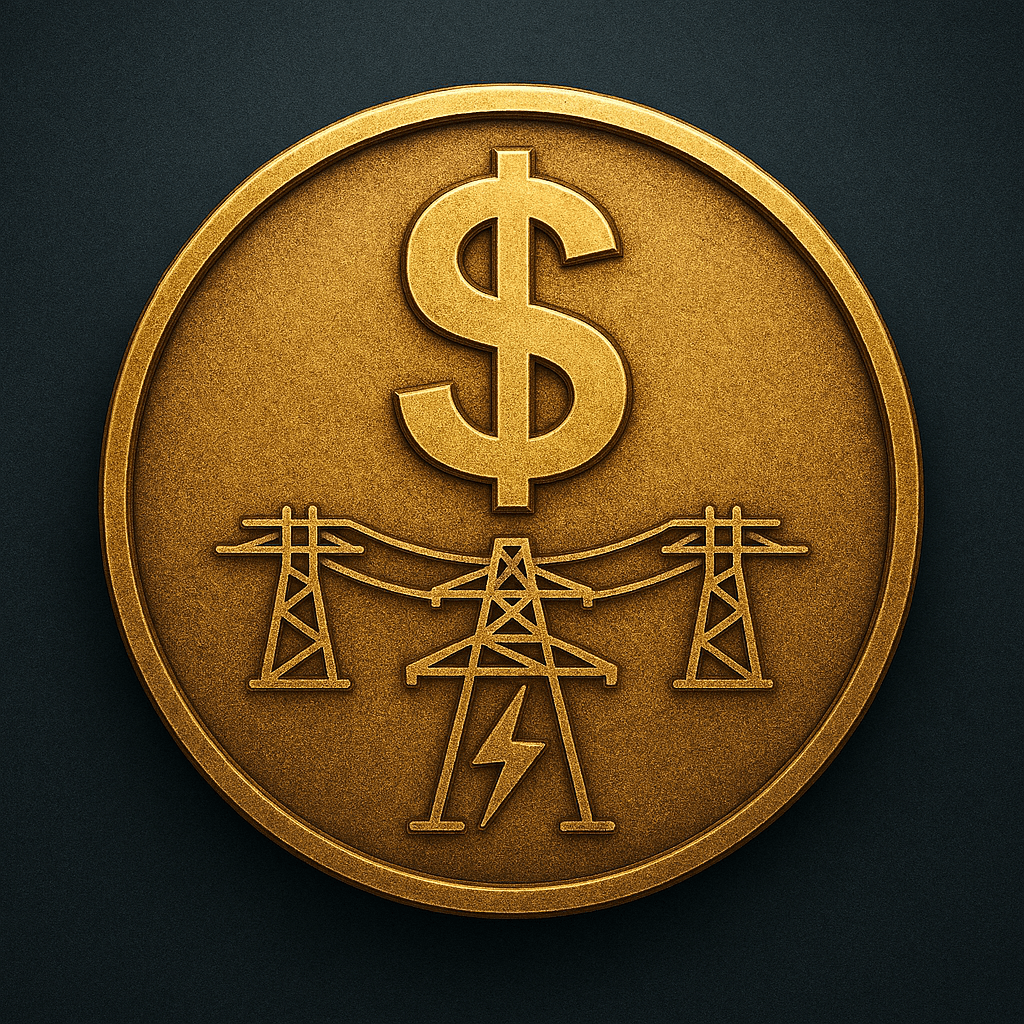
A monetary system fastened to work‑capacity. The ability of a civilization to perform work in the future. It solves the core problem fiat cannot: it ties money to something the world cannot fake. You can fake a balance sheet. You can fake a narrative. You can fake a token. You cannot fake a gigawatt. That is a first principle: neither arbitrary nor rigid, but physically independent of human interpretation. It scales with civilizational growth. It reflects real productivity. It resists political manipulation. And fraud becomes easy to detect. But only if there is the will to detect it. Most importantly, it aligns incentives with reality: you earn money by increasing the world’s capacity to perform work, not by manipulating symbols.
But a work‑anchored system adopted by even one sovereign does not remain a domestic experiment. It immediately creates pressure elsewhere. A currency tied to audited work‑capacity becomes harder, more credible, and more stable than fiat, and capital begins to migrate toward it. Exchange rates shift. Trade balances distort. Governments that rely on narrative management find their monetary sovereignty constrained by physics. They cannot negotiate with a watt. The result is geopolitical conflict, not because the system is coercive, but because it exposes the gap between a nation’s stories and its real productive base.
In such a system, money becomes a claim on future work. A power plant, a data center, a steel mill, a logistics network, each can issue claims proportional to its audited capacity to perform work. These claims circulate as money. They settle against actual output. Fraud becomes self‑defeating because it cannot survive contact with physics. A plant that over‑issues claims cannot deliver the promised work. A grid that misreports capacity is exposed by its own output. A ledger that attempts to rewrite history is contradicted by the physical world it purports to represent. In this architecture, cheating is not impossible, but it is unprofitable.
The transition from fiat to a work‑anchored system is evolutionary, not revolutionary. It occurs through parallel adoption. A second monetary base emerges alongside fiat. Institutions adopt it for long‑term contracts. Governments recognize it for infrastructure financing. Savings and credit migrate. Fiat becomes a convenience layer, not the foundation. This is not Bitcoin’s adoption curve. It is slower, quieter, and more stable because it is tied to real infrastructure, not speculative enthusiasm. Governments do not adopt it because they want to. They adopt it because the old system stops working for them. They do not lose control. They lose the illusion of control. And that is the real political friction.
Once money is anchored in work‑capacity, the Fed’s role changes fundamentally. It no longer manages inflation, steers the business cycle, manipulates expectations, or performs narrative maintenance. It becomes a clearinghouse, a standards body, a referee, an auditor. Its job shrinks from managing the economy to ensuring the measuring stick is honest. In that world, the debate about Fed independence becomes meaningless. One does not argue about the independence of the Bureau of Weights and Measures. One does not politicize the definition of a kilogram. One does not campaign on the governance of the volt. When money is anchored in physics, not narrative, the central bank becomes a notary, not a priesthood. And the question of its independence becomes as irrelevant as arguing about who should steer the boat when the rudder is missing.
The pointlessness of Fed independence is not a critique of the Fed. It is a recognition that the architecture it manages is reaching the end of its narrative life. Fiat’s fragility is not a failure of policy. It is a failure in its foundation. A work‑anchored monetary system, grounded in the ability of civilization to perform work, offers a path out of the cave of shadows. It replaces narrative with physics, belief with capacity, and discretion with measurement. And once money is anchored in reality, the independence of the storyteller becomes irrelevant. Because the story no longer holds the system together. Reality does.
In the end, every monetary architecture is a story about how a civilization chooses to coordinate work. Fiat coordinates through narrative. Gold coordinates through rigidity. Crypto coordinates through code. A work‑anchored system coordinates through physics and incentives. It does not promise perfection; it promises honesty. It does not eliminate politics; it limits the damage politics can do. And it does not replace human behavior; it aligns it with the real constraints of the world. When money measures capacity instead of belief, the system no longer depends on the storyteller. It depends on the civilization itself.
Fiat creates symbols. Work creates reality.
Postscript: In a work‑anchored system, generators of capacity become profit centers, users become cost centers, and currency becomes a digital ledger of claims and redemptions tied to the physical delivery of work. Taxes take the form of a pure consumption tax or a drawdown of civilization’s work‑capacity. The only form of taxation that aligns incentives, physics, and public finance.


 elsToday