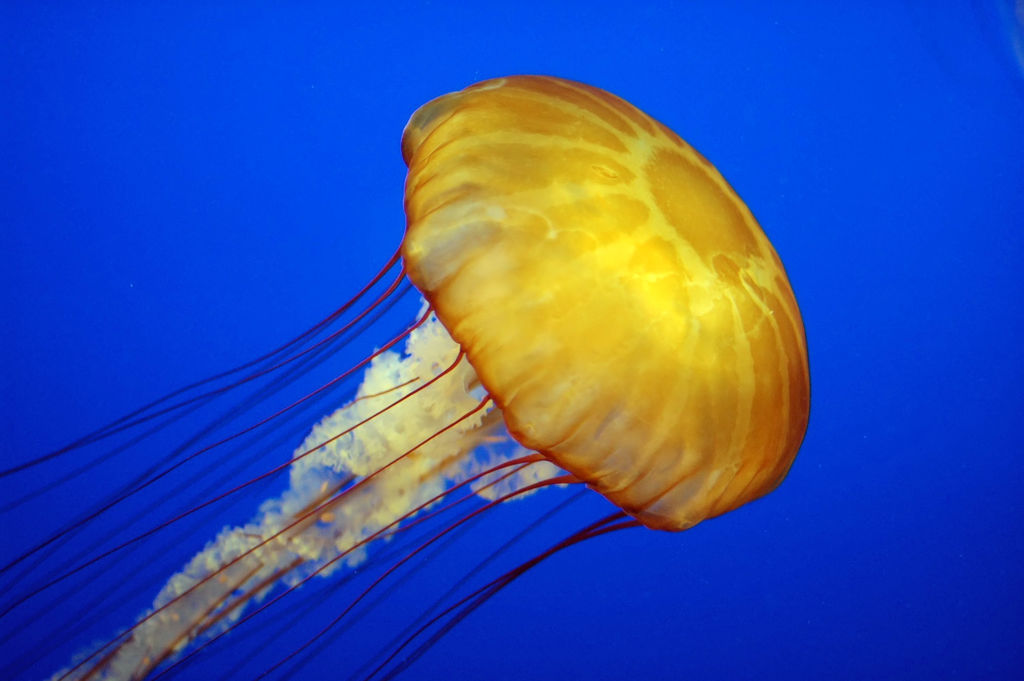
This essay began as a passing thought about jellyfish, those umbrellas of the sea drifting in blooms, fluthers, smacks, and swarms. They have no brain, no central command, only a diffuse matrix of neurons spread across their bodies. Yet they pulse, sting, drift, eat, and spawn; all without any trace of self-awareness.
This decentralized nerve net exposes the brittleness of Descartes’ dictum, cogito ergo sum: “I think, therefore I am.” Descartes, as did Socrates before him, equated thinking with consciousness.
For Socrates, thinking was the essence of the soul, inseparable from awareness and virtue. For Descartes, thinking was the proof of existence: the cogito. For philosophers today, consciousness reaches beyond thought, defined by the raw fact of experience; the sheer presence of what is.
Philosophers and neuroscientists now separate thinking (Reasoning, problem-solving, language; although language is at minimum a bridge from brain to mind) from consciousness (the subjective “what it’s like” experience). Yet separating the two only deepens the fog, the mystery of being. A newborn may have consciousness without thought. A computer may “think” without consciousness. A jellyfish reacts but does not reflect; its life is sensation without self-awareness.
Consciousness is more than biology or electronics, a core of being rising above life, thought, and reaction. Living is not the same as consciousness. Living is metabolism, reaction, survival. Consciousness is the something extra, the lagniappe, the “what it’s like” to be. A dog feels pain without philosophizing. A newborn hungers without reflection. A jellyfish recoils from harm, detects light, adapts its behavior. Is that sentient? Perhaps. But self-aware thought? Almost certainly not.
The spectrum of awareness occupies a wide corridor of argument and reality. On one end, the jellyfish: life without thought, existence without awareness. On the other, humans: tangled in language, reflection, and self-modeling cognition. Between them lies the mystery. Anesthesia, coma, or dreamless sleep show that thought can vanish while consciousness flickers on, or vice versa. The two are not bound in necessity; reality shows they can drift apart.
Neuroscience maps the machinery, hippocampus for memory, thalamus for awareness, but cannot settle the duality. Neurons may spark and signals flow, yet consciousness remains more than electrical activity. It is not reducible to living. It is not guaranteed by thought. It is the specter of being that transcends living biology.
The jellyfish reminds us that being does not require thinking. Humans remind us that thinking does not explain consciousness. Between them, philosophy persists, not by closure, but by continuing to ask.
Perhaps the jellyfish is not a primitive creature but a reflecting pool of possibilities: showing us that being does not require thinking, and that consciousness may be more elemental than the cogito admits. The question is not whether we think, but whether we experience. And experience, unlike thought, resists definition but it defines who we are.
In the end, Scarecrow, like the jellyfish, had no brain but was deemed the wisest man in Oz.
Graphic: A Pacific sea nettle (Chrysaora fuscescens) at the Monterey Bay Aquarium in California, USA. 2005. Public Domaine
 elsToday