White Holes, Black Holes, and the Cosmic Cycle

White holes, theoretical counterparts to black holes, might be two sides of a cosmic coin. Black holes devour matter with relentless gravity; white holes expel it, hurling energy, particles, and possibly time into the universe. Both stem from Einstein’s general relativity, which predicts black holes, proven by solid evidence, while white holes remain elusive, perhaps lurking beyond our Earthly senses. 

To see their link, rethink black holes’ strangest feature and flaw: the singularity. General relativity paints it as a point where spacetime crushes so tight that physics breaks, a bug, not a feature. Exotic matter, with odd traits like negative energy, was once the fix. But the University of Barcelona’s Pablo Bueno and team ditched it, tweaking gravity with higher-curvature corrections to erase singularities. This needs extra dimensions beyond our four, turning black holes from traps into dynamic zones. 

The University of Sheffield adds a twist: the event horizon isn’t sharp. Quantum gravity blurs it into a fuzzy gateway where spacetime bends, not breaks. In 4D, black holes are sinkholes, matter vanishes. In higher dimensions, it slips through, heading elsewhere. Sheffield’s take ties this to dark energy, the universe’s expansion driver. Here, it’s the power plant: quantum fluctuations, fueled by dark energy, replace the singularity with a bounce, flipping spacetime to a white hole. 

Enter white holes, Janus-like transitions, Roman god of gates and duality. Black holes vacuum everything; white holes, linked via higher dimensions, spit it out, maybe far off. Picture Sagittarius A*, the Milky Way’s core black hole, channeling matter 25,000 light-years to the Orion Nebula’s arm. Unseen, white holes might hide in dimensions we can’t touch. 

This hints at a cosmic cycle, like Earth’s water cycle: evaporate, rain, repeat. Black holes swallow, dark energy and quantum gravity bounce it through higher dimensions, and white holes release it back. Barcelona and Sheffield suggest no endpoints, just a recycling of cosmic raw materials across realms we’re barely capable of understanding.

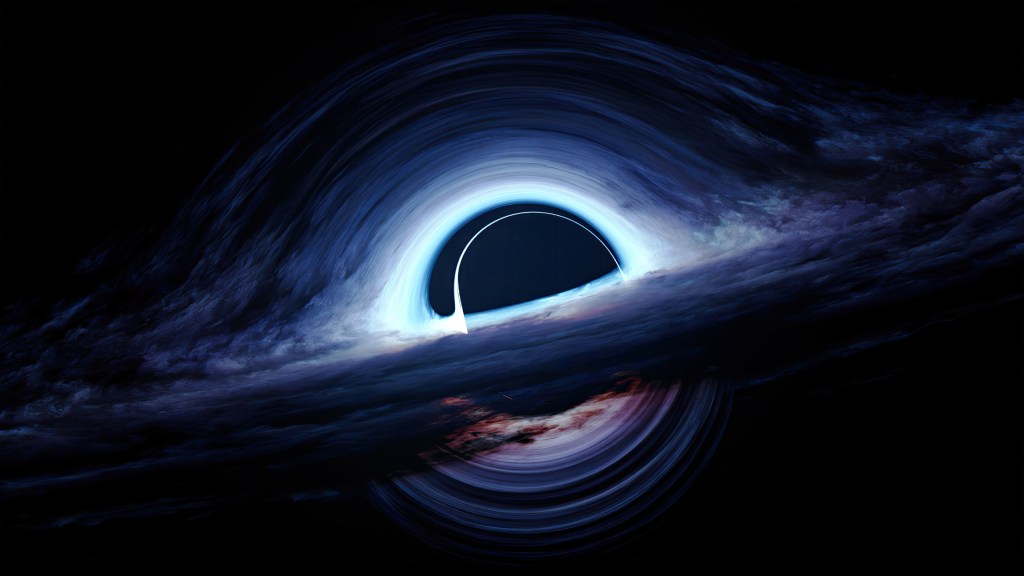
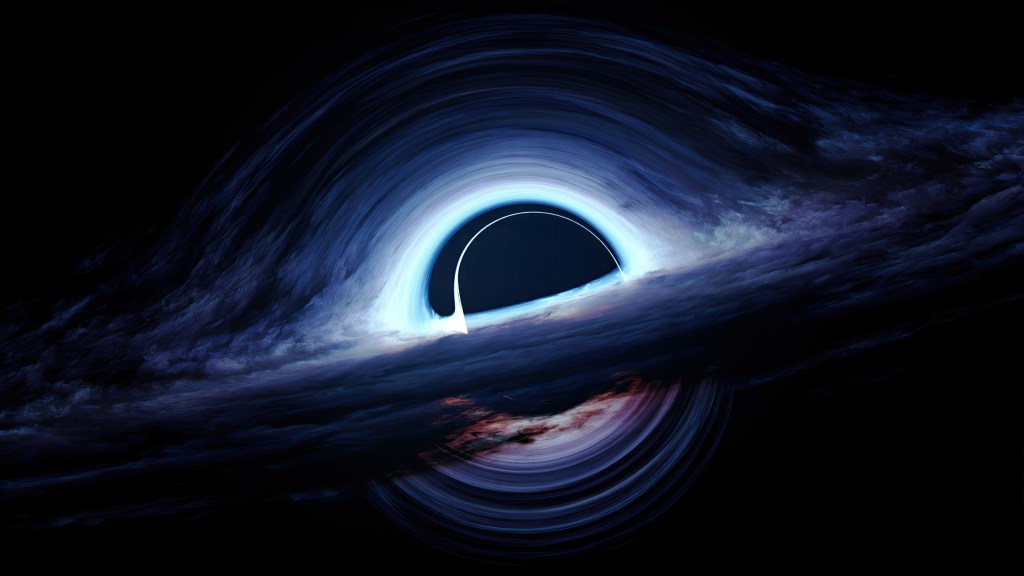
Source: Black Hole Singularity, Gielen and Menendez-Pidal, University of Sheffield, 2025. Regular Black Holes…by Bueno, P. et al, Physics Letter B, February 2025. Graphic: Black Hole Rendering.
Gravity and Vanilla Black Holes

Einstein’s theory of general relativity, which includes gravity, predicts that black holes have a tricky feature: a singularity. This is a point where space and time are squeezed so tightly that the laws of physics break down—think of it as a cosmic “error message.” To fix this, scientists often turn to exotic matter—hypothetical substances with bizarre properties like negative energy—to smooth things out. However, a team from the University of Barcelona, led by Pablo Bueno, found an alternative. They didn’t need exotic matter at all. Instead, they tweaked Einstein’s gravity by adding an infinite series of extra “rules” (higher-curvature corrections) to the math.

Their solution works in spacetimes with more than four dimensions—beyond our usual height, width, depth, and time. In these higher-dimensional worlds, black holes can exist without singularities. This “smooths out” black holes, making them less mysterious and more like regular objects in spacetime—no weird stuff required.

The presence of extra dimensions doesn’t just fix singularities—it can also change how black holes behave. In higher-dimensional spacetimes, black holes might have different event horizon shapes (the boundary beyond which nothing escapes) or other structural quirks. The Barcelona team’s work shows that these altered properties emerge naturally from gravity in more than four dimensions, offering a fresh perspective on these cosmic giants.

Thinking outside the box, is it possible that these extra dimensions link black holes to “a reality outside regular spacetime,” like wormholes (tunnels through spacetime), braneworlds (parallel universes on higher-dimensional “membranes”), or even gateways to white holes (theoretical opposites of black holes that spit stuff out)? Theories like string theory and braneworld scenarios suggest that extra dimensions might allow such connections. For example, a wormhole could theoretically bridge two distant points in our universe—or even lead to a completely different universe.

While the math of higher dimensions opens the door to these possibilities, it’s all conjecture. The Barcelona team’s work is a major step forward in understanding black holes in higher dimensions, but it doesn’t directly prove connections to other realities.

Source: Grok 3. Regular Black Holes… by Bueno, P. et al., Physics Letter B, February 2025. Graphic: Black Hole Rendering, iStock licensed.

Put Your Lights On

A distant galaxy at the edge of the universe and the beginning of time has revealed a remarkable discovery by Yale researchers. They have identified a variable quasar that rapidly brightens as its astrophysical jets periodically align with the position of Earth.

The researchers believe that this quasar, and others like it, played a significant role in bringing light into the early dark universe, alongside massive early stars which preceded the quasars.

Quasars are supermassive black holes at the centers of early galaxies, spinning at relativistic speeds. These early galaxies contained substantial unincorporated material, primordial gas clouds akin to present-day nebulae, which were easily captured by the black hole’s gravity. Near the event horizon of the black hole, this matter is caught in a ‘turbulent’ vortex, creating massive astrophysical jets. These jets, partially composed of ionized plasmas, are expelled at relativistic speeds, extending up to hundreds of light-years from the black hole and perpendicular to its event horizon. As the ionized hydrogen plasmas capture electrons from the neutral hydrogen in the early universe, photons are released, contributing to the illumination of the cosmos.

Thomas Connor, an astronomer at the Chandra X-Ray Center and co-corresponding author of the study, states, “[This] epoch of reionization is considered the end of the universe’s dark ages.”

Trivia: The song Put Your Lights On was written by Erik Schrody (Everlast) and performed with Santana on his 1999 album Supernatural. He wrote the song while recovering from a heart attack, pondering the hope that exists in life.

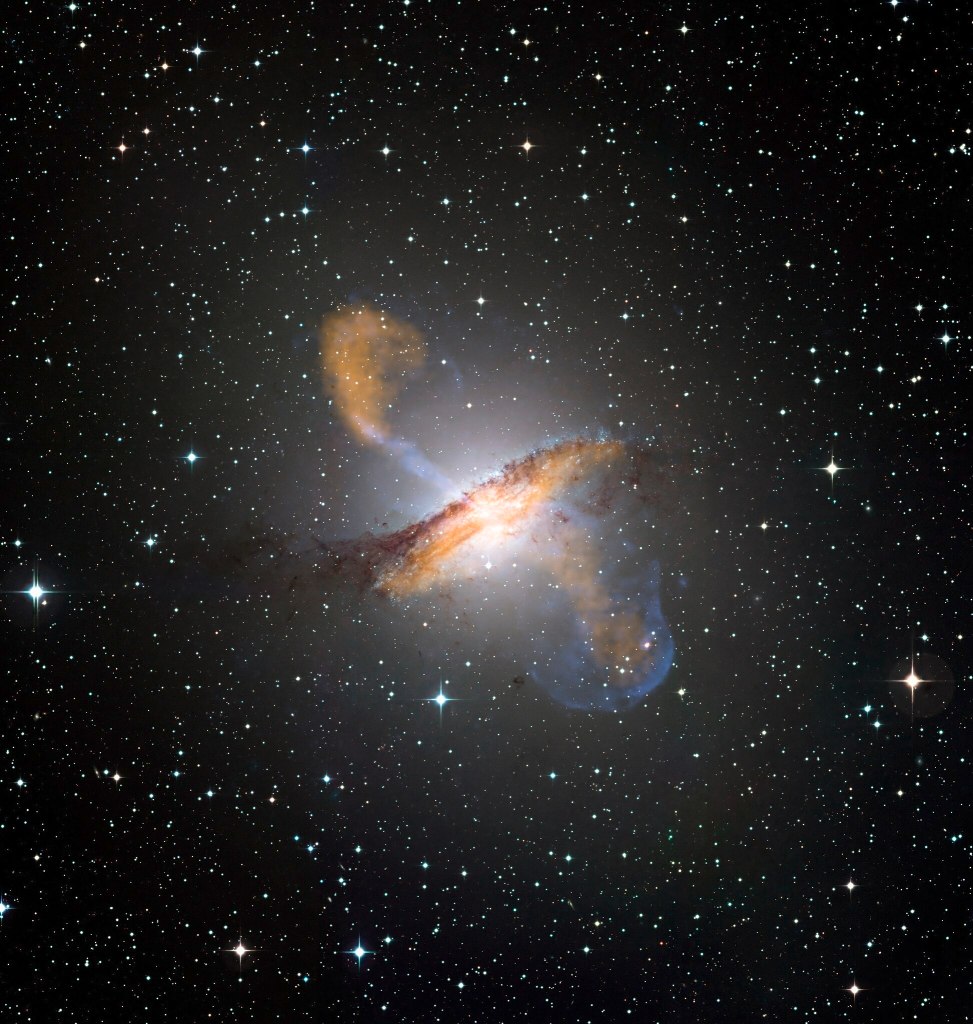
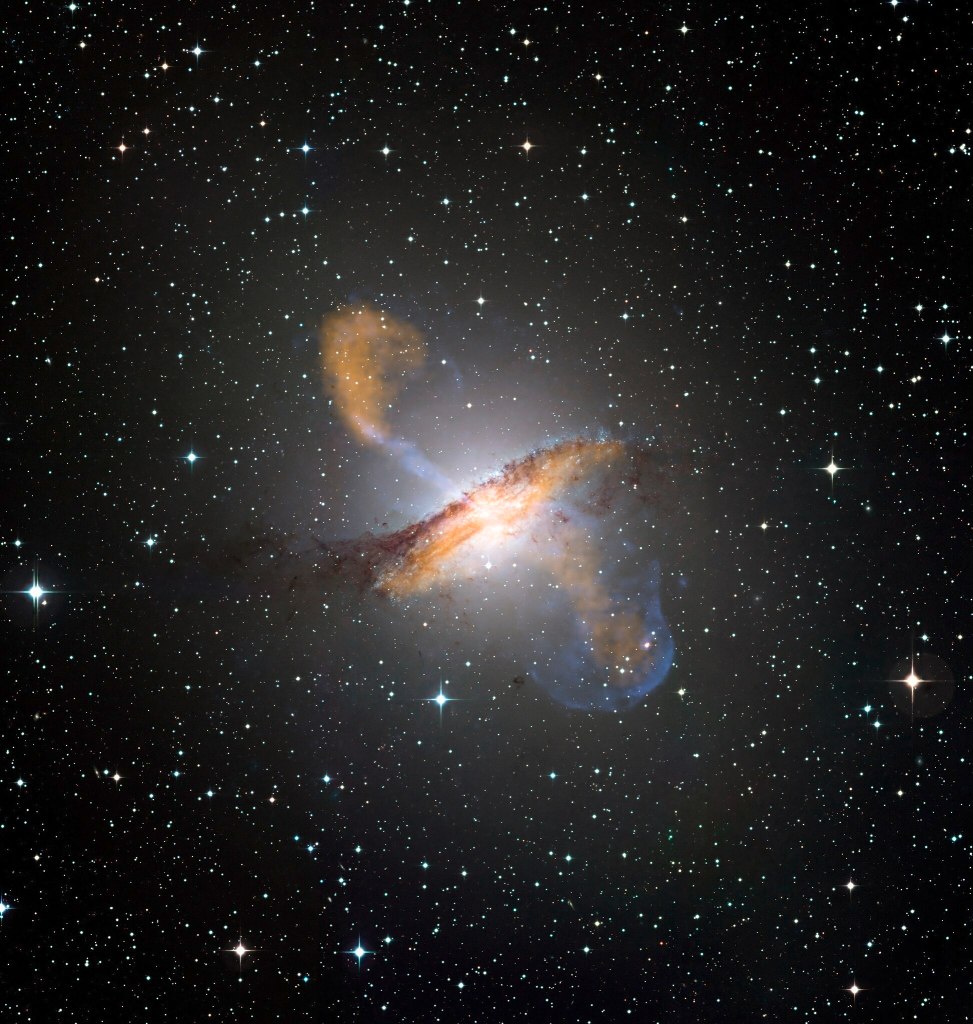
Source: This Quasar May Have Helped Turn the Lights on… by Shelton, Yale, 2025. Graphic: Black Hole Outflows from Centaurus A, ESO, 2009.

Plasma Jets

In a galaxy far, far away within the Draco (Dragon) constellation, an international team has, for the first time, observed plasma jets forming in real time and shooting out at relativistic speeds, perpendicular to the plane of a black hole’s event horizon. Plasma jets, composed of ionized matter, are a subset of astrophysical jets—energetic, narrow beams of matter and radiation ejected from various objects, primarily black holes, along their axis of rotation.

These plasma jets were observed in the Milky Way’s gravitationally captured satellite, the Draco Dwarf Galaxy, located 270 million light-years from Earth. The Draco Dwarf Galaxy is home to a black hole that apparently has a white dwarf star companion. A likely scenario is that the white dwarf was once a companion to a much larger star that evolved faster, went supernova, and collapsed into a black hole. Today, the black hole is possibly cannibalizing material from the white dwarf, potentially leading to the plasma jets observed by researchers.

Source: Astronomers observe real-time formation of black hole jets by UMBC, 2025. Graphic: Black Hole Outflows from Centaurus A, ESO, 2009.

Seeking God

95% of the universe is a mystery. About 68% is dark energy, which is believed to drive the accelerated expansion of the universe, though its exact nature is unknown. 27% is dark matter, which holds galaxies together and is believed to consist of one or more massive, yet unknown, particles.

Science Daily reports that researchers at the University of Michigan and five other institutions “have strengthened the case that matter becomes dark energy when massive stars collapse and become black holes.” This suggests that the universe’s expansion may be partly explained by the expansion of black holes through cosmological coupling. It also implies that black holes can gain mass without consuming matter, directly challenging the Standard Model of particle physics.

This either leads to the Big Freeze—infinite expansion through not quite infinite time—or the Big Crunch, where gravity eventually says ‘Enough!’ and collapses everything back into an infinitesimal point.

To sum up, we may or may not understand 5% of the universe, while the remaining 95% aligns with Socrates’ axiom from 6th century Greece—we essentially know nothing.

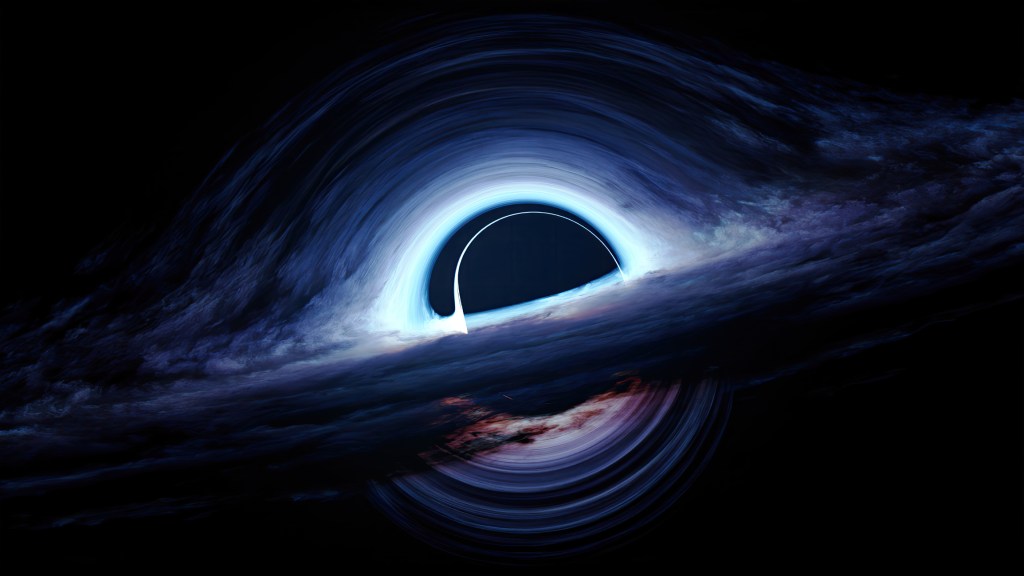
Source: University of Michigan. “Evidence Mounts for Dark Energy from Black Holes.” Science Daily. 2024. Graphic: Black Hole.

Runaway Black Hole

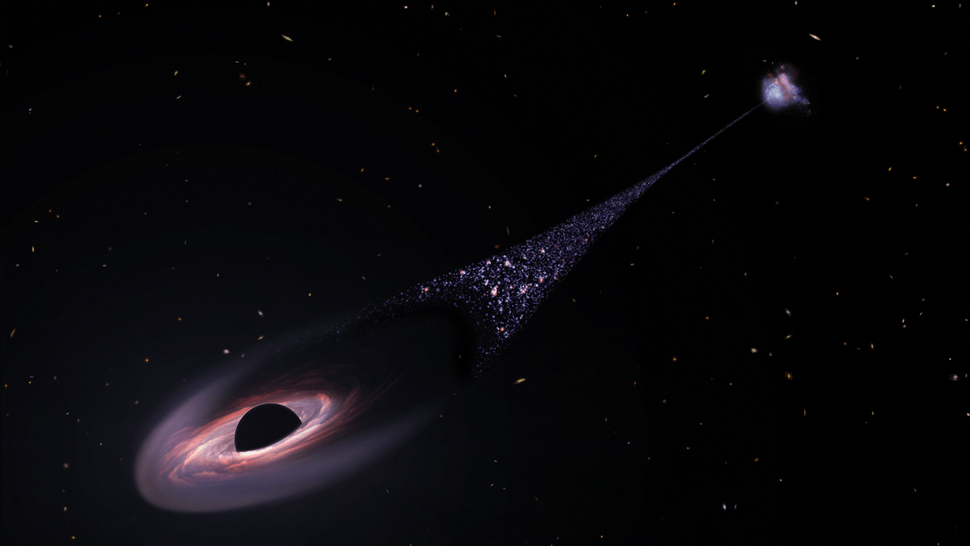
Brandon Specktor with LiveScience reports that ‘in 2023 astronomers reported the detection of something never seen before: a “runaway” black hole…’

The observed black hole with a mass of 20 million suns, is not gravitationally locked to any galaxy. It was spotted streaking darkly through space at more than 3 million miles per hour, or approximately 0.5% the speed of light, dragging a 200,000 light year long string of stars behind it like Christmas lights tied behind Santa’s sleigh.

Possible scenarios that may have sent the black hole on its merry way include various interactions with other massive objects, such as galactic collisions or gravitational recoil of merging black holes.

Source: 5 Space Discoveries that Scientists are Struggling to Explain by Brandon Specktor, LiveScience, 2024.  Graphic: NASA, ESA, Leah Hustak (STScl)