Mission of Gravity
By Hal Clement
Illustrations: Vincent Di Fate
Easton Press
Copyright: © 1987
Original Publication Date: 1954

Di Fate Biography:

Vincent Di Fate, born 1945 in Yonkers, is a New Yorker and American artist known for his depictions of science fiction, fantasy, and realistic space art. He has an MA from Syracuse University.
People Magazine noted the Di Fate is, “one of the top illustrators of science fiction…” His specialty is imaging technologies and environments in the nether regions of space and the universe. His clients include NASA, IBM, Scientific American, and The National Geographic Society. James Lizowski, Omni Magazine critic, noted that Di Fate, “combines the skills of a masterful painter with the fierce demand of an uncompromising artist to create visions of the future that are precise, powerful, and dazzling to the eye“.
His numerous awards include the: Hugo, Sklark, Lensman, Chesley, and Rondo Awards, among others for illustration of science fiction and fantasy subjects. He was inducted into the Science Fiction Hall of Fame in 2011 and the Illustrator’s Hall of Fame in 2019. He has consulted for MCA/Universal, 20th Century Fox, Walt Disney, MGM/United Artists.
Di Fate has also written three books and is currently working on his fourth. His second book Infinite Worlds was the first comprehensive history of science fiction art in America. Listed below are some of the books of fiction he has illustrated. Additionally, he has illustrated hundreds of sci-fi and fantasy book covers in his four decades as an artist.
Di Fate Book Illustrations (Partial):
- 2001: A Space Odyssey by Arthur C. Clarke
- Prelude to Foundation by Isaac Asimov
- The Demolished Man by Alfred Bester
- The Fabulous Riverboat by Philip José Farmer
- The Dark Design by Philip José Farmer
- The Magic Labyrinth by Philip José Farmer
- The World of Null-A by A.E. van Vogt
- Rules of Engagement by Elizabeth Moon
- The Time Traders by Andre Norton
- The Godmakers by Frank Herbert
Di Fate Bibliography:
- Di Fate’s Catalog of Science Fiction Hardware 1980
- Infinite Worlds: The Fantastic Visions of Science Fiction Art 1997
- The Science Fiction Art of Vincent Di Fate 2002
Clement Biography:
“Human beings are prone to believe the things they wish were true.” – Hal Clement
Hal Clement, born in 1922, in Massachusetts, passing away in 2003, was an American science fiction writer and a leader of the hard science fiction subgenre. Hard science, as it was defined in 1957 by P. Schuyler Miller, is characterized by scientific accuracy and logic. Hard science fiction is strongly rooted to known physical laws in the natural universe. In an interview with “The Science Fiction Radio Show” in the early 1980s Clement said that he had “…trouble writing something unless, I can, more or less convince myself it might happen.” In the old days before computers, he was known to whip out his slide rule and run through the calculations to make sure his stories passed the law of physics test.
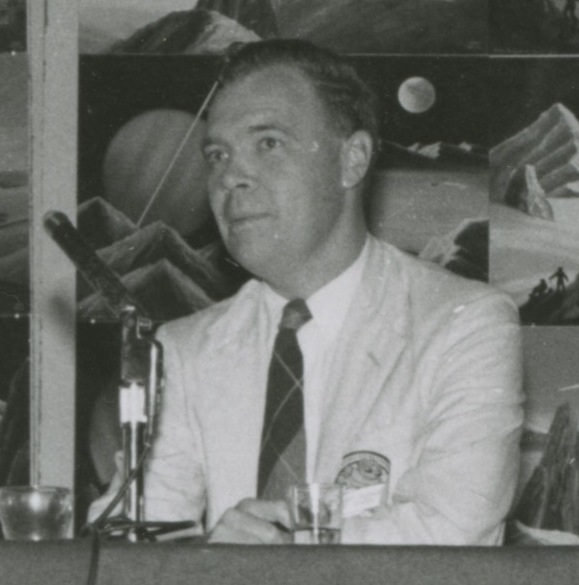
Clement received a degree in astronomy from Harvard University in 1943, an M.Ed. from Boston University in 1946, and eventually an M.S. in chemistry from Simmons College in 1963. He was a B-24 Liberator, a heavy bomber, pilot during WWII, flying combat missions over Europe, finishing his Air Force career after the war in the Air Force Reserve, retiring as a colonel. He taught astronomy and chemistry at the high school level in Massachusetts.
Clement while working towards his B.S. at Harvard wrote and published his first piece of science fiction, a short story called “Proof“. The story first appeared in a 1942 issue of Astounding Science edited by his mentor John W. Campbell. Campbell was known as the leader of the hard science wing of the science fiction genre which Clement admits affected his writing standards. Clement’s first three novels were Astounding Science serials under Campbell: Needle in 1950, Iceworld in 1953, and Mission of Gravity, his best-known novel, in 1954. Clement followed up Needle and Mission of Gravity with the sequels: Through the Eye of a Needle in 1978 and Star Light in 1971, respectively. He also wrote two additional short story sequels for Mission of Gravity: Lecture Demonstration in 1973 and Under in 2000.
In addition to his writing, Clement also painted astronomically oriented artworks under the name George Richard. In 1998, he was inducted into the Science Fiction and Fantasy Hall of Fame and was named the 17th SFWA Grand Master by the Science Fiction and Fantasy Writers of America in 1999.
Hal Clement wrote over 120 novels, novellas, short stories, and collections. Below is a listing of just his novels.
Clement Bibliography (Novels Only, Shorter Fiction not Listed):
- Needle 1950
- Iceworld 1953
- Mission of Gravity 1954
- The Ranger Boys in Space 1956
- Cycle of Fire 1957
- Close to Critical 1958
- Natives of Space 1965
- Star Light 1971
- Left of Africa 1976
- Through the Eye of a Needle 1978
- The Nitrogen Fix 1980
- Intuit 1987
- Still River 1987
- Fossil 1993
- Half Life 1999
- The Essential Hal Clement, Volume 1: Trio for Slide Rule and Typewriter 2007
- The Essential Hal Clement, Volume 3: Variations on a Theme by Sir Isaac Newton 2007
- Heavy Planet 2002
- Noise 2003
- Hal Clement SF Gateway Omnibus 2014
Mission of Gravity:
Mission of Gravity was first published in serialized form in The Astounding Science Fiction Anthology of 1953 with the hardcover coming out in 1954 followed by the paperback in 1958.
The story takes place on the planet Mesklin, an object thought to be in the 61 Cygni system, eleven light years from Earth. Mesklin is a super-giant bowl-shaped planet, flattened at the poles, an oblate spheroid, with an extreme rotation that allows for 18-minute days or approximately 9 minutes of daylight. The high spin rate creates gravity that equals about 3g at the equator and 700g at the poles. Clement eventually re-calculated the gravity over the planet and changed the polar regions to 200g. For comparison purposes the Sun has a gravity of 28g or 28 times that of Earth.
Earth has sent a probe to Mesklin to study its extreme gravity and other matters of value, but it became stranded in the high gravity areas of a pole ruling out a rescue by a human team. Earth wants to recover the probe at all costs to learn what secrets it contains.
The planet is populated by an intelligent species of centipedes that come in assorted sizes, but the ones be-friended by the Earth visitors are about three feet long. An Earth spacemen, Charles Lackland travels to the equator of the planet where he can just manage the 3g environment and meets Barlennan a captain of a sailing raft named the Bree. The Bree and its crew are on a trading voyage in the equatorial areas making a profit by bartering goods from isolated populations all over the planet. After Barlennan learns English, a deal is arranged for him and his crew to retrieve the probe at the poles and return it to the equator where the humans can pick it up. So begins the centipedes’ journey to the pole.
Literary Criticism:
As with all science fiction, Mission of Gravity suffers from futuristic technology that outdates itself in a few years. A quaint process in mapping the surface of Mesklin involves taking a series of high altitude photographs, displaying them of photo paper and trying to put them all together like a giant jig-saw puzzle. No GPS coordinates, no digital, just 1950 Earth tech and methodology. Leaving that aside though, the story is well worth reading. The science as presented is sound, mostly, the story telling and plot is a page turner, and the characterization of the alien’s life-forms is plausible and interesting. It will be worth your time and at 223 pages a quick read.
References and Readings:
- Science Fiction Planets Hal Clement’s Mesklin. By David Wallechinsky and Irving Wallace. Trivia-Library. 1975-1981
- Interview with Science Fiction Author Hal Clement. By Unknown. The Science Fiction Radio Show – Odessa College – Odessa, Texas. Early 1980s.
- Hal Clement. By Judith Tarr et al. Nebulas SFWA. 1998 (latest update 2023)
- Is the Planet Mesklin as Described in Hal Clement’s Mission of Gravity Correct? By Unknown. Physics. StackExchange. 2015
- Vincent Di Fate Biography. By Vincent Di Fate. Vincent Di Fate. 2016
- Clement, Hal. By Unknown. The Encyclopedia of Science Fiction. 2023 (latest update)
- Hal Clement. By Unknown. Wikipedia. 2001 (latest update 2024)
FootnoteA: Di Fate Cover Art for Ron Goulart Collection. Broke Down Engine. Macmillan. 1967
FootnoteB: Hal Clement at the 14th World Science Fiction Convention. Cropped from a Larger Photo. Public Domain. 1956
 elsToday