Swollen Caricatures

Fernando Botero Angulo, 1932-2023, was a Columbian practitioner of figuraism in paint and sculpture, a style where reality is discernable but changed to reflect the artist’s interpretation of his or her world. His unique style has taken on a life of its own and has become known as Boterismo where he exaggerates reality by inflating his objects, mimicking a fat farm on a carbo diet, injecting, according to some, a humor inherent in his plus sized models but it all seems so melodramatic. A melancholic need to explore life’s downsides, forcing the viewer to share not the beauty of life but its complexities and vulnerabilities. There is no happiness in his paintings, just a humorless life.

His style, not far removed from Legar’s Tubism, was the artist’s attempt to find himself and to relieve the self-inflicted anxiety that came from his mode of outward expression not matching his inward vision. He states that “…the moment comes when the painter manages to master the technique and at the same time all of his ideas become clear: at that point his desire to transpose them faithfully onto the canvas becomes so clear and compelling that painting becomes joy itself.”

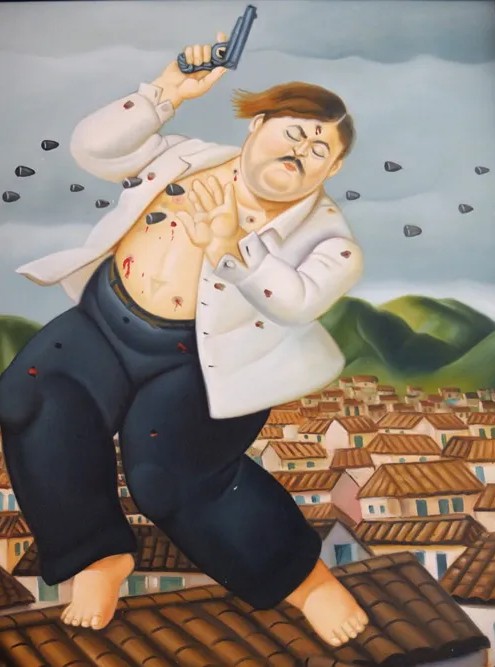
Botero’s 1999 painting, “The Death of Pablo Escobar”, a mafioso interpretation of Chagall’s “Fidler on the Roof”, was an attempt to capture the violence that the drug kingpin brought to Columbia and the world. Standing atop Columbian society, Escobar was laid low by his chosen swordian method of rule: bullets. The artist’s son Juan Carlos Botero states that his father wanted to reflect on the magnitude of the tragedy that Escobar’s actions meant for Columbia, but he also magnified the beast in the man, reminding the world that Columbia and Escobar were once synonymous. A cruel man ruling over a dysfunctional society that he created.

Source: Botero by Rudy Chiappini, 2015. Graphic: The Death of Pablo Escobar by Botero, 1999.
Know Thyself

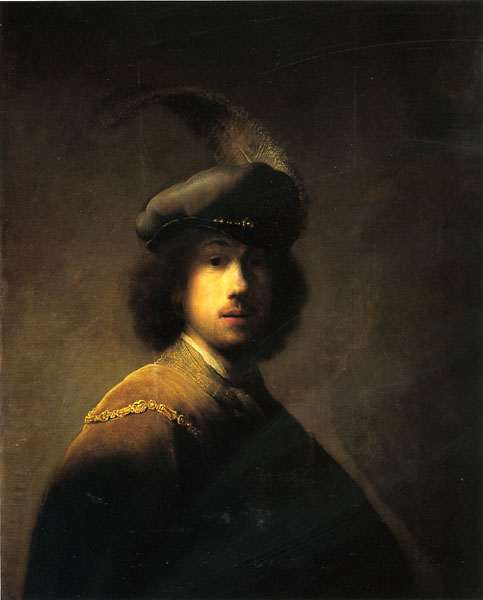
Draughtsman, etcher, painter, Rembrandt van Rijn, fascinated with the expressive face, inclined to acting out different character roles, inserting himself into the crowds to witness his subjects, shaping his public persona through his art, uncertain in youth, self-assured by mid-life, reflective towards the end, it is believed, with scholars still counting, that he created 40 to 50 paintings, 31 or 32 etchings, and 7 drawings of himself over a period of 44 years.

It is believed to be a record for self-portraits by a renowned artist.

The curator at the Museum of Fine Arts, Boston, C.S. Ackley writes that: “The artist used himself as a cheap model, studying his contorted features in the mirror.

A student of Rembrandt wrote in 1678 that a young budding artist should use a mirror to aid in the representation of the passions or emotions in order “to be at once performer and audience.”

To paraphrase the Delphic maxim: Know your art by studying yourself.

Source Rembrandt’s Journey by C.S. Ackley, 2003. ThoughtCo. 2019. Graphic: Rembrandt, Self-Portrait, Oil on Panel, 1629, Isabella Stewart Gardner Museum, Boston.

The Travels of Mary, Joseph, and Jesus

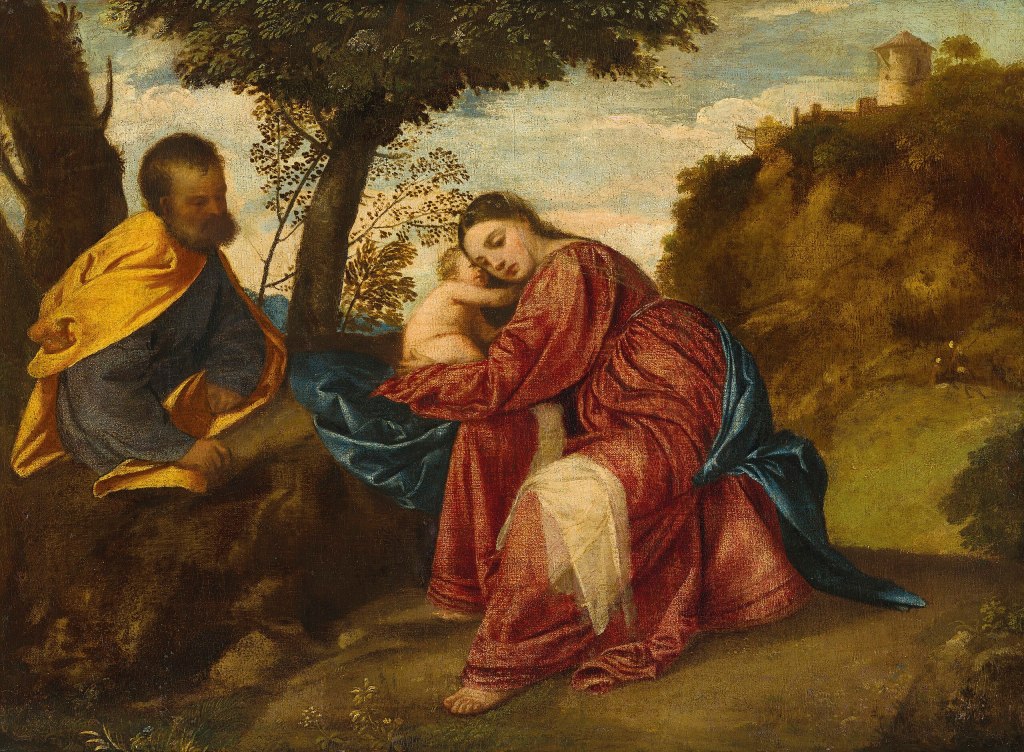
Rest on the Flight into Egypt was painted by the Venetian Renaissance master Tiziano Vecellio, better known as Titian, while he was in his late teens or possibly 20 years old in the year 1508. The painting was inspired by Joseph’s dream, recounted in Matthew 2:13-23, telling him and his young family to flee Herod and Judea.

The painting has changed hands repeatedly over the centuries being possessed by Dukes, Archdukes, Marquess, thieves, and other rich and powerful people. Below is a compilation of known owners of the painting through the years:

  • Possibly the first owner was Alfonso d’Este, Duke of Ferrara, 1508? Unverified.
  • Purchased by a Venetian merchant, Bartolomeo della Nave at an unknown date. Sold 1638
  • Purchased by James Hamilton, Duke of Hamilton in 1638
  • Purchased by Leopold Wilhelm, Archduke of Austria in 1649
  • Acquired by Hugh Andrew Johnston Munro of Novar in 1851
  • Acquired by John Thynne, Marquess of Bath in 1878
  • Stolen from Alexander Thynn, Marquess of Bath in 1995
  • Recovered for Alexander Thynn, Marquess of Bath in 2002. The painting was found at a bus stop in south-west London.
  • Sold by Ceawlin Thynn at Christie’s to an unknown buyer on 2 July 2024 for 17,560,000 pounds or about 22.17 million dollars.

Source: Christie’s June 2024. Artnet.com. The Art Newspaper.  Graphic: Rest on the Flight into Egypt, Titian, 1508, Public Domain.

Early Italian Renaissance Painting

Piero Della Francesca

By Anna Maria Maetzke

Photographs by Alessandro Benci

Published by Silvana Editoriale

Copyright: © 2013

An art book short on art and long on art history and art criticism.

Piero della Francesca, born in Tuscany in the early 15th century, is regarded as a true master before his time, eerily anticipating post impression by 500 years. Francesca was a major force in inputting perspective into paintings, greatly influenced by an Italian contemporary polymath, Leon Battista Alberti.

Francesca’s greatest works include the painting to the right, Federico da Montefeltro, Duke of Urbino, and the fresco, The Legend of the True Cross, located within the basilica of San Francesco in Arezzo, Italy.

The book contains all surviving paintings by the artist, about 150, which showcase his genius when compared with fellow artists such as Donatello and Brunelleschi, along with extensive research and commentary on Francesca’s life and art.