(Note: This is the second of 3 reviews detailing the stories and methods of stock market trend followers and traders that collectively became known as ‘Turtles’.)
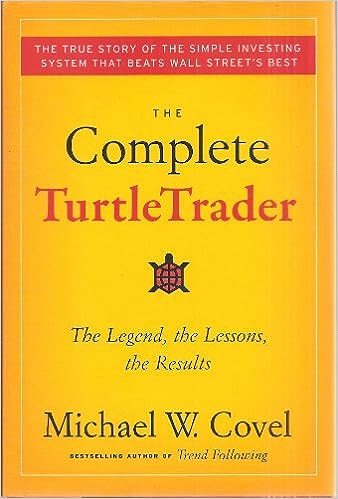
Michael W. Covel, 54, born in Virgina, is an author of 8 books on markets and trading with a specialization in the market technical analysis known as trend following or ‘Turtle’ trading.
He also hosts a podcast, ‘Trend Following Radio‘, which to date has recorded more than 1200 episodes. The podcast follows a format of interviewing leading authorities in economics, trading, and various other topics of interest to the investment world.
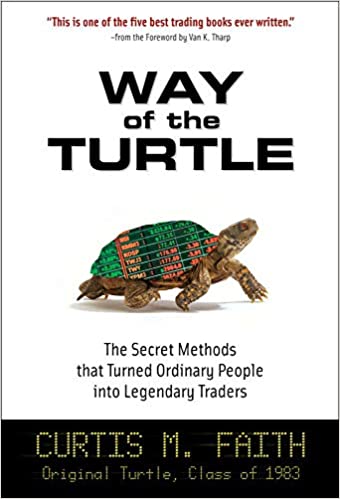
The previous post, ‘Turtle of the First’ was from the perspective of Curtis Faith who, in 1984, began his trading career in the first class of Richard Dennis’ ‘Turtles’. Michael Covel’s book is from the perspective of an outsider looking in. Before moving onto Covel’s story a quick recap from the previous post.
In 1983 Richard J. Dennis and his partner at C&D Commodities, their Chicago trading firm, budgeted $15,000 to run a recruitment ad in the Wall Street Journal, Barrons, and the International Herald Tribune seeking recruits to train in futures trading:
…Mr. Dennis and his associates will train a small group of applicants in his proprietary trading concepts. Successful candidates will then trade solely for Mr. Dennis: they will not be allowed to trade futures for themselves or others. Traders will be paid a percentage of their trading profits, and will be allowed a small draw. Prior experience in trading will be considered, but is not necessary. Applicants should send a brief resume with one sentence giving their reasons for applying…
From Richard J. Dennis et al ad in the above-mentioned newspapers and magazine.
From the replies to his ad Dennis chose 23 inductees into the ‘Turtle’ program that included college graduates with degrees in accounting, business, economics, geology, linguistics, marketing, music, and the US Naval Academy. Those from the paycheck world he picked a security guard, salesperson, broker, phone clerk, bartender, board game designer, and someone who listed himself as unemployed. An eclectic bunch for a very structured task indeed.
Dennis was looking for high IQ types willing to break from the herd and take risks. Intelligently calculated risks to be precise.
Dennis and his partner William Eckhardt taught the students in a conference room, not the trading pits, all they needed to trade in two weeks. Each student received $1 million to trade and was allowed to keep 15% of the profits.
They had one objective. Make as much money trading, on their terms, as humanly possible. It was definitely high risk, but the rewards were commiserate. The persistent need to win was mandatory if they were to survive as a ‘Turtle’.
Dennis insisted that to win, his students must always question conventional wisdom. He knew from experience in the trading pits that the majority opinion was wrong a majority of the time along with information coming from the news sources.
‘Turtles’ were discouraged from following the news, reading economic reports, or collecting stock tips because the markets move faster than information can be assimilated into the market. Or in other words information didn’t move the markets; people trading, often irrationally, did.
Conventional wisdom on Wall Street was to buy low and sell high. ‘Turtles’ tossed the conventional wisdom, bought high, and sold higher or shorted new lows.
Dennis and Eckhardt taught the ‘Turtles’ to follow the trend. They waited for the market to move then they followed it. Capturing most of the trend, up or down, was the goal.
They determined when to buy high, or to short stocks going lower, by observing breakouts in the markets or securities. If a stock made a new 20 or 55 day high, they bought the stock. If it made a new 20 or 55 day low, they shorted the stock. If the trend continued in the desired direction, they bought, or shorted, more of the stock. When the trend ended they sold.
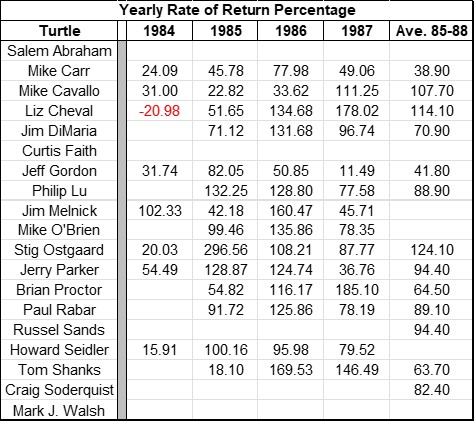
It was a simple system and it worked exceptionally well for the ‘Turtles’ who collectively made profits of $175,000,000 over the 5 years they worked for Dennis’s firm. The spreadsheet to the right shows the individual ‘Turtle’ results while they were working for Dennis (source: Covel and the Wall Street Journal – not all ‘Turtles’ listed)
(Note: This is the first of 3 reviews detailing the stories and methods of stock market trend followers and traders that collectively became known as ‘Turtles’. Curtis Faith was a turtle and a trader. The two reviews following this one concern publications by Michael Covel a market writer and trading coach who has lectured and written extensively on trend trading and Turtles.)
In 1983 Richard J. Dennis and his partner at C&D Commodities, their Chicago trading firm, budgeted $15,000 to run a recruitment ad in the Wall Street Journal, Barrons, and the International Herald Tribune seeking recruits to train in futures trading:
…Mr. Dennis and his associates will train a small group of applicants in his proprietary trading concepts. Successful candidates will then trade solely for Mr. Dennis: they will not be allowed to trade futures for themselves or others. Traders will be paid a percentage of their trading profits, and will be allowed a small draw. Prior experience in trading will be considered, but is not necessary. Applicants should send a brief resume with one sentence giving their reasons for applying…
From Richard J. Dennis et al ad in the above-mentioned newspapers and magazine.
The ad was the opening volley to proving a nature versus nurture disagreement between Dennis and his partner William Eckhardt. Dennis believed successful trading could be taught. Eckhardt, a mathematician by training turned trader, believed trading was innate, natural, inborn. You either had it or you didn’t, and no amount of teaching could change that.
To settle the debate Dennis agreed to teach his trading style and rules to a select group, letting them learn the craft using his money. From the firm’s ad and a follow-up true and false questionnaire they cobbled together a group of candidates, 23 in two tranches of 14 and 9 that were taught the firm’s trading rules. The traders came to be known as ‘Turtles’ because Dennis had seen a turtle farm, of all things, in Singapore and he believed he could raise traders as efficiently as Singaporeans raised turtles.
Over the next 5 years the ‘Turtles’ as a whole earned, made is probably a better word, $175,000,000. Dennis won the bet, but he worried that no amount of instruction could ultimately overcome human nature. Not sure if the following quote is a contradiction or just plain old irony but he worried his ‘Turtles’ couldn’t remain true to their training, stating “I always say that you could publish my trading rules in the newspaper, and no one would follow them. The key is consistency and discipline. Almost anybody can make up a set of rules that are 80% as good as what we taught our people. What they couldn’t do is give them the confidence to stick to those rules even when things are going bad” (from Market Wizards, by Jack Schwager).
Curtis Faith was a ‘Turtle’ selected in the first group and began trading under Dennis and Eckhardt’s tutelage in 1984. He was C&D Commodities’ most successful student, reportedly earning $31.5 million for the firm by the end of the experiment. To put that into context the 23 ‘Turtles’ as a whole averaged a little over $7.5 million each. Some twenty plus years later Faith published a book detailing his experience and methods living in ‘Turtle Time’ during the 1980s (apologies to Danny Flowers and Don Williams).
Faith was a risk taker, and he was probably the greatest risk taker of all the ‘Turtles’, even greater than Richard Dennis. Taking and managing risk is what traders do. They buy and sell risk. And you need nerves of steel or as Dennis states above: discipline. When managing risk, one needs a plan to get into a security and a plan to get out. In the immortal words in Don Schlitz’s 1976 song ‘The Gambler‘ made famous by Kenny Rogers: “You got to know when to hold them, know when to fold them…”
Traders buy and sell liquidity and price risk. Market Makers trade liquidity–making money off the spread between buy and sell prices. Speculators trade price risk. Buying low and selling high. Or with ‘Turtles’ buying high and selling higher or vice versa.
Speculators are not long-term investors. Speculators are short-term traders who have no desire or need to find the intrinsic or fundamental value of any security. Their only concern is price and which way is it moving; up, down, or sideways. The statistical analysis of price momentum and sometimes volume are the tools of the trade for the short-term speculators. This is usually referred to as technical analysis and technical trading.
Turtles are speculators, technical traders, playing trends in price that may not have a fundamental basis. Price trends without a fundamental basis are almost by definition irrational.
Adam Smith in his ‘Wealth of Nations’ postulated the first form of the Rational Choice Theory, that an individual’s actions are mostly selfish, which he dubbed the ‘Invisible Hand’. The theory suggests that individuals act in their own best interest and that their behavior is rational. At the beginning of the 20th century the hypothesis that the markets are efficient and rational began to take hold among traders and economists. This led to the Efficient-Market Hypothesis (EMH) or Theory that maintains that valuations or prices for assets such as stocks and bonds reflect all available information and are fairly valued. Only added information will then affect the price of an asset. This implies that it is impossible to beat the market. Just invest in DIAs, IWMs, SPYs, and QQQs and forget about them until you retire.
Faith and the Turtles say bunk to all that market rationality and index investing. Technical trading and trading like a turtle works because market movements are driven by the irrational collective behavior of the market participants or so they believed.
Turtles were trend followers attempting to take advantage of large price increases or decreases over a period of several months. Significant profitable trends happen infrequently with a high percentage of promising trend trades turning south soon after placing them. They experienced significantly more losers than winners but exited their losses quickly, usually around 20% below entry price.
Following trends is geared towards the present and what the market is currently doing. It is never about trying to predict the future. They entered trades when the calculated probabilities, through technical analysis, were in their favor.
The Turtle method was simple and easy to understand. The strategy could be summed up in one sentence. Trade with an edge, manage risk, be consistent, and keep it simple.
Trade with an edge. Have a plan and stick to it. Through experience or preferably back testing find a trading strategy that will have positive returns over the long run.
Manage your risk. Control your risk or in other words don’t bet the bank on a single trade and don’t hang onto your losers hoping for a turnaround.
Be consistent in executing your strategy. Do not jump into trades that look interesting but fail the tactical elements of your plan.
Keep it simple and follow your plan. Most of your trades may be losers but the winners will make up for the shortfall or drawdown. Think in terms of the long game and don’t fixate on the individual losing trades.
The Turtles tactics used in implementing their strategy were also simple.
Turtles traded liquid futures such as commodities, currencies, metals, energy, and bonds.
The Turtle’s most complicated tactic was position sizing the trades. Generally, the more liquid the market the fewer the contracts they traded.
The Turtles identified trends using two similar systems employing price breakouts at 20 and 55 days. They tried to enter as many of these breakouts as possible so as not to miss out on the rare but very profitable, large price movements.
All trades had stop losses.
Trade exits were set as a 10-day low for long positions and a 20-day high for shorts. They never exited a trade at maximum profitability but only when the end of the trend was evident.
Simple stuff and they made $175,000,000 with it. Dennis reportedly made $200,000,000 trading his own account.
Money for nothin’ Chicks for free Get your money for nothin’ And your chicks for free Oozin’ money for nothin’ And your chicks for free Get your money for nothin’ Chicks for free
Dire Straits, ‘Money for Nothing‘ written by Sting (Gordon Matthew Thomas Sumner) and Mark Knopfler, album: Brothers in Arms, 1985
I was looking for a money song to lead off the next few posts which will be about market security trading and the next thing you know I’m down the rabbit hole heading for White Rabbit’s house to retrieve his gloves, finding a zillion money songs along the way. Wonderland is a strange place as Grace Slick sang in Jefferson Airplane’s 1967 ‘Surrealistic Pillow‘ album. I digress.
Johnny Carson during one of his rare appearances on the Late Show, asked his country music star guest, Buck Owens, what the most common theme in music was. Owens answered with one word before Johnny even finished the question: love. Maybe for Owens and country music love is the constant but a study by North Carolina State University of songs making into Billboard pop charts from 1960 to 2009 found that the breakup of romantic relationships; ‘Breaking up is Hard to Do‘, thank your Mr. Sedaka, is number one. Which is depressing since I like my music on the happy side, but the study’s results show pop music gravitating further into the mirthless with time. The researchers found that songs have been getting steadily more depressing as they moved out of the 1960s and on into the first decade of 2000s. But love at least came in second. Bad love, good love, love to hate love, love comes, love goes. Money, alas, didn’t make the list.
So, it’s up to me to make one. Not an original idea or task, but I’ll make up for it with quantity. Below is a list of 400+ songs including duplicates performed by multiple artists.
Jay-Z and The Beatles recorded the most songs about money and I must say that worked out fairly well for them. The single word song title ‘Money‘ turns up 17 times in the list below but, is multiple different songs written by different artists with that title. Just for the record Pink Floyd’s ‘Money‘ is the cream of the money crop. ‘Easy Money‘ is another song title with at least a dozen different lyrical compositions and writers. I’ve listed 5 with Billy Joel’s version probably being the best known. Harlan Howard’s song ‘Busted‘ is covered by 6 different artists listed below including the soulful renditions by Ray Charles and Johnny Cash. ‘Money (That’s What I Want)‘ written by Berry Gordy and Janie Bradford and first performed by Barrett Strong is another money song covered by a plethora of bands including the Beatles and The Kingsmen. ‘Money (That’s What I Want)‘ was the first hit for the record label Motown.
Written by: Guy Ritchie – Ivan Atkinson – John Friedberg – Josh Berger
Music by: Christopher Benstead
Cast: Jake Gyllenhaal – Dar Salim – Emily Beecham –Jonny Lee Miller
Film Locations: Spain
Budget: $55 million
Worldwide Box Office: $17.5 million
American Army Sergeant John Kinley, played by Jake Gyllenhaal, and his Afghan interpreter Ahmed, played by Dar Salim take on the Taliban in a war-time tale of trust earned and promises kept.
I watched this movie because Guy Ritchie’s name was all over it. Director, writer, producer, even in the title: Guy Ritchie’s The Covenant. I suppose if you direct, write, and produce the movie you can put your name in the title. His past movies: Snatch, RocknRolla, Sherlock, The Gentleman, and others have complex, Rube Goldberg plots, twists within twists with tongue planted firmly in the cheek. I loved them and I wanted more Guy Ritchie movies. I expected more of the same with The Covenant and received nothing of the sort. The Covenant is a drama with a little war, a little action, and a little suspense thrown in. If Ritchie’s name weren’t all over the film you would not know it was a Ritchie film, which I guess explains why he put his name in the title. But it is a movie worthy of Ritchie’s name and fame.
The Covenant is Christopher Benstead’s fourth movie composing the music and score for Ritchie’s movies which included: The Gentlemen, Wrath of Man, and Aladdin. This movie’s play list:
A Horse With No Name – America
Long Cool Woman (In a Black Dress) – The Hollies
Truth – Alex Ebert
Toshna Ye Abem Shoda – Mehri Maftun
Say What You Want – White Denim
Thunder Continues In The Aftermath – Laurie Anderson & The Kronos Quartet
Darkness Falls – Margaret Lewis
Farkhâr Chi Khush-u Khush Havây Dâra Janam – Rahim Takhari
Darkness Falls and Thunder Continues are perfectly placed and worth the price of admission.
I’m ambivalent towards Jake Gyllenhaal, his acting skills, not him personally. Not that he can’t act, he can but his character portrayals always seem a bit off, not what your mind is expecting, especially in his nut case roles. In End of Watch and Nightcrawler he never fully captures the essence of his character. In places he is holding back emotionally, in other scenes he has gone too far but in the wrong direction. In The Covenant he manages a more consistent character portrayal and in the last battle scene he captures the moment with body language and facial expressions. No words needed.
The script is solid and concise without any major plot holes. Having someone with military experience to parse the script would have been helpful in a few of the scenes where Sgt. Kinley and Ahmed are evading capture through the mountains and foothills of Afghanistan. When you’re running for your lives, sitting down in the open when you have trees for cover seems ill-advised.
These negatives are mostly trivial though. The script, the direction, the camera work, the acting is all done well, not exceptional but certainly above average.
In the final scenes of the Benghazi movie, 13 Hours, the protagonists note that the Arab attack against the embassy compound must have required weeks if not months of advanced planning. A subtle message but one that called out the lie of the US administration’s stance that the attack was reaction to an anti-Islam movie the day before in Egypt. In the final scene of The Covenant a statement, posted on screen, revealed that in the aftermath of the Taliban’s recapture of Afghanistan, over 300 Afghan interpreters affiliated with the U.S. military were murdered by the Taliban terrorists, with thousands more still in hiding. Again, a subtle message dealing with the lack of foresight and due diligence concerning the US administration’s Afghan withdrawal plans and execution.
Original Book Publication Dates: 1705/1714/1729/1733
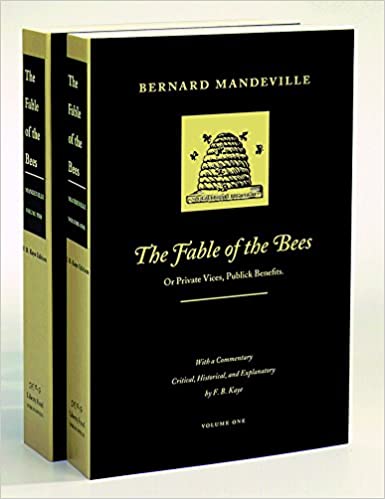
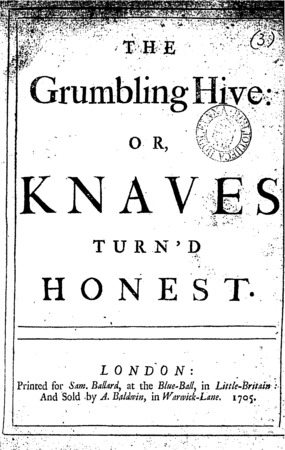
Bernard Mandeville was a free thinker, a contrarian, a troublemaker and likely loved every minute of it. His writings on vice and free living were greedily consumed by the 18th century public, and his notoriety began with a simple poem of 433 eight syllable coupled, rhymed lines, a doggerel of no artistic merit but with a moralistic message that has echoed, in various forms throughout the ages. It was originally titled: The Grumbling Hive or, Knaves turned Honest.
Mandeville was born in 1670 in the Dutch city of Rotterdam where he received a classical education at the Erasmus school and a medical degree from the University of Leiden. In the medical field he developed a special interest in what we would now call psychiatry and the use of talk therapy for curing hypochondriacs, the same branch his father practiced. He anticipated Freud by 175 years. Upon completing his medical studies, he moved to London to learn the language and decided to stay. In London he specialized in treating hypochondriacs, stomach ailments, writing political and philosophical tracts, all in which he achieved minor fame and fortune.
Beyond these meager particulars of his early life very little is known about Mandeville’s personal history. To know him, but not necessarily understand him, one must study his pamphlets and books on politics and philosophy and everything he wrote was soaked with politics and philosophy.
Mandeville’s written works sold so well that dozens of editions were needed to keep up with demand. His most celebrated work was The Grumbling Hive which he published anonymously in 1705. This little ditty immediately became a hit with the public and generated an immense amount of discourse and criticism.
Over the next 25 years or so he expanded the poem with commentary and essays under his own name with the next updated edition coming out in 1714 titled: The Fable of the Bees: or Private Vices, Public Benefits. In 1923 he again expanded the Fable of the Bees with an essay attacking charity schools, free schools for the poor, as nothing more than a vehicle to assuage the guilty conscience of the rich. The schools, while teaching the basics, the three Rs, were also a forum for instructing young minds in morality and religion. Mandeville was not so much against instructing the kids in addition and subtraction but that teaching morality in a capitalistic society was counterproductive.
Mandeville’s premise was that the rich set up and donated to the schools to atone for their gains attained through vice and greed. Mandeville would likely surmise that today’s charity and political donations, such as George Soros’ funding of weak on crime prosecutors, was atonement for their selfish gains in business and the markets. To put it mildly this did not go well with the upper crust, but it did increase the sales of his books.
In 1728 Mandeville expanded the Fable of the Bees again by adding a second volume which provided additional defense of his thesis that vice is good in the form of dialogs: elaborations on the division of labor and their associated economics. The two volumes were published together in 1733, the year of Mandeville’s death.
Mandeville’s basic thesis underlaying the Fable of the Bees was that greed and vice were good for the economy and society. A person’s self-interest in the pursuit of wealth and luxury provides benefits for everyone. A rising tide lifts all boats. The idea of selfishness for the public good certainly predates Mandeville and continues to the present day. The 1987 movie Wall Street, Gordon Gekko played by Michael Douglas argues that the human march of progress is fueled by personal self-interest and greed. Self-interest to accumulate wealth and fame. Morality does not enter into the equation, or it shouldn’t.
Mandeville believed that vice had a negligible effect on the population, but he obviously understood that it was the gateway drug to harder crimes. He understood that victimless crime led to felonious crime. He understood the “Broken Windows Theory” before it had a name. As such he strongly advocated for a robust and universal system of justice. A system that John Adams in 1779 would codify into the Massachusetts constitution as “a government of laws, and not of men.” By laws Mandeville meant the rules of conduct that private society imposed on itself over centuries of trial and error. He was not prescribing a legislative solution to criminal behavior although he offered advice in that arena also. Rather his economic laissez faire attitude carried over to his thoughts on justice. The fewer government mandates the better. He would readily agree with the 20th century Italian political philosopher Bruno Leoni’s notion on government decrees, “legislation…has come to resemble more and more a sort of diktat that the winning majorities in the legislative assemblies impose upon the minorities, often with the result of overturning long-established individual expectations and creating completely unprecedented ones.”
He emphasized the word justice, as in justice for all, without giving much serious thought to the criminal part of the equation. Mandeville’s endeavors at navigating the differences between vice and crime usually led to ambiguous reasoning and muddy waters. He had a wishful belief in a harmless sort of anarchy where everyone didn’t or shouldn’t bother their neighbors — much. Mandeville was stuck between his belief that selfish behavior is good, and that morality is an illusion, leaving no room for compromise. In the end all behavior could be explained by our selfish desires and motives. Altruistic behaviors were just cover for a guilty conscience.
Mandeville’s intellectual, educational, and philosophical journey, with little supporting evidence other than circumstantial bits and pieces, could be a great case study in nature versus nurture. His father and great-grandfather were both respected physicians with the wherewithal to send him to the best schools in Rotterdam.
His formal education began at the local Erasmus school which gave the students a grounding in Christianity, literature, poetry, drama, art, philosophy, languages, and history with an emphasis on lifelong learning. Desiderius Erasmus, a 15th, and 16th century resident of Rotterdam believed that man could only rise above other animals through self-improvement and study.
Another local resident of Rotterdam that had a profound influence on Mandeville was his contemporary, although a few decades older than himself, Pierre Bayle, a philosopher, and skeptic in the purest sense of the word. Bayle believed Christianity did not have a lock on virtuosity and morality. He believed in religious toleration beyond Catholicism for the simple reason that he was persecuted as a protestant. And he believed that one shouldn’t burden one’s conscience with guilt from minor transgressions or sins of the flesh.
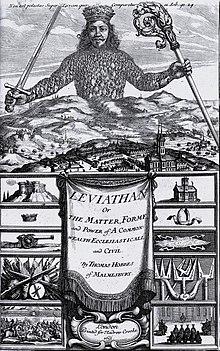
Thomas Hobbes, who died in the same decade that Mandeville was born, was an English polymath best known for his treatise on government and the governed: Leviathan. Leviathan is a discussion on how the individual and societies should be governed, and the covenants between the ruled and the ruler(s) that were needed to hold common-wealth, or as he called it, the Leviathan together. One of Hobbes main points about man as an individual in Leviathan, and which Mandeville was certainly familiar with, was that good and evil were constructs, mere names, for human emotional and physical appetites. The desires that make us human. Morality was nonsense.
26 years after Mandeville’s death Adam Smith wrote The Theory of Moral Sentiments where he introduced the concept of the ‘Invisible Hand’, a concept of individual self-interest driving the economic advancement of society. Adams stated, “They (ed. society) are led by an invisible hand to make nearly the same distribution of the necessaries of life, which would have been made, had the earth been divided into equal portions among all its inhabitants, and thus without intending it, without knowing it, advance the interest of the society, and afford means to the multiplication of the species.” Smith’s ‘Invisible Hand’ is practically interchangeable with Mandeville’s self-interest and greed thesis. Smith expanded upon the ‘Invisible Hand’ in his 1976 publication The Wealth of Nations.
The Theory of Moral Sentiments introduced the ‘Invisible Hand’ but was primarily intended to provide logical reasoning for man’s altruistic nature and furnish a rebuttal to Mandeville and others. Adams believed that morality was more than a word, more than an ethical nicety. Smith believed our sense of morality was real and natural. It was built into our being through the experience of living, and he termed it sympathy, what we would now call empathy. It was natural to care about the lives of others either because we have walked in the shoes of the less fortunate, or we can see with our own eyes what the less fortunate are living with or without. Empathy was the laissez faire sense of justice that Mandeville could not see, but should have, because it was in the opposite direction of selfishness. He wouldn’t look there because he believed it couldn’t be found.
Richard Dawkins’ 1976 book The Selfish Gene asserts that a human gene propagates itself into the future through the individual selfish motives of survival rather than through the desire to better a group or organism. The thought that a gene can be selfish is no more plausible than it can run a 4-minute mile, but it is a useful term to use as a descriptor. Dawkins claims that the selfish gene increases its chances of replication and survival by promoting altruistic behavior between like members of a group or organism. The selfish actions of the individual or the gene leads to unselfish actions of the group or the organism.
In the end Mandeville articulated a theory of self-interest driving societal economic advancement that causes emotional discomfort in most of us, not because it is wrong but because it is only half right. We may be selfish, but altruism and benevolence are part of our nature, a major part of who we are. Selfishness and altruism together advance our species and our society.
Bibliography:
1685 de Medicina Oratio Scholastica. Regneri Leers, Rotterdam. An oration in which BM declares his intent to study medicine at Leyden.
1689 Disputatio Philosophica de Brutorum Operationibus. Abraham Elzevier, Leyde. A dissertation delivered at Leyden in 1689, in which Mandeville defended the Cartesian position that animals are unfeeling automata.
1691 Disputatio Medica Inauguralis de Chylosi Vitiata. Abraham Elzevier, Leyden. Mandeville’s medical dissertation in which he argued that digestion involved fermentation, rather than warmth.
1703 Some Fables After the Easie and Familiar Method of Monsieur de la Fontaine. Printed for and sold by R. Wellington, London
1703 The Pamphleteers. A Satyr, London
1704 Æsop Dress’d or A Collection of Fables Writ in Familiar Verse. Printed for R. Wellington, London
1704 Typhon: Or the Wars Between Gods and Giants. Printed for J. Pero, Little Britain
1705 The Grumbling Hive, or Knaves Turn’d Honest. Printed for S. Ballard and A. Baldwin, London
1709 The Virgin Unmask’d: Or, Female Dialogues Betwixt an Elderly Maiden Lady … Printed, and are to be sold by J. Morphew, and J. Woodward, London
1709 The Female Tatler, by “a Society of Ladies”. A. Baldwin, London
1711 A Treatise of the Hypochondriack and Hysterick Diseases. In Three Dialogues. Printed J. Tonson, London
1712 Wishes to a Godson, with Other Miscellany Poems. Printed for J. Baker, London
1714 The Mischiefs that Ought Justly to be Apprehended from a Whig-Government. Printed for J. Roberts, London
1714 The Fable of the Bees: or, Private Vices, Public Benefits. Printed and sold by J. Roberts, London
1720 Free Thoughts on Religion, the Church, and National Happiness. Printed, and sold by T. Jauncy, and J. Roberts, London
1723 An Essay on Description in Poetry with A Description of a Rouz’d Lion. Printed in St. James Journal
1723 The Death of Turnus. Printed in St. James Journal
1723 The Fable of the Bees: or, Private Vices, Public Benefits. Expanded Edition. Printed for E. Parker, London
1724 A Modest Defence of Publick Stews. Printed by A. Moore, London
1725 An Enquiry into the Causes of the Frequent Executions at Tyburn: and a Proposal for Some Regulations Concerning Felons in Prison, and the Good Effects to be Expected from Them. Letters to the British Journal
1729 The Fable of the Bees: or, Private Vices, Public Benefits. Volume II. Printed and sold by J. Roberts, London
1732 An Enquiry into the Origin of Honour and the Usefulness of Christianity in War. Printed for J. Brotherton, London
1732 A Letter to Dion, Occasion’d by his Book called Alciphron. Printed and Sold by J. Roberts, London
1733 The Fable of the Bees: or, Private Vices, Public Benefits. Volumes I and II. London
Written by: Shay Hatten, Michael Finch, Derek Kolstad (creator of characters)
Music by: Tyler Bates – Joel J. Richard
Cast: Keanu Reeves – Ian McShane – Donnie Yen – Hiroyuki Sanada – Bill Skarsgard
Film Locations: France – Germany – Japan – Jordan – USA
Budget: $100 million
Worldwide Box Office: $430 million
Nobody give me trouble ’cause they know I got it made I’m bad, I’m nationwide Well I’m bad, bad, bad, bad, bad, I’m nationwide
ZZ Top – I’m Bad, I’m Nationwide – 1979 – Deguello Album
John Wick wants his freedom back. He skips the nationwide bit, goes worldwide in Chapter 4 against the High Table and he’s bad, sooo bad as in he’s really good, and the movie is good; all is good. Make that better than good. Better than the previous three, which were also really good. Do yourself a favor and watch.
The core team is back for Chapter 4. Chad Stahelski directs again as he did in the first three Wick movies. Stahelski, a former stunt coordinator and stuntman, co-founder of design company 87Eleven, debuted as a director in the first John Wick garnering several Best First Feature awards. He is producing the upcoming Ballerina, a John Wick spinoff set in a time between John Wick Chapter 3 – Parabellum and John Wick Chapter 4.
Shay Hattan returns as screenwriter as he was in Chapter 3. Although only 29 years old or 30 depending on who you ask, Hattan has already established himself as a force in Hollywood. His upcoming writing projects include Ballerina and Rebel Moon, a sci-fi, space action movie.
Tyler Bates and Joel J. Richard served up the music for all four movies. Bates has also worked on the two Guardians of the Galaxy movies, Deadpool 2, Fast and Furious: Hobbs and Shaw. In his past life he wrote, produced, and played guitar for the band Marilyn Manson. Richard’s efforts beyond the Wick movies are mostly confined to movie shorts and tv series which include The Andromeda Strain and Quantico.
Reeves, Reddick, and McShane keep it fun and tite. Reeves is John Wick. It is his role, and it will be a long time before they find someone else to play the role, if ever. Wick will endure — as long as Disney never buys the rights to the franchise.
Just for fun Reeves as John Wick spoke 511 words in the first movie which ran for 101 minutes. Normal speech is 100-130 words per minute. 380 words in the second movie with a duration of 122 minutes. An unknown number in the third movie and 380 words again in Chapter 4 which came in at 169 minutes. If Reeves and Eastwood ever team up, they could do an entire movie without saying a word.
Ian McShane was an excellent choice as the manager of The Continental. British suave, debonair, unflappable but the years are taking their toll. He will be 81 in September of 2023.
Lance Reddick died on 17 March 2023 at the age of sixty. Much too short of a time on this planet, much too soon to leave. RIP.
Fishburne contines in his role as the Bowery King but only in a few quick scenes well into this movie plus the closing scene. His first scene in Chapter 4 where he delivers a ‘I am God’ speech is perplexing. This scene could have been pared down by two thirds without any loss of continuity or meaning.
Long live John Wick. If spinoffs are the answer, I’ll take ’em and it will be good.
Awards: Fantasia International Film Festival 2022 — Best International Feature Award
Directed by: Franklin Ritch
Written by: Franklin Ritch
Music by: —
Cast: Tatum Matthews, David Girard, Sinda Nichols, Franklin Ritch, Lance Henriksen
Film Locations: —
Budget: Low Budget
Worldwide Box Office: Limited Release – Unknown
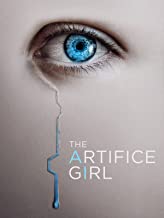
The beginning of the movie finds a computer programmer, Gareth played by Franklin Ritch, being interrogated by government agents questioning his ties to various pedophiles operating around the world. As the scene progresses, we learn that the programmer has created an artificial intelligence program represented by a nine-year-old girl avatar named Cherry. She entices, online, child molesters and pedophiles, learns their identities, and reports them, through Gareth, to the authorities.
The movie is divided into three main scenes progressing linearly in time. The first scene opens with Gareth in his early to mid-twenties. The second scene is 15 years into the future with the same actors aged 15 additional years except Cherry who is still nine years old. The final scene is even further into future where Gareth is an old man played by Lance Henriksen. Cherry hasn’t aged a day.
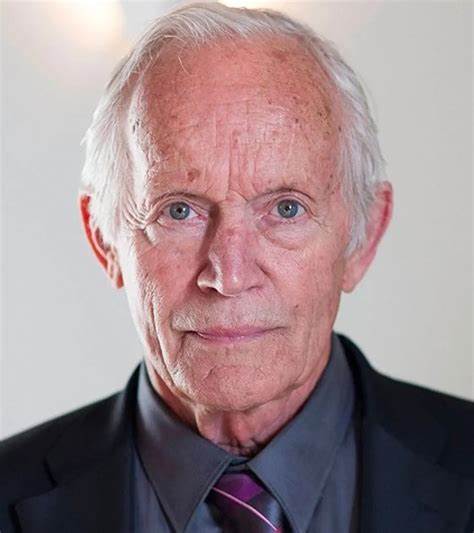
I found the choice of Henriksen to play Gareth simply sublime. He played a synthetic human named Bishop with a heroic ‘heart’ in the 1986 movie Aliens and the living human Bishop with an evil heart in the 1992 Alien 3 movie.
For a low budget movie everything is done right, almost to perfection. The only quibble is Sinda Nichols’ over the top acting in the opening scenes but that is more of a ding on the screenplay and direction rather than the performance. Tatum Matthew’s acting is very good considering her age. She maintains a slight mechanical inflected voice throughout the movie which seems fitting for a computer-generated delivery.
This movie is worth your investment of 93 minutes not just because it is well done but also there is some thinking to be done. The thinking isn’t heavy. It just comes along for the ride. A few of the same questions addressed in the Alien movies, and others, by Henriksen’s Bishop roles are reprised in The Artifice Girl. Are humans good or evil for creating Cherry? Is Cherry ultimately evil or good? Do humans understand the consequences of AI? Should you do something just because you can?
(Picture above left: Tatum Matthews age 14. Picture above right is Lance Henriksen age 83.)
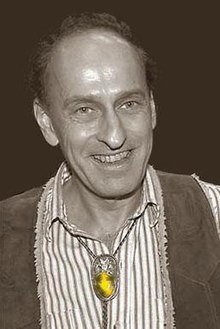
Roger Zelazny was a giant of science fiction and fantasy from the mid-1960s till his death in 1995 at the age of 58. For 42 years, beginning slow, learning to crawl in 1953, sprinting from the mid-60s onward, his prodigious writing produced 46 novels and novellas, more than 140 short stories, and plethora of poems, chapbooks, anthologies, and collections which earned him six Hugos and three Nebula Awards.
Zelazny’s prolific output flowed from an inventive mind wrapped around the mythology and literary fiction of the distant past. Homer to Shakespeare, Greek gods to Norse myths — Zelazny’s fictional future was filled with characters reprising roles from civilization’s long-gone coterie of rogues and heroes, some real, most not.
His greatest commercial achievement, the ten novels of Amber weave through the book’s fictional universe’s two true worlds: Amber, an Arthurian legend with Shakespearean Histories and Chaos, Greek myth at the edge of the abyss with all else in between being nothing but shadow of no real substance. Zelazny credits Farmer’s World of Tiers and French legend including the Song of Roland for inspiration in writing Amber with allusion to much that is Shakespeare: Hamlet, As You Like It, Julius Ceasar, and many of the other Histories and Romances. With an M.A. in Jacobean literature and a love of poetry it takes little imagination to suspect the shadows of Amber may also have a connection to Shakespeare’s Sonnet 53:
What is your substance, whereof are you made, That millions of strange shadows on you tend? Since every one hath, every one, one shade, And you but one, can every shadow lend. …
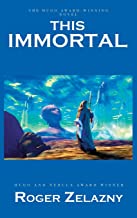
This Immortal or …And Call Me Conrad is a story of Greek myth meeting nuclear Armageddon of Earth. With the remaining population of a couple million living in the few places left on Earth that aren’t toxic, the galactic future appears to belong to the Vegans. The Vegans, from the star system of Vega, who may incidentally have been herbivores, were blue skinned aliens preferring humans as a source of cheap labor and prostitution and not much else. A Vegan author has come to Earth to write a book on the remaining locations of civilizational wonder left on the planet. He has requested that Conrad serve as his tour guide.
Conrad or Konstatin Nomikos, a young man, a rather ugly young man of innumerable years bearing a mysterious past would rather not. Would rather not serve as a tour guide. Would rather not serve as protector of a blue alien that Conrad’s former freedom party wishes to kill. But he does because he is curious, and it may be important.
With promises to protect and to serve Conrad, the blue alien, a few old acquaintances from his old freedom party and a hired assassin set off to survey the Earth’s past glories.
The story plays out as a film noir in words. A detective novel solving mysteries that may or may not be crimes. A cynical protagonist questioning motivations of all. A page-turner of mutant battles, robot wrestling, life squabbles, and glib dialogue. A piece-by-piece narrative of what Conrad wants and who he is. All brought to you through the lens of ancient Greek gods, myth, and literature.
MajorAwards:
1966 Hugo Novel Award for: …And Call Me Conrad (published in book form as This Immortal)
1966 Nebula Novelette Award: The Doors of His Face, the Lamps of His Mouth
1966 Nebula Novella Award: He Who Shapes
1968 Hugo Novel Award: Lord of Light
1976 Hugo and Nebula Novella Award: Home Is the Hangman
1984 Hugo Novelette Award: Unicorn Variation
1986 Hugo Novella Award: 24 Views of Mt. Fuji, by Hokusai
1987 Hugo Novelette Award: Permafrost
Bibliography:
Novels and Novellas:
1965…And Call Me Conrad
1966 This Immortal (book form of the serialized …And Call Me Conrad)
1966 The Dream Master
1967 Lord of Light
1969 Creatures of Light and Darkness
1969 Isle of the Dead (Francis Sandow)
1969 Damnation Alley
1970 Nine Princes in Amber (Chronicles of Amber)
1971 Jack of Shadows
1972 The Guns of Avalon (Chronicles of Amber)
1973 Today We Choose Faces
1973 To Die in Italbar (Francis Sandow)
1975 Sign of the Unicorn (Chronicles of Amber)
1976 Deus Irae (co-authored with Philip K. Dick)
1976 Home is the Hangman
1976 Doorways in the Sand
1976 Bridge of Ashes
1976 The Hand of Oberon (Chronicles of Amber)
1978 The Courts of Chaos (Chronicles of Amber)
1979 Roadmarks
1980 Changeling (Wizard World)
1981 Madwand (Wizard World)
1981 The Changing Land
1982 Coils (co-authored with Fred Saberhagen)
1982 Dilvish, the Damned
1982 Eye of Cat
1985 Trumps of Doom (Chronicles of Amber)
1986 Blood of Amber (Chronicles of Amber)
1987 Sign of Chaos (Chronicles of Amber)
1987 A Dark Traveling
1989 Knight of Shadows (Chronicles of Amber)
1989 Wizard World (omnibus)
1990 The Mask of Loki (co-authored with Thomas T. Thomas)
1990 The Black Throne (co-authored with Fred Saberhagen)
1991 Bring Me the Head of Prince Charming (The Millennial Contest co-authored with Robert Sheckley)
1991 Prince of Chaos (Chronicles of Amber)
1992 Flare (1992) (co-authored with Thomas T. Thomas)
1992 Here There Be Dragons (written 1968/69)
1992 Way Up High (written 1968/69)
1993 If at Faust You Don’t Succeed (The Millennial Contest co-authored with Robert Sheckley)
1993 A Night in the Lonesome October
1994 Wilderness (1994) (co-authored with Gerald Hausman)
1995 A Farce to Be Reckoned With (The Millennial Contest co-authored with Robert Sheckley)
1998 Psychoshop (co-authored with Alfred Bester)
1997 Donnerjack (posthumous collaboration with Jane Lindskold)
1999 Lord Demon (posthumous collaboration with Jane Lindskold)
2009 The Dead Man’s Brother (written in 1971)
Short Stories:
1953 Conditional Benefit
1954 And the Darkness is Harsh
1954 Mr. Fuller’s Revolt
1955 Youth Eternal
1958 The Outward Sign
1962 Horseman!
1962 Passion Play
1962 The Teachers Rode a Wheel of Fire
1962 Moonless in Byzantium
1963 On the Road to Splenoba
1963 Final Dining
1963 The Borgia Hand
1963 A Thing of Terrible Beauty
1963 Circle has Her Problems
1963 The Malatesta Collection
1963 The Stainless Steel Leech
1963 Monologue for Two
1963 Threshold of the Prophet
1963 A Museum Piece
1963 Mine is the Kingdom
1963 King Solomon’s Ring
1963 The Misfit
1963 A Rose for Ecclesiastes
1963 The Great Slow Kings
1964 Lucifer
1964 The Salvation of Faust
1964 The New Pleasure
1964 The Monster and the Maiden
1965 But Not the Herald
1965 He Who Shapes (shorter version of The Dream Master)
1965 The Doors of His Face, the Lamps of His Mouth
1965 Passage to Dilfar (Dilvish)
1965 Of Time and Yan
1965 The Furies
1965 The Drawing
1965 Thelinde’s Song (Dilvish)
1965 Devil Car (Sam Murdock)
1966 Synopsis of Part One…And Call Me Conrad (became This Immortal)
1966 Comes Now the Power
1966 Love is an Imaginary Number
1966 Divine Madness (republished by Lightspeed Magazine 2018)
1966 For a Breath I Tarry
1966 The Bells of Shoredan (Dilvish)
1966 Late, Late Show
1966 This Moment of the Storm
1966 The House of the Hanged Man
1967 The Knight for Merytha (Dilvish)
1967 Dawn (Lord of Light)
1967 The Man Who Loved the Faioli
1967 In the House of the Dead (excerpt from Creatures of Light and Darkness)
1967 Angel, Dark Angel
1967 Damnation Alley
1967 The Last Inn on the Road (with Dannie Plachta)
1967 A Hand Across the Galaxy
1967 Death of the Executioner (Lord of Light)
1968 Dismal Light (Francis Sandow)
1968 Heritage
1968 Stowaway
1968 Corrida
1968 He That Moves
1968 Song of the Blue Baboon
1968 Creatures of Light
1969 The Eve of RUMOKO (Nemo)
1969 The Steel General
1969 Creatures of Darkness
1969 Come to Me Not in Winter’s White (with Harlan Ellison)
1969 The Year of the Good Seed (with Dannie Plachta)
1970 The Man at the Corner of Now and Forever
1970 My Lady of the Diodes
1970 Alas! Alas! This Woeful Fate
1971 Sun’s Trophy Stirring
1971 Add Infinite Item
1973 ‘Kjwalll’kje’k’koothaïlll’kje’k (Nemo)
1974 The Engine at Heartspring’s Center
1975 Home is the Hangman (Nemo)
1975 The Game of Blood and Dust
1976 TheForce That Through the Circuit Drives the Current
1977 No Award
1977 Is There a Demon Lover in the House?
1978 Shadowjack (Jack of Shadows)
1978 Stand Pat, Ruby Stone
1979 Halfjack
1979 Go Starless in the Night
1979 A Very Good Year …
1979 Garden of Blood (Dilvish)
1979 The White Beast (Dilvish)
1980 The Places of Aache (Dilvish)
1980 Exeunt Omnes
1980 Fire and/or Ice
1980 The George Business
1981 The Changing Land (Dilvish)
1981 Tower of Ice (Dilvish)
1981 Last of the Wild Ones (Sam Murdock)
1981 Recital
1981 Walpurgisnacht
1981 Unicorn Variation
1981 And I Only Am Escaped to Tell Thee
1981 The Naked Matador
1981 The Horses of Lir
1981 Madwand (excerpt)
1982 A City Divided (Dilvish)
1982 Devil and the Dancer (Dilvish)
1982 Eye of Cat (excerpt)
1983 Shadowjack (character Outline)
1983 Mana from Heaven (Magic Goes Away)
1984 Itself Surprised (Berserker with Fred Saberhagen)
1984 LOKI 7281
1985 Dayblood
1985 A Mars rózsája
1985 Dreadsong
1985 24 Views of Mt. Fuji, by Hokusai (Cthulhu Mythos)
1985 Prolog to Trumps of Doom (Amber)
1986 The Bands of Titan
1986 Permafrost
1986 Night Kings
1987 The Sleeper (Wild Cards-Croyd Crenson)
1987 Quest’s End
1987 Ashes to Ashes (Wild Cards-Croyd Crenson)
1988 Concerto for Siren and Serotonin I-VIII (Wild Cards)
1988 Deadboy Donner and the Filstone Cup
1988 Concerto for Siren and Serotonin (Wild Cards-Croyd Crenson)
1989 Kalifriki of the Thread
1990 The Deadliest Game
1992 Flare (excerpt with Thomas T. Thomas)
1992 Way Up High
1992 Come Back to the Killing Ground, Alice, My Love (Kalifriki)
1993 The Long Sleep (Wild Card-Croyd Crenson)
1993 Prince of the Powers of This World
1994 The Salesman’s Tale (Amber)
1994 Tunnel Vision
1994 Godson
1994 The Shroudling and The Guisel (Amber)
1995 Blue Horse, Dancing Mountains (Amber)
1995 Coming to a Cord (Amber)
1995 Epithalamium
1995 The Long Crawl of Hugh Glass
1995 The Three Descents of Jeremy Baker
1995 Lady of Steel
1995 Postlude (Forever After)
1995 Prelude the First (Forever After)
1995 Prelude the Second (Forever After)
1995 Prelude the Fourth (Forever After)
1995 Prelude the Third (Forever After)
1996 Hall of Mirrors (Amber)
2000 Lord Demon (excerpt with Jane Lindskold)
2005 A Secret of Amber (Amber. Co-authored with Ed Greenwood between 1977 and 1992)
2009 Sandow’s Shadow (Francis Sandow outline)
2009 Shadowland (Jack of Shadows outline)
2009 The Sleeper (Wild Cards-Croyd Crenson outline)
2009 Hand of the Master
2009 Studies in Saviory
2009 The Great Selchie of San Francisco Bay
2009 The Juan’s Thousandth
2009 There Shall Be No Moon!
2009 Through a Glass, Greenly
2009 Time of Night in the 7th Room
2009 Bridge of Ashes (outline)
2009 Doorways in the Sand (summary)
2009 Guns of Avalon: Deleted Sex Scene
2009 The Hounds of Sorrow
2009 The Insider
2009 The Window Washer
2009 Alien Speedway (outline)
2009 Changeling (film outline)
2009 Coils (outline)
2009 Donnerjack, of Virtù: A Fable for the Machine Age (outline)
2009 Dysonized Biologicals (outline)
2009 Godson: A Play in Three Acts
2009 Head Count
2009 The Ahriman Factor (outline)
2019 Seven Tales of Amber (Amber)
Poetry:
1974 Poems
1980 When Pussywillows Last in the Catyard Bloomed
1981 To Spin Is Miracle Cat
1996 Hymn to the Sun: An Imitation
2011 Collected Stories (poetry and unpublished works)
Snippets and Chapbooks:
1974 Poems
1979 The Bells of Shoredan
1980 For a Breath I Tarry
1980 The Last Defender of Camelot
1981 A Rhapsody in Amber
1986 The Bands of Titan / A Freas Sampler / A Dream of Passion
1991 The Doors of His Face, the Lamps of His Mouth
1992 Here There Be Dragons
1992 Way Up High
1996 Home is the Hangman
1994 And the Darkness is Harsh
2003 The Last Defender of Camelot
Collections:
1967 Four for Tomorrow
1969 Three for Tomorrow
1971 The Doors of His Face, The Lamps of His Mouth, and Other Stories
1976 My Name Is Legion (Nemo)
1978 The Illustrated Roger Zelazny
1980 When Pussywillows Last in the Catyard Bloomed
1980 The Last Defender of Camelot (Pocket Books and SFBC)
1981 The Last Defender of Camelot (Underwood-Miller)
1981 Today We Choose Faces / Bridge of Ashes (omnibus)
1981 A Rhapsody in Amber
1981 To Spin is Miracle Cat
1981 Alternities #6
1982 Dilvish, the Damned
1983 Unicorn Variations
1989 Frost & Fire (1989)
1991 Gone to Earth
1992 The Graveyard Heart/Elegy for Angels and Dogs
1992 Gone to Earth / Author’s Choice Monthly #27 (Pulphouse)
1996 Hymn to the Sun: An Imitation
2001 Isle of the Dead / Eye of the Cat (omnibus)
2002 The Last Defender of Camelot (ibooks)
2003 Manna from Heaven
2003 To Die in Italbar / A Dark Traveling (omnibus)
2005 The Doors of His Face, The Lamps of His Mouth, and Other Stories
2009 The Collected Stories of Roger Zelazny
Volume 1: Threshold
Volume 2: Power & Light
Volume 3: This Mortal Mountain
Volume 4: Last Exit to Babylon
Volume 5: Nine Black Doves
Volume 6: The Road to Amber
2018 The Magic – October 1961-October 1967
2022 The Scarlet Lady
2022 Kalifrike
Anthologies:
1953 Thurban 1 #3
1955 Senior Scandals
1964 The Graveyard Heart (Party Set)
1968 Nebula Award Stories Three
1968 Nozdrovia #1
1989 He Who Shapes / The Infinity Box (with Kate Wilhelm)
1990 Elegy for Angels and Dogs / The Graveyard Heart (Party Set with Walter Jon Williams)
1990 Home is the Hangman / We, in Some Strange Power’s Employ, Move on a Rigorous Line (with Samuel R. Delany)
1995 Forever After
1995 Warriors of Blood and Dream (with Martin H. Greenberg)
1995 Wheel of Fortune
1996 The Williamson Effect
2017 Shadows and Reflections: Stories from the Worlds of Roger Zelazny
2022 The Night Kings and the Heirs
Non-Fiction:
1988 Roger Zelazny’s Visual Guide to Castle Amber (with Neil Randall)
Oh no, they say, he’s got to go Go go Godzilla, yeah Oh no, there goes Tokyo Go go Godzilla, yeah
…
History shows again and again How nature points up the folly of men
Songwriter: Donald Roeser a.k.a. Buck Dharma 1977 (Blue Oyster Cult)
In the shadows, as far as music is concerned and not nearly as fun as the Godzilla ditty above we have ABBA a less memorable example of fantasy theatrics:
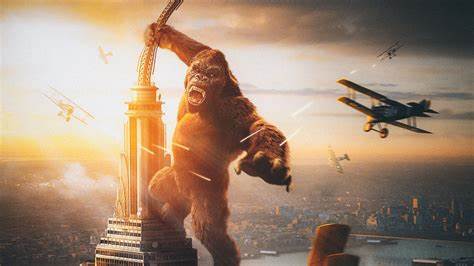
We do the King Kong song, won’t you sing along Listen to the music and it couldn’t go wrong We do the King Kong song, gotta sing along Can’t you hear the beating of the monkey tom-tom? Listen to the rhythm of the King Kong song
Songwriters: Benny Andersson and Bjorn Ulvaeus 1974 (ABBA)
Recently on Twitter there was some tit-for-tat centered around the Antarctic ozone hole. One side was asking, somewhat sarcastically, why the ozone hole isn’t in the news anymore and the other side replying that it wasn’t in the news anymore because the problem was solved…duh. Journalists and low info opinionistas representing both sides of the argument were putting forth gotcha strawmen that signified fury and snark but proved little and settled nothing. Both sides were uninformed and wrong which is not to say that I’m an expert in ozone and holes, well maybe holes, I dig a lot of them. The ozone hole is in the news, but you must look for it, usually in the science related press, and the consensus is that the solution is found, but there are still questions to answer and the models may need tweaking.
Let’s get the tweaking out the way first before moving on to the problem and possible solution. The scientific method requires an explanation or a hypothesis for an observation in the natural world, for example the ozone hole is caused by ozone destroying CFCs or chlorofluorocarbons such as Freon, sometimes expressed as a R-12 or CCl2F2 (one Carbon, two Chlorine, two Fluorine). An explanation needs to be testable, usually involving a prediction that will support the initial hypothesis such as, if ozone destroying chlorofluorocarbons are eliminated from the atmosphere the ozone hole will ‘close’. The ozone hole is closing but probably not as smoothly as the models first predicted leading to my use of the technical term: tweaking. Just so we don’t get ahead of ourselves let me be clear that most scientific hypothesis and the models generated to support them need tweaking. Most hypotheses are falsifiable as opposed to scientific theories which are not. If a theory is falsifiable, it is no longer a theory. A hypothesis on the other hand may just need a minor adjustment, or major, for the explanation to subsume the new data and or observations and still be valid.
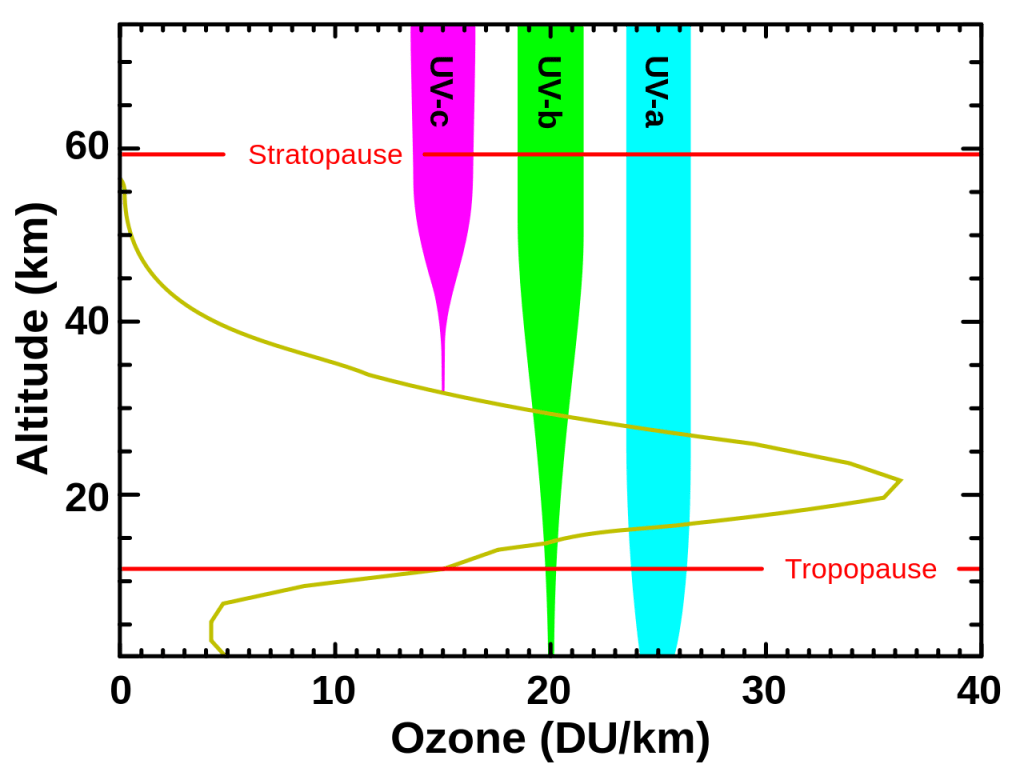
The importance of ozone, O3, and dioxygen, O2, in the atmosphere is that it filters out some to most of the harmful effects of ultraviolet, UV, radiation that comes to the Earth from our Sun. UV radiation comes in three main flavors: UVA, UVB, and UVC progressing from the lower frequency, longer wavelength UVA to the higher frequency, shorter wavelength UVC. UVC is entirely removed by O2 in the upper half of the stratosphere, an atmospheric layer 7-50 kilometers above the surface of the Earth. UVB radiation is mostly removed by ozone in the lower half of the stratosphere, but some of the radiation does make it to the surface of the Earth. UVA radiation travels to the surface of the Earth practically unimpeded.
The graph to the left shows the relative amounts or intensity of the three flavors of UV radiation that pass through the Earth’s atmosphere. The vertical axis on the graph is height above sea level while the horizontal axis measures the amount of ozone in Dobson units per kilometer (DU/km) in the atmosphere. The yellowish curve trending sideways on the graph shows the relative density of ozone in the atmosphere. The outline of the yellowish curve is essentially the ozone layer, with its densest O3 concentration between 20-25 kilometers above the surface of the Earth. UVC in purple is filtered out by O2 and is essentially removed before it even reaches the top of the ozone layer. UVB in green is dramatically reduced as it passes through a healthy ozone layer. The greater the density of the ozone layer the greater the reduction in UVB radiation. UVA rays experience very little reduction in intensity or amount as they traverse the atmosphere.
The harmful effects of UV radiation are significant and different for the different frequencies. Since UVC does not reach the surface of the Earth it is not a big long-term concern but may cause skin burns and eye injuries from artificial sources such as tanning beds. These injuries usually resolve themselves in a week. UVB radiation has been implicated in skin cancers, sunburns, skin blistering, premature aging, and immune suppression. It is also held responsible for darkening and thickening of the skin. UVA is responsible for tanning, sunburns, premature aging, wrinkles, and some skin cancers. There are also benefits from UV radiation. UVC radiation has been used to reduce the spread of bacteria in water, air, and solid surfaces. Hospitals during the height of our collective Covid madness had these UVC light sources dispersed throughout their facilities. UVB, in short time intervals, helps the body in the production of vitamin D useful for maintaining bone and muscle health. UV therapy or phototherapy may also assist in treating rickets, psoriasis, and eczema. Too much exposure to UV radiation can be detrimental to your health but one should get 15-20 minutes of sunlight per day.
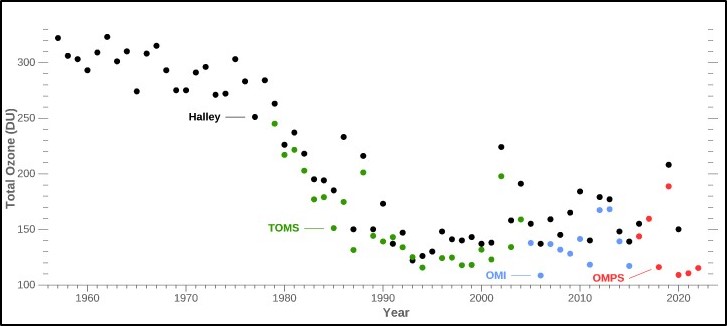
In the Antarctic summer of 1956, the British Royal Society founded the Halley Bay Base Research Station, on the Brunt Ice Shelf. It was built in partial preparation for the International Geophysical Year of 1957-58. (Only governments can dictate singular nouns to be plurals.) As part of their mandate the Royal Society began to collect ozone measurements indirectly using a Dobson Spectrophotometer. The black dots in the graph to the left are data collected by the Halley Base at the surface while the colored dots are derived from NASA satellite measurements. From the beginning of the measurements at Halley through the end of 70s the results showed a slight but noticeable decrease in ozone in the skies over Antarctica. From 1980 onward the loss of ozone as measured from Halley and NASA satellites became pronounced and until the mid-1980s, inexplicable.
In 1985 Joe Farmin and his team with the British Antarctica Survey published a paper in Nature describing this catastrophic 40% loss of ozone over the south pole in less than 10 years. His team also identified the atmospheric release of CFCs as the probable causative agent in creating the ozone hole over the Antarctic.
Additional chemical, meteorological, and atmospheric research in 1986 through 1988 produced the needed theoretical and empirical evidence to implicate chlorine as the ruinous perpetrator responsible for the global loss of ozone. This research and the recognition of the detrimental health effects due to the loss of ozone led directly to the Montreal Protocol, an international treaty designed to protect and heal the atmospheric ozone layer.
The treaty was signed in 1987 with an effective implementation date of 1 January 1989. The treaty has been universally ratified. The main purpose of the treaty was to phase out various forms of man-made chlorine and bromine chemicals, both halogens, that make their way into the stratosphere. In 2012 it was estimated that 98% of the ozone depleting chemicals have been phased out and their concentration in the stratosphere was beginning to decline. In 2018 China, a signatory to the treaty, was implicated in the continued production and release of CFCs.
Current ozone models predict that ozone levels in the northern and southern hemisphere mid-latitudes along with the Artic will revert to 1980 levels by the 2040s. Antarctic ozone should revert to 1980 levels sometime in the mid-2060s. These estimates have fluctuated by 20-30 years, plus or minus since the first predictions came out in the 1990s.
Ozone is three atoms of oxygen combined into one molecule and is found in higher concentrations in the lower to middle parts of the stratosphere which is 7-50 kilometers above sea-level, where it absorbs solar derived ultraviolet radiation. This higher concentration of ozone in the stratosphere is usually referred to as the Ozone Layer. An ozone molecule will split into a single oxygen atom and a two-oxygen molecule, O2, after absorbing a packet of bond breaking UVB radiation. The oxygen atom and the O2 molecule will eventually recombine into an ozone molecule under the right conditions. This oxygen cycle of combinations and breakups are temperature dependent with colder temperatures retarding recombination of oxygen atoms and O2 molecules into ozone molecules. The colder it is in the stratosphere the longer it takes to produce new ozone and it can get very cold in the stratosphere, especially in the Antarctic skies.
A visual confirmation of very low temperatures in the ozone layer of the stratosphere is the presence of Polar Stratospheric Clouds or PSCs. These clouds were likely seen by 19th and early 20th century explorers, including R.F. Scott in 1912. These clouds probably have existed in the Antarctic winter skies since the continent parked itself over the south pole towards the middle of the Cretaceous 100 million years ago. These are stratiform clouds made up of droplets of frozen water and nitric acid forming at temperatures below -78 degrees Celsius. Nitric acid is a catalyst also implicated in the destruction of ozone in the stratosphere.
Nitric acid does not have a strictly natural or human source but is an end product through chemical reactions with nitrogen oxide in the atmosphere. When nitrogen oxide absorbs sunlight in the atmosphere it reacts with O2 to form nitrogen dioxide. Nitrogen dioxide then reacts with water to produce nitric acid and more nitrogen oxide. Natural sources produce about 90% of the world’s nitrogen oxide including lightning strikes, volcanoes, oceans, and biological decay in soil and water. Human sources such as cars and trucks, coal-fired power plants, large industrial operations, ships, and airplanes account for the rest. Eliminating the planet of anthropogenically produced nitrogen oxide will not have any noticeable effect on the continued destruction of ozone in stratosphere by nitric acid although the possibility of supersonic jets passing through the stratosphere could theoretically introduce nitric acid directly into this atmospheric layer.
PSCs also electrostatically attract, concentrate, and store CFCs. Chlorine, the first C in CFC, is another catalyst that acts in concert with nitric acid to increase the destruction of ozone in the stratosphere. Chlorine atoms are released from the CFC molecules when the molecular bonds are broken through the absorption of atmospheric photons traveling from the Sun. The individual chlorine atoms then react with ozone to produce ClO plus O2. The ClO further reacts with a single oxygen atom to produce Cl and O2. With the chlorine atom freed from the oxygen atom it can start the whole ozone destructive cycle all over again. One chlorine atom will eventually destroy thousands of ozone molecules.
Ozone depletion is a global occurrence but due to Antarctica’s unique geography the depletion is most intense and widespread there. Due to the huge atmospheric temperature gradient between Antarctica and the tropics and the continent being surrounded by water causes winds over the southern land mass to move in a clockwise direction creating a stratospheric polar vortex. This vortex effectively contains and sustains a single static air mass over the continent that does not mix with the rest of the earth’s atmosphere, leading to the above-mentioned concentration and storage of CFCs.
During the Antarctic spring, atmospheric temperatures rise, and the frozen PSCs melt in the stratosphere to release all the CFCs and nitric acid compounds that were previously absorbed and stored in the cloud. The CFCs and nitric acid are now free to begin their destruction of ozone molecules. Through this process the infamous ozone hole is formed during the Antarctic spring which partially closes again during the Antarctic winter.
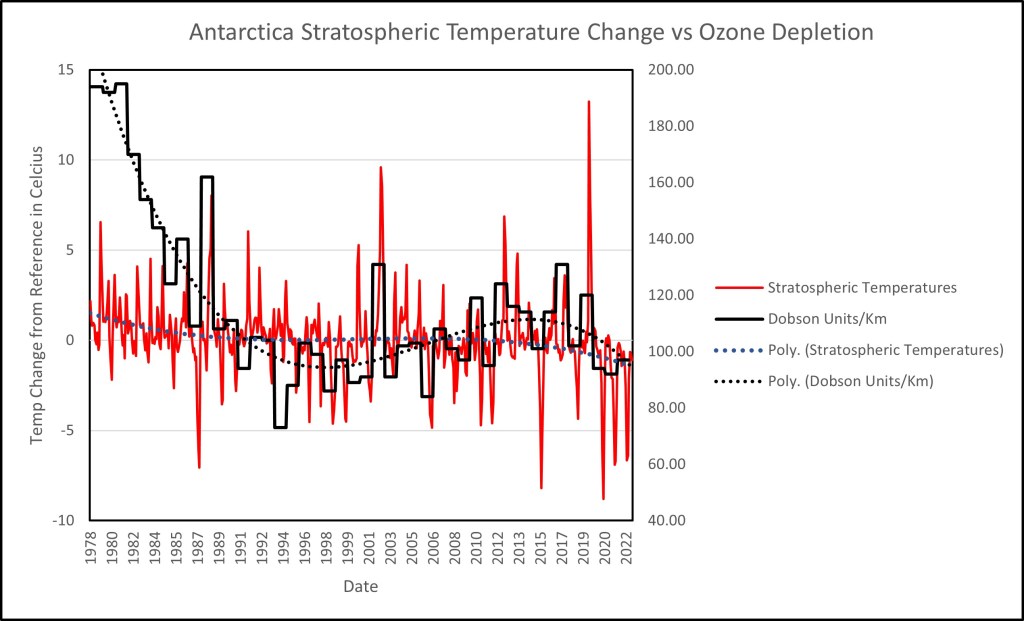
The graph to the right shows the south pole stratospheric temperature and Dobson NASA satellite derived data. The solid red line shows the temperature difference from the 1991-2020 monthly average. The dotted blue line is a polynomial fit to the temperature data that exhibits a slight cooling trend from 1979 through 2022. The temperature spikes, negative and positive occur during the Antarctic spring months of September through November. The temperature spikes usually come in pairs. A large negative value temperature spike in the Antarctic spring is generally followed by a large positive value temperature spike in the spring of the following year. This duality of temperature pairs seems paradoxical or at least inexplicable. The answer is not readily apparent but may lie in the fact that CFCs not only destroy ozone but are also powerful greenhouse gases. More powerful than CO2, methane, and laughing gas but less so than water vapor. In the cool spring years additional CFCs may be concentrated and stored in the stratosphere provoking a feedback loop with solar radiation that raises stratospheric temperatures the following spring. More on this below but this hypothesis is just an unsupported conjecture at this point. A noticeable exception to this observation is the three large negative temperature spikes in 2020, 2021, and 2023 which were not followed by corresponding positive spikes. Is this evidence of the removal of CFCs from the stratosphere causing less heat to be trapped there?
The black solid line on the graph above is the lowest yearly minimum Dobson Unit/km values. Lower Dobson values equate to larger ozone losses. The lowest yearly Dobson minimum represents the maximum ozone loss for that year. The yearly minimum Dobson values usually occur in Antarctica spring months of September through November. Higher or lower Dobson values do not display a significant correlation with the stratospheric temperature spikes except they both occur in the springtime suggesting other variables are at play. The other factors may include water vapor and ice, nitric acid, Chinese abrogation of the Montreal Protocols… The black dotted line is a polynomial fit to Dobson data and suggests that beginning in the early 2020s the ozone hole started increasing in size again. The ozone scientific community says it is closing.
And now, just to give you something else to chew on, putting Godzilla and King Kong together in the same playroom, it is known, as stated above, that CFCs, in addition to depleting ozone in the stratosphere, are potent greenhouse gases. In a 2013 University of Waterloo (Canada) discussion published on phy.org stated that “Chlorofluorocarbons (CFCs) are to blame for global warming since the 1970s and not carbon dioxide, according to new research from the University of Waterloo published in the International Journal of Modern Physics B…” Professor Lu, author of the published paper: Cosmic-Ray-Driven Reaction and Greenhouse Effect of Halogenated Molecules: Culprits for Atmospheric Ozone Depletion and Global Climate Change, comments that “Most conventional theories expect that global temperatures will continue to increase as CO2 levels continue to rise, as they have done since 1850. What’s striking is that since 2002, global temperatures have actually declined – matching a decline in CFCs in the atmosphere. My calculations of CFC greenhouse effect show that there was global warming by about 0.6 °C from 1950 to 2002, but the earth has actually cooled since 2002. The cooling trend is set to continue for the next 50-70 years as the amount of CFCs in the atmosphere continues to decline.”
The decline in surface temperatures was actually true at the time of Lu’s comment above, but global temperatures began to increase post 2013 and then began to decline again in the early 2020s. Is climate cyclic?
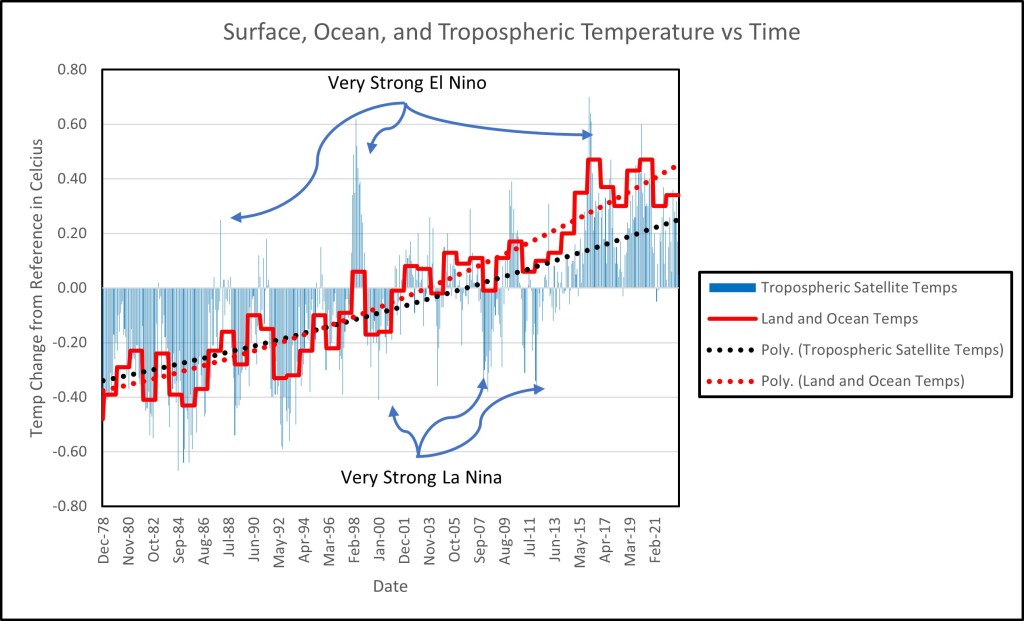
The graph to the left is derived from published NASA surface and atmospheric temperature data. The data in blue is globally collected satellite data for tropospheric temperatures: the atmospheric layer from the surface of the Earth to the base of the stratosphere. The y-axis is the monthly change in temperatures from the 1991-2020 average. Some of the large spikes in temperatures are attributed to exceptionally strong El-Nino or La Nina events–in other words, weather rather than climate. El-Nino generally is responsible for warmer than normal temperatures while La Nina generally leads to cooler than normal temperatures. There is a broad concurrence between the satellite and surface temperature collected data with both showing a slight cooling from 2015 to present day, but it is probably too soon to call this a long-term trend. The stall in temperature increase is curious and may be related to the removal of CFCs from the stratosphere.
The black dash line is a polynomial fit of satellite data trend. The satellite trend shows approximately a 0.6-degree Celsius warming since 1979. The solid red line is the globally collected surface and ocean buoy temperature data. The data was shifted to equal the 1979 satellite data points while retaining the actual slope. This was done to facilitate comparison between the data sets. The red dotted line is the polynomial fit to the surface land and ocean data trend. The surface data trend shows approximately a 0.8-degree Celsius warming since 1979. The surface and ocean data match the satellite data increase in temperatures until the beginning of century where the two data trends begin to diverge. This divergence is attributed to a land measurement heat island effect and statistical adjustments applied to the surface and ocean data that is not applied to the satellite data.
The old hypothesis was that eliminating CFCs from the atmosphere would restore the ozone layer to its 1980 only slightly damaged state.
It is now believed that higher temperatures will minimize the formation of PSCs and thus the collection, concentration, and storage of CFCs in these clouds thus reducing the loss of ozone. The elimination of man-made CFCs and other halogens will help reduce the rise in temperatures through loss of these greenhouse gases. Without CFCs the ozone layer may heal. Without CFCs the global mean temperature may not rise. That’s my new hypothesis–Godzilla and King Kong may be twins.
Amity Shlaes, age 62, is the Presidential Scholar at the King’s College, a Christian, classical liberal arts school in Manhattan where she teaches Coolidge, the subject of her most recent book. She previously taught at New York’s Stern School of Business, also in Manhattan where she lectured on Great Depression economics, a subject of her third book which was released in 2007. She is chairwoman of the board of the Calvin Coolidge Presidential Foundation of Plymouth, Vermont, and chairs the jury for the Manhattan Institute’s Hayek Book Prize located in, well–Manhattan. Shlaes is a past trustee of the German Marshall Fund, a public policy think tank promoting cooperation between North America and Europe, initially funded by the West German government as a memorial to the post WWII Marshall Plan. In the early 2000s she was a senior fellow of economic history at the Council on Foreign Relations, a think tank specializing in U.S. foreign policy and international relations.
Shlaes and Sauvik Chakraverti shared the inagural $15,000 Bastiat Prize, a journalism award given by the Reason Foundation, in 2002 for her political economy writing. (Chakraverti received the award for being the greatest libertarian ever.) She gave the 2004 Bradley Lecture, an American Enterprise Institute program series, on the Schechter vs United States Supreme court case that invalidated parts of the legal and regulatory over-reach during the FDR administration. Shlaes received the $50,000 Hayek Book Prize in 2007 for “The Forgotten Man: A New History of the Great Depression. She also recieved the 2007 New York City Deadline Club award, a journalistic Pulitzer type award for opinion writing. Shlaes recieved the 2021 $250,000 Bradley Prize from the Milwaukee based Lynde and Harry Bradley Foundation, a grassroots and faith-based philanthropic organization, for her work on economic history.
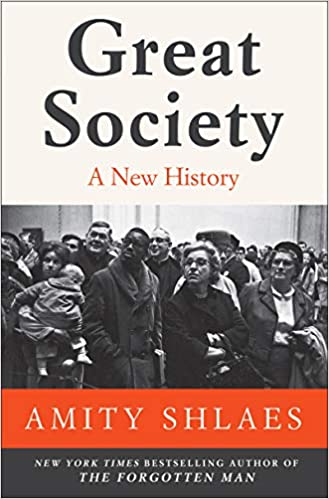
Amity Shlaes has five New York Times bestsellers: The Greedy Hand: How Taxes Drive Americans Crazy, The Forgotten Man: A New History of the Great Depression, The Forgotten Man: Graphic Edition, Coolidge, and Great Society: A New History.
Shlaes has written for numerous publications over years including The New Republic, The New Yorker, the Spectator of London, The New York Times, The Washington Post, the National Review, the Wall Street Journal, The American Spectator, Foreign Affairs, Bloomberg News, and Die Zeit. She currently writes a column for Forbes.
Great Society: A New History details Lyndon Johnson’s efforts as president to eliminate poverty in United States. On 22 November 1963, a few hours after the assassination of John Kennedy, Lyndon Johnson was sworn in as the 36th president of the United States. Johnson inherited a robust, growing economy with low unemployment. As a life-long politician, inheriting a healthy economy was not something he believed he could run on for the 1964 presidential election and win. He chose to finish Kennedy’s sensible initiatives on tax rate cuts, budget reduction and civil rights guarantees to all while he worked out the details for his own signature plans that became known as the War on Poverty. The purpose of his strategy was not only to eliminate poverty but expand federal government involvement in education, health and finances for the elderly, and providing aid to the working poor and unemployed. Between August 1964 and July 1965 Congress passed and Johnson signed four major programs that were the prime tactics behind the strategy for the War on Poverty. The first bill signed was the Economic Opportunity Act which created the Job Corps and Youth Corps, along with providing work, education, and training for young adults. Additional programs were geared towards college students, rural poor, and migrants. The second bill passed was the Food Stamp Act which provided nutritional subsidies for the poor. The Elementary and Secondary Education Act was the third bill passed and involved grants to schools and states to assist in the education of low-income families. The final bill passed was the Social Security Act of 1965 which created Medicare and Medicaid.
Proponents of the War on Poverty programs state that poverty rates decreased, as defined by the US government’s Census Bureau, from approximately 23% in 1958 to 11.3% in 1973. The Great Society programs were not fully funded and implemented until late 1965 to late 1966 at which time the poverty rates had already dropped below 15% without any of Johnson’s anti-poverty stimulants. Poverty rates since the passage of the Great Society programs have stubbornly remained between 11 and 15%. An alternate interpretation of the Great Society programs is that at best, they did nothing to reduce poverty to, at worst, they cemented poverty forever more into a narrow range between 11-15% of the population. Inflation adjusted cost estimates for the Great Society programs from inception to present are somewhere north of $60 trillion or a little more than a trillion dollars per year.
Shlaes tells us the story of Johnson’s War on Poverty. She begins with the Kennedy years and ends with Nixon, but it is all Johnson in between. Johnson fathered the Great Society, nursed his skinny stepson into the corpulent war in Vietnam, and left before he had to pay child support. She tells the story of the events and happenings that brought us the Great Society, but she tells the story through the people on the ground and in the halls of power. Michael Harrington and Tom Hayden, socialists with the Students for Democratic Society who crafted the Port Huron statement, a communist manifesto which played a starring role in the birth of the Great Society. Abbie Hoffman who took over SDS and morphed it into a violent Maoist offshoot called the Yippies who were always throwing a temper tantrum against something. Walter Reuther, UAW president and king maker for the Democrat party and money man for all things socialist. Sargent Shriver, poster child for the Peter Principle, was the actual architect of the War on Poverty. Daniel Patrick Moynihan, an intellectual with a heart and absolutely no common sense until his epiphany on cause and effect in 1980s. Burns and Nixon who had the dubious distinction of following Johnson like the men walking behind the elephant parade with a broom and an excessively big bucket and they will be hated for it forever. And Paul Volker the man who showed the nation the secret recipe to fix problems caused by fiscally prolificate politicians — a barrel of remarkably high interest rates.
Shlaes tells this story through the eyes of the men and women who were there. She tells their stories and doesn’t offer much in the way of opinion, neither good nor bad. Even in the end she plays the historian without interjecting herself into the story but the story snitches on itself: good intentions and bad ideas are not the basis for public policy.
(The picture of Amity Shlaes comes from the Great Society: A New History jacket back cover. The graph of poverty rates is derived from Census Bureau data.)







 elsToday